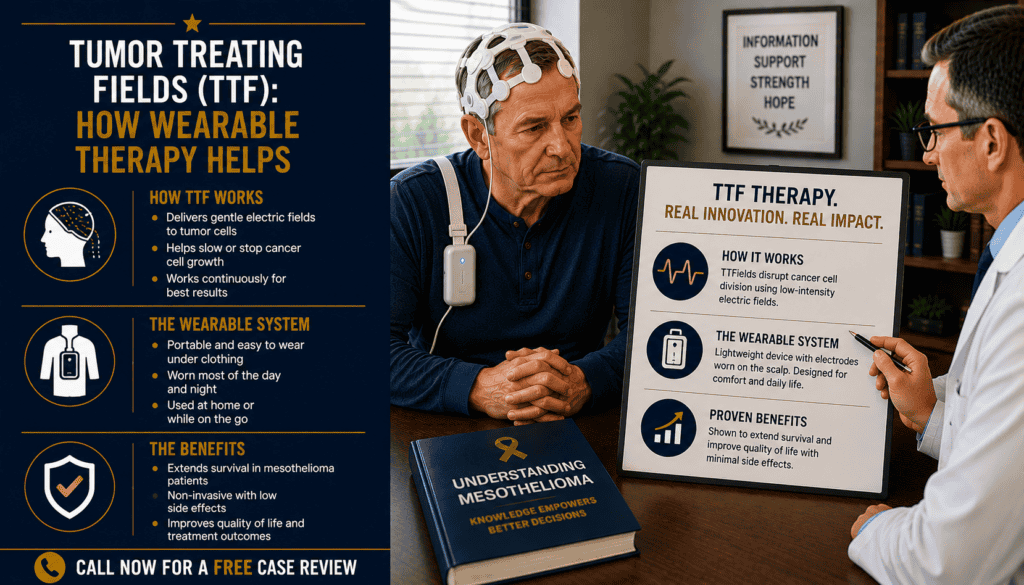
Tumor Treating Fields (TTFields) for Mesothelioma: How Wearable Therapy Works
An evidence-based guide to portable electrical-field treatment, practical considerations and informed treatment decisions.
Tumor treating fields (TTFields, sometimes abbreviated TTF) use a portable medical device and adhesive arrays worn on the torso to deliver alternating electric fields to a tumor region. They are a distinct approach from chemotherapy, immunotherapy and radiation. For mesothelioma, the key question is not simply whether the device can be worn at home, but whether its potential benefits, uncertain comparative effectiveness and daily demands fit an individual patient’s care plan.
Important distinction: The FDA authorized a TTFields device for certain adults with unresectable malignant pleural mesothelioma when used with pemetrexed and platinum chemotherapy. This is a Humanitarian Device Exemption (HDE), not proof that TTFields alone cures mesothelioma or that adding it improves survival compared with modern treatments in a randomized trial. A 2025 ASCO guideline update found insufficient data to definitively recommend adding TTFields to pemetrexed and platinum based on the available single-arm trial.
What Are Tumor Treating Fields?
TTFields are low-intensity, intermediate-frequency alternating electrical fields delivered through insulated adhesive transducer arrays attached to the skin. A portable generator supplies the fields while the patient carries the equipment. The treatment is designed to interfere with processes needed for dividing cancer cells; it does not remove a tumor, and it is not the same as an electrical shock or conventional radiotherapy.
| Term | What it means |
|---|---|
| TTFields | Alternating electric fields delivered regionally through skin-mounted arrays. |
| Transducer arrays | Adhesive components positioned on the torso according to a trained team’s instructions. |
| Portable generator | Device connected to the arrays and powered by battery or external power. |
| HDE authorization | FDA pathway for certain devices used in rare conditions; evidence standard differs from conventional effectiveness approval. |
| Unresectable pleural mesothelioma | Cancer of the lining around the lungs that cannot be removed surgically; treatment selection requires specialist assessment. |
TTFields are sometimes discussed as “wearable therapy,” but wearing a device does not make treatment simple or risk-free. Patients still need oncology follow-up, monitoring and practical support. Read the broader mesothelioma treatments overview for context.
How Does Wearable TTFields Therapy Work?
The device creates alternating fields in the targeted chest region. Laboratory research suggests these fields disrupt the organization and separation of structures involved in cancer-cell division. This proposed mechanism differs from chemotherapy, which acts throughout the body, and radiation, which uses ionizing radiation. A mechanistic explanation alone does not establish that a treatment extends an individual patient’s life.
| Feature | TTFields | Why it matters |
|---|---|---|
| Delivery | Arrays on skin connected to a portable generator | Treatment can occur outside an infusion center after training. |
| Target | Regional electrical fields directed to the chest | Not a whole-body treatment for disease elsewhere. |
| Partner treatment | Pemetrexed plus cisplatin or carboplatin in the mesothelioma FDA indication | The device is not authorized as standalone mesothelioma therapy. |
| Monitoring | Oncology visits, imaging, symptom review and skin checks | Treatment response and tolerability still require medical assessment. |
The FDA’s mesothelioma authorization dates to May 23, 2019. Device trade names and labeling can change through supplements, so the treating team should confirm the current model, instructions and exact indication before prescribing.
Who May Be Considered for TTFields?
The FDA mesothelioma indication concerns adults with unresectable, locally advanced or metastatic malignant pleural mesothelioma using the device concurrently with pemetrexed and platinum-based chemotherapy. This should not be generalized to peritoneal mesothelioma, to patients receiving immunotherapy alone, or to use without systemic treatment. Whether it is appropriate also depends on overall health, goals of care, skin condition, ability to use the equipment and the oncologist’s assessment.
| Clinical factor | Question for the specialist |
|---|---|
| Cancer location | Is the diagnosis pleural mesothelioma rather than another mesothelioma type? |
| Resectability | Has an experienced multidisciplinary team assessed surgery and systemic treatment? |
| Proposed regimen | Is pemetrexed with cisplatin or carboplatin part of the plan? |
| Daily feasibility | Can the patient and caregiver manage arrays, power and skin care? |
| Other conditions or devices | Are there safety precautions, implants or skin problems relevant to the current labeling? |
| Patient priorities | Does the expected time wearing the device fit comfort, independence and personal goals? |
A specialist may recommend a different first-line regimen, including immunotherapy-based options, depending on the diagnosis and clinical circumstances. See immunotherapy for mesothelioma and finding mesothelioma doctors.
What Daily Wear, Setup and Care Involve
A trained device team typically teaches the patient or caregiver how to position and replace arrays, connect power, carry the generator and respond to alarms. The STELLAR trial evaluated continuous use, generally targeting more than 18 hours daily. That research schedule should not be mistaken for a universal prescription: follow the current product labeling and your treating team’s specific instructions.
| Daily task | Practical consideration |
|---|---|
| Array placement | Follow the team’s positioning map; do not improvise placement. |
| Skin preparation | Ask about shaving, cleaning and managing adhesive sensitivity. |
| Wear schedule | Discuss recommended hours, breaks and how usage is recorded. |
| Power supply | Plan batteries, charging, outlets and travel. |
| Clothing and mobility | Practice dressing, sleeping and carrying equipment comfortably. |
| Follow-up | Know whom to call for alarms, discomfort, damaged arrays or equipment failure. |
Ask for hands-on training and written instructions. A caregiver can help if the patient wishes, but consent and ability to participate matter. Patients who cannot comfortably maintain the prescribed schedule should tell their care team rather than conceal missed hours.
What Does the Research Actually Show?
The phase II STELLAR study enrolled 80 patients with previously untreated, unresectable pleural mesothelioma and evaluated TTFields together with pemetrexed and cisplatin or carboplatin. It reported median overall survival of 18.2 months. This number describes the trial group; it cannot predict an individual’s survival or establish the added benefit of the device because the study had no randomized comparison arm.
| Evidence | Finding | Important limitation |
|---|---|---|
| FDA action (2019) | HDE authorization for the device with pemetrexed and platinum chemotherapy in the specified pleural population | HDE authorization should not be described as proof of a cure or a randomized survival benefit. |
| STELLAR phase II trial | 80 participants; median overall survival 18.2 months | Single-arm design; no simultaneous randomized chemotherapy-only group. |
| STELLAR skin effects | Mild-to-moderate device-related skin reactions were reported in 53/80; severe grade 3 reactions in 4/80 | Rates reflect this study and may not match an individual’s experience. |
| ASCO guideline update (2025) | Insufficient evidence to definitively recommend adding TTFields to pemetrexed/platinum | Modern treatment comparisons and patient burden remain important. |
Avoid comparing STELLAR’s 18.2-month median directly with a number from a different trial and calling the difference a proven TTFields benefit: patient characteristics, supportive care and treatments can differ. Ask your oncologist how this evidence compares with options available today. Clinical-trial participation may be worth discussing; see the NCI mesothelioma treatment trial listings.
Side Effects, Safety and Limitations
Skin irritation beneath the adhesive arrays is a prominent device-related adverse effect. Patients may also find wearing equipment burdensome or experience sleep disruption, movement restrictions and practical challenges. Chemotherapy given alongside the device has separate systemic risks, including low blood counts, nausea and fatigue. Do not attribute every symptom to the device or assume that absence of device discomfort means the cancer is responding.
| Issue | What to discuss or do |
|---|---|
| Redness, itching or rash | Contact the device team early for approved skin-care and placement guidance. |
| Blistering, open skin or severe pain | Promptly contact the treating team; do not continue over damaged skin without advice. |
| Equipment alarm or interruption | Use the provided support number and follow manufacturer instructions. |
| Fever, worsening breathlessness or chest pain | Seek urgent clinical guidance; severe or sudden symptoms may require emergency assessment. |
| Fatigue or low blood counts | Ask whether chemotherapy, cancer or another cause needs evaluation. |
| Uncertainty about implants or other devices | Review the current labeling and disclose every implanted or wearable medical device. |
Do not apply creams, ointments or adhesive products under arrays unless the device team approves them. Device-specific contraindications and warnings should be checked in the current FDA labeling rather than assumed from another TTFields product or another cancer indication.
How TTFields Fit Among Mesothelioma Treatment Options
TTFields are not interchangeable with surgery, systemic drugs or supportive care. The best discussion considers cancer type, extent, prior treatment, current evidence and what the patient values. An additional device may be feasible for some people but undesirable or unsuitable for others.
| Option | Role to discuss | Key distinction |
|---|---|---|
| TTFields plus specified chemotherapy | Possible option within the FDA pleural mesothelioma indication | Requires daily device use; incremental benefit remains uncertain. |
| Chemotherapy | Systemic treatment with regimens chosen by oncology team | May be used without TTFields. |
| Immunotherapy | Systemic option for selected patients | Different evidence and toxicity profile; TTFields indication does not automatically extend to it. |
| Surgery | Assessment in selected patients at experienced centers | Not suitable for every tumor or patient. |
| Radiation | Selected local control or symptom-management situations | Uses ionizing radiation, unlike TTFields. |
| Supportive and palliative care | Relief of symptoms and help with quality of life | Can be provided alongside cancer-directed treatment. |
For additional context, review surgery, chemotherapy and radiation, multimodal therapy and your mesothelioma care team.
Questions to Ask, Costs and Next Steps
Ask the oncology team to explain the expected purpose of TTFields for your situation, the uncertainty in the evidence and how treatment would be evaluated. Insurance coverage and out-of-pocket costs can vary. Request a benefits check and a written estimate from the provider and insurer; an FDA authorization does not guarantee payment by every plan.
| Ask your care team | Why it matters |
|---|---|
| Am I within the exact FDA mesothelioma indication? | Avoids applying evidence from another disease or treatment regimen. |
| Why recommend this rather than chemotherapy or immunotherapy without the device? | Clarifies the individual treatment rationale. |
| What benefit is supported by a randomized trial? | Separates established findings from uncertain comparisons. |
| How many hours per day should I wear it, and for how long? | Makes the lifestyle commitment concrete. |
| Who helps with skin reactions and equipment problems after hours? | Prevents gaps in support. |
| What are my insurance responsibilities? | Clarifies device, supplies, chemotherapy and visit charges. |
| What will prompt stopping or changing treatment? | Establishes response, side-effect and preference checkpoints. |
Bring a medication list, pathology report, recent scans and a companion if desired. A second opinion can help clarify choices without committing to a device. Read second opinions and treatment costs.
Frequently Asked Questions About TTFields
Does TTFields cure mesothelioma?
No. It is not an established cure. The device has a specific FDA authorization for use with certain chemotherapy in eligible pleural mesothelioma patients, and the added survival benefit has not been definitively established in a randomized trial.
Is the device FDA authorized for mesothelioma?
Yes. The FDA granted a Humanitarian Device Exemption in May 2019 for adults with unresectable, locally advanced or metastatic malignant pleural mesothelioma when used with pemetrexed and platinum-based chemotherapy. Ask the team to check current labeling.
Can I use TTFields without chemotherapy?
The mesothelioma FDA indication specifies concurrent use with pemetrexed and platinum chemotherapy. Do not assume standalone use is an authorized or proven substitute.
Is TTFields the same as radiation therapy?
No. TTFields deliver alternating electrical fields through arrays; radiation therapy uses ionizing radiation. They have different mechanisms, indications and practical requirements.
How many hours a day is the device worn?
The STELLAR study used continuous therapy with a target exceeding 18 hours daily. Your device team should provide the current prescribed schedule and training; do not substitute a trial protocol for personal instructions.
What is the most common device-related problem?
Skin reactions beneath adhesive arrays were common in STELLAR. Report irritation early and follow the device team’s instructions for skin care and array replacement.
Does the STELLAR survival figure prove TTFields adds months of life?
No. The trial was single-arm, meaning it lacked a simultaneous randomized comparison group. Its median survival cannot isolate the device’s added effect or predict a particular patient’s outcome.
Will insurance pay for TTFields?
Coverage varies by plan, indication, network and authorization requirements. Ask the device provider and insurer for a written benefits review and estimate before starting.
Confirmed Primary Sources and Clinical Guidance
- FDA Humanitarian Device Exemption H180002: mesothelioma indication and approval history.
- STELLAR phase II clinical trial, Lancet Oncology (2019).
- ASCO pleural mesothelioma guideline update: TTFields evidence assessment.
- ClinicalTrials.gov STELLAR study record.
- National Cancer Institute mesothelioma treatment summary.
Research and device labeling can change. Review current instructions and discuss new evidence with your oncology team.
Get Help Understanding Your Options
Call 800.291.0963 to discuss available information and next steps. Live chat is available 24/7, 365 days a year. Submit Your Case through our website.
There is no guarantee of treatment results, eligibility for a particular therapy or compensation. Medical decisions belong with qualified clinicians; legal eligibility depends on individual circumstances.
⚕️ Legal & Medical Information Disclaimer
This page provides general information, not personalized medical or legal advice. Consult your treating oncology team for diagnosis and treatment decisions and a qualified attorney for legal questions.