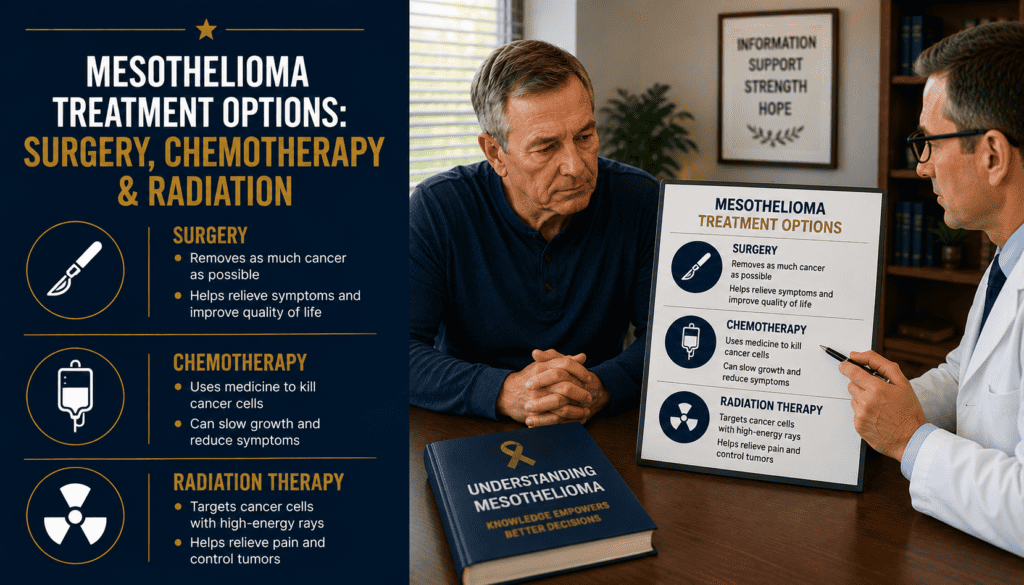
Mesothelioma Treatment Options: Surgery, Chemotherapy and Radiation
A patient-focused comparison of three established approaches, their limitations and how they may fit into a personalized treatment plan.
Mesothelioma treatment is not one-size-fits-all. Surgery, chemotherapy and radiation have different goals: removing selected visible tumors, treating cancer cells through the bloodstream, or targeting a particular area. Your team may recommend one approach, a combination, or another option such as immunotherapy. Decisions depend on where the cancer started, pathology, disease extent, health and your priorities. No treatment guarantees a cure.
Surgery vs. chemotherapy vs. radiation: a practical comparison
These three treatments are not interchangeable. The table summarizes common roles; actual recommendations may differ for pleural mesothelioma (lining of the chest) and peritoneal mesothelioma (lining of the abdomen).
| Option | What it does | When it may be considered | Important limitation |
|---|---|---|---|
| Surgery | Removes selected visible cancer or addresses complications | Selected patients evaluated by experienced surgeons | Major procedures carry risks and may leave microscopic disease |
| Chemotherapy | Drugs circulate through the body or are delivered regionally | Disease that cannot be removed; selected combination plans | Can affect healthy cells and may not control every tumor |
| Radiation | Targets cancer in a defined treatment field | Selected local control or pain relief | Nearby healthy organs limit dose and coverage |
| Supportive care | Treats pain, breathlessness, fatigue and other concerns | At any stage, alongside cancer-directed care | Does not replace tumor-directed therapy when indicated |
Start with the broader mesothelioma treatments overview and ask your oncologist what each proposed treatment is intended to accomplish.
Surgery for mesothelioma: types, eligibility and risks
A mesothelioma-experienced surgeon may evaluate whether removing visible tumor is feasible and whether expected benefits justify the risks. Pleural operations include pleurectomy/decortication, which removes involved pleural tissue while preserving the lung, and extrapleural pneumonectomy, which removes an entire lung and adjacent structures. These are substantial operations and should not be portrayed as routine or universally beneficial. Some patients instead need a smaller procedure to manage fluid or obtain tissue.
| Procedure | Potential role | What to ask |
|---|---|---|
| Pleurectomy/decortication | Remove selected pleural tumor while retaining the lung | How much tumor can be removed, and what complications are expected? |
| Extrapleural pneumonectomy | Extensive operation in exceptionally selected situations | Why is this preferable to lung-sparing approaches or nonsurgical care? |
| Cytoreductive surgery ± HIPEC | For carefully selected peritoneal mesothelioma at specialized centers | Is the tumor distribution suitable and what is the recovery burden? |
| Pleurodesis or fluid drainage | Control recurrent fluid or relieve breathlessness | Is this symptom management rather than tumor removal? |
Surgical eligibility depends on pathology, imaging, cardiopulmonary function, other conditions and specialist judgment. Request a clear explanation of potential complications, recovery, alternatives and what would happen if surgery is not performed. See pleurodesis for an example of a symptom-focused procedure.
Chemotherapy for mesothelioma: drugs and treatment process
Systemic chemotherapy reaches cancer cells through the bloodstream. A platinum drug such as cisplatin or carboplatin combined with pemetrexed is a commonly used regimen for pleural mesothelioma. The precise regimen and whether chemotherapy is paired with immunotherapy or another drug depend on the clinical setting and current approvals. In selected peritoneal cases, heated intraperitoneal chemotherapy (HIPEC) is delivered into the abdomen during a specialized surgical approach; it is not the same as standard intravenous chemotherapy.
| Topic | What patients should know | Question for the team |
|---|---|---|
| Treatment schedule | Chemotherapy is often administered in cycles with rest periods | How many cycles are planned and when will response be checked? |
| Blood counts | Treatment may lower infection-fighting cells, red cells or platelets | Which symptoms require an urgent call? |
| Kidney and nerve effects | Some platinum medicines can affect kidneys, hearing or nerves | What monitoring and protective steps apply to me? |
| Pemetrexed supportive medicines | Folic acid, vitamin B12 and other medicines may be prescribed | Exactly when should I start each supportive medicine? |
Tell the team about every medication and supplement you take. Do not start or stop prescribed vitamins or medicines without their instructions. Learn how systemic drugs differ from immunotherapy for mesothelioma.
Radiation therapy: targeted treatment and symptom relief
Radiation therapy directs high-energy radiation at a defined area. In mesothelioma it may be considered for selected local treatment plans or to relieve pain from a symptomatic tumor. Radiation planning is especially complex around the lungs, heart, spinal cord and other sensitive tissues. It does not treat all cancer cells throughout the body in the way systemic drugs can.
| Use | Potential purpose | Limitation or concern |
|---|---|---|
| Painful localized tumor | Reduce pain or other focal symptoms | Relief is not guaranteed; effects may take time |
| Selected combined treatment | Treat a defined region in a specialist-designed plan | Benefit and safety depend on anatomy and prior treatment |
| External-beam radiation | Deliver a planned dose over one or more visits | Inflammation, fatigue and organ-specific effects are possible |
| Proton therapy | May alter dose distribution in selected cases | Superior outcomes for every mesothelioma patient are not established |
Ask the radiation oncologist to show the treatment field and explain potential lung inflammation, skin effects, fatigue, expected benefit and what alternatives exist. Read the dedicated radiation therapy guide.
Combining treatments: multimodal care and newer options
A multimodal plan uses more than one approach, sometimes in sequence. For example, a team may discuss systemic therapy before or after surgery, or radiation for a specific symptom. Combining therapies can increase treatment burden and is not automatically better. Immunotherapy is another important treatment category; for certain unresectable pleural mesothelioma cases, clinicians may discuss immune checkpoint inhibitors or chemotherapy-immunotherapy combinations.
| Possible plan | Why it might be discussed | Key uncertainty |
|---|---|---|
| Surgery plus systemic therapy | Address visible tumor and possible microscopic disease | Will combined risks outweigh expected benefit? |
| Systemic therapy plus symptom-directed radiation | Treat cancer broadly while targeting a painful site | How will timing and toxicity be coordinated? |
| Immunotherapy-based treatment | An alternative or addition in certain settings | Which regimen fits the diagnosis and medical history? |
| Clinical trial | Access a carefully monitored research strategy | What are eligibility, randomization and standard-care alternatives? |
A multidisciplinary review can help reconcile different recommendations. Read multimodal therapy and ask whether a clinical trial is appropriate.
How doctors choose treatment for pleural and peritoneal mesothelioma
A treatment choice requires an accurate tissue diagnosis and an understanding of disease extent. The team should review cell type, imaging, symptoms, heart and lung function, prior therapies and patient preferences. The staging systems and surgical pathways for pleural and peritoneal disease differ; do not assume that a treatment offered for one automatically applies to the other.
| Clinical factor | Why it changes the conversation | Useful next step |
|---|---|---|
| Cancer location | Chest and abdominal disease have different specialist procedures | Confirm whether your team has relevant site-specific experience |
| Histology | Epithelioid and non-epithelioid tumors may respond differently | Request the final pathology report and discuss uncertainty |
| Disease distribution | Extent can affect operability and radiation planning | Review scans with the treating team |
| Overall health | Frailty and organ function affect treatment tolerance | Ask about individualized risk assessment |
| Patient goals | Time at home, symptom control and treatment burden matter | State what outcomes matter most to you |
If recommendations conflict, consider a mesothelioma second opinion before an irreversible major procedure, when time and clinical circumstances permit.
Side effects, supportive care and when to call
Supportive and palliative care can begin at diagnosis and continue alongside active cancer treatment. It may address pain, fluid buildup, nausea, nutrition, anxiety, sleep and practical concerns. Your oncology team should provide a written contact plan for new symptoms. Sudden severe breathlessness, chest pain, confusion or other rapidly worsening symptoms warrant urgent medical assessment.
| Treatment | Potential problem | Action to discuss in advance |
|---|---|---|
| Surgery | Bleeding, infection, blood clots or reduced breathing capacity | Recovery plan and emergency warning signs |
| Chemotherapy | Fever, dehydration, low blood counts or neuropathy | When to call immediately and which medicines to take |
| Radiation | Fatigue, irritation or inflammation of nearby tissues | Symptom monitoring and follow-up schedule |
| Immunotherapy | Immune inflammation affecting lungs, bowel, liver or hormones | Which new symptoms require immediate oncology contact |
Fluid-related breathlessness may need procedures such as pleurocentesis; abdominal fluid may require paracentesis. These procedures manage complications rather than curing the cancer.
Questions to ask before choosing a treatment
Bring a family member or trusted person if you wish, and request written copies of your pathology, imaging reports and proposed treatment plan. Ask the team to explain what happens if the first treatment does not work, and how they will measure whether the treatment is helping.
| Ask your care team | Why the answer matters |
|---|---|
| What is the goal: cure attempt, disease control or symptom relief? | Clarifies what success would mean |
| Why this treatment instead of another option? | Makes trade-offs explicit |
| What benefits are supported for patients like me? | Avoids applying averages to an individual |
| What are the major risks and likely recovery time? | Supports practical planning |
| Will I need surgery, chemotherapy or radiation in a particular sequence? | Clarifies scheduling and coordination |
| Should I obtain a specialist second opinion or trial evaluation? | Identifies additional options |
| Who should I call after hours if symptoms worsen? | Creates an actionable safety plan |
Additional resources: treatment costs and financial planning, hospice care when appropriate, and the complete treatment overview.
Frequently asked questions
Can surgery cure mesothelioma?
Surgery may be considered with curative intent in selected circumstances, but recurrence can occur and no operation guarantees a cure. Ask about realistic goals and risks for your specific case.
Is chemotherapy used if surgery is not possible?
Yes. Systemic therapy is commonly considered for disease that cannot be removed. The regimen depends on tumor type, prior treatment, health and current guidance.
Does radiation replace chemotherapy?
Usually not. Radiation treats a defined area; chemotherapy is systemic. They have different roles and may sometimes be combined.
What is the difference between chemotherapy and immunotherapy?
Chemotherapy interferes with cancer cell growth; immunotherapy helps the immune system attack cancer. Benefits and side effects differ, and a specialist should explain the options for your diagnosis.
Is peritoneal mesothelioma treated the same as pleural mesothelioma?
No. Selected patients with peritoneal disease may be evaluated for cytoreductive surgery and HIPEC, whereas pleural approaches focus on the chest and may involve different systemic or local therapies.
Can I receive surgery, chemotherapy and radiation together?
Some selected patients receive combinations in a planned sequence. That does not mean all three are appropriate for everyone; combined treatment can increase complications.
How will I know if treatment is working?
Your team may compare imaging, symptoms, examination and other clinical findings at planned intervals. Stable disease can sometimes be a meaningful outcome.
Should I get a second opinion before treatment?
A mesothelioma-experienced multidisciplinary review can be useful, particularly before major surgery or when recommendations differ. Ask your current team whether a referral can be arranged promptly.
Medical sources and further reading
This educational overview is informed by the National Cancer Institute’s patient treatment summary and peer-reviewed PDQ professional summary. Treatment approvals and guidelines may change; confirm current options with your care team.
Get help understanding your options
Call 800.291.0963 to discuss asbestos-related questions and available resources. Live chat is available 24/7, 365 days a year. Submit Your Case.
Compensation is not guaranteed; eligibility and deadlines depend on individual facts and applicable law.
⚕️ Legal & Medical Information Disclaimer
This page is general information, not medical or legal advice. A qualified clinician must assess treatment suitability and urgent symptoms; consult a licensed attorney about individual legal rights.