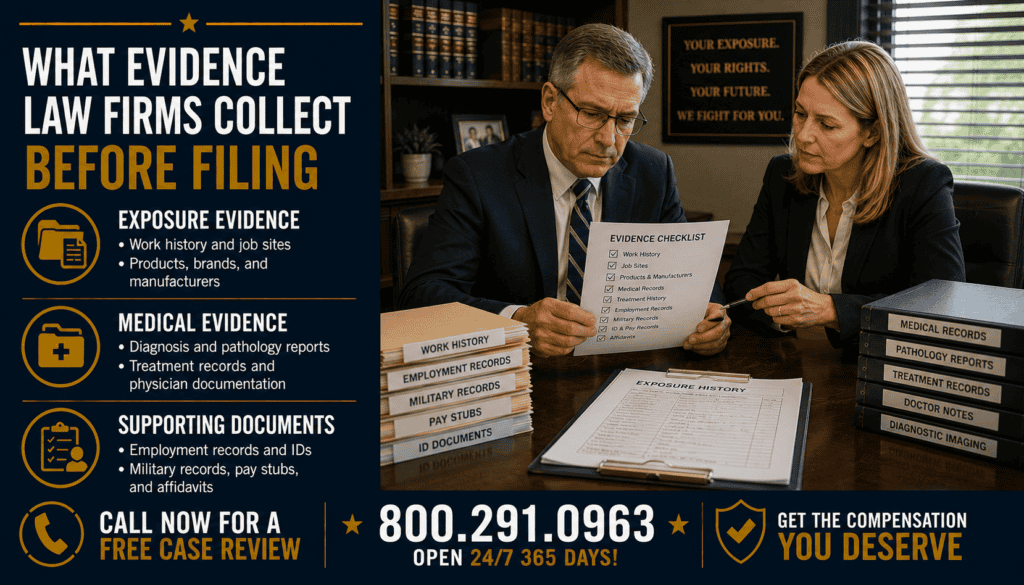
What Evidence Law Firms Collect Before Filing
Before an asbestos or mesothelioma lawsuit is filed, the factual record usually needs to be developed far enough to identify the claimant, the diagnosis, important exposure locations and periods, and one or more potentially responsible parties. That does not mean every piece of evidence must already be in hand. It means the available facts should be investigated carefully enough to support the allegations that will be made and to identify important gaps requiring further work.
Evidence collection is often challenging because occupational asbestos exposure may have occurred decades earlier. Useful proof can therefore come from many sources: medical records, Social Security earnings histories, union files, pay records, coworkers, product catalogs, purchase documents, historical photographs, maintenance records and corporate information. A careful pre-filing investigation distinguishes documented facts from memories, leads and assumptions.
📂 Why Evidence Is Collected Before Filing
A pre-filing investigation helps determine what claims the known facts may support, which parties may be connected to the exposure history and where additional records should be sought. It can also reveal conflicts in dates, employer names, product identification or corporate history before those issues become embedded in a complaint.
| Evidence group | Primary question |
|---|---|
| Medical | What disease was diagnosed and when? |
| Employment | Where and when did the person work? |
| Exposure | What tasks and materials may have produced exposure? |
| Product/worksite | What asbestos-containing products or systems were present? |
| Defendant | Which legal entities may be connected to those products or premises? |
| Witness | Who has firsthand knowledge? |
| Damages | What losses are being claimed and documented? |
For the broader framework, see the Mesothelioma Lawsuit Evidence & Documentation hub.
🩺 Medical and Diagnostic Records
Medical documentation can establish the diagnosis, diagnosis date, disease type, treatment and clinical course. Depending on the case, records may include pathology and cytology reports, biopsy and operative reports, immunohistochemistry results, imaging reports, oncology notes, hospital records and treatment summaries.
These records answer medical questions; they generally do not identify the workplace or company responsible for a historical asbestos exposure. Medical proof therefore needs to be coordinated with the separate exposure investigation.
🗓️ Employment and Work-History Evidence
A chronological work history gives the investigation its structure. Start with employer names, facilities, departments, job titles, approximate dates, union affiliations, contractors and regular tasks. Then compare those memories with records.
Potential sources include Social Security earnings histories, personnel files, pay stubs, union dispatch records, pension records, tax documents, leave records and work tickets. A record that confirms employment may still leave unanswered which department, task or product was involved.
See Tracking Your Work History to Prove Exposure and Finding Old Pay Stubs and Leave Records.
🏭 Building an Asbestos-Exposure History
The exposure history should describe what the person actually did rather than simply listing industries associated with asbestos. Useful details include work areas, equipment, materials, maintenance tasks, demolition or repair work, frequency, duration, proximity and whether others nearby performed dusty tasks.
Dates matter because products, formulations, contractors and ownership can change. A structured timeline makes it easier to compare a worker’s history with job-site and product records.
See How to Document Your Asbestos Exposure History and How Attorneys Build an Asbestos Exposure Timeline.
📦 Product and Equipment Identification
Investigators may look for product names, packaging descriptions, equipment models, manufacturers, suppliers, insulation types, gaskets, packing, construction materials and other details associated with the work. Potential sources include invoices, purchase orders, catalogs, specifications, work orders, maintenance files and historical photographs.
Product identification should be period-specific whenever possible. A brand may have had different formulations or owners at different times, and the manufacturer of a machine may differ from the manufacturer of insulation or replacement components used with it.
👥 Coworkers and Other Witnesses
Former coworkers, supervisors, contractors and other firsthand witnesses can sometimes fill gaps left by incomplete records. They may remember product labels, routine repairs, equipment, work locations or contractors present at a facility.
Record what each witness independently remembers, including the basis for the recollection. Avoid supplying product names or dates that the witness did not personally recall. Independent documents can then be used to corroborate or test the account.
Related guidance: Why Witness Statements Are Crucial in Asbestos Trials.
🗄️ Historical Job-Site and Business Records
Historical records can connect a product, contractor or activity to a particular facility and period. Examples include purchase orders, invoices, engineering specifications, construction documents, maintenance logs, equipment manuals, ship or facility records and photographs.
| Record | What it may help show | Important limit |
|---|---|---|
| Invoice | Product, supplier, date or destination | Does not automatically prove worker contact. |
| Work order | Task, equipment and location | May not identify material composition. |
| Historical photo | Equipment, label or work area | Appearance alone does not prove asbestos content. |
| Specification | Material required for a project | May not prove what was actually installed. |
| Maintenance log | Repair activity and dates | May omit individual worker names. |
🏢 Identifying Potential Defendants
Pre-filing research may examine manufacturers, suppliers, contractors, premises owners and corporate successors that could be connected to the documented exposure history. The appropriate defendant depends on the evidence and the legal theories recognized in the jurisdiction.
Corporate identity deserves careful verification. Mergers, acquisitions, name changes and bankruptcy reorganizations can complicate the connection between a historical brand and a current legal entity. Identifying a company is not the same as establishing that it is legally liable.
💵 Records Supporting Claimed Losses
When damages are claimed, supporting material may include medical bills, insurance statements, wage and tax records, employer documentation, travel costs and other evidence of claimed financial losses. Records concerning treatment and functional limitations may also be relevant to other legally recoverable damages depending on applicable law.
In covered federal cases, Rule 26(a)(1) requires a computation of each category of damages claimed and supporting evidentiary material, subject to the rule’s terms and any applicable court order or stipulation.
🔗 Preserving and Authenticating Evidence
Keep originals intact when possible. Preserve complete digital files rather than screenshots alone, record where documents came from and identify alterations made to working copies. A clear source history can make later authentication easier.
Federal Rule of Evidence 901 generally requires sufficient evidence to support a finding that an item is what its proponent claims. Authentication does not automatically resolve other admissibility questions.
See Chain-of-Custody Best Practices for Exposure Evidence and How to Authenticate Old Photos, Ship Logs and Base Records.
🧩 What Happens When Records Are Missing
Old employers may have closed and records may have been lost. Missing records do not justify guessing. Instead, the investigation can look for independent sources such as coworkers, union archives, public records, historical catalogs, facility documents, photographs and records from suppliers or contractors.
The goal is to distinguish three categories: facts supported by records, facts supported by firsthand recollection, and unresolved questions. That distinction helps prevent an uncertain lead from being presented as established fact.
See Building a Strong Mesothelioma Case From Limited Records.
⚖️ What Must Be Known Before a Complaint Is Filed
The precise pleading requirements depend on the court and jurisdiction. A pre-filing investigation should provide a reasonable factual basis for allegations rather than treating the complaint as a substitute for investigation.
Federal Rule of Civil Procedure 11 requires an attorney or unrepresented party presenting a pleading to certify, after an inquiry reasonable under the circumstances, that factual contentions have evidentiary support or, when specifically identified, will likely have evidentiary support after a reasonable opportunity for further investigation or discovery. State procedural rules can differ.
This does not mean every potential trial exhibit must be collected before filing. Some evidence may be available only through discovery from defendants or third parties.
🔎 Evidence Collection Continues After Filing
Filing is not the end of the investigation. In covered federal cases, Rule 26 requires initial disclosures of specified witnesses and supporting documents or categories, damages information and other material, while discovery can reach nonprivileged matter relevant to a claim or defense and proportional to the needs of the case.
Depositions, interrogatories, document requests, requests for admission and subpoenas may develop evidence that was not accessible before filing. Parties also have duties to supplement certain disclosures and discovery responses when the rule requires it.
✅ Pre-Filing Evidence Checklist
- Diagnosis date and treating facilities
- Pathology, biopsy and oncology records
- Employer names and approximate employment dates
- Job sites, departments and work areas
- Job titles and actual day-to-day tasks
- Social Security, payroll, union or pension records when available
- Names of coworkers and other firsthand witnesses
- Product, equipment, contractor and supplier information
- Invoices, purchase orders, work orders or specifications when available
- Historical photographs and facility records
- Corporate-history information for potential defendants
- Medical bills and records supporting claimed financial losses
- Original documents and source information
- A written list of unresolved factual gaps
For the next-level evidence review, see Evidence You Need to Win an Asbestos Lawsuit.
❓ Frequently Asked Questions
Do all records have to be collected before filing?
No. The required factual basis and pleading rules depend on the jurisdiction and case. Some relevant evidence may only become available through discovery after filing.
What medical records are useful at the beginning?
Diagnosis information, pathology, biopsy records, oncology records and relevant imaging or treatment documentation can provide a useful medical foundation. The precise records needed vary.
What if I cannot remember the asbestos product name?
Start with employers, job sites, work areas, tasks, equipment and coworkers. Those details can provide leads for historical product research without guessing a brand.
Why are Social Security and employment records useful?
They can help corroborate employers and employment periods, although they may not identify the specific department, task or asbestos product involved.
Can a coworker statement replace missing company records?
A firsthand witness can provide important evidence, but the strength and purpose of the testimony depend on what the witness personally observed. Independent corroboration can be valuable when available.
Why collect old invoices and purchase orders?
They may connect a product or supplier to a workplace and time period. They do not automatically establish that a particular claimant encountered the product.
Should I collect a sample of suspected asbestos myself?
No. Do not disturb suspect material to create evidence. Existing surveys or professionally collected and documented samples should be evaluated instead.
Can additional defendants be identified after filing?
Potentially, depending on the evidence, procedural rules and deadlines. Discovery can sometimes reveal corporate, product or site information that was unavailable earlier.
Why preserve original photographs and files?
Originals can retain metadata, context and source information that may be lost through cropping, screenshots or repeated editing.
Does collecting these records guarantee a lawsuit can be filed or won?
No. Evidence must be evaluated under the law governing the claim, and defendants may dispute exposure, causation, liability, damages or other issues.
📞 Request a Case Evaluation
If you or a family member has been diagnosed with mesothelioma, you do not need to reconstruct decades of employment and product history before requesting a review. Begin with the information already available—diagnosis, employers, job sites, approximate dates and names of coworkers—and preserve any original records you have.
Call 800.291.0963 for a no-obligation case evaluation. Talk to a real person 24/7, 365 days a year. There are no out-of-pocket legal fees for a contingency-fee claim unless compensation is recovered. Submit your case here.
📝 Summary
Before filing an asbestos lawsuit, the evidence investigation commonly focuses on medical diagnosis, employment history, asbestos-exposure circumstances, product and job-site identification, witnesses, potentially responsible companies and documented losses. Complete records are not always available, especially after decades, so reliable cases may require multiple independent sources. Preserve originals, identify uncertainties and avoid treating employment at an asbestos-associated workplace as automatic proof of exposure to every product used there. Evidence development can continue through formal discovery after a lawsuit is filed.
🔗 Confirmed Sources
- Cornell Legal Information Institute — Federal Rule of Civil Procedure 11
- Cornell Legal Information Institute — Federal Rule of Civil Procedure 26
- Cornell Legal Information Institute — Federal Rule of Evidence 901
Disclaimer: General information only—not legal or medical advice. This website is not a law firm. Pleading, evidence, discovery and filing requirements vary by jurisdiction and case. No particular evidence or prior result guarantees an outcome.