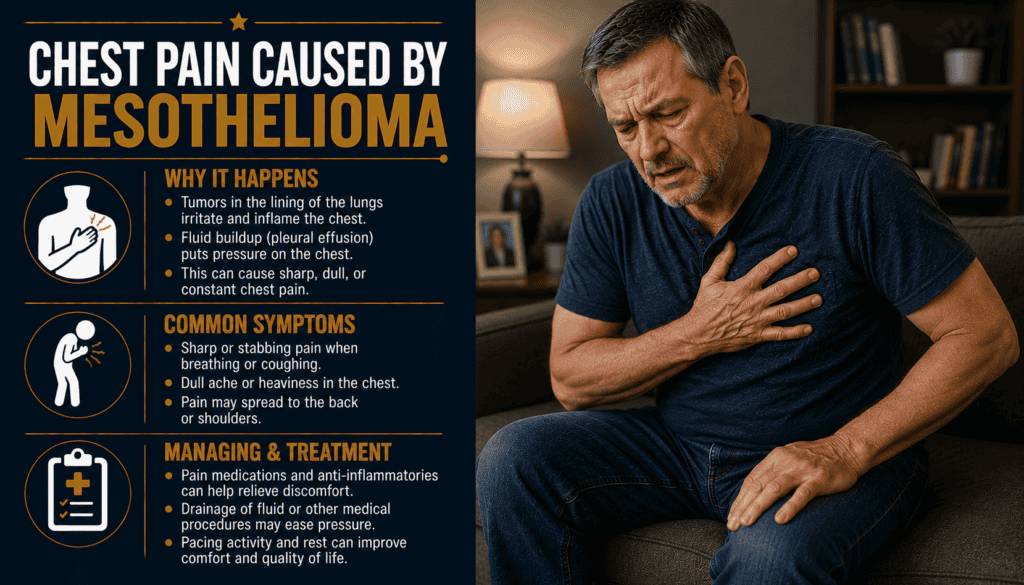
Chest Pain Caused by Mesothelioma
Causes, Warning Signs, Diagnosis & Pain Relief Options
Chest pain can be an important symptom of pleural mesothelioma, a cancer that develops in the lining around the lungs. Pain may arise from the tumor affecting the pleura or chest wall, inflammation, fluid around a lung, or another medical problem. Its intensity does not reliably reveal the cancer stage. New or changing pain deserves assessment rather than an assumption that mesothelioma is the cause.
The National Cancer Institute (NCI) identifies pain beneath the rib cage, breathing difficulty and fluid buildup as possible mesothelioma symptoms. This guide explains how to describe chest pain to your care team, what can require emergency care, and how clinicians may investigate and treat the underlying problem. See the broader mesothelioma symptoms guide for other symptoms.
🫁 Why Mesothelioma Can Cause Chest Pain
The pleura is a thin lining covering the lungs and inner chest wall. Mesothelioma may irritate this tissue or extend into adjacent structures, producing discomfort. Fluid between the pleural layers can also cause chest discomfort and breathlessness. These mechanisms can coexist; symptoms alone cannot determine which is responsible.
| Possible contributor | How it may feel | Clinical next step |
|---|---|---|
| Pleural irritation | Pain that changes with deep breathing | Report breathing-related pain |
| Chest-wall involvement | Persistent, localized or tender discomfort | Discuss imaging and pain assessment |
| Pleural effusion | Pressure or discomfort with shortness of breath | Ask whether fluid is present |
| Treatment-related effects | Pain near a recent procedure or radiation site | Tell the treating team when it began |
Chest pain is not a diagnosis
Heart disease, blood clots, infection and other causes may also produce chest pain. Do not self-diagnose a new episode, even with an established cancer diagnosis. The pleural effusion guide explains fluid-related symptoms in more detail.
| Question | Why it matters |
|---|---|
| When did it start? | A sudden onset can change the urgency of assessment. |
| Where is it located? | A precise location helps guide examination. |
| Does breathing change it? | This can help characterize pleural pain. |
📋 Chest Pain Patterns and What They May Mean
People describe chest pain as sharp, aching, pressure-like, burning or tender. These words help communication but cannot prove a specific cause. Record whether pain is constant or episodic, whether it spreads, and whether it limits sleep, movement or breathing.
| Pain description | Useful detail to report |
|---|---|
| Sharp with inhalation | Does coughing also trigger it? |
| Dull persistent ache | Is it new or worsening? |
| Pressure or tightness | Does it occur with sweating or dizziness? |
| Pain near a procedure site | Any redness, fever or drainage? |
Use a consistent symptom record
Tell the team your pain score on a 0–10 scale, what you were doing, medication taken, time to relief and side effects. A diary is useful only if it does not delay urgent assessment.
| Diary item | Example entry |
|---|---|
| Time and duration | Started at 2 p.m.; lasted 20 minutes |
| Location | Left side under ribs |
| Triggers | Worse with a deep breath |
| Associated symptoms | Shortness of breath or fever |
| Response | What treatment helped, if any |
🚨 When Chest Pain Is an Emergency
Call 911 for sudden, severe or unexplained chest pain, especially with shortness of breath, fainting, sweating, or pain spreading to the arm, back or jaw. Do not drive yourself. A heart attack or another emergency may occur in a person with mesothelioma, and it is unsafe to assume all chest pain comes from cancer.
| Situation | Action |
|---|---|
| Sudden chest pain with severe breathlessness or fainting | Call 911 immediately. |
| Possible heart-attack symptoms | Call 911 even if you are unsure. |
| New chest pain that is not immediately life-threatening | Contact the oncology team promptly for guidance. |
| Pain that is increasing despite prescribed treatment | Contact the care team for reassessment. |
Other symptoms that change the urgency
Tell emergency clinicians about your cancer, recent procedures and current medicines. Sudden breathing problems, coughing blood, or collapse need urgent medical assessment. Your clinician can determine whether a blood clot, infection, fluid or another condition is involved.
| Associated symptom | What to communicate |
|---|---|
| Breathlessness | Sudden or gradual; at rest or exertion |
| Fever | Temperature and any recent procedures |
| Coughing blood | Amount and timing; seek urgent assessment |
| New dizziness or fainting | Call emergency services if severe or with chest pain |
Need help now? Call 800.291.0963
Live chat is available 24/7, 365 days a year.
Submit Your Case
🔬 How Doctors Evaluate Chest Pain
Doctors start with the history, vital signs and examination, then choose tests based on urgency and the likely cause. Chest pain evaluation may include tests for emergencies as well as tests related to mesothelioma. NCI lists chest X-ray, CT and biopsy among tools used in diagnosing mesothelioma; no single symptom confirms the diagnosis.
| Assessment | What it helps evaluate |
|---|---|
| History and physical examination | Pain features, breathing and other symptoms |
| Chest X-ray | Fluid or other visible chest abnormalities |
| CT imaging | Detailed anatomy and possible causes |
| Tissue biopsy and pathology | Cancer diagnosis when indicated |
Imaging and pathology have different jobs
Imaging can show suspicious changes or fluid; pathology examines tissue for cancer. If imaging suggests a new issue, the team decides whether additional sampling is needed. See mesothelioma diagnosis and imaging tests for mesothelioma.
| Finding | Important limitation |
|---|---|
| Pleural thickening | Does not alone establish why pain is present |
| Pleural fluid | May have malignant or nonmalignant causes |
| A suspicious mass | Often requires tissue assessment |
| No obvious change on one test | Does not automatically rule out every urgent cause |
💧 Pleural Fluid and Breathing Relief
Pleural effusion means extra fluid in the space around the lung. It can contribute to chest discomfort and difficulty breathing, but fluid may have cancer-related or noncancer causes. NCI describes fluid drainage and procedures to reduce recurrence as possible symptom-management options; the right approach depends on the individual.
| Approach | Purpose | Key consideration |
|---|---|---|
| Thoracentesis | Drain fluid for testing or relief | Fluid may return; procedure has risks |
| Indwelling pleural catheter | Allow ongoing drainage in selected patients | Requires training and infection precautions |
| Pleurodesis | Reduce repeat fluid accumulation | Not appropriate for every patient |
Questions to ask about fluid
Ask whether the fluid is causing your symptoms, whether it should be sampled, what benefits are expected from drainage, and which complications require a call. Do not attempt fluid drainage without training and a prescribed plan. Related reading: pleurocentesis and pleurodesis.
| Ask your clinician | Reason |
|---|---|
| Is fluid contributing to the pain? | Targets treatment to the cause |
| How quickly could fluid return? | Helps plan follow-up |
| What warning signs follow a procedure? | Supports safer recovery |
💊 Pain Treatment and Symptom Control
Pain management is individualized. Clinicians may combine medication, treatment directed at the cancer, procedures for fluid and supportive or palliative care. Do not change prescribed doses or add over-the-counter products without checking for interactions, especially during chemotherapy or while taking blood thinners.
| Option | Potential role | Important safeguard |
|---|---|---|
| Prescribed pain medication | Reduce discomfort | Follow dose and side-effect instructions |
| Cancer-directed therapy | May reduce tumor-related symptoms | Benefits depend on disease and treatment plan |
| Palliative radiation | May help selected patients with localized cancer pain | Requires specialist evaluation |
| Palliative-care consultation | Coordinate pain, breathing and quality-of-life support | Can be provided alongside cancer treatment |
Ask for reassessment when pain persists
Uncontrolled pain is a reason to contact the care team. Discuss whether the cause has changed, whether medicines need adjustment, and how to prevent constipation, drowsiness or other adverse effects. Palliative care is symptom-focused care and does not automatically mean hospice. See managing pain and symptoms and palliative care for mesothelioma.
| Follow-up topic | Example question |
|---|---|
| Effectiveness | How much relief should I expect? |
| Side effects | What should prompt a call? |
| Breakthrough pain | What is the written rescue plan? |
| Medication safety | Are there interactions with my other drugs? |
🏠 Daily Comfort and Caregiver Planning
Practical support may make pain easier to manage, but it does not replace evaluation or prescribed treatment. Ask the clinical team about positioning, activity limits, breathing strategies and rehabilitation appropriate to your condition. Caregivers can help keep an accurate symptom list and bring it to appointments.
| Home strategy | Practical application |
|---|---|
| Pacing | Break tasks into shorter periods with rest |
| Positioning | Ask which positions are comfortable and safe |
| Medication list | Keep doses and times current |
| Caregiver communication | Agree on who contacts the team when symptoms change |
Prepare for the next appointment
Bring imaging reports if requested, a current medication list, symptom notes and a short list of questions. Seek help with travel, caregiving and emotional strain when needed. Read caregiver support and family resources and shortness of breath in mesothelioma.
| Bring to appointment | Why |
|---|---|
| Medication list | Helps prevent interactions |
| Pain diary | Shows trends and response |
| Procedure dates | Connects symptoms to recent care |
| Priority questions | Keeps the visit focused |
❓ Frequently Asked Questions
Can mesothelioma cause chest pain?
Yes. Pleural mesothelioma may cause pain under the ribs or chest discomfort, but chest pain has many possible causes and needs appropriate assessment.
Does chest pain mean mesothelioma has reached stage 4?
No. Pain severity alone cannot establish stage. Staging requires clinical assessment and appropriate tests.
Can fluid around the lung cause chest pain?
Yes. Pleural effusion can cause discomfort and shortness of breath. A clinician must determine whether fluid is present and what caused it.
Should I call 911 for sudden chest pain?
Yes, for sudden, severe or unexplained chest pain, particularly with breathlessness, fainting, sweating or spreading pain. Do not drive yourself.
Will draining pleural fluid always stop the pain?
No. Drainage may help symptoms caused by fluid, but tumor involvement or another condition may continue to cause pain.
Can palliative care begin during cancer treatment?
Yes. Palliative care can support symptom control alongside cancer-directed treatment.
What should I tell my doctor about chest pain?
Report onset, location, severity, duration, triggers, associated symptoms and response to medication.
Can chest pain be caused by something other than mesothelioma?
Yes. Heart disease, blood clots, infection and treatment-related conditions are among possibilities; urgent symptoms require immediate assessment.
🧾 Chest Pain: Key Takeaways
| Key point | What to remember |
|---|---|
| Cause | Mesothelioma is one possibility, not the only one |
| Emergency | Call 911 for sudden severe or unexplained pain with warning signs |
| Diagnosis | History, examination and selected tests identify the cause |
| Relief | Care may involve medicines, fluid procedures and palliative support |
🔗 Related Mesothelioma Resources
- Mesothelioma symptoms
- Pleural effusion
- Recognizing early symptoms
- Mesothelioma treatments
- Mesothelioma diagnosis
📚 Confirmed Government Medical Sources
- National Cancer Institute: Mesothelioma Symptoms
- National Cancer Institute: Diagnosis and Prognosis
- National Cancer Institute: Treatment
- National Cancer Institute: Cardiopulmonary Syndromes
- National Heart, Lung, and Blood Institute: Heart Attack Symptoms
📨 Submit Your Case
Call 800.291.0963
Live chat is available 24/7, 365 days a year.
Submit Your Case
People diagnosed with mesothelioma may wish to review potential legal and financial options. Eligibility and outcomes depend on individual facts, applicable law and available evidence; compensation is never guaranteed. This service is not an emergency medical resource.
⚕️ Legal & Medical Information Disclaimer
This page provides general information, not medical or legal advice. Consult qualified clinicians about chest pain and treatment, and a qualified attorney about individual claims. For emergency symptoms, call 911.