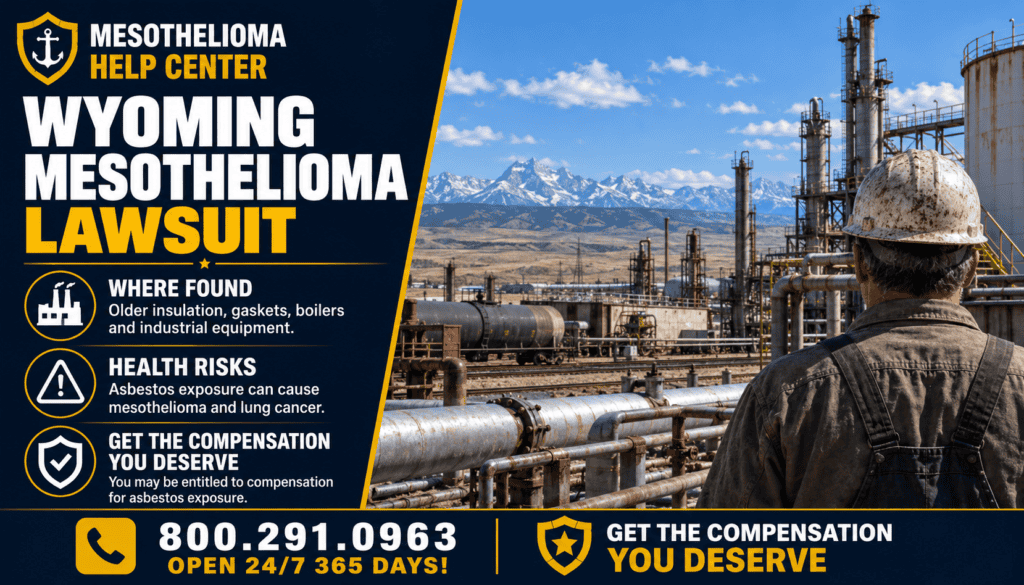
Wyoming Mesothelioma Lawsuits
Wyoming mesothelioma lawsuits may involve historical work in energy production, refining, rail transportation, mining, utilities and older building maintenance. These occupational settings warrant careful investigation of specific historical asbestos exposure sources.
An exposure history should distinguish the actual asbestos-containing product and disturbance activity from mere employment in an industry or residence in a county. Detailed employment records can help identify relevant workplaces, products, dates, and witnesses.
Exposure and Legal Overview
Wyoming mesothelioma lawsuits may involve historical work in energy production, refining, rail transportation, mining, utilities and older building maintenance. The inquiry requires evidence of the alleged exposure, the medical diagnosis, potentially responsible parties and the governing jurisdiction. A disease diagnosis does not, on its own, identify the source or establish liability.
An exposure history should distinguish the actual asbestos-containing product and disturbance activity from mere employment in an industry or residence in a county. Different legal theories may apply to manufacturers, suppliers, premises owners or contractors, and no compensation outcome can be guaranteed.
Wyoming’s exposure investigations often begin with an employment timeline rather than a list of alleged asbestos sites. Record every employer, job title, union affiliation, contractor, facility and period of work. Someone who changed jobs between a mine, rail shop and municipal boiler room may need separate evidence for each period. The source of a possible exposure can be a product used by a contractor rather than one manufactured or purchased by the principal employer.
Mesothelioma has a long latency period, so an inquiry may reach back decades before diagnosis. That makes dated documents particularly important: payroll records, Social Security earnings histories, apprenticeship records, photographs, maintenance schedules and former coworkers’ accounts can help reconstruct an otherwise incomplete history. A location’s industrial character does not establish that a particular person encountered asbestos.
Wyoming claims may also involve work performed outside Wyoming, military service, household exposure or products distributed nationally. A qualified lawyer should consider all plausible jurisdictions and exposure sources before selecting defendants or deciding where to file. This page provides a statewide research framework, not a substitute for the underlying facts of an individual case.
Compare the Wyoming overview with the national state-by-state guide Mesothelioma Lawsuits in All 50 States. This is a research pathway, not evidence of exposure at a particular Wyoming site.
For the broader legal framework, review Mesothelioma Legal Options & Rights. This is a research pathway, not evidence of exposure at a particular Wyoming site.
Historical Industries and Materials
Historic boilers, steam piping, turbine systems, mechanical gaskets, insulation and some older building materials are potential research leads at industrial and commercial sites.
| Historical setting | Possible materials to investigate | Records to seek |
|---|---|---|
| Power and mechanical systems | Older thermal insulation, gaskets, packing and refractory products | Maintenance logs, equipment specifications and purchase records |
| Transportation and heavy industry | Some historic friction products, machinery seals and insulation | Job descriptions, overhaul records and product identification |
| Construction and building maintenance | Some older pipe covering, flooring and fire-resistant materials | Renovation permits, surveys and contractor records |
Not every product or facility contained asbestos. Materials must be verified by time period and evidence rather than assumed from the industry alone.
Oil production and refining: Older steam lines, pumps, valves, compressors and process heaters are useful starting points for document searches. Some historic insulation, flange gaskets and packing materials contained asbestos. Investigators should establish the specific unit, manufacturer, overhaul date and whether the material was disturbed. Modern replacement parts must not be assumed to have the same composition as original equipment.
Coal mining and mineral operations: The mineral being mined should not be confused with the asbestos that might have been present in equipment or buildings. Investigate repair shops, boiler systems, heavy equipment friction components, electrical equipment and maintenance work. Mine assignment maps, job classifications and purchasing records can help determine who worked near particular tasks.
Railroads and transportation: Wyoming’s rail corridors and service facilities created potential contact with older locomotives, brakes, engine components, pipe insulation and building systems in some historical periods. Exposure differs among operating crews, mechanics, shop employees, cleaners and construction contractors. Establish the exact equipment model, work performed and time frame.
Utilities and construction: Power generation, district heating, school maintenance, hospital plant rooms and commercial renovation may have involved thermal insulation and other historical asbestos-containing materials. Review renovation specifications, abatement reports and contractor invoices before making site-specific claims. The presence of a boiler alone is not proof that its insulation contained asbestos.
Equipment and construction-material research may lead to historical manufacturers; see Asbestos Manufacturers. This is a research pathway, not evidence of exposure at a particular Wyoming site.
Where a documented product traces to a reorganized company, consult Asbestos Manufacturer Trust Funds. This is a research pathway, not evidence of exposure at a particular Wyoming site.
The broader compensation mechanism is explained in What Are Asbestos Trust Funds?. This is a research pathway, not evidence of exposure at a particular Wyoming site.
If the same worker later serviced comparable systems during Air Force duty, examine Air Force Power Plant & Boiler Room Asbestos Exposure. This is a research pathway, not evidence of exposure at a particular Wyoming site.
States, Counties and Local Context
Natrona County (Casper), Laramie County (Cheyenne), Campbell County (Gillette), Sweetwater County and Lincoln County have different industrial and transportation histories. Investigate individual employers and facilities rather than assuming site-wide exposure.
Preserve addresses, dates, worksite names, union records and employers. County boundaries are useful research organizers, not proof that an exposure or a claim arose there.
Casper and Natrona County: Energy production, refining, transportation and industrial maintenance are relevant lines of inquiry. A worksite-by-worksite review is preferable to treating all facilities in the region alike. Preserve refinery unit assignments, contractor rosters and maintenance records when available.
Cheyenne and Laramie County: Railroad operations, public infrastructure, older commercial buildings and military-related work histories can merit investigation. Record whether a person worked at a rail facility, a private contractor’s shop, a municipal property or a federal installation; these distinctions can affect the records available and possible legal pathways.
Gillette and Campbell County: Coal extraction and associated heavy-equipment maintenance may provide occupational leads. Investigate workshops, replacement parts, building systems and contractor activities, rather than presuming asbestos exposure from coal work itself.
Rock Springs and Sweetwater County: Mining, rail transportation, energy facilities and building trades provide historically plausible avenues for research. Also consider Sheridan, Fremont, Albany and other counties where an individual actually lived or worked. County residence does not necessarily identify the county where exposure occurred.
Create a chronological map of each work location, including transfers across state lines. Wyoming residents may have held jobs in neighboring Colorado, Utah, Montana, Idaho, Nebraska or South Dakota. Preserve out-of-state exposure separately because jurisdiction, product evidence and witnesses may differ.
Military and Veteran Exposure
F. E. Warren Air Force Base and Wyoming Air National Guard activities may be relevant to documented military or civilian facility-maintenance histories. Do not infer asbestos exposure merely from assignment to a base.
Where military service is relevant, collect discharge and assignment records, vessel or unit details, installation work orders and contractor histories. VA benefit eligibility and third-party civil claims require separate analysis; avoid attributing civilian work to military service without documentation.
Wyoming military histories should focus on documented service and duty assignments. F. E. Warren Air Force Base near Cheyenne has a long military history, but service at the installation does not by itself establish asbestos exposure. Investigate specific buildings, maintenance assignments, vehicle shops, construction projects and time periods if supported by service or facility records.
Some Wyoming veterans also served at naval installations, aboard vessels or at overseas bases. Shipboard boiler rooms, pipe systems and machinery maintenance may be relevant when actual Navy service is documented; a generic Navy link should not be used to imply a connection for an Air Force or civilian claimant. Obtain DD Form 214, personnel assignments, military occupational specialty information, unit histories and relevant maintenance documentation.
VA disability compensation, medical care and civil litigation are distinct processes with separate eligibility rules. A veteran can seek guidance on possible VA exposure-related benefits without assuming a civil lawsuit is automatically available. Family members should preserve both service and post-service employment histories because exposures may have occurred in multiple settings.
For documented Air Force service associated with Wyoming, consult U.S. Air Force Asbestos Exposure. This is a research pathway, not evidence of exposure at a particular Wyoming site.
When a particular base building or maintenance assignment is involved, see Air Force Base Asbestos Exposure & Mesothelioma Lawsuit. This is a research pathway, not evidence of exposure at a particular Wyoming site.
For installation steam-system work, investigate Air Force Power Plant & Boiler Room Asbestos Exposure. This is a research pathway, not evidence of exposure at a particular Wyoming site.
The general installation evidence framework appears in Military Bases Asbestos Exposure. This is a research pathway, not evidence of exposure at a particular Wyoming site.
Occupations and Secondary Exposure
Refinery and utility mechanics, rail workers, miners, insulators, construction crews, electricians and maintenance personnel may have distinct worksite and product histories.
Direct handling, nearby-trade dust and possible take-home exposure are different factual questions. A household history may require information about laundering work clothes, the relationship to the worker and the original material source.
Maintenance employees often require the most detailed task reconstruction. A mechanic who opened pumps and valves may have had a different potential exposure than an operator who remained in a control room. For insulators, pipefitters, electricians, boilermakers, millwrights, construction workers and laborers, describe the material handled, tools used, work duration and proximity to other trades.
Secondary exposure may involve asbestos fibers transported on clothing, shoes, tools or vehicles. Investigators should identify the worker’s original job, the household member’s activities, laundry practices, shared spaces and dates. A household relationship alone does not prove exposure, and the medical and legal questions should be evaluated separately.
Self-employed workers and contractors may lack a single employer archive. Tax returns, business licenses, customer invoices, supplier receipts, union benefit records and photographs can help fill those gaps. For deceased workers, family interviews conducted early can preserve names of colleagues and contractors who may otherwise be difficult to locate.
For a Wyoming resident whose separately documented Army duties included vehicle repair, see Army Vehicle Equipment Asbestos Exposure. This is a research pathway, not evidence of exposure at a particular Wyoming site.
Records and Evidence
| Record category | Purpose |
|---|---|
| Employment and earnings records | Establish employers, jobs and dates |
| Product, purchasing and maintenance documents | Identify materials and potential manufacturers |
| Medical and pathology records | Establish diagnosis and chronology |
| Witnesses and historical photographs | Corroborate work methods and proximity |
| Service records, when relevant | Separate military and civilian exposure histories |
Begin collecting records promptly because older business records and witnesses may become harder to locate over time.
Begin with a master chronology containing dates, addresses, employers, job titles, supervisors, equipment names and known coworkers. Label uncertain details as recollections rather than established facts. Compare memories with independent records and keep copies of originals, including metadata when documents are digital.
Product identification can involve manufacturer markings, historic catalogs, material safety data sheets, specifications, invoices and testimony about replacement parts. Equipment manufacturer identity and asbestos-product manufacturer identity are not necessarily the same. A lawyer may need to evaluate both original and aftermarket components.
Medical documentation can include pathology, imaging, treatment records and a physician’s diagnosis. Keep medical records separate from the exposure narrative and avoid making unsupported causal claims. If the claimant has died, preserve death records, estate documents and the identity of legally authorized family representatives.
Useful government or institutional records may include federal service records, property files, environmental or abatement reports and OSHA-related materials when available. Not every archive retains records from decades ago; a missing record is not proof that a particular exposure did or did not occur.
Trust-specific product and work-history documentation is discussed in Evidence Needed for Asbestos Trust Fund Approval. This is a research pathway, not evidence of exposure at a particular Wyoming site.
For how qualifying reorganizations and trust procedures work, read Understanding Asbestos Trust Funds. This is a research pathway, not evidence of exposure at a particular Wyoming site.
Lawsuits and Compensation
Depending on the facts, possible avenues include personal-injury lawsuits, wrongful-death actions, asbestos bankruptcy trust claims and VA benefits for eligible veterans. They are not interchangeable, and trust submissions can affect litigation disclosures or recoveries.
Filing periods, discovery rules, jurisdiction and who may bring a claim vary. Do not calculate a deadline solely from a generic state chart. Ask a qualified attorney to review the relevant statutes and facts promptly.
Related Internal Resources
A personal-injury lawsuit generally concerns a living claimant, while a wrongful-death action concerns rights that may arise after death. Trust fund submissions address liabilities of qualifying bankrupt asbestos companies. These avenues may overlap but require separate eligibility analyses and consistent exposure disclosures.
Filing deadlines are especially important in diseases diagnosed long after the relevant work. The applicable state law, discovery principles, date of diagnosis or death, defendant, and forum can change the analysis. Do not rely on a single generic number of years; seek prompt review by counsel familiar with Wyoming and any other potentially relevant jurisdictions.
Potential damages and recoveries depend on proof, applicable law and the individual facts. Medical costs, lost earnings, other legally recoverable losses and available benefits may be relevant, but no settlement, verdict or trust payment is guaranteed. A claims review should identify all plausible sources and explain how different proceedings interact.
Preserve a record of any earlier lawsuits, trust submissions, workers’ compensation matters or VA applications. Inconsistent work histories can complicate later evaluation. Families should ask how estate authority, medical authorizations and document retention affect their ability to investigate a claim.
The related Wyoming disease-specific resource is Wyoming Asbestos Lung Cancer Lawsuits. This is a research pathway, not evidence of exposure at a particular Wyoming site.
Manufacturer-specific trust research may be relevant; compare Asbestos Manufacturer Trust Funds. This is a research pathway, not evidence of exposure at a particular Wyoming site.
Return to the broader Mesothelioma Lawsuit section for general claim and compensation topics.
Frequently Asked Questions
Does working in a named industry prove exposure?
No. Verify the material, task, dates and credible supporting evidence.
Can families investigate exposure from work clothing?
Potentially. Establish the worker’s original exposure and household circumstances.
Can veterans explore more than one benefit or claim?
Sometimes, depending on service history, alleged responsible parties and applicable rules. Each avenue needs independent review.
What should I preserve first?
Diagnosis records, employment and service dates, addresses, product details, photographs and potential witnesses.
Which Wyoming industries should be investigated first?
Begin with the person’s actual employment. Energy, refining, coal operations, railroad shops, utilities, construction and building maintenance can be relevant, but none establishes exposure without product and task evidence.
Does living in Casper, Cheyenne or Gillette establish an asbestos claim?
No. County or city residence helps locate records, but a claim requires an individualized exposure and legal assessment.
Can a Wyoming resident investigate exposure in another state?
Yes. Record every work and service location. A lawyer can assess the jurisdiction and deadlines applicable to each potential claim.
What if the employer has closed?
Social Security earnings records, union archives, former coworkers, equipment documentation, property records and successor-company information may still help reconstruct the history.
Is military exposure handled differently?
VA benefits and civil claims have different eligibility standards. Identify the installation, service dates, assignment and specific work rather than assuming exposure from veteran status.
Can family members investigate a deceased worker’s history?
They can preserve available records and consult counsel about estate authority, wrongful-death rules and any applicable filing deadlines.
Summary and Confirmed Sources
Build an individualized timeline linking location, task, product, employer and diagnosis. The following official resources support general background, not any unverified site-specific allegation.
Review Your Exposure History
Call 800.291.0963 or share your information below to discuss possible resources. Eligibility depends on individual circumstances.
Disclaimer: This page is general educational information and is not individualized legal or medical advice. Historical examples do not establish exposure or liability. No claim result is guaranteed. Consult a qualified professional about health concerns and a licensed attorney about filing deadlines.