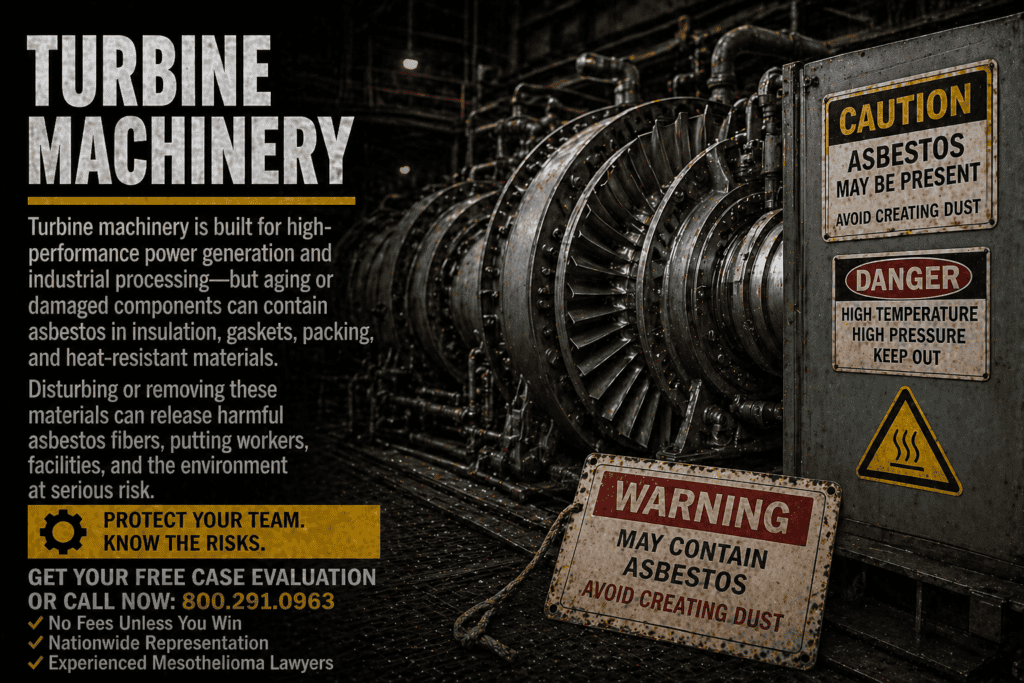
⚡ Turbine Machinery Asbestos Exposure
Older steam, gas, and industrial turbine systems may have operated with or near asbestos-containing insulation, gaskets, seals, packing, thermal blankets, and other heat-resistant materials. Turbines were widely used in power plants, refineries, ships, factories, military installations, and other high-temperature industrial settings.
Turbine work alone does not prove asbestos exposure. The turbine manufacturer, model, installation date, insulation system, gaskets, replacement parts, surrounding equipment, maintenance history, and actual work performed should be investigated before concluding that asbestos was present.
For broader information, see Machinery Asbestos Exposure and Power Generation & Electrical Machinery Asbestos Exposure.
⚡ Turbine Machinery Asbestos Exposure
Turbines operate under high temperatures and, in many applications, high pressure. Historically, some turbine systems and nearby piping or mechanical equipment used asbestos-containing products because asbestos resisted heat, fire, and wear.
Potential exposure was more likely when an asbestos-containing material was cut, removed, scraped, broken, deteriorated, or otherwise disturbed during repair, overhaul, insulation replacement, or shutdown work.
Relevant systems could include:
- Steam turbines
- Industrial gas turbines
- Marine propulsion turbines
- Power-generation turbine-generator sets
- Refinery and process-industry turbine equipment
🔍 Where Asbestos May Have Been Used Around Turbines
| Turbine Area | Possible Historical Asbestos-Containing Material |
|---|---|
| Turbine casing and hot surfaces | Certain insulation, lagging, or removable thermal coverings |
| Flanges and joints | Certain high-temperature gaskets and packing |
| Steam and process piping | Pipe insulation, flange gaskets, and valve packing |
| Exhaust or heat-shield areas | Selected thermal blankets or heat-resistant materials |
| Nearby pumps and valves | Certain gaskets, packing, and insulated components |
These are potential historical pathways, not proof that every turbine or accessory contained asbestos. Manufacturer specifications, maintenance manuals, insulation records, parts documents, and procurement records can help identify the actual materials used.
🛠️ Turbine Maintenance and Outage Exposure
Major turbine maintenance can involve opening casings, removing insulation, separating flanges, replacing gaskets, servicing valves, and working around insulated piping. If asbestos-containing materials were present, those tasks could disturb fibers.
Tasks worth investigating include:
- Turbine casing splits
- Insulation or lagging removal
- Gasket scraping and replacement
- Valve and flange maintenance
- Steam-pipe repair
- Major overhaul work
- Shutdown and outage maintenance
- Cleanup after insulation or gasket removal
Working near turbine maintenance does not automatically prove meaningful asbestos exposure. Proximity, frequency, duration, ventilation, the specific material involved, and whether that material actually contained asbestos are important.
👷 Workers Who May Have Encountered Asbestos
Potentially relevant workers can include turbine mechanics, millwrights, power plant workers, electricians, stationary engineers, pipefitters, boilermakers, insulation workers, maintenance mechanics, refinery personnel, shipyard workers, utility workers, and military personnel assigned to turbine or power systems.
An occupation or worksite alone does not establish exposure. A stronger history connects the worker’s actual duties to a specific turbine, insulation system, gasket, component, or nearby piece of equipment.
For broader occupational research, see Asbestos Exposure in High-Risk Jobs.
🏭 Related Power-Generation and Electrical Machinery
Turbines commonly operated as part of larger power-generation systems. Workers could move among turbine-generator sets, generators, motors, transformers, circuit breakers, bus ducts, motor-control centers, and emergency-power equipment during installation, inspection, shutdowns, and repair.
- Generator Set Machinery Asbestos Exposure
- Electric Motor Machinery Asbestos Exposure
- Transformer Machinery Asbestos Exposure
- Circuit Breaker Machinery Asbestos Exposure
- Bus Duct Machinery Asbestos Exposure
- Motor Control Center (MCC) Machinery Asbestos Exposure
- Emergency Power Inverter Machinery Asbestos Exposure
Related heat-process equipment may also matter. See Boiler Machinery Mesothelioma Lawsuit and Steam Boiler Machinery Asbestos Exposure.
📂 Evidence That May Document Turbine Asbestos Exposure
Because turbine exposure may have occurred decades before diagnosis, historical records can be important in reconstructing what equipment and materials were present.
Useful evidence may include:
- Turbine manufacturer and model information
- Outage and maintenance logs
- Equipment manuals and parts catalogs
- Insulation specifications
- Gasket and packing records
- Procurement and purchase records
- Plant or ship machinery lists
- Photographs and nameplate information
- Employer, union, or military records
- Coworker and supervisor statements
- Medical and pathology records
Related product research can include Machinery Products Asbestos Exposure and Pumps, Valves & Gaskets Asbestos Exposure.
🫁 Asbestos Diseases and Health Risks
Inhaling asbestos fibers can increase the risk of mesothelioma, lung cancer, and asbestosis. These diseases can appear many years after exposure, so an old turbine or power-plant work history may remain medically relevant long after retirement.
A turbine work history alone does not diagnose an asbestos-related disease or prove medical causation. People with respiratory symptoms or a known exposure history should discuss appropriate medical evaluation with qualified healthcare professionals.
⚖️ Legal and Compensation Options
A person diagnosed with an asbestos-related disease may be able to investigate civil claims when evidence connects exposure to asbestos-containing products associated with potentially responsible manufacturers, suppliers, distributors, contractors, insulation companies, or other entities.
Asbestos bankruptcy trust claims may also be available when the claimant satisfies the requirements of a specific trust. Veterans may have separate VA benefit options when applicable service-connection requirements are met.
Exposure decades ago does not automatically preserve or defeat a legal claim. Filing deadlines vary by jurisdiction, claim type, diagnosis or death, discovery rules, and other facts, so deadlines should be evaluated individually.
Useful related pages include Asbestos Manufacturers, Asbestos Exposure in Job Sites, and Secondhand Asbestos Exposure.
❓ Frequently Asked Questions
Did all older turbines contain asbestos?
No. Asbestos use depended on the turbine manufacturer, model, insulation system, gaskets, replacement materials, and era.
Where might asbestos have been used around turbine machinery?
Potential historical sources include certain casing insulation, lagging, thermal blankets, gaskets, packing, insulated piping, and nearby valves or pumps.
Could turbine overhauls disturb asbestos?
Potentially, if asbestos-containing insulation, gaskets, packing, or related materials were removed or disturbed during the work.
Does working near a turbine prove exposure?
No. The actual material, work activity, distance, frequency, duration, and ventilation should be considered.
Could power plant workers have been exposed from equipment other than turbines?
Yes. Exposure histories may also involve generators, boilers, motors, transformers, piping, pumps, valves, switchgear, and other equipment.
What records can help identify a turbine and its materials?
Maintenance logs, outage records, manuals, parts catalogs, insulation specifications, purchase records, equipment lists, photographs, employer records, and witness statements can help.
Does a decades-old turbine exposure automatically qualify someone for a lawsuit?
No. Legal eligibility and filing deadlines depend on the jurisdiction, claim type, evidence, diagnosis, and other case-specific facts.
Can family members have secondhand exposure?
Potentially. A household exposure history should examine whether asbestos fibers were carried home on contaminated work clothing, shoes, tools, or other items.
⚡ Help for Turbine and Power-Generation Workers
Identify turbines, insulation, components, jobsites and records that may document exposure
A focused review can examine turbine manufacturers, models, maintenance work, insulation systems, gaskets, related machinery, jobsites, employment or military records, witnesses, medical evidence, asbestos trusts, and potential legal claims.
Call 800.291.0963 to discuss possible turbine machinery asbestos exposure. Live chat is available 24/7, 365 days a year. You can also Submit Your Case.
No exposure determination, medical causation finding, trust payment, lawsuit outcome, settlement, verdict, or compensation amount is guaranteed.
⚕️ Legal & Medical Information Disclaimer
This page provides general educational information and is not medical or legal advice. It does not establish asbestos exposure, diagnosis, medical causation, legal liability, claim eligibility, or compensation. Consult qualified medical and legal professionals about your circumstances.