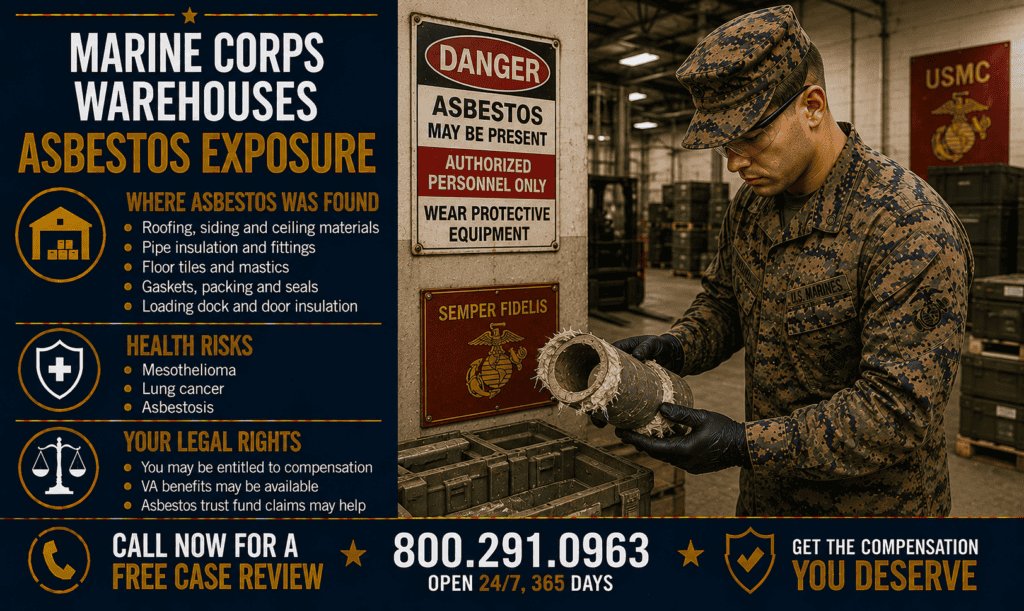
Marine Corps Warehouses Asbestos Exposure
Exposure, Evidence and Claims
Marine Corps warehouses housed supplies and equipment in buildings constructed and renovated across different eras. Some older building materials could contain asbestos, but an installation address alone does not establish exposure.
This page focuses on warehouse structures, maintenance events and actual employee duties. It distinguishes potential exposure from disturbed building materials from questions about asbestos-containing goods stored inside.
Marine Warehouse Buildings and Uses
Marine Corps Warehouse Environments
Marine Corps warehouses supported food, equipment, vehicle parts, clothing and other military logistics. Buildings differed by age, construction and use, so no single asbestos profile applies to every installation warehouse.
A warehouse might have concrete walls, metal framing and newer systems, or older thermal insulation, floor materials and roofing. Age may guide research but does not prove a particular material contained asbestos.
Warehouse clerks, forklift operators, maintenance personnel and renovation contractors performed different tasks. Exposure assessment should begin with the individual’s assignment and the physical worksite.
Evidence question: Can the available records establish the warehouse building number and use during the relevant service years? Record the source and identify gaps rather than assuming exposure.
For the wider service history, compare Marine Corps bases. This distinction helps separate the individual assignment from the broader service environment. For marine corps warehouses asbestos exposure, this connection matters specifically when evaluating warehouse building number and use.
For a related occupational distinction, see Marine Corps occupations. This distinction helps separate the individual assignment from the broader service environment. For marine corps warehouses asbestos exposure, this connection matters specifically when evaluating warehouse building number and use.
Building Materials to Investigate
Historic Construction Materials
Some older buildings incorporated asbestos-containing floor tiles, pipe insulation, roofing, fireproofing and certain cement products. Many visually similar materials did not contain asbestos.
Pipe insulation around heating systems may have been located above storage aisles or in mechanical rooms. Whether workers encountered disturbed insulation depends on maintenance and building conditions.
Intact flooring or roofing is not equivalent to cutting, scraping or demolishing it. The likelihood of fiber release depends on material type and disturbance.
Facility specifications, renovation surveys and material-testing records are stronger evidence than assuming every warehouse constructed in a particular decade used asbestos.
Evidence question: Can the available records establish the flooring, insulation or roof product during the relevant service years? Record the source and identify gaps rather than assuming exposure.
The neighboring equipment topic is Marine Corps supply personnel. That page addresses a different work activity; the material and date still need to match this case. For marine corps warehouses asbestos exposure, this connection matters specifically when evaluating flooring, insulation or roof product.
For broader military material context, consult Marine Corps overseas deployments. That page addresses a different work activity; the material and date still need to match this case. For marine corps warehouses asbestos exposure, this connection matters specifically when evaluating flooring, insulation or roof product.
Storage, Loading and Cleaning Tasks
Daily Warehouse Work and Potential Contact
Receiving and shipping activities included loading pallets, moving crates and managing inventory. Ordinary movement of sealed goods should not automatically be characterized as asbestos exposure.
Cleaning tasks may be relevant if settled dust came from a known asbestos-containing material, particularly after building work. Sweeping by itself does not identify the source of dust.
Handling older spare parts might raise a product-specific question about gaskets, brake components or insulation. That is distinct from exposure caused by damaged building materials.
Shift logs and duty rosters can help establish whether a Marine worked in the affected aisle or building during an identified repair or disturbance.
A related repair setting is discussed in Marine Corps equipment manufacturers. The comparison is useful when the same facility supported several maintenance specialties. For marine corps warehouses asbestos exposure, this connection matters specifically when evaluating assigned aisle and daily tasks.
The corresponding occupational perspective appears in Marine Corps pump equipment. The comparison is useful when the same facility supported several maintenance specialties. For marine corps warehouses asbestos exposure, this connection matters specifically when evaluating assigned aisle and daily tasks.
Renovation and Disturbance Events
Construction and Renovation Activities
Warehouse upgrades may have involved replacing steam lines, removing floor finishes, repairing roofs or altering electrical systems. Such work could disturb asbestos-containing materials if those materials were present.
Contractor schedules, permits and abatement records can clarify whether work took place while warehouse operations continued. An empty building during renovation presents a different scenario from an occupied storage area.
The specific task matters: drilling into a wall, stripping insulation and replacing a roof have different dust pathways. A general record that a warehouse was renovated is not enough.
Historical maintenance photographs and work orders may identify the affected zone, barriers and cleaning practices, although records from older projects may no longer exist.
For installation-level context, review Marine Corps electrical equipment. Its equipment discussion should not be taken as evidence about every Marine Corps installation. For marine corps warehouses asbestos exposure, this connection matters specifically when evaluating renovation date and affected zone.
Another relevant equipment pathway is covered by Marine Corps power facilities. Its equipment discussion should not be taken as evidence about every Marine Corps installation. For marine corps warehouses asbestos exposure, this connection matters specifically when evaluating renovation date and affected zone.
Warehouse Personnel and Contractors
Workers, Supervisors and Outside Trades
Warehouse personnel might have remained in storage areas while civilian trades repaired adjacent mechanical systems. Establish where the individual was stationed and whether the work overlapped their shift.
Facilities personnel performing repairs could have direct contact with a material that logistics staff never touched. Their exposure histories should not be combined merely because they worked at the same installation.
Supply Marines may also have handled suspect products in inventory. The separate Marine Corps supply personnel page addresses those duties without treating warehouse occupancy as equivalent to product handling.
Witnesses can help identify visible debris, temporary closures or renovation periods. Ask for dated observations rather than broad statements that the building was dusty.
To distinguish this task from nearby work, read Army Corps of Engineers asbestos exposure. Use the related page to identify separate tasks rather than combining them into one exposure history. For marine corps warehouses asbestos exposure, this connection matters specifically when evaluating logistics worker versus contractor.
For a related Marine Corps work setting, see Merchant Marine engine-room equipment. Use the related page to identify separate tasks rather than combining them into one exposure history. For marine corps warehouses asbestos exposure, this connection matters specifically when evaluating logistics worker versus contractor.
Facility Records and Site History
Locating Building and Service Records
Installation master plans, building numbers, property records and historical floor plans can identify the correct warehouse. Names may change as installations reorganize.
Construction specifications, maintenance contracts, environmental surveys and renovation files may document materials in a specific building. A survey conducted decades later needs careful interpretation.
Personnel files and unit rosters establish assignments; they usually do not identify the building materials. Combining workplace and facility records can narrow the exposure question.
If a warehouse was demolished, demolition records may preserve information about insulation or other suspect materials. The absence of a record does not establish that asbestos was or was not present.
For procurement and product-source context, consult Merchant Marine electricians. Supplier and product records remain necessary for any specific manufacturer attribution. For marine corps warehouses asbestos exposure, this connection matters specifically when evaluating facility survey and building plan.
A separate military-silo perspective is provided by Marine Corps asbestos exposure. Supplier and product records remain necessary for any specific manufacturer attribution. For marine corps warehouses asbestos exposure, this connection matters specifically when evaluating facility survey and building plan.
Medical and Exposure Documentation
Medical History and Relevant Exposure
People diagnosed with mesothelioma may have exposures from several jobs over many years. A warehouse assignment should be evaluated alongside later civilian work and other military duties.
A clinician can consider a documented history of asbestos exposure while evaluating symptoms and diagnosis. The presence of a historic warehouse does not establish a medical condition.
Families may find it useful to assemble dates, building identifiers, renovation events and witness contacts in a single chronology for medical or legal review.
Not all dust in an older warehouse is asbestos. Accurate history requires distinguishing construction dust, packaging debris and any identified asbestos-containing material.
For a broader health discussion, see Military veterans asbestos exposure. Health information is not a substitute for diagnosis or a documented occupational history. For marine corps warehouses asbestos exposure, this connection matters specifically when evaluating diagnosis and full employment history.
For another exposure setting, review Merchant Marine health risks. Health information is not a substitute for diagnosis or a documented occupational history. For marine corps warehouses asbestos exposure, this connection matters specifically when evaluating diagnosis and full employment history.
Benefits and Legal Options
Compensation and Service Connection
VA disability compensation may be relevant for qualifying former Marines with diagnosed disease and supporting evidence. The decision depends on the governing rules and individual record.
Potential civil or trust claims require attention to specific products, manufacturers, exposure circumstances and deadlines. A base warehouse address alone does not establish legal responsibility.
Building materials might have been installed by different contractors at different times. Evidence should distinguish the original construction from later renovations and repairs.
Qualified medical and legal professionals can assess the records without presuming that every warehouse worker was exposed or that compensation is guaranteed.
For compensation-context comparisons, see Merchant Marine asbestos trust claims. Different compensation routes have distinct rules and cannot be presumed from a job title. For marine corps warehouses asbestos exposure, this connection matters specifically when evaluating installation record and product attribution.
The wider military asbestos-exposure overview is Marine Corps equipment. Different compensation routes have distinct rules and cannot be presumed from a job title. For marine corps warehouses asbestos exposure, this connection matters specifically when evaluating installation record and product attribution.
❓ Frequently Asked Questions
Can a warehouse building contain asbestos without dusty inventory?
It is possible only if the person encountered an identifiable asbestos-containing material under circumstances that could release fibers. The occupational title, building or equipment category alone is not enough; verify specific products and tasks. Marine Corps Warehouses Asbestos Exposure: confirm the specific record before relying on this answer.
Which renovation records can identify suspect materials?
Start with dated service or installation records, then compare the relevant technical specifications, purchase history, repair orders and firsthand witness observations. Documentation is strongest when it matches the actual time and location. Marine Corps Warehouses Asbestos Exposure: confirm the specific record before relying on this answer.
Does a Marine Corps assignment prove asbestos exposure?
No. An assignment establishes service context, not the composition of materials or an individual exposure. Records should connect a specific person to a product, location, task and timeframe. Marine Corps Warehouses Asbestos Exposure: confirm the specific record before relying on this answer.
Can exposure occur without directly handling asbestos?
Potentially, when an identifiable asbestos-containing material was disturbed nearby. Whether that happened depends on documented work activities, distance, duration and other circumstances; mere proximity is insufficient. Marine Corps Warehouses Asbestos Exposure: confirm the specific record before relying on this answer.
How long after exposure can mesothelioma appear?
Mesothelioma often develops decades after asbestos exposure. The timing varies, and a clinician must evaluate the individual history and medical findings. Marine Corps Warehouses Asbestos Exposure: confirm the specific record before relying on this answer.
Which military documents can help?
Service personnel records, unit assignments, technical manuals, work orders and installation records can establish different parts of the history. No single record necessarily proves exposure. Marine Corps Warehouses Asbestos Exposure: confirm the specific record before relying on this answer.
Can family members gather evidence?
Yes. Families can preserve records, dates, equipment descriptions and witness contacts. They should distinguish firsthand recollections from assumptions and avoid altering original documents. Marine Corps Warehouses Asbestos Exposure: confirm the specific record before relying on this answer.
Are VA benefits automatic for a mesothelioma diagnosis?
No. VA eligibility and service connection are assessed under applicable rules and require appropriate evidence. A diagnosis alone does not establish a particular service exposure. Marine Corps Warehouses Asbestos Exposure: confirm the specific record before relying on this answer.
📞 Get the Mesothelioma Help & Compensation You Deserve — Contact Us Today!
Our team has 25+ years of experience helping families explore mesothelioma-related options. A diagnosis or possible exposure does not guarantee eligibility, compensation or any particular outcome.
📲 Contact Us Today — Three Easy Ways!
CALL: 800.291.0963 · LIVE CHAT: 24/7/365 · CONTACT FORM: Use the form below.
Disclaimer: This information is not be considered as legal or medical advice. Mesothelioma Help Center is not a law firm or medical provider and does not determine legal or VA eligibility.