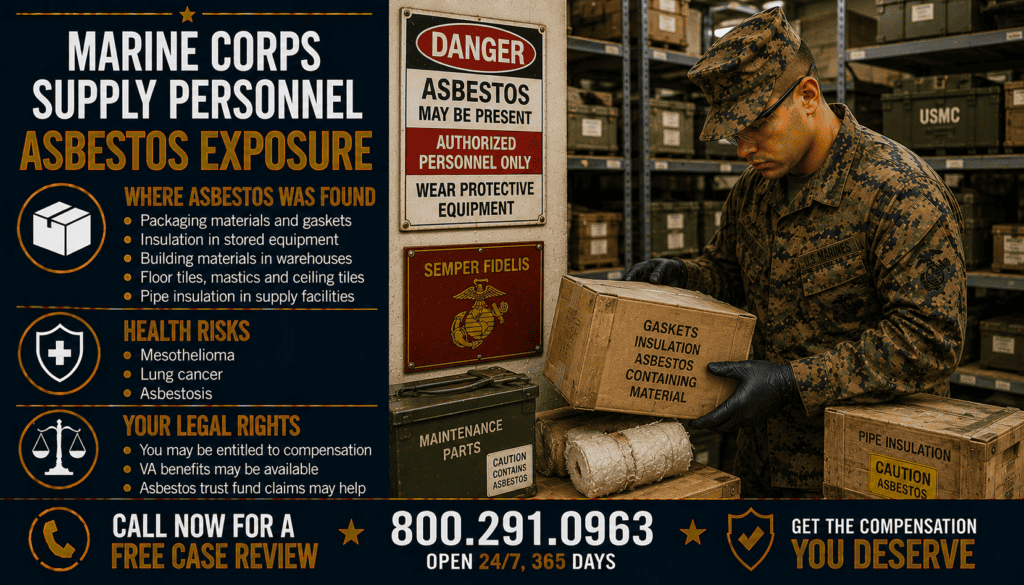
Marine Corps Supply Personnel Asbestos Exposure
Exposure, Evidence and Claims
Marine Corps supply personnel worked in logistics environments that differed greatly from vehicle and equipment repair shops. This article examines historical inventory, packaging and supply duties that may be relevant to asbestos exposure, while distinguishing material handling from exposure assumptions.
The focus is on product identification, work records and realistic dust pathways—not a claim that every supply Marine handled asbestos. Families investigating mesothelioma can use the evidence framework to organize dates, unit assignments and materials.
Supply and Inventory Work
Supply Duties in Historical Marine Units
Supply Marines supported units by ordering, receiving, recording, storing and issuing material needed for vehicle maintenance, construction, aviation support and base operations. The relevant occupational question is not whether someone worked in supply generally, but what products passed through a particular storeroom and whether handling those products released dust.
A supply clerk processing paperwork had a different exposure profile from a worker opening deteriorated cartons of older friction materials or insulation. Job descriptions, shift assignments and unit-level storage practices help distinguish administrative work from direct contact with goods.
Historical inventories could include replacement gaskets, brake linings, packing materials, electrical components and insulation. Some older examples of these product categories contained asbestos, but the material composition must be established by manufacturer, model, specification and period.
Evidence question: Can the available records establish the supply billet, unit and location during the relevant service years? Record the source and identify gaps rather than assuming exposure.
For the wider service history, compare Marine Corps occupations. This distinction helps separate the individual assignment from the broader service environment. For marine corps supply personnel asbestos exposure, this connection matters specifically when evaluating supply billet, unit and location.
For a related occupational distinction, see Marine Corps bases. This distinction helps separate the individual assignment from the broader service environment. For marine corps supply personnel asbestos exposure, this connection matters specifically when evaluating supply billet, unit and location.
Stored Materials and Product Labels
Recognizing Materials in Inventory
Look for national stock numbers, historical Federal Supply Class records, manufacturer names, part numbers and issue dates. An inventory entry reading “gasket” or “brake assembly” does not prove asbestos content, although it may identify a part worth researching.
Insulating cloth, pipe lagging, cementitious thermal products and heat-resistant packing could arrive under different descriptions. Product specifications, dated catalogs and procurement records can sometimes establish whether a particular shipment used asbestos or a substitute.
Original packages are useful because a box can identify the manufacturer and product series. A recollection of a brand is weaker when multiple suppliers sold interchangeable parts under a shared stock number.
Evidence question: Can the available records establish the shipment date, part number and packaging during the relevant service years? Record the source and identify gaps rather than assuming exposure.
The neighboring equipment topic is Marine Corps overseas deployments. That page addresses a different work activity; the material and date still need to match this case. For marine corps supply personnel asbestos exposure, this connection matters specifically when evaluating shipment date, part number and packaging.
For broader military material context, consult Marine Corps warehouses. That page addresses a different work activity; the material and date still need to match this case. For marine corps supply personnel asbestos exposure, this connection matters specifically when evaluating shipment date, part number and packaging.
Receiving, Issue and Return Tasks
Receiving and Issuing Components
Receiving teams unloaded pallets, checked shipment contents and sometimes repacked damaged supplies. Handling sealed, intact cartons generally presents a different potential pathway from opening torn bags of dusty material or cleaning spilled loose product.
Issue counters distributed parts to mechanics, electricians and construction personnel. The supply Marine may have handled unused materials without being present when those materials were installed, ground, cut or removed.
Returned components could be soiled with oil, corrosion, brake dust or insulation residue. Investigators should establish whether returned items were cleaned or stripped in the supply area rather than assuming every returned part produced asbestos dust.
A related repair setting is discussed in Marine Corps equipment. The comparison is useful when the same facility supported several maintenance specialties. For marine corps supply personnel asbestos exposure, this connection matters specifically when evaluating receiving shift, item and issue record.
The corresponding occupational perspective appears in Marine Corps equipment manufacturers. The comparison is useful when the same facility supported several maintenance specialties. For marine corps supply personnel asbestos exposure, this connection matters specifically when evaluating receiving shift, item and issue record.
Packaging and Dust Pathways
Where Dust Might Have Been Generated
Potential disturbance scenarios include damaged bags of insulating compound, unpacking deteriorated heat-resistant goods, sweeping dusty storage areas and sorting used friction parts. None of these scenarios establishes exposure without evidence of the material and actual work.
Air movement through a warehouse could redistribute settled dust, but proximity alone is not a dose measurement. Consider frequency, duration, ventilation, cleaning methods and whether the worker handled a product directly.
Paper records may document shipment volume but not conditions at the point of use. Coworker statements about torn packaging or routine sweeping may add detail if tied to a specific unit, location and timeframe.
For installation-level context, review Marine Corps power facilities. Its equipment discussion should not be taken as evidence about every Marine Corps installation. For marine corps supply personnel asbestos exposure, this connection matters specifically when evaluating dust source, cleaning practice and time.
Another relevant equipment pathway is covered by Army Corps of Engineers asbestos exposure. Its equipment discussion should not be taken as evidence about every Marine Corps installation. For marine corps supply personnel asbestos exposure, this connection matters specifically when evaluating dust source, cleaning practice and time.
Motor Pool and Maintenance Support
Connections to Repair Shops
Supply personnel frequently interacted with motor pools, maintenance battalions and facility shops. A parts-runner delivering a replacement pump packing set could have been present briefly, while a Marine stationed in the shop might have remained during the repair.
Requisitions and maintenance work orders can be cross-checked to determine whether the same product was requested, received and installed. That connection is more informative than a general assertion that a base used asbestos.
For related repair tasks, the page on Marine Corps pump equipment explains why pump packing and flange gaskets require product-specific analysis; supply exposure is a separate issue from a mechanic disturbing installed material.
To distinguish this task from nearby work, read Merchant Marine engine-room equipment. Use the related page to identify separate tasks rather than combining them into one exposure history. For marine corps supply personnel asbestos exposure, this connection matters specifically when evaluating parts delivery versus actual repair.
For a related Marine Corps work setting, see Merchant Marine electricians. Use the related page to identify separate tasks rather than combining them into one exposure history. For marine corps supply personnel asbestos exposure, this connection matters specifically when evaluating parts delivery versus actual repair.
Service Records and Witnesses
Reconstructing a Supply Assignment
Service records, military occupational specialty entries, unit rosters and duty descriptions can establish whether a Marine was assigned to a supply billet. Additional evidence is needed to establish the products handled and the working conditions.
Useful supporting documents include stock ledgers, receiving reports, requisitions, disposal paperwork, procurement specifications and base warehouse diagrams. Records may be incomplete, especially for older deployments or reorganized units.
Witnesses can describe whether a Marine opened shipments, repacked goods, swept floors or delivered parts. Ask about specific tasks rather than prompting a witness to assume asbestos exposure based on the occupation.
For procurement and product-source context, consult Merchant Marine dry docks. Supplier and product records remain necessary for any specific manufacturer attribution. For marine corps supply personnel asbestos exposure, this connection matters specifically when evaluating stock ledger, witness and product label.
A separate military-silo perspective is provided by Merchant Marine health risks. Supplier and product records remain necessary for any specific manufacturer attribution. For marine corps supply personnel asbestos exposure, this connection matters specifically when evaluating stock ledger, witness and product label.
Health History and Diagnosis
Medical Evaluation After Suspected Exposure
Mesothelioma and other asbestos-related diseases may be diagnosed decades after exposure. A former supply Marine should tell clinicians about suspected products, years of service and any later civilian occupations involving construction or maintenance.
Exposure history is not itself a diagnosis. Imaging, specialist evaluation and appropriate pathology determine whether a condition is mesothelioma or another disease; symptoms such as breathlessness can have many causes.
Clinicians may ask about smoking because it changes some lung-cancer risks, but smoking does not explain mesothelioma and should not be used to dismiss a credible asbestos history.
For a broader health discussion, see Merchant Marine asbestos trust claims. Health information is not a substitute for diagnosis or a documented occupational history. For marine corps supply personnel asbestos exposure, this connection matters specifically when evaluating medical chronology and later occupations.
For another exposure setting, review Merchant Marine mesothelioma lawsuits. Health information is not a substitute for diagnosis or a documented occupational history. For marine corps supply personnel asbestos exposure, this connection matters specifically when evaluating medical chronology and later occupations.
Claims and Compensation
Legal and VA Considerations
A mesothelioma diagnosis may prompt review of VA disability compensation, civil claims and asbestos bankruptcy trusts. Eligibility depends on service status, exposure evidence, medical documentation and the rules governing each route.
A supply assignment alone does not identify a responsible manufacturer. Product identification may require comparing a historic stock number with manufacturer catalogs and maintenance purchase records.
Civil claims and trust submissions can have different deadlines and evidence requirements. A qualified attorney can assess whether the relevant products, employers and legal jurisdictions support any particular claim.
For compensation-context comparisons, see Marine Corps asbestos exposure. Different compensation routes have distinct rules and cannot be presumed from a job title. For marine corps supply personnel asbestos exposure, this connection matters specifically when evaluating claim route, manufacturer and supporting documents.
The wider military asbestos-exposure overview is Military veterans asbestos exposure. Different compensation routes have distinct rules and cannot be presumed from a job title. For marine corps supply personnel asbestos exposure, this connection matters specifically when evaluating claim route, manufacturer and supporting documents.
❓ Frequently Asked Questions
Can supply Marines have asbestos exposure without repairing equipment?
It is possible only if the person encountered an identifiable asbestos-containing material under circumstances that could release fibers. The occupational title, building or equipment category alone is not enough; verify specific products and tasks. Marine Corps Supply Personnel Asbestos Exposure: confirm the specific record before relying on this answer.
What inventory records are most helpful?
Start with dated service or installation records, then compare the relevant technical specifications, purchase history, repair orders and firsthand witness observations. Documentation is strongest when it matches the actual time and location. Marine Corps Supply Personnel Asbestos Exposure: confirm the specific record before relying on this answer.
Does a Marine Corps assignment prove asbestos exposure?
No. An assignment establishes service context, not the composition of materials or an individual exposure. Records should connect a specific person to a product, location, task and timeframe. Marine Corps Supply Personnel Asbestos Exposure: confirm the specific record before relying on this answer.
Can exposure occur without directly handling asbestos?
Potentially, when an identifiable asbestos-containing material was disturbed nearby. Whether that happened depends on documented work activities, distance, duration and other circumstances; mere proximity is insufficient. Marine Corps Supply Personnel Asbestos Exposure: confirm the specific record before relying on this answer.
How long after exposure can mesothelioma appear?
Mesothelioma often develops decades after asbestos exposure. The timing varies, and a clinician must evaluate the individual history and medical findings. Marine Corps Supply Personnel Asbestos Exposure: confirm the specific record before relying on this answer.
Which military documents can help?
Service personnel records, unit assignments, technical manuals, work orders and installation records can establish different parts of the history. No single record necessarily proves exposure. Marine Corps Supply Personnel Asbestos Exposure: confirm the specific record before relying on this answer.
Can family members gather evidence?
Yes. Families can preserve records, dates, equipment descriptions and witness contacts. They should distinguish firsthand recollections from assumptions and avoid altering original documents. Marine Corps Supply Personnel Asbestos Exposure: confirm the specific record before relying on this answer.
Are VA benefits automatic for a mesothelioma diagnosis?
No. VA eligibility and service connection are assessed under applicable rules and require appropriate evidence. A diagnosis alone does not establish a particular service exposure. Marine Corps Supply Personnel Asbestos Exposure: confirm the specific record before relying on this answer.
📞 Get the Mesothelioma Help & Compensation You Deserve — Contact Us Today!
Our team has 25+ years of experience helping families explore mesothelioma-related options. A diagnosis or possible exposure does not guarantee eligibility, compensation or any particular outcome.
📲 Contact Us Today — Three Easy Ways!
CALL: 800.291.0963 · LIVE CHAT: 24/7/365 · CONTACT FORM: Use the form below.
Disclaimer: This information is not be considered as legal or medical advice. Mesothelioma Help Center is not a law firm or medical provider and does not determine legal or VA eligibility.