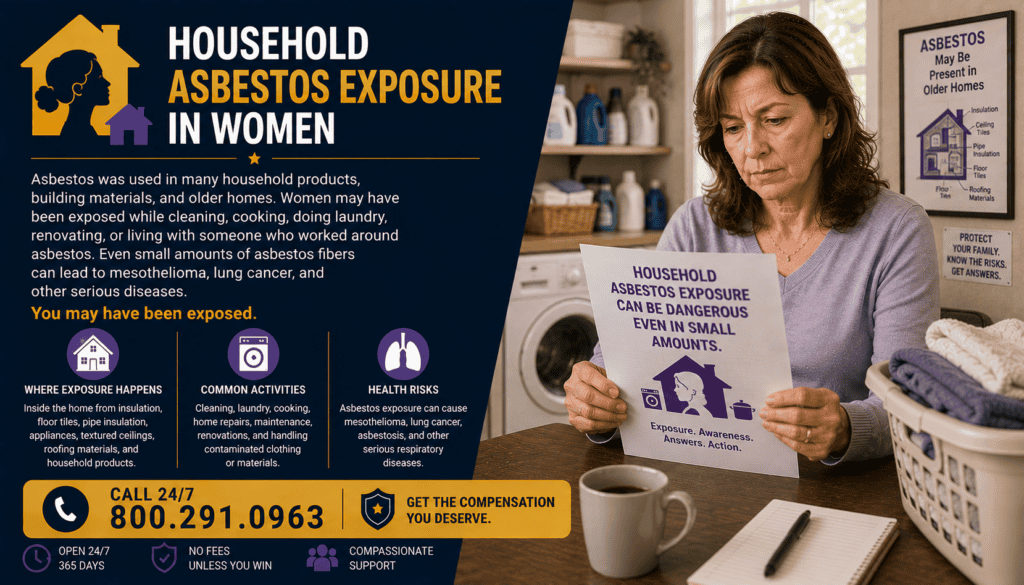
Household Asbestos Exposure in Women
Women may have encountered asbestos in the home through more than one pathway: older asbestos-containing building materials disturbed during repairs or remodeling, certain historical household products, or fibers carried home by a worker on clothing, shoes, skin or hair. Living in an older home does not itself prove exposure. The material, condition, activity, dates and household contact should be documented whenever possible.
EPA explains that asbestos-containing material in good condition and left undisturbed is unlikely to present a health risk, while damaged or disturbed material can release fibers into the air. The National Cancer Institute also recognizes household exposure through family contact with heavily exposed workers. A reliable history therefore separates building-related, product-related and take-home pathways instead of treating every household circumstance as the same type of exposure.
🏠 Household Asbestos Exposure in Women
Household asbestos exposure can involve the home itself, activities performed inside it, products historically used there, or contamination transported from a workplace. EPA states that asbestos fibers may be released when asbestos-containing material is disturbed during product use, home maintenance, repair, remodeling or demolition. NCI notes that people may also encounter asbestos at home through family contact.
Start with the Women’s Asbestos Exposure hub. Build separate timelines for every residence, renovation project, suspect material, household product and worker who may have brought occupational contamination home.
| Question | Details to document |
|---|---|
| Where? | Address, room, basement, garage or other area |
| When? | Years of residence and project or contact dates |
| What source? | Building material, household product or take-home contamination |
| What happened? | Damage, repair, sanding, cutting, removal, cleanup or laundry |
🧱 Asbestos-Containing Materials in Older Homes
EPA identifies historical household and building materials that may contain asbestos, including some vinyl floor tiles and sheet-flooring backing or adhesives, roofing and siding shingles, textured paint and patching compounds, heat-protective materials around stoves, hot-water and steam-pipe insulation, furnace insulation and door gaskets, and certain heat-resistant fabrics.
A material should not be identified as asbestos based on appearance alone. EPA says the only way to know for sure is qualified laboratory testing and recommends that sampling be performed by a properly trained and accredited asbestos professional when suspect material is damaged or will be disturbed.
| Material/area | Evidence to seek |
|---|---|
| Flooring | Product records, renovation files or professional analysis |
| Pipe/furnace insulation | Inspection, photographs, contractor or laboratory records |
| Roofing/siding | Product identification, contractor files or testing |
| Wall/ceiling materials | Renovation records, inspection or laboratory analysis |
🔨 Renovation, Repair and DIY Exposure
Renovation is important because EPA states that asbestos-containing materials may release fibers when disturbed, damaged, cut, torn, sanded, sawed, drilled or scraped. EPA’s 2024 asbestos risk evaluation also specifically considered do-it-yourself home remodelers and renovators who may disturb legacy asbestos-containing materials.
Document the exact project: which room was remodeled, what material was removed, who performed the work, whether dust was generated, how debris was cleaned, whether the family remained in the home and whether any asbestos inspection or laboratory analysis was performed.
| Question | Evidence |
|---|---|
| What project? | Floor, ceiling, wall, pipe, furnace, roof or siding work |
| Who performed it? | Household member, contractor or other worker |
| Was asbestos identified? | Professional inspection, laboratory result or product record |
| How was debris handled? | Work practices, cleanup records and witness recollections |
👕 Take-Home and Laundry Exposure
NCI reports evidence that family members of workers heavily exposed to asbestos face an increased risk of mesothelioma and explains that fibers brought home on shoes, clothing, skin and hair are the suspected pathway. This household pathway is different from exposure caused by asbestos-containing material in the home itself.
See Take-Home Asbestos Exposure in Women and Laundry-Related Asbestos Exposure in Women. Document the worker’s employer, occupation, asbestos source, work clothing practices, changing or showering routines, household laundry and the woman’s contact with those items.
📦 Household and Consumer Product Questions
Historical consumer and household products can create another research pathway. EPA’s asbestos information identifies examples such as certain heat-resistant fabrics and older home construction or repair products. Product category alone does not establish that a particular brand, model, formulation or production year contained asbestos.
Use the Women’s Consumer Products & Household Asbestos Exposure hub. Preserve packaging, labels, receipts, photographs, model numbers, product names, purchase dates and any reliable testing or manufacturer records.
🗂️ Reconstructing a Household Exposure History
Build a residence-by-residence timeline. Record addresses, occupancy dates, owners, major renovations, contractors, suspect materials, product use and household members with potentially asbestos-exposed jobs. Preserve property records, permits, invoices, photographs, inspection reports, laboratory results, employment records and witness statements.
The Mesothelioma Lawsuit Evidence & Documentation hub provides additional record-gathering guidance. Keep memories such as “the basement pipes had old insulation” separate from verified evidence establishing that the insulation actually contained asbestos.
| Evidence link | Possible documentation |
|---|---|
| Residence | Property, lease, utility or address records |
| Potential source | Product, building, worker or material records |
| Asbestos identification | Laboratory analysis, survey or reliable product evidence |
| Disturbance/contact | Project files, photographs and witness accounts |
| Medical diagnosis | Pathology, imaging and treating-clinician records |
🫁 Medical Documentation and Latency
NCI classifies asbestos as a known human carcinogen and identifies asbestos exposure as the major risk factor for mesothelioma. NCI states that asbestos exposure also causes cancers including lung, laryngeal and ovarian cancer and notes that asbestos-related conditions may not appear until 10 to 40 years or more after exposure.
Use the Women’s Asbestos Diseases hub for focused health information. Medical records establish diagnosis and treatment, while household, property, product and employment evidence addresses the possible source and pathway of exposure.
⚖️ Potential Claim Questions
A household exposure investigation may examine product manufacturers, suppliers, employers, contractors, premises owners or asbestos bankruptcy trusts depending on the documented source and applicable law. A home-renovation exposure, consumer-product exposure and take-home occupational exposure can involve different responsible parties and legal theories.
Review the Women’s Asbestos Legal Options hub and Mesothelioma Lawsuits in All 50 States. Legal duties, filing deadlines and available claim routes vary by jurisdiction and facts. Compensation is not guaranteed.
🛡️ What to Do With Suspect Material Today
EPA advises leaving asbestos-containing material alone when it is in good condition and will not be disturbed. If suspect material is damaged or a renovation will disturb it, EPA recommends evaluation and sampling by a properly trained and accredited asbestos professional. Improper sampling or removal can increase the risk of releasing fibers.
Do not dust, sweep or use a regular vacuum on debris that may contain asbestos, and do not saw, sand, scrape or drill suspect materials. EPA recommends qualified professionals for removal and major repair and states that homeowners should not take samples themselves.
❓ Frequently Asked Questions
Can women be exposed to asbestos in the home?
Potentially. Household exposure can involve disturbed asbestos-containing building materials, certain historical products or fibers brought home by an occupationally exposed worker.
Does an older home automatically contain asbestos?
No. Age may identify a reason to investigate, but specific materials should not be assumed to contain asbestos without reliable evidence.
Can I tell whether a material contains asbestos by looking at it?
No. EPA states that visual inspection alone cannot determine whether a material contains asbestos.
When is asbestos in a home most concerning?
EPA explains that risk arises when asbestos-containing material is damaged or disturbed and fibers become airborne.
Can home remodeling create asbestos exposure?
Yes, if asbestos-containing material is disturbed. EPA specifically recommends professional evaluation when suspect material will be affected by renovation.
Can a worker bring asbestos fibers into the home?
Yes. NCI identifies clothing, shoes, skin and hair as possible pathways for fibers brought home by heavily exposed workers.
What records can help document household exposure?
Property and renovation records, photographs, asbestos surveys, laboratory results, product records, employment histories and witness accounts can help reconstruct the history.
Is compensation guaranteed for household asbestos exposure?
No. Exposure evidence, responsible parties, medical documentation, deadlines and applicable law affect whether a claim is available.
📞 Submit Your Case
If you or a loved one has a mesothelioma diagnosis and a possible household asbestos history, gather former addresses, residence dates, renovation details, photographs, contractor records, product information and the employment histories of household members who may have worked around asbestos. Unknown details should remain research leads rather than guesses.
Call 800.291.0963 for a no-obligation case evaluation. Live chat is available 24/7, 365 days a year. Submit your case here.
📝 Summary
Household asbestos exposure in women can involve disturbed building materials, renovation or repair activities, historical household products or fibers carried home by an asbestos-exposed worker. EPA emphasizes that undisturbed asbestos-containing material in good condition is unlikely to pose a health risk. A reliable investigation identifies the specific source, dates, disturbance or contact pathway and supporting property, product, employment, witness and medical records.
🔗 Confirmed Sources
- U.S. EPA — Protect Your Family from Exposures to Asbestos
- U.S. EPA — Learn About Asbestos
- U.S. EPA — Asbestos and Home Remodeling
- U.S. EPA — Asbestos Health Risks in Homes and Buildings
- National Cancer Institute — Asbestos Exposure and Cancer Risk
This page provides general information, not legal or medical advice. This website is not a law firm. Exposure, eligibility, filing deadlines and compensation depend on individual facts and applicable law. No outcome is guaranteed.