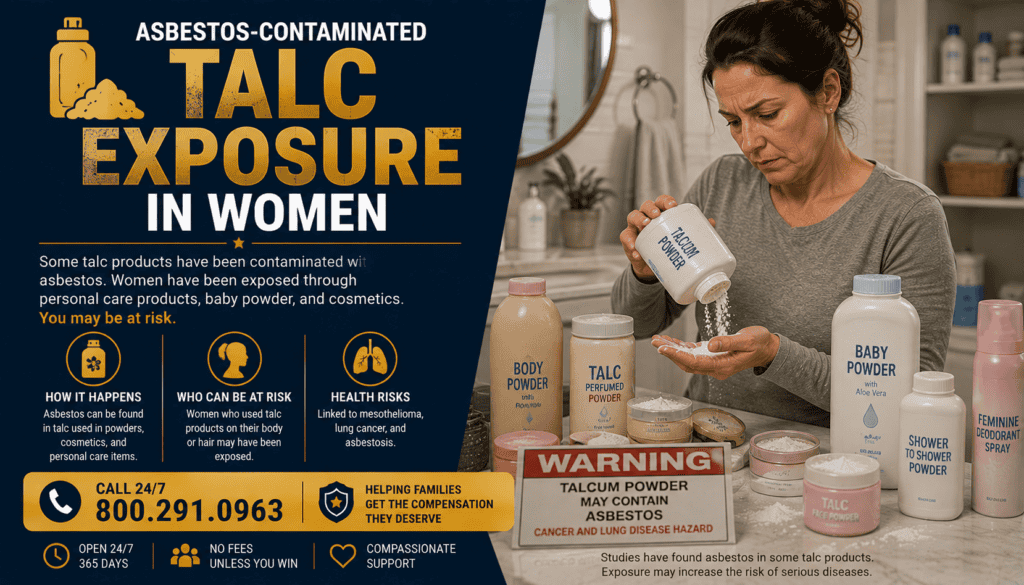
Asbestos-Contaminated Talc Exposure in Women
Women who used talc-containing powders, makeup or other personal-care products may have questions about asbestos contamination. Talc and asbestos are different naturally occurring minerals, but the U.S. Food and Drug Administration explains that they can occur near one another geologically. This creates a potential for asbestos contamination when talc ore is mined, making product-specific sourcing and testing important.
A history of talc use does not by itself prove asbestos exposure. A careful investigation should identify the product, brand, manufacturer or distributor, approximate years of use, frequency, application method and, when available, lot or batch information. FDA testing has produced different findings across survey periods, so results should be tied to the samples actually tested rather than generalized to every talc product.
🧴 Asbestos-Contaminated Talc Exposure Overview
FDA describes talc as a naturally occurring mineral used in many cosmetic and personal-care products to absorb moisture, prevent caking, improve product feel and make facial makeup opaque. The agency also identifies asbestos as a potential contaminant of talc. The relevant question for an individual exposure history is therefore whether reliable evidence connects the talc-containing product actually used with asbestos contamination.
Start with the Women’s Consumer Products & Household Asbestos Exposure hub. List powders, cosmetics and other talc-containing products remembered over time. Record confirmed product information separately from uncertain memories that require additional research.
| Question | Details to document |
|---|---|
| Which product? | Brand, product name, package and manufacturer |
| When used? | Approximate first/last year and frequency |
| Did it contain talc? | Ingredient label or historical formulation evidence |
| Was asbestos documented? | Testing, FDA record, recall or reliable laboratory evidence |
⛏️ Why Talc Can Be Contaminated With Asbestos
FDA explains that talc and asbestos are naturally occurring silicate minerals with different crystal structures, but they may occur in close proximity in the earth. Because asbestos is a known carcinogen when inhaled, FDA emphasizes careful selection of talc mining sites and sufficient testing of talc ore to help prevent contamination.
This distinction matters: talc should not be described as asbestos. A product that contains talc should not automatically be described as asbestos-contaminated. Evidence should address the source and testing of the relevant talc or finished product.
📦 Talc-Containing Products to Investigate
FDA states that talc is used in many cosmetic products, including products ranging from baby powder to blush. It may also be present in other personal-care formulations. For an exposure investigation, the ingredient list is a starting point—not proof of contamination.
For cosmetic-specific histories, see Makeup and Cosmetic Asbestos Exposure in Women. For broader consumer-product histories, review Household Product Asbestos Exposure in Women.
| Detail | Why it matters |
|---|---|
| Brand/product | Identifies the relevant product line |
| Ingredient list | May document talc in the formulation |
| Lot/batch | Can help compare the item with testing records |
| Use dates | Helps match historical formulation and survey periods |
🔬 FDA Talc Testing and Historical Findings
FDA has conducted multiple sampling assignments of talc-containing cosmetics. In its 2019 sampling assignment, FDA reported 43 samples negative and 9 positive for asbestos. In contrast, FDA reported that asbestos was not detected in any of the 50 samples tested in 2021, any of the 50 samples tested in 2022, or any of the 50 samples tested in 2023.
These results demonstrate why product-specific interpretation matters. A positive finding documents the tested sample; a negative survey does not prove that all talc products were asbestos-free. FDA’s earlier 2009–2010 survey likewise found no asbestos in the tested samples but expressly noted limitations that prevented generalizing the findings to most or all talc products marketed at the time.
FDA proposed standardized testing requirements for talc-containing cosmetics in December 2024, but withdrew that proposed rule in November 2025 after receiving comments warranting further consideration and assessment. The withdrawn proposal should not be described as a current final testing requirement.
| Survey/status | FDA-reported result |
|---|---|
| 2019 sampling | 43 samples negative; 9 positive |
| 2021 sampling | No asbestos detected in 50 tested samples |
| 2022 sampling | No asbestos detected in 50 tested samples |
| 2023 sampling | No asbestos detected in 50 tested samples |
| 2024 proposed testing rule | Withdrawn by FDA in November 2025 |
🌫️ Reconstructing a Talc Exposure History
Reconstruct long-term use by life stage and product. Record how frequently a powder or cosmetic was used, how it was applied, whether visible airborne powder was generated and whether the same brand or formulation was used consistently. These details describe potential contact; they do not establish asbestos contamination without supporting product evidence.
Old photographs, purchase histories, containers, family recollections and advertisements may help identify products that are no longer sold. Avoid converting a general memory such as “I used talcum powder” into a specific brand or product unless the evidence supports that identification.
🔎 Product, Brand, Lot and Manufacturer Evidence
FDA’s published talc-testing tables can include distributor or manufacturer, brand, product name, batch or lot number, FDA sample identification and analytical findings. These details can help determine whether a remembered product resembles one that was actually tested, but even matching brand names may not establish that a different lot or year had the same result.
If an old container remains, preserve its label, ingredients, lot number and packaging. Do not intentionally create airborne powder to investigate exposure. Qualified professionals can advise on appropriate laboratory analysis, sample handling and chain of custody when testing is relevant.
🗂️ Records and Evidence to Preserve
Strong evidence may include original containers, photographs, receipts, historical ingredient information, manufacturer records, FDA testing tables, recall information and qualified laboratory reports. Preserve complete records with dates and sample identifiers rather than relying on isolated headlines or summaries.
The Mesothelioma Lawsuit Evidence & Documentation hub provides additional guidance. Keep product identification, exposure history and medical documentation organized as separate evidence categories.
| Evidence | Potential purpose |
|---|---|
| Container/label | Brand, ingredients, maker and lot information |
| Receipt/photo | May corroborate purchase or use period |
| FDA testing record | Documents findings for a specific tested sample |
| Laboratory report | Documents analytical findings for the sample tested |
| Witness account | May corroborate repeated product use |
🫁 Medical Documentation and Asbestos Exposure
The National Cancer Institute classifies asbestos as a known human carcinogen and states that asbestos exposure causes mesothelioma and cancers including lung, laryngeal and ovarian cancer. The medical question of asbestos-related disease is separate from the product question of whether a particular talc product was contaminated.
Use the Women’s Asbestos Diseases hub for focused health information. Preserve pathology, imaging and treating-clinician records separately from the talc-product timeline. A diagnosis alone does not identify a particular talc product as the exposure source.
⚖️ Potential Talc-Related Claim Questions
A talc-related asbestos claim investigation may examine whether evidence connects a specific product, manufacturer, distributor or talc source with asbestos contamination and with the individual’s use. Product identity, relevant dates, testing evidence, frequency of use, medical documentation and applicable law can all matter.
Review the Women’s Asbestos Legal Options hub. FDA’s finding that asbestos contamination of talc is possible does not establish contamination, liability or compensation in every individual case.
❓ Frequently Asked Questions
Is talc the same mineral as asbestos?
No. FDA describes talc and asbestos as different naturally occurring minerals.
Why can asbestos occur in talc?
FDA explains that talc and asbestos may occur near one another geologically, creating a potential for contamination.
Does using talcum powder prove asbestos exposure?
No. Evidence is needed to establish asbestos contamination of a relevant product or sample.
Has FDA found asbestos in talc-containing cosmetics?
Yes. FDA’s 2019 sampling assignment reported 9 positive samples and 43 negative samples.
What did FDA find in its more recent 2021–2023 surveys?
FDA reported no asbestos detected in any of the 50 samples tested in each of those three survey years.
Do negative FDA surveys prove all talc products were asbestos-free?
No. Survey results apply to the samples tested and should not be generalized to every product, lot or historical formulation.
Did FDA finalize its proposed standardized talc-testing rule?
No. FDA withdrew the December 2024 proposed rule in November 2025 for further consideration and assessment.
Is compensation guaranteed in an asbestos-contaminated talc claim?
No. Product identification, contamination evidence, individual exposure, medical evidence and applicable law affect whether a claim is available.
📞 Submit Your Case
If you or a loved one has a mesothelioma diagnosis and a history of using talc-containing products, gather product names, brands, approximate years, photographs, containers, ingredient labels, lot numbers and purchase records when available. Unknown details should remain research leads rather than guesses.
Call 800.291.0963 for a no-obligation case evaluation. Live chat is available 24/7, 365 days a year. Submit your case here.
📝 Summary
FDA recognizes the potential for asbestos contamination of talc because the minerals can occur near one another geologically, but talc use alone does not prove asbestos exposure. A reliable investigation identifies the exact product and use period, compares it with relevant testing or documentary evidence, and keeps product-source evidence separate from medical diagnosis.
🔗 Confirmed Sources
- U.S. FDA — Talc
- U.S. FDA — 2019 Talc-Containing Cosmetic Sampling Results
- U.S. FDA — 2022 Talc-Containing Cosmetic Testing
- U.S. FDA — 2023 Talc-Containing Cosmetic Testing
- National Cancer Institute — Asbestos Exposure and Cancer Risk
This page provides general information, not legal or medical advice. This website is not a law firm. Product identification, exposure, eligibility, filing deadlines and compensation depend on individual facts and applicable law. No outcome is guaranteed.