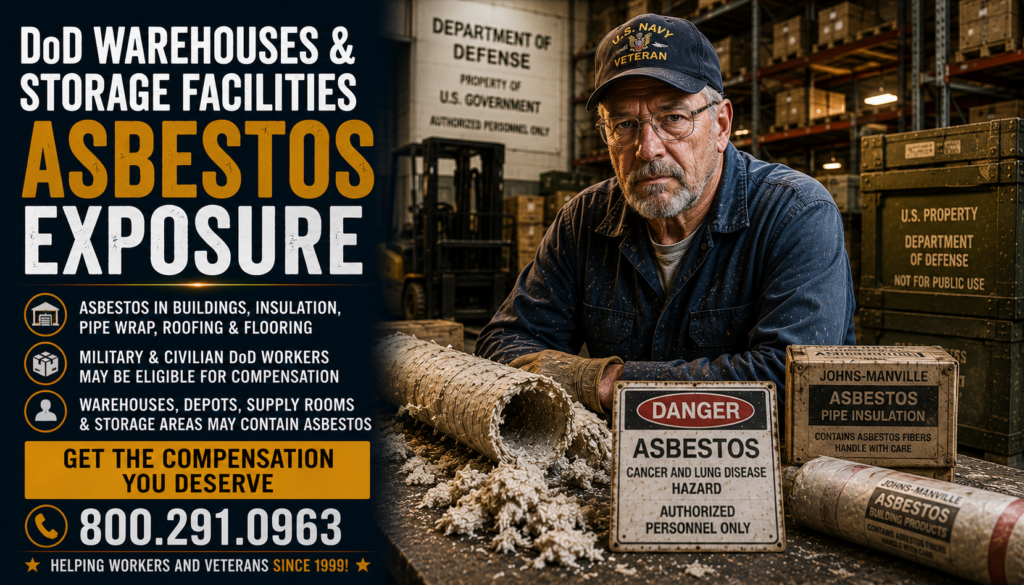
🛡️ DoD Warehouses & Storage Facilities Asbestos Exposure
DoD Warehouses & Storage Facilities Asbestos Exposure concerns historical exposure circumstances involving military warehousing, storage buildings, and material distribution. The Department of Defense (DoD) operated facilities and equipment that, depending on construction date and product specifications, sometimes contained asbestos. Actual exposure depends on the work performed, the materials present, and whether those materials were disturbed.
For veterans, civilian employees, and families facing mesothelioma or asbestos-related lung cancer, the practical starting point is a specific duty history. This article identifies relevant work areas, possible materials, records, and options for seeking qualified medical and legal guidance.
📑 On This Page
- 📍 Understanding the Exposure Setting
- 🏗️ Where Exposure May Have Occurred
- 👷 Workers, Duties & Exposure Pathways
- ⚙️ Materials & Equipment
- 📁 Records & Evidence
- 🩺 Mesothelioma & Asbestos-Related Lung Cancer
- ⚖️ Compensation, Trust Funds & VA Benefits
- ❓ Frequently Asked Questions
- 📚 Summary & Confirmed Sources
📍 Understanding the Exposure Setting
DoD activities involving military warehousing, storage buildings, and material distribution were not uniform across installations or decades. Some locations used asbestos-containing insulation, fireproofing, flooring, or mechanical components because the products resisted heat, wear, or fire. The presence of a military facility alone does not establish that a particular worker encountered asbestos.
Exposure risk becomes more specific when a person handled older roofing and siding, floor tiles, insulated pipes, fireproofing, and stored replacement parts, worked beside a crew disturbing them, or cleaned contaminated dust. Installation dates, equipment models, product brands, renovation records, and personal assignments help distinguish a plausible pathway from a documented one.
Older defense properties underwent construction, repair, demolition, and modernization over many years. A product installed in one era may have remained in place long after new uses of asbestos declined. Conversely, a later assignment in a remodeled building may not have involved asbestos at all.
Important questions include where the person worked, who supervised the task, which equipment was opened, whether dust was visible, and whether workers used dry sweeping or compressed air. Co-workers and maintenance logs can sometimes clarify these details decades later.
🏗️ Where Exposure May Have Occurred
Potential exposure areas associated with supply depots, stockrooms, storage hangars, loading docks, and maintenance spaces should be assessed individually. A facility name is not proof of asbestos exposure; work orders, material surveys, and the date of the task provide essential context.
| Work Area | Why Exposure May Have Occurred |
|---|---|
| Storage aisles and stockrooms | Aging building materials could be disturbed during repairs or alterations. |
| Loading docks | Renovation of siding, ceilings, and mechanical systems could release debris. |
| Utility and boiler spaces | Insulated pipes and heating equipment required maintenance. |
| Stored equipment sections | Older replacement gaskets or friction parts could be unpacked. |
| Roofing and mezzanine areas | Construction work could disturb historical asbestos-containing materials. |
At storage aisles and stockrooms, the relevant issue is not simply being present. Aging building materials could be disturbed during repairs or alterations. A useful account identifies the exact repair, the affected material, the approximate date, and whether the worker personally handled debris or remained nearby during removal.
At loading docks, the relevant issue is not simply being present. Renovation of siding, ceilings, and mechanical systems could release debris. A useful account identifies the exact repair, the affected material, the approximate date, and whether the worker personally handled debris or remained nearby during removal.
At utility and boiler spaces, the relevant issue is not simply being present. Insulated pipes and heating equipment required maintenance. A useful account identifies the exact repair, the affected material, the approximate date, and whether the worker personally handled debris or remained nearby during removal.
👷 Workers, Duties & Exposure Pathways
Jobs that may warrant a closer review include warehouse workers, logistics specialists, forklift operators, custodians, and building maintenance teams. These assignments varied by installation and period. Occupational titles help locate service and employment records, but they cannot substitute for evidence of a specific material or work process.
Direct handling can involve removing old insulation, scraping gasket residue, cutting replacement material, repairing damaged panels, or servicing older friction components. The likelihood and intensity of airborne fibers depend on material type, condition, technique, ventilation, and protective controls.
Bystander exposure is another consideration. Personnel stationed near supply depots, stockrooms, storage hangars, loading docks, and maintenance spaces may have worked while other crews performed maintenance or demolition. Shared rooms, ventilation pathways, and cleanup practices can matter when reconstructing the sequence of events.
Civilian employees and contractors often worked alongside active-duty personnel. Their employer records, union histories, contracts, payroll records, and work orders may identify the precise project more clearly than a broad military occupational description.
Service members may have transferred between bases, vessels, depots, or units. A timeline should list each posting separately rather than assuming the same materials or conditions existed throughout a military career.
Exposure could also occur during temporary duty, emergency repairs, inspections, equipment turnover, or renovation work. A short assignment may be relevant if it involved significant disturbance of an asbestos-containing product.
⚙️ Materials & Equipment
Products historically relevant to this topic include older roofing and siding, floor tiles, insulated pipes, fireproofing, and stored replacement parts. Not every product in these categories contained asbestos, and some modern versions are asbestos-free. Product identification should be supported by purchase records, labels, technical manuals, or reliable historical specifications.
Thermal insulation was historically used on certain steam lines, boilers, turbines, and other hot equipment. Cutting or removing deteriorated insulation can release fibers if the material contains asbestos. Encapsulated, intact material presents a different exposure scenario from damaged material undergoing removal.
Gaskets and packing were used in some high-temperature valves, pumps, engines, and machinery. Disturbance could occur during scraping, grinding, replacement, or cleaning. A product name and approximate manufacturing period help determine whether an asbestos-containing formulation was involved.
Some historical brake and clutch products used asbestos as a friction ingredient. Their relevance depends on the particular equipment and task. A mechanic servicing a modern non-asbestos component should not automatically be treated as having the same exposure as someone handling older asbestos-containing friction material.
Building products could include certain floor tiles, adhesives, ceiling materials, fireproofing, roofing, and siding. Exposure questions usually focus on disturbance during renovation or demolition rather than the mere presence of intact installed materials.
Safety procedures, respiratory protection, ventilation, wet methods, and regulated abatement practices have changed over time. Current workplace requirements should not be projected backward onto earlier decades without supporting evidence.
📁 Records & Evidence
Records are most useful when they connect a named person, a location, a time period, and a particular task or product. Even partial records can support a credible chronology when cross-checked with personnel assignments and co-worker recollections.
| Record or Evidence | What It May Establish |
|---|---|
| DD Form 214, service history, or personnel file | Service dates, units, occupational specialty, and duty stations. |
| Civilian employment and payroll records | Employer, position, project period, and location. |
| Maintenance logs and work orders | Equipment serviced, repair methods, and relevant dates. |
| Technical manuals and procurement records | Part numbers, historical materials, and product suppliers. |
| Facility surveys and abatement reports | Documented asbestos-containing building materials in specific areas. |
| Witness statements and photographs | Work practices, proximity, locations, and equipment identity. |
A practical chronology starts with the earliest known assignment and moves forward by month or year. Include the installation, unit or employer, building or vessel, tasks, supervisors, and the names of people who may remember the work.
Medical records establish diagnosis and treatment history, not the exact source of exposure. Pathology reports, imaging, physician notes, and occupational history should be preserved separately from employment evidence.
A missing purchase record does not automatically defeat an exposure account, but it does increase the importance of corroboration. Avoid assuming a product contained asbestos solely because another model or another facility used a similar product.
Family members may be able to help assemble old photographs, letters, service records, and work histories. Keep copies of original documents and note how each record was obtained.
🩺 Mesothelioma & Asbestos-Related Lung Cancer
Mesothelioma is a cancer associated with asbestos exposure and commonly affects the lining of the lungs, although other sites are possible. It often appears many years after exposure. Diagnosis requires medical evaluation and usually tissue-based testing.
Asbestos exposure can also contribute to lung cancer risk. Smoking is an important independent cause of lung cancer and can interact with asbestos exposure to increase risk. A medical professional should assess all relevant risk factors rather than assuming a diagnosis has a single cause.
Symptoms such as persistent cough, breathlessness, chest discomfort, unexplained weight loss, or fluid around the lung warrant prompt medical attention. These symptoms are not specific to asbestos-related disease and should not be used to self-diagnose.
A diagnosis does not, by itself, establish where asbestos exposure occurred or who may be legally responsible. Medical evidence and a supported occupational history answer different questions, and both may be important in a benefits or compensation review.
⚖️ Compensation, Trust Funds & VA Benefits
Veterans may be eligible to apply for VA disability compensation when a service-connected condition is established under applicable rules. The VA evaluates medical evidence, service history, and the claimed connection; military service or a particular rank does not automatically prove asbestos exposure.
Civilian employees and contractors may have different potential remedies depending on employer, worksite, state law, and the identity of any responsible product manufacturer. Federal employment and contractor cases can involve distinct procedural rules.
Asbestos bankruptcy trusts were established by certain companies through bankruptcy proceedings. They are not a single Department of Defense trust fund. Eligibility depends on each trust’s criteria, supporting exposure evidence, and applicable deadlines.
Personal injury or wrongful death claims may also be available in some circumstances. Filing deadlines vary, so a qualified attorney should review the relevant jurisdiction and dates. VA benefits and civil compensation involve different systems and should not be conflated.
Gathering evidence early can help preserve witness names, product details, and worksite information. Do not delay medical care while exploring legal options, and avoid promises about eligibility, awards, or outcomes.
Related DoD exposure topics are listed below. These links are intended to help readers follow a specific duty, equipment, or facility connection rather than jump through unrelated pages.
- DoD Aircraft Hangars Asbestos Exposure
- DoD Aircraft Maintenance Asbestos Exposure
- DoD Aviation Support Equipment Asbestos Exposure
- DoD Base Housing Barracks Asbestos Exposure
- DoD Civilian Maintenance Workers Asbestos Exposure
- DoD Construction Contractors Asbestos Exposure
- DoD Depot Level Equipment Overhaul Asbestos Exposure
- DoD Dry Dock Operations Asbestos Exposure
- DoD Emergency Repairs Demolition Asbestos Exposure
- DoD Firefighters Crash Rescue Asbestos Exposure
- DoD Heavy Equipment Motor Pools Asbestos Exposure
- DoD Naval Vessels Asbestos Exposure
- DoD Power Plants Boiler Facilities Asbestos Exposure
- DoD Asbestos Trust Fund Claims
- Commissioned Officers Asbestos Exposure O 1 O 3
- DoD Shipyards Asbestos Exposure
- DoD Training Facilities & Armories Asbestos Exposure
- DoD Vehicle Maintenance Facilities Asbestos Exposure
❓ Frequently Asked Questions
Does working for the DoD prove asbestos exposure?
No. Employment or service establishes a possible setting, but exposure requires evidence of relevant materials, duties, dates, and conditions.
Which historical materials should be checked first?
Check records for older roofing and siding, floor tiles, insulated pipes, fireproofing, and stored replacement parts, then compare product dates, specifications, and the tasks performed.
Can nearby workers have been exposed?
Possibly. Work near insulation removal, equipment repair, or dusty demolition can matter, but proximity and conditions need documentation.
What records help reconstruct a military work history?
Personnel assignments, DD Form 214, unit records, maintenance logs, technical manuals, and statements from co-workers may be useful.
Can civilian employees pursue compensation?
Depending on their circumstances, civilians may have potential claims or employment-related remedies; applicable rules differ from VA benefits.
Is there one DoD asbestos trust fund?
No. Certain bankrupt asbestos companies maintain separate trusts with their own exposure and filing requirements.
Can asbestos-related illness develop decades later?
Yes. Mesothelioma and other asbestos-related conditions may have long latency periods, making historical work records important.
What should someone do after a mesothelioma diagnosis?
Seek appropriate medical care, preserve diagnostic and service records, and consider qualified VA or legal guidance about eligibility and deadlines.
📚 Summary & Confirmed Sources
DoD Warehouses & Storage Facilities Asbestos Exposure should be evaluated through individual work histories rather than assumptions about military service. Useful evidence connects supply depots, stockrooms, storage hangars, loading docks, and maintenance spaces with specific materials, tasks, and time periods. The linked DoD articles provide additional context on related facilities and occupations.
Confirmed Sources & Further Reading
U.S. Department of Veterans Affairs — Asbestos Exposure
National Cancer Institute — Asbestos Exposure and Cancer Risk
Find Out If You May Qualify for Asbestos Compensation Today
Call 800.291.0963 — help is available 24/7/365. 25+ years of experience.
Disclaimer: Mesothelioma Help Center is not a law firm or medical provider and does not determine legal or VA eligibility. This page provides general information and is not legal or medical advice.