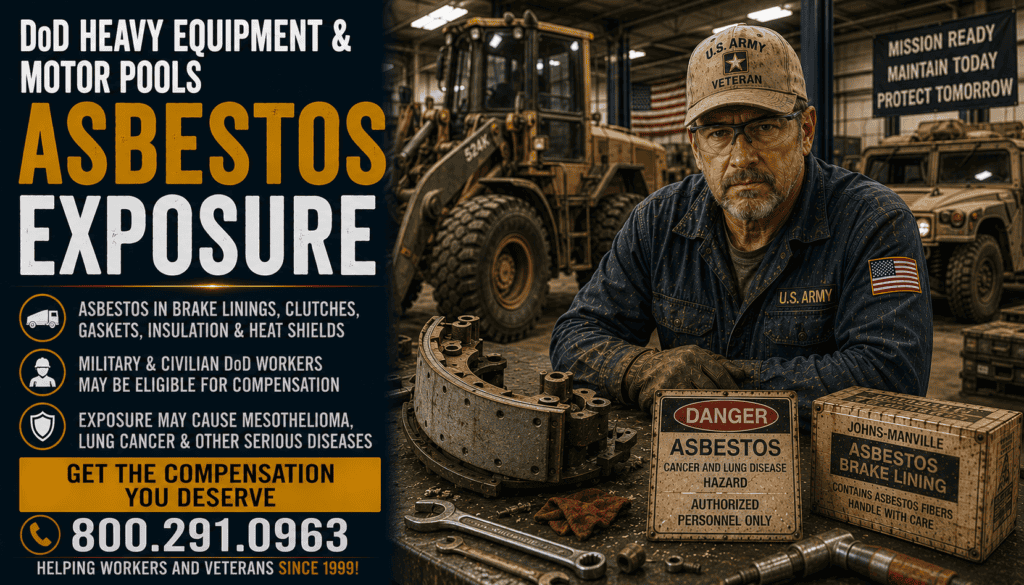
🛡️ DoD Heavy Equipment & Motor Pools Asbestos Exposure
DoD Heavy Equipment & Motor Pools Asbestos Exposure examines how vehicle maintenance, motor-pool operations, heavy equipment overhaul, and field repair may have brought military personnel and civilian employees near asbestos-containing products in older defense facilities and equipment. The most useful information identifies actual duties, dates, locations, and materials rather than relying on a broad job title.
People diagnosed with mesothelioma or asbestos-related lung cancer may need to reconstruct work performed decades earlier. This article explains possible exposure pathways, supporting records, and benefit or compensation options without assuming that any specific assignment caused disease.
📑 On This Page
- 📍 Understanding the Exposure Setting
- 🏗️ Where Exposure May Have Occurred
- 👷 Workers, Duties & Exposure Pathways
- ⚙️ Asbestos-Containing Materials & Equipment
- 📁 Records & Evidence
- 🩺 Mesothelioma & Asbestos-Related Lung Cancer
- ⚖️ Compensation, Trust Funds & VA Benefits
- ❓ Frequently Asked Questions
- 📚 Summary & Confirmed Sources
📍 Understanding the Exposure Setting
In Department of Defense environments, vehicle maintenance, motor-pool operations, heavy equipment overhaul, and field repair sometimes involved older structures or equipment that had been built when asbestos was used for fire resistance, insulation, and friction performance. The presence of asbestos in a particular product must be checked against the relevant period and manufacturer. Neither a military assignment nor employment at a defense facility, by itself, proves exposure.
A reliable account separates confirmed historical asbestos use from an individual’s possible contact. Materials varied across buildings, vessels, vehicle models, manufacturers, and years. This page provides a framework for documenting circumstances; it does not establish that any particular worker was exposed. Documentation may include orders, facility records, equipment specifications, photographs, witness accounts, and medical histories. A timeline is especially important when a person served at multiple installations or held different occupations.
Related DoD work settings help place an assignment in context. DoD Civilian Maintenance Workers describes facility and equipment work by civilian personnel, while DoD Construction Contractors addresses renovation and contractor activities. Military Bases provides broader installation context. These connections are intended to help readers follow the specific work involved rather than assume every installation had identical conditions.
How Historical Exposure Could Occur
Asbestos exposure generally involves breathing airborne fibers released from disturbed asbestos-containing material. For vehicle maintenance, motor-pool operations, heavy equipment overhaul, and field repair, disturbance could occur during removal, cutting, scraping, drilling, replacement, or cleanup. Working nearby can matter when dust migrates through shared rooms, ventilation, corridors, or repair bays. The intensity and duration of contact depend on the task and controls used.
A careful account should distinguish routine operation from unusual events such as major overhauls, equipment failures, emergencies, or building renovation. It should also distinguish direct handling from bystander exposure. An incident that created visible dust is worth documenting, but dust alone does not identify asbestos without supporting evidence.
🏗️ Where Exposure May Have Occurred
The following work areas are examples for historical record review, not a claim that asbestos was present at every site or in every year. Exact building numbers, vessel identities, equipment models, and renovation dates can substantially improve an exposure history.
| Work Area | Why Records May Matter |
|---|---|
| Motor-pool repair bays | Work in motor-pool repair bays may have involved repair, removal, cleaning, or maintenance of older components; records can identify products, dates, and personnel. |
| Brake and clutch service areas | Work in brake and clutch service areas may have involved repair, removal, cleaning, or maintenance of older components; records can identify products, dates, and personnel. |
| Vehicle storage and dispatch facilities | Work in vehicle storage and dispatch facilities may have involved repair, removal, cleaning, or maintenance of older components; records can identify products, dates, and personnel. |
| Field maintenance tents | Work in field maintenance tents may have involved repair, removal, cleaning, or maintenance of older components; records can identify products, dates, and personnel. |
| Depot repair workshops | Work in depot repair workshops may have involved repair, removal, cleaning, or maintenance of older components; records can identify products, dates, and personnel. |
| Parts cleaning and component rebuilding areas | Work in parts cleaning and component rebuilding areas may have involved repair, removal, cleaning, or maintenance of older components; records can identify products, dates, and personnel. |
For related environments, compare DoD Base Housing & Barracks and DoD Aircraft Hangars. Where tasks involved machinery refurbishment, DoD Depot-Level Equipment Overhaul may offer another relevant path. These links should be used selectively based on the person’s actual assignment and not treated as evidence of exposure on their own.
Worksite Conditions and Shared Spaces
A person may have worked in a facility during a period of repairs rather than directly on the materials being removed. Shift overlap, ventilation patterns, barriers, housekeeping, and cleanup methods can affect the plausibility of contact. Older work records may describe projects but omit every person who passed through a space, making coworker statements and schedules useful supplements.
👷 Workers, Duties & Exposure Pathways
People whose duties may warrant review include vehicle mechanics, heavy equipment operators, motor-pool supervisors, parts handlers, and nearby workers. Their circumstances can differ greatly even at the same installation. A supervisor might have entered a work area periodically, while a mechanic or laborer could have handled parts throughout a shift. Documenting actual work is more useful than assuming an entire occupational category shared one exposure level.
Direct Handling, Nearby Work, and Cleanup
Workplace records can help separate these possibilities. Military Occupations provides a starting point for comparing duties, while DoD Emergency Repairs & Demolition describes a different situation in which damaged building materials may have been disturbed quickly. Neither occupational labels nor proximity alone establishes asbestos contact.
Veterans, Civilian Employees, and Contractors
Defense installations frequently brought together uniformed personnel, federal civilian employees, and outside contractors. They may have worked on the same machinery or in adjacent rooms while belonging to different employers. Because eligibility for VA benefits, civil claims, workers’ compensation, or trust funds may differ, records should identify both the employer and the work performed.
⚙️ Asbestos-Containing Materials & Equipment
Historically, some historical brake linings, clutch components, gaskets, heat shields, and insulation contained asbestos. Other possible materials in defense environments included thermal insulation, certain cement products, fireproofing, floor tiles, boiler components, and specialized seals. Composition depended on the product, maker, and date; the mere presence of an old component does not confirm asbestos.
Heat Resistance, Friction, and Building Products
Equipment and product context can be explored through Military Products. If the assignment involved vehicles or ground machinery, DoD Heavy Equipment & Motor Pools is relevant. For heating systems, DoD Power Plants & Boiler Facilities provides a more focused discussion of boilers and steam distribution.
Why Product Identification Matters
Different replacement parts could be installed in the same model over its service life. Maintenance dates, technical manuals, purchase orders, supplier invoices, photographs, and witness descriptions may help establish which product was used. A product identified at another installation should not be assumed to have been used at the site in question.
📁 Records & Evidence
A useful chronology should record dates, location, unit or employer, job duties, materials, specific projects, witnesses, and the timing of any medical diagnosis. Records from different sources may contain gaps or conflicting dates; noting those uncertainties is better than filling them with assumptions.
| Record or Evidence | What It May Help Establish |
|---|---|
| Vehicle maintenance logs | Can help identify the timing, location, personnel, equipment, or scope of work connected with vehicle maintenance logs. |
| Motor-pool duty assignments | Can help identify the timing, location, personnel, equipment, or scope of work connected with motor-pool duty assignments. |
| Equipment model and parts records | Can help identify the timing, location, personnel, equipment, or scope of work connected with equipment model and parts records. |
| Brake and clutch service orders | Can help identify the timing, location, personnel, equipment, or scope of work connected with brake and clutch service orders. |
| Depot repair histories | Can help identify the timing, location, personnel, equipment, or scope of work connected with depot repair histories. |
| Unit equipment inventories | Can help identify the timing, location, personnel, equipment, or scope of work connected with unit equipment inventories. |
Building an Exposure Timeline
Start with the earliest known assignment and work forward, separating routine duties from unusual repair projects. Identify each location precisely when possible, including building numbers, ship names, equipment identifiers, or unit designations. Then list which documents support each entry and which details remain based on recollection.
Medical records should be kept separately from exposure records, although both are needed in many claims. Pathology reports, imaging, specialist notes, and a documented diagnosis can establish the medical component; they do not by themselves identify which product or worksite caused exposure.
🩺 Mesothelioma & Asbestos-Related Lung Cancer
Mesothelioma
Mesothelioma is a cancer strongly associated with asbestos exposure and most often affects the lining of the lungs. It can develop decades after exposure. Symptoms such as breathlessness, chest discomfort, or persistent cough are not specific to mesothelioma, so diagnosis requires medical evaluation, imaging, and often tissue examination.
An exposure history can assist clinicians, but a person should not wait to assemble every historical document before seeking medical care. Treatment and prognosis depend on the type, stage, overall health, and clinical assessment. This article cannot determine whether a particular individual has mesothelioma or the cause of a diagnosis.
Asbestos-Related Lung Cancer
Asbestos exposure can increase lung cancer risk, and smoking combined with asbestos exposure raises risk further. Not every lung cancer is asbestos-related. A clinician evaluates pathology, imaging, smoking and occupational histories, and other risk factors. For a compensation review, medical evidence and a credible exposure account may both be important.
Long Latency and Documentation
Because asbestos-related illnesses can appear many years after exposure, older coworkers and records may be difficult to locate. Preserving available employment records, service documents, photographs, and product details promptly can help reconstruct the history. Families may assist when a former worker is unable to provide every detail.
⚖️ Compensation, Trust Funds & VA Benefits
Potential options can include asbestos bankruptcy trust claims, certain civil claims, employment-related remedies, and VA benefits for qualifying veterans. These processes have different evidence requirements, eligibility rules, and filing deadlines. A diagnosis or DoD assignment does not automatically establish entitlement to any particular payment.
Asbestos Bankruptcy Trust Funds
Certain companies established asbestos trusts through bankruptcy proceedings. Trust claims generally require a qualifying diagnosis and evidence that connects exposure to products or operations covered by a particular trust. See DoD Asbestos Trust Fund Claims for related context; it does not mean that the Department of Defense itself operates a general asbestos bankruptcy trust.
VA Benefits and Civilian Claims
Veterans may seek VA disability compensation when they can establish a service connection under applicable rules. Civilian federal employees and contractors may have different legal or administrative pathways. The correct route depends on employment status, the exposure circumstances, the responsible entity, and applicable law.
Department of Defense Asbestos Exposure provides broader background, and U.S. Navy Asbestos Exposure may be relevant where the assignment involved naval operations. Claims should be evaluated individually rather than relying on generalized descriptions of military asbestos use.
Time Limits and Case Review
❓ Frequently Asked Questions
Could older military vehicle brakes contain asbestos?
Not necessarily. Historical use of asbestos is documented in some materials and settings, but the specific site, product, task, and dates must be evaluated.
Does operating heavy equipment prove exposure?
No. Material composition and the circumstances of disturbance vary, so records are needed to assess whether asbestos was present and fibers could have been released.
Why are model and service dates important?
Potentially. Nearby work or cleanup can matter when asbestos-containing material was disturbed, but proximity alone is not proof of exposure.
Could a mechanic nearby be exposed?
Duty assignments, maintenance logs, project records, equipment specifications, and coworker accounts may help identify the relevant time and place.
Which records identify motor-pool assignments?
Record what is known, preserve the uncertainty, and look for contemporaneous documents or witnesses rather than assuming a material contained asbestos.
Can replacement parts differ from original parts?
Yes, workspaces sometimes overlapped, but benefits and claims rules may differ according to employer, service status, and circumstances.
How do veterans and civilian mechanics document work?
No. A building, vehicle, or vessel age is a reason to check product records, not proof that a particular worker inhaled asbestos fibers.
What should be collected after an asbestos-related diagnosis?
Seek appropriate medical care, preserve diagnosis and work records, and consider qualified advice about benefit and claim deadlines.
📚 Summary & Confirmed Sources
DoD Heavy Equipment & Motor Pools Asbestos Exposure is best evaluated through a documented account of duties, locations, dates, and materials. Historical asbestos use in some defense facilities and products does not establish exposure for every service member or civilian worker. Relevant records can help separate what is known from what still needs verification.
For general background, consult the National Cancer Institute asbestos fact sheet, ATSDR asbestos information, and VA asbestos exposure benefits information. These sources explain health risks and VA considerations; they do not independently verify a particular worksite or assignment.
Find Out If You May Qualify for Asbestos Compensation Today
Call 800.291.0963 — help is available 24/7/365. 25+ years of experience.
Disclaimer: Mesothelioma Help Center is not a law firm or medical provider and does not determine legal or VA eligibility. This page provides general information and is not legal or medical advice.