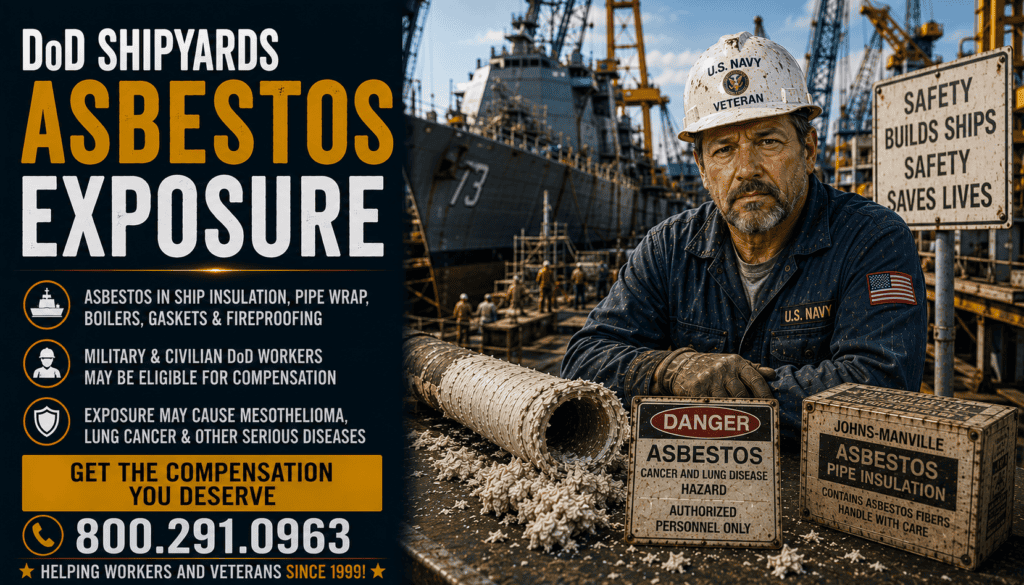
DoD Shipyards Asbestos Exposure
Department of Defense shipyards supported naval construction, repairs, and overhauls that sometimes involved asbestos-containing insulation and mechanical components. Veterans, federal workers, and private contractors may need to examine their specific assignments to understand whether their work disturbed asbestos.
Exposure circumstances varied by ship, yard, year, trade, and task. Documenting the actual vessel, materials, repair work, and coworkers provides a stronger basis for medical discussions and potential claims than a general shipyard employment history.
DoD Shipyard Exposure Overview
Department of Defense shipyard asbestos exposure involved particular ship construction, maintenance, overhaul, and repair activities at Navy-operated yards and private facilities performing military contracts. During portions of the twentieth century, ship systems used heat-resistant insulation and sealing materials that sometimes contained asbestos. A worker’s exposure depended on the vessel, facility, assignment, products, and tasks actually performed—not simply the fact that the shipyard served the Department of Defense.
Large shipyard projects placed sailors, federal civilian employees, and contractor trades in adjacent compartments. Removing damaged insulation, opening steam systems, cutting old packing, or cleaning debris could disturb asbestos-containing materials. Whether fibers reached another worker depends on the conditions of the job, proximity, ventilation, and duration. The broader Department of Defense asbestos exposure section addresses other military facilities, while Navy asbestos exposure focuses on service-specific work.
Shipyards, Dry Docks, and Vessel Overhauls
Dry docks allowed workers to inspect hulls, remove machinery, renew piping, and modernize propulsion systems. Overhauls often involved several trades entering a compartment in sequence. Pipefitters might disconnect a steam line, insulation crews might strip a covering, and mechanics might rebuild pumps or valves before equipment was returned to service. Each step should be evaluated separately for the material disturbed.
Work also occurred in machine shops, fabrication buildings, warehouses, and shoreside utility plants. An assignment to a shipyard does not establish that every building or ship contained asbestos. Useful research identifies the yard, vessel name and hull number, dates, shop, compartment, equipment, and any available work orders. See U.S. naval shipyards and Navy shipyard asbestos exposure for additional yard-specific context.
Asbestos Materials in Shipboard Systems
Historical shipbuilding materials that may have contained asbestos included thermal pipe lagging, boiler insulation, turbine insulation, gaskets, valve packing, cementitious compounds, and certain heat-resistant coverings. Composition varied across manufacturers, procurement contracts, equipment generations, and replacement parts. A description such as “white insulation” is not enough to identify asbestos without supporting evidence.
Investigators can compare dated engineering drawings, technical manuals, qualified product lists, purchasing documents, and manufacturer specifications with the actual equipment serviced. A ship undergoing modernization may have contained a mixture of original and replacement materials. Navy ships asbestos exposure provides a related view of shipboard equipment and maintenance.
Shipyard Occupations and Contractor Work
Potentially relevant occupations include insulators, pipefitters, boilermakers, machinists, electricians, welders, riggers, laborers, painters, and cleanup crews. Navy personnel may also have performed ship’s-force maintenance during overhaul. Different jobs could involve direct material handling or work nearby while another trade disturbed a documented asbestos-containing product.
For a reliable exposure history, identify a person’s trade or Navy rating, supervisor, department, worksite, tools, daily assignments, and the specific materials involved. Contractor names and employment dates may help connect a worker to an overhaul project. Related resources include military occupations, civilian contractors, and shipyard job sites.
Repairs, Removal, and Airborne Dust
Fibers can become airborne when asbestos-containing insulation or packing is cut, broken, scraped, removed, or handled as debris. Work in confined machinery spaces can make ventilation and nearby activity important to reconstruct. However, the presence of dust alone does not prove the dust contained asbestos, and exposure cannot be established from an occupation title without additional details.
Helpful evidence includes dated photographs, work permits, removal specifications, industrial hygiene measurements, abatement records, and testimony from people present. If a worker remembers opening flange connections, changing packing, or stripping lagging, record the system, component, location, and approximate dates. shipyard pipefitters and shipyard boilermakers discuss two repair trades.
Documenting DoD Shipyard Assignments
Veterans can start with discharge papers, service personnel files, Navy ratings, ship assignments, and overhaul dates. Civilian employees and contractors may use employment records, union histories, payroll documents, personnel files, and project correspondence. Combining these with ship histories and maintenance records can establish whether the person was present for a particular repair period.
For each claimed exposure event, document the vessel or facility, dates, task, material, frequency, duration, distance, ventilation, and available witnesses. Keep documented facts separate from memories that still need confirmation. shipyard electricians and shipyard machinists can help organize occupation-specific questions.
Medical Concerns and Mesothelioma
Asbestos exposure is associated with mesothelioma, lung cancer, asbestosis, and certain other asbestos-related conditions. These diseases can have long latency periods. A diagnosis requires medical evaluation; symptoms such as persistent shortness of breath, chest pain, or unexplained fluid around the lungs have multiple possible causes and should not be attributed to asbestos without clinical assessment.
Workers concerned about past shipyard exposures should share their occupational and military history with a qualified healthcare professional. Records of imaging, pathology, specialist visits, and diagnosis dates may also matter when evaluating benefits or legal options. The shipyard welders page describes another work setting where nearby repair activity can be relevant.
VA Benefits, Civil Claims, and Trust Funds
VA evaluates asbestos-related disability claims individually. Service in a Navy shipyard or at a DoD facility does not automatically establish exposure or entitlement. A claim generally needs evidence of a current condition, relevant service circumstances, and a medical connection between the condition and military exposure. Civilian workers ordinarily follow different benefits and compensation systems.
Depending on the circumstances, an eligible person may also investigate legal claims involving responsible manufacturers or asbestos bankruptcy trusts. Deadlines, proof requirements, and available defendants differ by jurisdiction and claim type. A veteran may have questions about VA benefits and private-company claims at the same time. Review shipyard boiler equipment, shipyard pump and valve equipment, and asbestos trust funds for related material and claims context.
Practical Steps for Veterans and Families
Begin with a timeline of service or employment, including shipyards, ships, units, employers, and years. Add the names of shops and compartments, work activities, equipment, materials, and coworkers. Preserve any photographs, orders, pay records, technical manuals, or correspondence. Where the material is uncertain, note that uncertainty rather than assuming it contained asbestos.
Next, request relevant service and medical records, identify the precise products and contractors where possible, and ask qualified professionals about medical and legal questions. The mesothelioma lawsuits resource and Navy and DoD environmental health reports page offer further avenues for gathering documentation.
❓ Frequently Asked Questions
Did all DoD shipyard workers encounter asbestos?
No. Exposure depends on the specific ship, yard, era, material, job, and activity. A shipyard assignment alone is insufficient to establish an individual exposure.
Which shipyard tasks could disturb asbestos?
Examples include removing documented asbestos insulation, replacing certain gaskets or packing, opening insulated steam lines, and cleaning debris from such work.
Could sailors be exposed during an overhaul?
Potentially. Some sailors worked aboard vessels or performed maintenance while shipyard repairs were underway. Their duties and proximity to the material must be examined.
Can civilian contractors pursue VA benefits?
VA disability compensation generally depends on qualifying military service. Civilian contractors may have different workers’ compensation or civil claim options.
What records are useful for a shipyard exposure history?
Ship assignments, personnel records, overhaul schedules, work orders, product specifications, contractor records, photographs, and detailed coworker statements can help.
Does an asbestos exposure history prove mesothelioma?
No. Mesothelioma requires a medical diagnosis, and exposure history is only one part of evaluating potential causation and claims.
Can veterans investigate trust fund claims?
Some veterans may qualify for asbestos trust claims involving identified products or companies, depending on each trust’s criteria and supporting evidence.
📞 Get the Mesothelioma Help & Compensation You Deserve — Contact Us Today!
If you or someone you love has been diagnosed with mesothelioma after military or civilian shipyard work, you can discuss your exposure history and questions about possible compensation.
Our team brings more than 25 years of experience helping people explore asbestos-related legal options and connect with appropriate resources.
📲 Contact Us Today — Three Easy Ways!
CALL: 800.291.0963 — Speak with our team.
LIVE CHAT: Available 24/7/365.
CONTACT FORM: Use the form below to request assistance.
Disclaimer: This information is not be considered as legal or medical advice. Mesothelioma Help Center is not a law firm or medical provider and does not determine legal or VA eligibility.