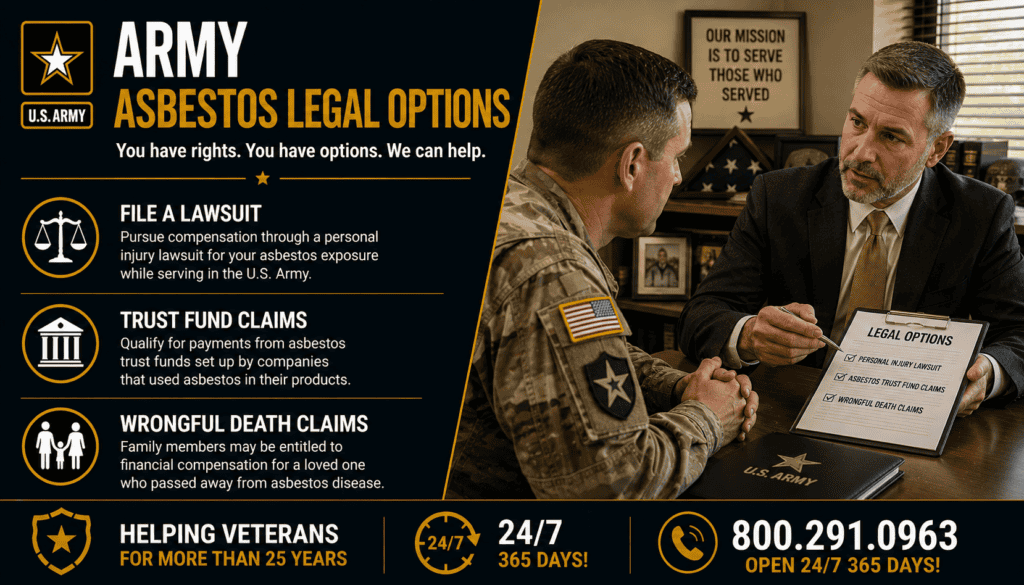
Army Asbestos Legal Options
Army veterans diagnosed with mesothelioma or another asbestos-related disease may have questions about VA disability compensation, evidence requirements, accredited representation, and possible civil legal claims. VA recognizes asbestos-related disability claims when the evidence establishes military asbestos contact, a related health condition, and the required medical connection.
This guide explains Army asbestos legal options, including VA claims, exposure documentation, VA-accredited representatives, possible civil asbestos cases, deadlines, and record preservation. VA benefits and civil claims are separate processes, so veterans and families should evaluate each path under its own rules rather than assuming that eligibility or evidence in one automatically determines the other.
Army Asbestos Legal Options Overview
Army veterans diagnosed with an asbestos-related disease may have more than one potential path for seeking benefits or compensation. One path is a VA disability compensation claim based on asbestos exposure during military service. Depending on the facts, a veteran or family may also want to ask a qualified attorney about possible civil claims involving non-government manufacturers, suppliers, contractors, premises owners, or other legally responsible parties.
These paths use different legal standards, evidence, procedures, deadlines, and decision makers. A VA claim is a federal veterans-benefits matter. A civil asbestos claim generally arises under state law and depends on jurisdiction, exposure history, product or premises identification, diagnosis, and other case-specific facts. Eligibility for one process should not be assumed to establish eligibility in another.
VA states that asbestos disability compensation generally requires a health condition caused by asbestos and military contact with asbestos. VA also requires medical records, service records identifying the veteran’s job or specialty, and medical evidence connecting military asbestos contact to the claimed condition.
This page connects legal-option research with the broader U.S. Army asbestos exposure section, Army jobs occupations asbestos exposure, and Army asbestos exposure health risks.
VA Disability Compensation Claims
VA states that veterans may be eligible for disability compensation based on asbestos exposure when two requirements are met: the veteran has a health condition caused by asbestos exposure, and the veteran had contact with asbestos while serving in the military. Compensation, when awarded, is a federal veterans benefit rather than damages awarded in a civil lawsuit.
Veterans Benefits Administration adds that the veteran generally must have been discharged under conditions other than dishonorable, must have been exposed to asbestos during military service, and must have a disease or disability related to that in-service exposure. Exposure by itself is not a condition subject to service connection.
VA identifies construction, carpentry, demolition, insulation work, flooring, roofing, cement sheet, pipe products, clutch facings, and brake linings among occupational circumstances relevant to asbestos claims. Army veterans in maintenance, engineering, electrical, construction, vehicle, and facility assignments may therefore need detailed occupational evidence.
VA allows disability claims to be filed online, by mail, in person, or with assistance from an accredited representative. Veterans should use current VA instructions because forms, online systems, and processing procedures can change.
Evidence for Army Asbestos Exposure
VA identifies three core evidence categories for an asbestos disability claim: medical records showing the health condition, service records listing the veteran’s job or specialty, and a doctor’s statement connecting military asbestos contact with the health condition. VBA also states that evidence of in-service exposure may include military occupational specialty and where the veteran was stationed.
Army exposure reconstruction can go further. Useful records may include the DD-214, Official Military Personnel File, MOS history, assignment orders, evaluation reports, unit histories, installation records, building numbers, asbestos surveys, work orders, technical manuals, maintenance logs, equipment models, National Stock Numbers, photographs, environmental reports, and coworker statements.
Occupation-specific evidence can be organized through pages covering Army mechanics asbestos exposure, Army engineers asbestos exposure, Army electricians asbestos exposure, Army maintenance workers asbestos exposure, Army firefighters asbestos exposure, and Army supply personnel asbestos exposure.
Records should identify what the veteran actually did rather than rely solely on a broad MOS or unit title. Dates, installation, building or equipment, task, material, disturbance method, proximity, frequency, duration, protective equipment, and witnesses can help distinguish a specific exposure history from a general possibility.
VA-Accredited Representation
VA recognizes three types of accredited representatives who may assist with benefit claims: Veterans Service Organization representatives, accredited attorneys, and accredited claims agents. VA states that accredited VSO representation on VA benefit claims is always free, while accredited attorneys or claims agents may charge fees in circumstances permitted by VA rules.
Veterans can use VA’s official accreditation search to verify whether a representative is currently accredited. This is important because VA accreditation governs who may prepare, present, and prosecute benefit claims on a claimant’s behalf under VA rules.
VA states that accredited representatives can help gather evidence, file a claim, communicate with VA, and request decision review. Attorneys and claims agents may also assist with legal arguments in Supplemental Claims, Higher-Level Reviews, or Board appeals, depending on the stage and representation agreement.
A veteran should review representation and fee agreements carefully. VA advises claimants to discuss fees, payment arrangements, and what happens if representation ends. Civil asbestos representation is a separate matter and should not be confused with VA accreditation or a VA power of attorney.
Possible Civil Asbestos Claims
Some veterans diagnosed with mesothelioma or another asbestos-related disease may also investigate whether exposure involved legally responsible non-government companies or premises. Depending on state law and the evidence, potential defendants could include manufacturers, suppliers, contractors, distributors, or property owners. The viability of any claim is case-specific and should be evaluated by a lawyer licensed in the relevant jurisdiction.
Civil cases typically require detailed exposure identification. Evidence may include product names, manufacturers, job sites, contractors, equipment, invoices, purchase records, technical manuals, photographs, coworkers, depositions, and historical company records. Military service records can help establish where and when a veteran worked but do not automatically establish civil liability.
Army exposure research can begin with Army bases asbestos exposure, Army equipment asbestos exposure, and Army vehicles asbestos exposure. These records can help organize possible products and locations for further investigation.
Potential civil claims may be affected by statutes of limitation, statutes of repose, choice-of-law rules, bankruptcy proceedings, prior settlements, releases, workers’ compensation rules, federal defenses, and other legal issues. Because those rules vary, this page does not state that a particular veteran has a viable lawsuit.
VA Benefits and Civil Claims
A VA disability claim and a civil asbestos case are not the same proceeding. VA determines entitlement to federal veterans benefits under veterans law. A civil court or settlement process addresses potential legal liability under applicable civil law. Evidence may overlap, but the legal questions are different.
A veteran may therefore want to maintain a single organized exposure chronology that can support discussions with health care providers, VA representatives, and—when appropriate—civil counsel. The chronology should separate military and civilian exposures and identify specific installations, jobs, buildings, equipment, products, manufacturers, and dates.
VA-accredited representation should be verified through VA. A lawyer handling a civil asbestos claim may or may not also be VA-accredited. Veterans should understand which matter a representative has agreed to handle and what fee agreement applies to each matter.
Do not assume that receipt of VA benefits determines civil liability, or that a civil recovery automatically establishes VA service connection. Questions about coordination, offsets, liens, reimbursement, settlement terms, or effect on other benefits should be directed to qualified counsel or the relevant benefit program.
Deadlines and Preserving Records
Legal deadlines can be important in both VA and civil matters, but they operate differently. VA claim effective-date rules and decision-review deadlines are governed by federal veterans law. Civil filing deadlines are generally governed by applicable jurisdictional law and can vary by diagnosis, death, discovery, defendant, location, and claim type.
Veterans and families should avoid relying on a generic internet deadline. A lawyer can determine which state’s law may apply to a possible civil claim. For VA matters, claimants should follow current VA instructions and notices, particularly after receiving a rating decision or other decision with review rights.
Preserving records early can be useful even before representation is selected. Keep original military records, medical records, pathology reports, imaging, employment records, Social Security earnings records, union records, photographs, equipment manuals, product documents, correspondence, and names of coworkers or witnesses.
Do not discard old records merely because they seem unrelated. Mesothelioma and other asbestos-related diseases can have long latency periods, and historical documents may help reconstruct exposures that occurred decades earlier. The U.S. Army ranks asbestos exposure hub can also help organize changes in duties across a military career.
Practical Next Steps
First, obtain and preserve medical documentation of the diagnosis, including pathology when available. Second, gather the veteran’s DD-214, personnel file, MOS history, assignment records, unit information, installation history, and occupational records. Third, create a chronological exposure history covering both military and civilian employment.
For a VA claim, review the official VA asbestos-exposure requirements and consider speaking with a VA-accredited VSO representative, attorney, or claims agent. Verify accreditation through VA’s official search before appointing a representative.
For a possible civil claim, consider speaking with an attorney experienced in asbestos litigation in the relevant jurisdiction. Ask which exposures and defendants are being investigated, which deadlines may apply, how costs and fees are handled, and whether the firm will coordinate with any separate VA representation.
Families should also preserve witness information. Names, phone numbers, units, shops, supervisors, coworkers, contractors, and people familiar with buildings or equipment can become harder to locate over time. A factual exposure chronology can help every professional reviewing the history work from the same underlying information.
Frequently Asked Questions
Can an Army veteran file a VA claim based on asbestos exposure?
Potentially. VA requires a health condition caused by asbestos exposure and military contact with asbestos, supported by medical and service evidence.
Is asbestos exposure alone a VA disability?
No. VBA states that exposure itself is not a condition subject to service connection; a disease or disability related to the exposure must be claimed.
What evidence does VA request for an asbestos claim?
VA identifies medical records, service records listing the veteran’s job or specialty, and medical evidence connecting military asbestos contact with the health condition.
Can a VSO help with a VA asbestos claim?
Yes. VA states that accredited VSO representatives can help gather evidence and file claims, and their VA benefit-claim services are free.
How can a veteran verify a representative?
Use VA’s official accreditation search for attorneys, claims agents, and VSO representatives.
Is a VA claim the same as an asbestos lawsuit?
No. A VA claim concerns federal veterans benefits, while a civil asbestos case addresses potential legal liability under applicable civil law.
Can military records matter in a civil asbestos investigation?
Yes. They may help establish duty locations, dates, occupations, buildings, equipment, and possible products, although they do not automatically establish liability.
Are civil asbestos deadlines the same in every state?
No. Filing deadlines and related rules vary by jurisdiction and claim type. A lawyer licensed in the relevant jurisdiction should evaluate the applicable deadline.
Should veterans keep both military and civilian exposure records?
Yes. A complete chronology can help distinguish possible exposure sources and support medical, VA, and legal evaluation.
Review Your Army Asbestos Exposure History
If you or a family member has been diagnosed with mesothelioma after Army service, gather the DD-214, personnel file, MOS history, assignment orders, unit histories, installation and building records, equipment and vehicle information, technical manuals, maintenance logs, asbestos surveys, environmental reports, photographs, witness information, pathology reports, treatment records, VA decisions, civilian employment records, and other documents relevant to possible exposure. Keep copies of all claim, representation, and fee documents.
Call 800.291.0963 for a no-obligation case evaluation. Talk to a real person 24/7, 365 days a year. You can also submit your case here.
Many mesothelioma law firms handle qualifying civil cases on a contingency-fee basis; confirm fees, expenses, representation scope, and applicable deadlines with the firm you retain. Mesothelioma Help Center is not a law firm and does not provide legal or medical advice.
🔗 Confirmed Sources
- U.S. Department of Veterans Affairs — Veterans Asbestos Exposure
- Veterans Benefits Administration — Asbestos Exposure Compensation
- VA — How to File a Disability Claim
- VA — Get Help From an Accredited Representative or VSO
- VA — Accredited Representative FAQs
- VA Office of General Counsel — Accreditation Search
- VA Office of General Counsel — Accreditation, Discipline, and Fees
- VA Public Health — Asbestos
Disclaimer: General information only—not legal or medical advice. This website is not a law firm. Exposure, VA eligibility, liability and deadlines vary by case and jurisdiction. Do not disturb suspected asbestos. Past results do not guarantee future outcomes.