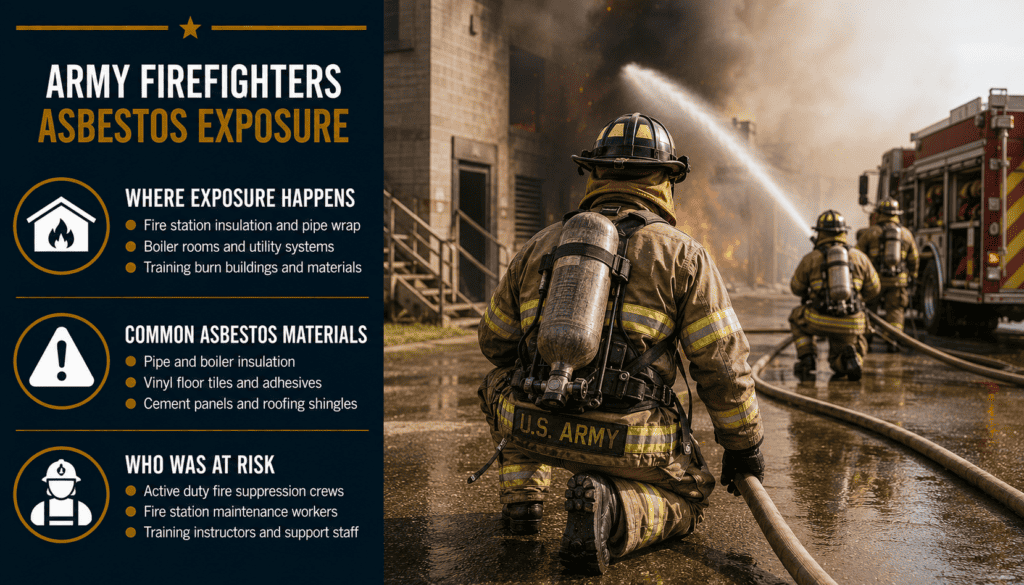
Army Firefighters Asbestos Exposure
Army firefighters have responded to structure fires, rescues, emergencies, and damaged facilities across military installations. NIOSH recognizes that asbestos from older building materials can be released when structures are damaged, while VA explains that airborne asbestos fibers can create health risks when asbestos-containing material is disturbed.
This guide explains how Army firefighters may have encountered asbestos during fire suppression, overhaul, rescue, recovery, structural collapse, debris work, training, and cleanup. It also covers older Army buildings, contaminated gear and apparatus, exposure records, VA disability evidence, and practical ways to reconstruct a firefighter’s military response history without assuming every fire involved asbestos.
Army Firefighters Asbestos Exposure Overview
Army firefighters have protected installations, personnel, aircraft, vehicles, warehouses, barracks, maintenance facilities, utility buildings, and other military property. Firefighting itself does not prove asbestos exposure. The historical concern arises when fire, collapse, rescue, overhaul, demolition, or cleanup disturbs asbestos-containing building materials and releases fibers into smoke, dust, debris, gear, or work areas.
NIOSH explains that hazardous substances can be released when building materials break apart and specifically identifies asbestos in older buildings as one contaminant that can reach firefighters and their protective clothing. A CDC-hosted firefighter cancer review also notes that structural firefighters may encounter asbestos during fire suppression, overhaul, rescue, and recovery, as well as through resuspension from contaminated apparatus and gear.
VA states that asbestos-containing material presents a serious health risk when disturbed so that particles and fibers become airborne. VA also identifies demolition of old buildings, construction, insulation work, and damaged asbestos-containing material as military circumstances that may involve exposure. These principles are directly relevant when reconstructing an Army firefighter’s response history.
This page is part of the Army jobs occupations asbestos exposure hub and connects firefighter histories with Army bases asbestos exposure, Army asbestos exposure health risks, and the broader U.S. Army asbestos exposure section.
Structure Fires and Emergency Response
Army firefighters may respond to fires in barracks, warehouses, maintenance shops, administrative buildings, hospitals, utility facilities, training structures, and other installation property. The asbestos question depends on the building’s materials, age, condition, fire damage, and the responder’s actual location and duties.
NIOSH states that firefighter hazards vary with construction type, building materials, building contents, fire conditions, and other incident factors. Current NIOSH field research at active structure fires has detected a range of respiratory hazards, including asbestos, dusts, formaldehyde, volatile organic compounds, and combustion products. That evidence supports investigating asbestos as one of several possible fireground hazards rather than treating every fire as an asbestos incident.
Fire can damage ceilings, walls, pipe insulation, roofing, siding, flooring, mechanical systems, and fire-resistant materials. Collapse, hose streams, forcible entry, ventilation, salvage, and movement through damaged areas may further disturb debris. Whether asbestos fibers were actually present requires building-specific or material-specific evidence.
Installation research can include Army barracks asbestos exposure, Army warehouses asbestos exposure, Army maintenance buildings asbestos exposure, and Army medical facilities asbestos exposure.
Overhaul, Rescue, and Recovery Work
Exposure potential can continue after visible flames are controlled. Firefighters may perform overhaul to locate hidden fire, pull ceilings or wall coverings, open concealed spaces, move damaged contents, remove debris, and confirm extinguishment. Rescue and recovery operations can also place personnel inside structurally damaged buildings.
A CDC-hosted meta-analysis of firefighter cohort studies states that structural firefighters may encounter asbestos during fire suppression, overhaul, rescue, and recovery when asbestos-containing building materials are disturbed. It also notes possible resuspension of asbestos fibers from contaminated firefighting gear and apparatus.
The exposure history should distinguish interior attack, exterior operations, overhaul, ventilation, rescue, salvage, investigation support, debris handling, apparatus cleanup, and station duties. Time spent in respiratory protection, when respiratory protection was removed, visible dust, structural collapse, ventilation, and proximity to damaged material can all be relevant.
Post-fire demolition may involve additional personnel and hazards. VA specifically identifies demolition of old buildings as a possible military asbestos-exposure circumstance. Related project research can include Army construction units asbestos exposure and Army engineers asbestos exposure.
Older Army Buildings and Asbestos Materials
Older military buildings are important because asbestos was historically used for heat resistance, fire protection, insulation, and durability. VA Veterans Health Library identifies military asbestos uses including cements, adhesives, floor coverings, pipe coverings, gaskets, valves, friction products, and heat-resistant fabrics.
For firefighters, potentially relevant building materials can include documented asbestos-containing pipe insulation, boiler insulation, wall or ceiling materials, flooring, roofing, siding, fireproofing, cement products, gaskets, and mechanical-system components. A building’s age alone does not prove that a specific material contained asbestos.
Building surveys, asbestos-management plans, environmental files, renovation records, drawings, specifications, abatement documents, photographs, and post-fire reports can help identify what was present. The most useful evidence connects a documented material to the firefighter’s actual response area and duties.
Facility-specific research can include Army training facilities asbestos exposure, Army power plants asbestos exposure, and Army HVAC equipment asbestos exposure.
Contaminated Gear, Apparatus, and Station Areas
Fireground contaminants can travel beyond the immediate incident. NIOSH states that hazardous substances can transfer from firefighters’ protective gear to skin, equipment, and the fire station. Its 2026 guidance specifically notes that asbestos may be released as older building materials break apart and that contaminants can collect on turnout gear.
For historical asbestos research, relevant questions include whether dusty gear was brushed or shaken out, whether apparatus interiors accumulated debris, how hose and tools were cleaned, whether contaminated gear entered living or work areas, and whether respirators were used during cleanup. Documentation may be limited for older incidents, so witness accounts can become important.
Contaminated gear does not establish a particular dose or disease. Firefighters can encounter many chemicals and particulates at fires, and NIOSH emphasizes that exposures vary by incident. The goal is to reconstruct the specific asbestos pathway when evidence supports one.
Station and equipment histories can also be researched through the Army equipment asbestos exposure section and relevant installation records.
Fire Training and Other Army Duties
Army firefighters may participate in live-fire training, aircraft rescue exercises, structural drills, inspections, prevention activities, equipment maintenance, station upkeep, and emergency-response preparation. Training exposure should be evaluated separately from operational fire response because structures, fuels, materials, controls, and protective practices may differ.
NIOSH notes that live-fire training in acquired structures presents hazards and that approved burn buildings and current consensus guidance are intended to reduce risks. For historical training, records may identify whether a structure was purpose-built, acquired, renovated, or inspected for hazardous materials before use.
Firefighters can also perform station maintenance or work near other Army trades. Facility repairs, vehicle or apparatus maintenance, utility work, and renovation can create separate potential exposure histories. Related research includes Army maintenance workers asbestos exposure.
Rank and assignment can change duties over time. Junior firefighters may perform more hands-on suppression and overhaul, while senior personnel may serve as crew leaders, inspectors, trainers, or supervisors. The U.S. Army ranks asbestos exposure hub can help organize those changes without assuming duties from rank alone.
Records for Documenting Firefighter Exposure
Begin with military records establishing the veteran’s MOS, unit, installation, rank, dates, fire department assignment, and emergency-response duties. Useful documents can include the DD-214, Official Military Personnel File, assignment orders, evaluation reports, training records, firefighter certifications, unit histories, duty rosters, station logs, photographs, and coworker statements.
Incident evidence may include fire reports, dispatch logs, alarm records, after-action reports, building numbers, photographs, investigation reports, demolition records, hazardous-material reports, and records describing structural damage. Building evidence can include asbestos surveys, environmental assessments, drawings, renovation histories, abatement files, and facility-management records.
Equipment and gear records may include respiratory-protection programs, SCBA records, turnout-gear issue records, apparatus assignments, cleaning procedures, maintenance records, and standard operating procedures. Historical procedures should be compared with what firefighters recall actually occurring during the relevant period.
Create a chronology listing installation, station, incident date, building or location, construction type, duty, interior or exterior position, fire and collapse conditions, suspected material, overhaul or debris work, respiratory protection, gear cleanup, visible dust, proximity, frequency, duration, and witnesses. A detailed incident-based history is more useful than assuming exposure from the firefighter occupation alone.
Health Concerns and VA Benefits
VA Public Health states that symptoms of asbestos-related diseases often do not appear until 20 to 50 years after exposure. For former Army firefighters, this latency can make old incident reports, personnel records, building surveys, station logs, photographs, and witness statements important when reconstructing responses decades later.
VA states that veterans may be eligible for disability compensation if they have a health condition caused by asbestos exposure and had contact with asbestos during military service. VA asks for medical records, service records listing the veteran’s job or specialty, and medical evidence connecting military asbestos contact with the claimed condition.
Firefighter status alone does not establish asbestos exposure or service connection. Evidence is stronger when it identifies an older or damaged structure, documented asbestos-containing material, suppression or overhaul activity, debris conditions, respiratory protection, and duration. Civilian firefighting and other occupational exposures should also be included when relevant.
Veterans concerned about historical fireground exposure should discuss their complete military and civilian histories with a qualified health care provider or VA Environmental Health Coordinator. VA’s VET-HOME program can also help eligible veterans document military environmental exposure histories and discuss exposure-related concerns.
Frequently Asked Questions
Could Army firefighters have been exposed to asbestos?
Potentially. NIOSH and CDC sources identify asbestos as a possible structural-fire contaminant when older asbestos-containing building materials are damaged or disturbed.
Does being an Army firefighter prove asbestos exposure?
No. Exposure depends on the incident, building materials, structural damage, duties, proximity, respiratory protection, frequency, and duration.
Can overhaul work disturb asbestos?
Potentially. Overhaul can involve opening walls and ceilings and moving damaged debris. CDC research identifies overhaul as one activity during which asbestos-containing materials may be disturbed.
Can asbestos contaminate firefighter gear?
Potentially. NIOSH states that hazardous substances released from damaged building materials, including asbestos, can contaminate turnout gear and other equipment.
Could post-fire demolition create a separate exposure pathway?
Yes. VA identifies demolition of older buildings as a possible asbestos-exposure circumstance when asbestos-containing material is disturbed.
Do all older Army buildings contain asbestos?
No. Building age can guide research, but surveys, specifications, environmental records, or material testing are needed to identify asbestos in a particular facility.
What records can help document firefighter exposure?
Personnel files, station logs, incident reports, dispatch records, after-action reports, asbestos surveys, building records, photographs, gear records, and witness statements may help.
Can an Army firefighter with mesothelioma seek VA disability compensation?
Potentially. VA requires evidence of military asbestos contact and a health condition caused by asbestos, supported by applicable service and medical evidence.
Why can decades-old fire reports matter?
VA states that symptoms of asbestos-related diseases often do not appear until 20 to 50 years after exposure, making historical incident and building records potentially important.
Review Your Army Firefighting History
If you or a family member has been diagnosed with mesothelioma after Army firefighting service, gather the DD-214, personnel file, MOS history, assignment orders, evaluation reports, firefighter certifications, station assignments, duty rosters, incident reports, dispatch logs, after-action reports, building numbers, asbestos surveys, environmental records, demolition files, photographs, SCBA and gear records, witness statements, pathology reports, treatment records, VA correspondence, and civilian occupational history. Reconstruct each potentially relevant fire, overhaul, rescue, recovery, demolition, training, and cleanup event separately.
Call 800.291.0963 for a no-obligation case evaluation. Talk to a real person 24/7, 365 days a year. You can also submit your case here.
Many mesothelioma law firms handle qualifying civil cases on a contingency-fee basis; confirm fees and expenses with the firm you retain. Mesothelioma Help Center is not a law firm and does not provide legal or medical advice.
🔗 Confirmed Sources
- VA Public Health — Asbestos
- U.S. Department of Veterans Affairs — Veterans Asbestos Exposure
- Veterans Benefits Administration — Asbestos Exposure Compensation
- VA Veterans Health Library — Veteran Exposure to Asbestos
- NIOSH — Structure Fires
- NIOSH — Protecting Firefighters from Contaminated Gear
- CDC/NIOSH — Firefighting and Cancer: Meta-analysis of Cohort Studies
- NIOSH — Emergency Responder Research and Structure-Fire Respiratory Hazards
- VA VET-HOME — Military Environmental Exposure Assessments
Disclaimer: General information only—not legal or medical advice. This website is not a law firm. Exposure, VA eligibility, liability and deadlines vary by case and jurisdiction. Do not disturb suspected asbestos. Past results do not guarantee future outcomes.