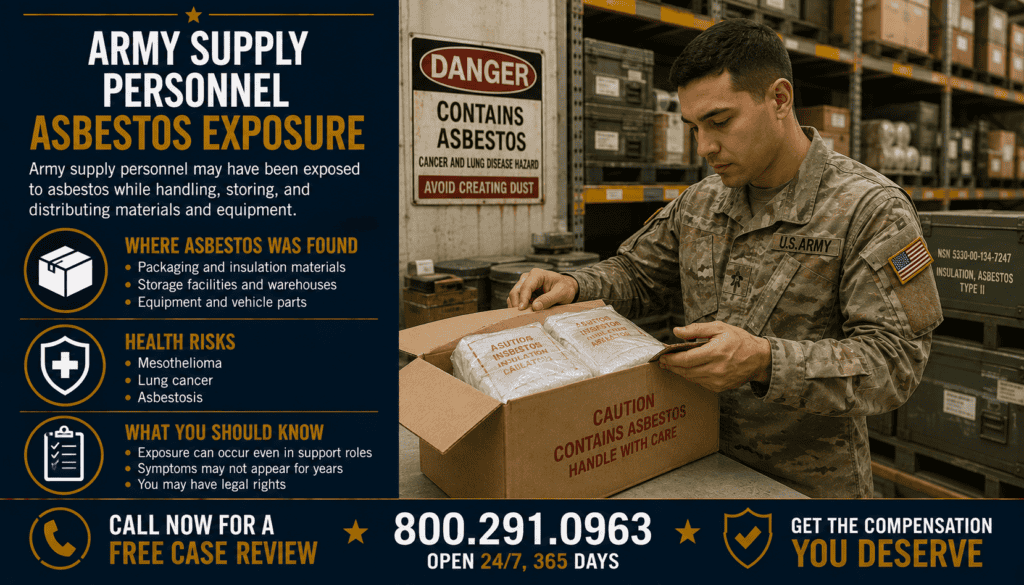
Army Supply Personnel Asbestos Exposure
Army supply personnel have received, stored, inventoried, packaged, transported, and issued vehicle parts, equipment components, construction products, and other military supplies. VA records show that historical military asbestos uses included brakes, gaskets, valves, cements, adhesives, floor coverings, and pipe coverings, making product-specific supply records potentially important when reconstructing past exposure.
This guide explains how Army supply personnel may have encountered asbestos through older military stock, damaged materials, warehouses, depots, returned parts, nearby maintenance work, and asbestos-containing building materials. It also covers supply and facility records, VA disability evidence, health considerations, and practical ways to document an individual veteran’s work history without assuming that every supply assignment involved asbestos.
Army Supply Personnel Asbestos Exposure Overview
Army supply personnel have received, inventoried, stored, packaged, transported, and issued parts, equipment, construction materials, and other military supplies. Supply work itself does not establish asbestos exposure. The relevant historical question is whether a soldier handled damaged or deteriorated asbestos-containing products, worked around dust released from those products, or spent time in older Army storage and maintenance facilities containing asbestos materials.
VA Veterans Health Library identifies historical military asbestos uses including brakes, gaskets, valves, cements, adhesives, floor coverings, and pipe coverings. A VA WRIISC information sheet also identifies packaging among the broad range of manufactured products in which asbestos was historically used. These sources support investigating particular materials without assuming that all Army stock or packaging contained asbestos.
Army records provide useful facility context. Army Environmental Command states that asbestos-containing materials remain a management issue in older Army buildings. A Secretary of the Army safety message notes that DoD facilities continue to contain asbestos products and identifies historical uses such as pipe and furnace insulation, concrete, floor tile, siding, and brake shoes.
This page is part of the Army jobs occupations asbestos exposure hub and connects supply histories with Army warehouses asbestos exposure, Army equipment asbestos exposure, and the broader U.S. Army asbestos exposure section.
Army Supply Duties and Work Areas
Supply duties can include receiving shipments, checking stock numbers, inspecting packages, shelving and binning parts, operating storage areas, issuing components to maintenance sections, preparing material for transportation, managing inventories, and processing returned or excess property. Depending on the unit, personnel may support vehicles, construction, engineering, facilities, communications, weapons, utilities, and general organizational equipment.
Work areas can include warehouses, supply rooms, depots, motor pools, maintenance shops, outdoor storage yards, loading docks, shipping areas, and temporary field facilities. The exposure history should identify the actual location and material rather than treating every supply assignment as equivalent.
Army Sustainment Command’s Packaging, Storage and Containerization Center describes the Army’s continuing responsibilities for packaging, storage, transportation, and hazardous-material information. Its Hazardous Materials Information Resource System includes safety data and transportation and disposal information used to support hazardous-material compliance. Modern systems should not be projected backward as proof of historical practices, but they illustrate the kinds of records relevant to supply research.
Location-specific research may include Army ammunition depots asbestos exposure, Army motor pools asbestos exposure, and Army maintenance buildings asbestos exposure.
Older Parts and Asbestos-Containing Materials
Supply personnel may historically have handled replacement components later identified as asbestos-containing. VA identifies brakes, gaskets, valves, cements, adhesives, and pipe and floor coverings among military asbestos uses. The Army safety message likewise identifies brake shoes and several older building materials as examples of asbestos-containing products.
For vehicle and equipment supply, relevant historical items may include documented asbestos-containing brake or clutch friction components, gaskets, valves, heat-resistant materials, and other replacement parts. For facility supply, relevant products can include documented asbestos-containing floor products, cement materials, insulation, or other construction stock. Product composition varied by manufacturer, specification, contract, stock number, and era.
The presence of a product in a warehouse does not necessarily mean fibers were released. VA explains that asbestos is most hazardous when asbestos-containing material is damaged or disturbed and fibers become airborne. An intact sealed part can present a different exposure circumstance from damaged friable material, torn packaging, broken insulation, or dusty returned components.
Equipment-related research can continue through Army vehicle equipment asbestos exposure, Army boiler equipment asbestos exposure, and Army fuel system equipment asbestos exposure.
Warehouses, Depots, and Storage Areas
Older Army storage facilities can be relevant for two separate reasons: the products being stored and the construction materials in the building itself. Army Environmental Command states that its asbestos program addresses safe handling and removal of asbestos-containing materials in older buildings. Fort Carson similarly reports asbestos-containing building materials throughout most older buildings at Fort Carson and Piñon Canyon Maneuver Site.
Historical Army depot records also show the breadth of supply operations. The former Sioux Army Depot operated from 1942 to 1967 to receive, store, and issue Army ammunition, ammunition components, and general military supplies. USACE records state that one 1942 depot building used cement asbestos as a construction material. This is a documented example, not evidence that every Army depot or warehouse contained asbestos.
Supply personnel working in older facilities may therefore need to research roofs, siding, flooring, ceilings, piping, insulation, mechanical rooms, and renovation history in addition to stored stock. Building surveys, environmental records, renovation files, and asbestos-management plans can help identify documented materials.
The Army warehouses asbestos exposure page provides additional facility context, while the Army bases asbestos exposure section can help organize installation-specific research.
Receiving, Issuing, Packaging, and Handling
Receiving and issuing work can involve opening containers, inspecting items, repackaging material, moving stock, cleaning shelves and bins, handling returns, and disposing of damaged property. For asbestos research, the important questions are what material was present, whether it was damaged or friable, whether dust was released, and how frequently the soldier handled it.
VA’s WRIISC asbestos information sheet notes that asbestos was historically used in a wide range of manufactured goods, including building materials, friction products, heat-resistant fabrics, packaging, gaskets, and coatings. That broad historical use makes item-specific documentation important. It does not mean ordinary cardboard boxes or all military packaging contained asbestos.
Returned parts can deserve separate attention from new stock. A new sealed gasket or brake component may have been packaged differently from a used component returned from a maintenance shop. Dust, residue, broken friction material, damaged insulation, or contaminated wrapping should be documented when supported by records or witness accounts.
Supply records that may help include stock numbers, National Stock Numbers, Federal Supply Classes, receipts, issue documents, technical manuals, parts catalogs, procurement records, packaging specifications, safety data, manufacturer literature, and photographs of original containers or labels.
Nearby Maintenance and Facility Work
Supply sections are often located near maintenance bays, motor pools, equipment shops, loading areas, and facility work. A supply soldier may not personally remove brakes, gaskets, insulation, or building materials but could have worked near personnel performing those tasks. Proximity and shared-air conditions should be investigated separately from direct product handling.
Army workplace asbestos guidance incorporates OSHA controls for automotive brake and clutch inspection, disassembly, repair, and assembly. VA identifies servicing clutch facings and brake linings among occupational circumstances relevant to asbestos exposure. These sources support investigating supply rooms adjacent to historical vehicle maintenance when dusty friction-product work occurred.
Building renovation is another possible nearby pathway. The Secretary of the Army safety message states that asbestos-containing material can release microscopic fibers when disturbed or damaged and directs installations to use qualified inspection and controlled asbestos management for renovation and demolition.
Related occupational research includes Army mechanics asbestos exposure, Army maintenance workers asbestos exposure, and Army construction units asbestos exposure.
Records for Documenting Supply Exposure
Begin with service records establishing the veteran’s MOS, unit, installation, rank, dates, and supply responsibilities. Useful records can include the DD-214, Official Military Personnel File, assignment orders, evaluation reports, training records, unit histories, duty rosters, warehouse assignments, property-book records, photographs, and statements from personnel who worked in the same supply section.
Product evidence can include National Stock Numbers, Federal Supply Classes, requisition and issue records, packing lists, receipts, technical manuals, illustrated parts catalogs, procurement records, packaging specifications, manufacturer literature, safety data sheets, and historical hazardous-material records. Exact identifiers can be particularly useful because products with similar names may have different compositions.
Facility evidence can include warehouse or building numbers, construction dates, asbestos surveys, environmental assessments, renovation records, floor plans, work orders, abatement files, demolition records, and photographs. A building’s age is a research clue, not proof of asbestos exposure.
Create a chronology listing unit, installation, supply facility, dates, rank, MOS, stock or product, task, packaging condition, visible dust, damaged material, nearby maintenance or renovation work, ventilation, protective equipment, proximity, frequency, duration, and witnesses. The U.S. Army ranks asbestos exposure hub can help organize changes from hands-on supply work to supervisory responsibilities.
Health Concerns and VA Benefits
VA Public Health states that symptoms of asbestos-related diseases often do not appear until 20 to 50 years after exposure. This long latency can make old stock records, warehouse assignments, personnel files, building surveys, photographs, and witness statements important when reconstructing Army supply work performed decades earlier.
VA states that veterans may file disability compensation claims for health problems they believe are related to military asbestos exposure, and VA decides those claims case by case. Veterans Benefits Administration requires evidence of in-service asbestos exposure and a disease or disability related to that exposure. Exposure by itself is not a condition subject to service connection.
Supply personnel are not automatically identified as exposed simply because of their MOS. A claim or medical exposure history is stronger when it identifies specific products, damaged material, documented asbestos-containing components, older facilities, nearby dusty work, dates, and duration rather than relying only on the supply job title.
Veterans concerned about historical supply exposure should discuss their complete military and civilian occupational histories with a qualified health care provider or VA Environmental Health Coordinator. The Army asbestos exposure health risks page provides additional information about latency, mesothelioma, lung cancer, medical evaluation, and VA evidence.
Frequently Asked Questions
Could Army supply personnel have been exposed to asbestos?
Potentially. Exposure could involve documented asbestos-containing parts or materials, damaged stock, older storage facilities, or nearby maintenance and renovation work. Individual circumstances must be investigated.
Does an Army supply MOS prove asbestos exposure?
No. MOS establishes occupational context, but exposure depends on the specific material, building, handling conditions, dust release, proximity, frequency, and duration.
What military products historically used asbestos?
VA identifies brakes, gaskets, valves, cements, adhesives, floor coverings, and pipe coverings among historical military asbestos uses.
Could packaging itself contain asbestos?
Some historical manufactured packaging products used asbestos, according to VA WRIISC, but that does not mean all military packaging or ordinary shipping boxes contained asbestos. Product-specific evidence is required.
Could an Army warehouse itself contain asbestos?
Potentially. Army sources document asbestos-containing materials in older military buildings. A survey or other facility record is needed to identify materials in a particular warehouse.
Could supply personnel be exposed near vehicle maintenance?
Potentially. Shared work areas near dusty brake, clutch, gasket, or other asbestos-containing component work may warrant investigation based on proximity and work practices.
What records can help document a supply exposure history?
Personnel files, warehouse assignments, stock numbers, issue records, technical manuals, procurement files, packaging specifications, building surveys, photographs, and witness statements may help.
Can an Army supply veteran with mesothelioma seek VA disability compensation?
Potentially. VA requires evidence of military asbestos exposure and a disease or disability related to that exposure, supported by applicable medical and service evidence.
Why can decades-old supply records matter?
VA states that asbestos-related disease symptoms often do not appear until 20 to 50 years after exposure, making historical supply and facility records potentially important.
Review Your Army Supply Work History
If you or a family member has been diagnosed with mesothelioma after Army supply service, gather the DD-214, personnel file, MOS history, assignment orders, evaluation reports, unit histories, warehouse and building numbers, stock numbers, issue and receipt records, packing lists, technical manuals, parts catalogs, procurement records, packaging specifications, safety data, asbestos surveys, environmental files, photographs, witness statements, pathology reports, treatment records, VA correspondence, and civilian occupational history. Reconstruct each potentially relevant product, storage location, handling task, damaged-material event, and nearby maintenance or renovation activity separately.
Call 800.291.0963 for a no-obligation case evaluation. Talk to a real person 24/7, 365 days a year. You can also submit your case here.
Many mesothelioma law firms handle qualifying civil cases on a contingency-fee basis; confirm fees and expenses with the firm you retain. Mesothelioma Help Center is not a law firm and does not provide legal or medical advice.
🔗 Confirmed Sources
- VA Veterans Health Library — Veteran Exposure to Asbestos
- VA Public Health — Asbestos
- Veterans Benefits Administration — Asbestos Exposure Compensation
- VA WRIISC — Exposure to Asbestos Information Sheet
- U.S. Army Combat Readiness Center — Workplace Asbestos
- Secretary of the Army — Asbestos Awareness Safety Message
- U.S. Army Environmental Command — Toxics Management
- Army Sustainment Command — DoD Hazardous Materials Information Resource System
- U.S. Army Corps of Engineers — Former Sioux Army Depot
Disclaimer: General information only—not legal or medical advice. This website is not a law firm. Exposure, VA eligibility, liability and deadlines vary by case and jurisdiction. Do not disturb suspected asbestos. Past results do not guarantee future outcomes.