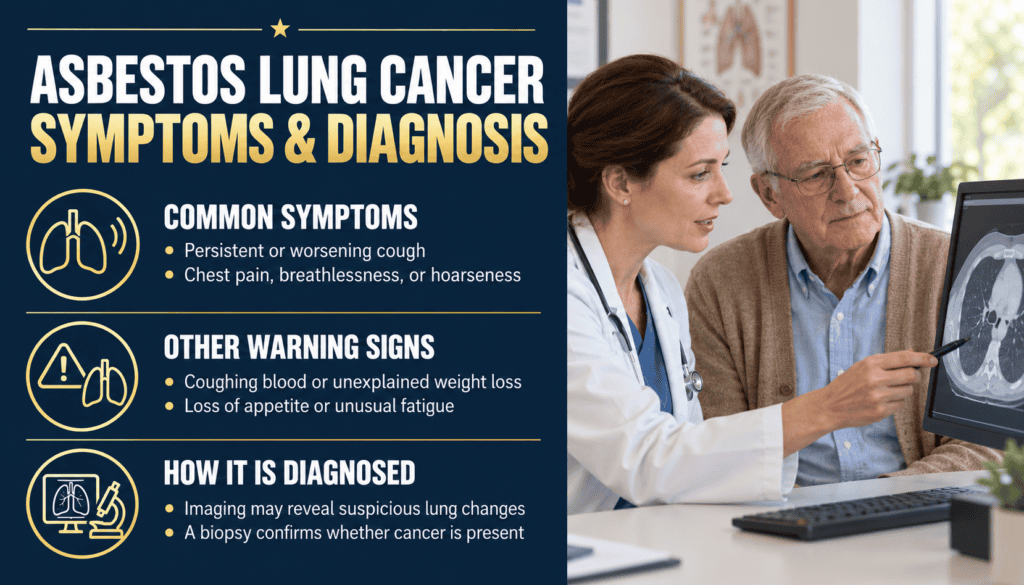
Asbestos Lung Cancer Symptoms & Diagnosis
Asbestos-related lung cancer may not cause noticeable symptoms in its earliest stages. When symptoms do appear, they can resemble those caused by infections, chronic lung disease, heart conditions, smoking-related illness, or other forms of lung cancer. Persistent or worsening symptoms therefore require medical evaluation rather than assumptions about their cause.
For people with a history of occupational, military, or other asbestos exposure, the work history can be especially important because lung cancer may develop decades after fibers were inhaled. A person may have retired long before symptoms begin and may no longer associate an old shipyard, construction project, industrial plant, military assignment, or mechanical job with a new diagnosis.
Doctors diagnose lung cancer through a combination of medical history, imaging, and procedures that examine cells or tissue. Asbestos exposure history can provide important context, but it does not by itself diagnose lung cancer or prove that asbestos caused a particular tumor.
This page serves as the Asbestos Lung Cancer Symptoms & Diagnosis hub within the broader Diagnosed With Lung Cancer section. Related pages in the silo address Asbestos Lung Cancer Causes & Risk, Asbestos Lung Cancer Risk, Smoking and Asbestos Lung Cancer Risk, and the Asbestos Lung Cancer Latency Period.
🫁 Common Asbestos Lung Cancer Symptoms
Asbestos-related lung cancer generally causes the same kinds of symptoms as lung cancer associated with other causes. There is no unique symptom pattern that proves a tumor was caused by asbestos.
Possible symptoms include:
- Persistent or worsening cough
- Shortness of breath
- Chest pain or discomfort
- Coughing up blood
- Hoarseness
- Wheezing
- Unexplained weight loss
- Loss of appetite
- Persistent fatigue or weakness
- Repeated respiratory infections such as bronchitis or pneumonia
These symptoms can result from many conditions other than cancer. Their significance depends on duration, severity, progression, medical history, imaging findings, and other clinical factors.
⚠️ Early Warning Signs and Symptom Changes
Early lung cancer may produce few or no obvious symptoms. When warning signs do occur, they may be subtle and easy to attribute to aging, smoking, respiratory infection, or chronic lung disease.
| Possible Warning Sign | What to Notice | Why Medical Review Matters |
|---|---|---|
| Persistent cough | A new cough that does not resolve | Persistent cough has many causes and may require imaging or further evaluation |
| Change in chronic cough | A familiar cough becomes deeper, more frequent, or otherwise different | A change from baseline can be clinically important |
| Shortness of breath | New or increasing difficulty breathing | Can reflect lung, heart, airway, or other conditions |
| Chest pain | Persistent pain, pressure, or discomfort | Chest symptoms require evaluation, especially when new or worsening |
| Unexplained weight loss | Weight loss without intentional dieting | Can occur with cancer and many other illnesses |
| Fatigue | Persistent decline in energy or stamina | Should be considered with other symptoms and medical history |
Symptoms alone cannot distinguish asbestos-related lung cancer from lung cancer caused by smoking, radon, occupational chemicals, genetic factors, or other causes.
🏥 When Symptoms Need Medical Evaluation
People should seek medical attention for persistent, unexplained, or worsening respiratory symptoms. This is particularly important for people with substantial histories of asbestos exposure or smoking.
Prompt evaluation is especially important for symptoms such as coughing up blood, increasing shortness of breath, persistent chest pain, unexplained weight loss, or a persistent cough that changes noticeably.
Urgent or emergency care may be appropriate for severe breathing difficulty, sudden severe chest pain, coughing up significant amounts of blood, fainting, confusion, or other rapidly worsening symptoms.
Tell your healthcare provider about older jobs
A current medical history should include significant occupational and military exposures even if they occurred decades earlier. Patients may want to mention shipyard work, construction, insulation work, industrial maintenance, power generation, refinery work, mechanical trades, railroad work, military service, demolition, or other jobs where asbestos-containing materials may have been disturbed.
🔬 How Doctors Diagnose Lung Cancer
Lung cancer diagnosis generally begins with symptoms, medical history, physical examination, and imaging. If a suspicious abnormality is found, doctors may use additional testing to determine whether cancer is present and what type it is.
| Diagnostic Step | What It Can Help Determine |
|---|---|
| Medical history | Symptoms, smoking history, occupational exposures, family history, and other risks |
| Physical examination | General health and signs that may require further evaluation |
| Chest imaging | Whether a lung mass, nodule, enlarged lymph node, fluid, or other abnormality is present |
| Tissue or cell sampling | Whether cancer is present and the microscopic cancer type |
| Molecular or biomarker testing | Tumor characteristics that may help guide treatment in appropriate cases |
| Staging evaluation | How far the cancer has spread |
The exact sequence varies by patient. Doctors choose tests based on the location and appearance of abnormalities, symptoms, general health, and other clinical findings.
🩻 Imaging Tests Used in Lung Cancer Diagnosis
Imaging can identify suspicious abnormalities, but imaging alone usually cannot determine the exact microscopic type of lung cancer or establish asbestos as the cause.
Chest X-ray
A chest X-ray may reveal a mass, fluid, or another abnormality, but small or early cancers can be difficult to identify on standard X-rays. An abnormal X-ray commonly leads to additional imaging.
CT scan
Computed tomography provides more detailed images of the lungs and surrounding structures. CT may help identify a suspicious nodule or mass, enlarged lymph nodes, pleural abnormalities, or other findings that need further evaluation.
PET scan
Positron emission tomography may be used in appropriate cases to evaluate areas of increased metabolic activity and help with staging. PET findings are interpreted together with CT, pathology, and other information.
Other imaging may be used depending on the patient’s findings and the questions the medical team needs to answer.
🧪 Biopsy and Pathology
A suspicious image does not by itself establish the exact cancer type. Doctors often need cells or tissue for microscopic examination by a pathologist.
Depending on the tumor’s location and the patient’s condition, tissue may be obtained through bronchoscopy, needle biopsy, lymph-node sampling, surgery, or another procedure selected by the medical team.
| What Pathology Can Help Determine | Why It Matters |
|---|---|
| Whether cancer is present | Confirms or excludes malignancy in the sampled tissue |
| Major lung cancer type | Distinguishes small cell from non-small cell lung cancer |
| Histologic subtype | May identify adenocarcinoma, squamous cell carcinoma, or another subtype |
| Biomarkers or molecular features | May affect treatment options for some patients |
There is generally no routine pathology label that says a lung tumor was “caused by asbestos.” Evaluating asbestos as a contributing cause usually requires combining the confirmed diagnosis with a documented exposure history and other relevant risk factors.
🧬 Small Cell vs. Non-Small Cell Lung Cancer
Lung cancers are broadly divided into non-small cell lung cancer (NSCLC) and small cell lung cancer (SCLC). These groups behave differently and may be treated differently.
Non-small cell lung cancer accounts for most lung cancer diagnoses and includes several major subtypes, including adenocarcinoma and squamous cell carcinoma. Small cell lung cancer tends to grow and spread differently and is staged and treated using approaches tailored to that disease.
Asbestos exposure can be relevant to lung cancer risk, but asbestos exposure alone does not determine which microscopic lung cancer type a person develops.
Diagnosis, pathology, staging, and treatment decisions should be made by qualified medical professionals based on the individual patient’s findings.
👷 Why Asbestos Exposure History Matters After Diagnosis
Because asbestos-related cancers can have long latency periods, a person diagnosed today may need to reconstruct work or military service from decades earlier.
Relevant information can include:
- Employers and years worked
- Military branch, duty stations, ships, bases, units, or occupational specialty
- Specific jobs and tasks performed
- Work around insulation, boilers, piping, pumps, valves, gaskets, packing, furnaces, or other high-heat systems
- Construction, renovation, demolition, or maintenance work
- Work performed by nearby trades
- Product, equipment, or building records
- Coworker or witness information
Not every product, workplace, machine, ship, or building contained asbestos. Composition varied by manufacturer, model, component, product, era, and location, so exposure should be established with specific evidence when possible.
For more background, review Asbestos Lung Cancer Causes & Risk and the Asbestos Lung Cancer Latency Period.
Navy veterans can also review the confirmed U.S. Navy Asbestos Exposure hub, while people whose exposure involved civilian work on military or government projects can review Civilian Contractors Asbestos Exposure.
📋 Lung Cancer Screening vs. Diagnosing Symptoms
Screening and diagnostic testing are different. Screening is intended to look for lung cancer in people who do not currently have symptoms but meet eligibility criteria. Diagnostic testing evaluates symptoms or an abnormal finding that is already present.
Low-dose CT is the standard screening method for people who meet established lung cancer screening criteria. Current eligibility recommendations focus heavily on age and smoking history. A history of asbestos exposure should still be discussed with a qualified healthcare professional when reviewing overall risk and deciding whether additional evaluation is appropriate.
People with persistent or worsening symptoms should not rely on screening guidance alone. Symptoms require medical assessment based on the individual’s current condition.
Diagnosed with lung cancer after years in a potentially exposed trade or military assignment? Call 800.291.0963 or Submit Your Case. Live help is available 24/7, 365 days a year.
❓ Frequently Asked Questions
What are the most common symptoms of asbestos-related lung cancer?
Possible symptoms include persistent cough, shortness of breath, chest pain, coughing up blood, hoarseness, fatigue, unexplained weight loss, appetite loss, and recurring respiratory infections. These symptoms can also have many non-cancer causes.
Are asbestos lung cancer symptoms different from other lung cancers?
Usually not. There is no unique set of symptoms that proves a lung cancer was caused by asbestos. Exposure history must be evaluated separately.
Can asbestos lung cancer develop without symptoms?
Yes. Early lung cancer can sometimes be present without obvious symptoms. This is one reason people with significant risk histories should discuss appropriate medical evaluation with their healthcare providers.
Can a chest X-ray diagnose asbestos lung cancer?
A chest X-ray may identify an abnormality, but it generally cannot establish the exact cancer type or prove asbestos causation. Additional imaging and tissue testing may be necessary.
Why is a biopsy important?
A biopsy provides cells or tissue that a pathologist can examine to determine whether cancer is present and what type of lung cancer it is.
Can doctors tell from a biopsy that asbestos caused the lung cancer?
Generally, no single biopsy finding labels a lung cancer as asbestos-caused. Medical diagnosis and exposure causation are separate questions. Exposure history, latency, smoking history, and other evidence may need to be considered.
Should I tell my doctor about asbestos exposure from decades ago?
Yes. Significant occupational or military asbestos exposure can remain relevant even if it occurred decades before diagnosis.
What should I do after a lung cancer diagnosis if I worked around asbestos?
Continue medical care with qualified professionals and begin documenting your employment, military service, worksites, job duties, products, equipment, and possible exposure history. If appropriate, a legal investigation can assess whether a claim may be available.
📞 Lung Cancer Diagnosis After Possible Asbestos Exposure?
If you or a family member has been diagnosed with lung cancer after work in construction, shipyards, industrial plants, military service, mechanical trades, power generation, refineries, or another potentially exposed environment, documenting the exposure history can be important even when the work occurred decades ago.
Call 800.291.0963 to discuss jobs, worksites, military assignments, equipment, and materials that may be relevant to an asbestos lung cancer investigation. Live help is available 24/7, 365 days a year.
Submit Your Case for a case-specific review of potential asbestos exposure and legal options. Eligibility depends on the diagnosis, evidence, responsible companies or trusts, jurisdiction, and filing deadlines.
For more information about potential legal claims, visit Lung Cancer Asbestos Lawsuit.
⚕️ Legal & Medical Information Disclaimer
This page provides general educational information only. It does not establish a diagnosis, medical causation, legal liability, VA eligibility, or entitlement to compensation. Consult qualified medical and legal professionals for advice about your specific situation.