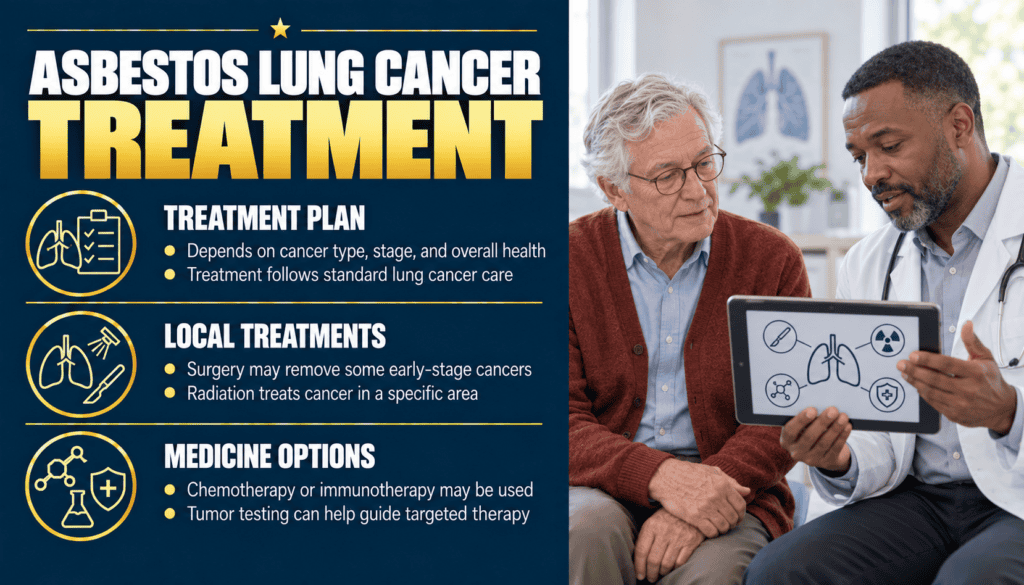
Asbestos Lung Cancer Treatment
Treatment for asbestos-related lung cancer is based on the lung cancer itself—not on asbestos exposure alone. Doctors consider whether the cancer is non-small cell lung cancer (NSCLC) or small cell lung cancer (SCLC), its stage, tumor location, lymph-node involvement, molecular and biomarker findings, lung function, previous treatment, and the patient’s overall health.
Depending on those factors, treatment may include surgery, chemotherapy, immunotherapy, radiation therapy, targeted therapy, supportive care, clinical trials, or a combination of approaches. Asbestos exposure remains important for understanding possible causation and other asbestos-related lung conditions, but it does not create a separate universal treatment protocol.
This page is the Asbestos Lung Cancer Treatment hub within the broader Diagnosed With Lung Cancer silo. Patients still establishing their diagnosis can review Diagnosing Asbestos-Related Lung Cancer, while information about symptoms is available through the Asbestos Lung Cancer Symptoms & Diagnosis hub.
🩺 How Asbestos Lung Cancer Treatment Is Chosen
There is no single treatment that is appropriate for everyone diagnosed with asbestos-related lung cancer. Treatment planning begins with an accurate diagnosis and staging evaluation.
| Factor | Why It Matters for Treatment |
|---|---|
| Lung cancer type | NSCLC and SCLC have different treatment pathways. |
| Stage | Shows how far the cancer has spread and whether local treatment may be feasible. |
| Tumor location | Can affect whether surgery or certain radiation approaches are possible. |
| Lymph nodes | Nodal involvement can change stage and treatment strategy. |
| Molecular findings | Some NSCLCs have actionable alterations that may be treated with targeted drugs. |
| Biomarkers | Can help guide use of certain immunotherapies and other treatments. |
| Lung and heart function | Important when considering surgery and other intensive treatments. |
| Overall health | Helps determine which treatments a patient may safely tolerate. |
A multidisciplinary team may include a medical oncologist, thoracic surgeon, radiation oncologist, pulmonologist, radiologist, pathologist, oncology nurses, and palliative-care specialists.
🫁 Non-Small Cell Lung Cancer Treatment
Non-small cell lung cancer accounts for most lung cancers. Treatment varies substantially by stage and tumor biology.
Earlier-stage NSCLC may sometimes be treated with surgery. Radiation can be an alternative for some patients who cannot undergo surgery. Depending on the stage and pathology, chemotherapy, immunotherapy, or targeted therapy may be given before or after local treatment.
Locally advanced disease may require combinations of systemic therapy and radiation, with surgery considered only in selected situations. Metastatic NSCLC is generally treated primarily with systemic therapy chosen according to tumor histology, molecular testing, biomarkers, previous treatment, and patient health.
The fact that asbestos contributed to a patient’s risk does not change NSCLC into a separate cancer type. Pathology and molecular characteristics remain central to treatment selection.
🧬 Small Cell Lung Cancer Treatment
Small cell lung cancer generally grows and spreads more rapidly than NSCLC, so systemic treatment plays a particularly important role.
Treatment may involve chemotherapy, immunotherapy, radiation therapy, and supportive treatment. Surgery is reserved for a relatively small group of carefully selected patients with very early disease.
For extensive-stage SCLC, systemic therapy commonly includes chemotherapy with immunotherapy when appropriate. Radiation may also be used in selected situations based on disease location, treatment response, symptoms, and the overall care plan.
Individual treatment decisions should be made by the oncology team using the patient’s current stage and medical condition.
🔪 Surgery for Asbestos-Related Lung Cancer
Surgery may be considered when lung cancer is sufficiently localized and the patient has adequate lung function and overall health to tolerate an operation. It is used much more commonly for selected NSCLC than for SCLC.
| Procedure | General Purpose |
|---|---|
| Wedge resection | Removes the tumor with a small margin of surrounding lung tissue. |
| Segmentectomy | Removes an anatomical segment of a lung lobe. |
| Lobectomy | Removes one lobe of the lung and is a common operation for operable lung cancer. |
| Sleeve resection | Removes a tumor-involved section of airway while preserving additional lung when feasible. |
| Pneumonectomy | Removes an entire lung in selected cases where less extensive surgery is not adequate. |
A thoracic surgeon considers tumor size and location, lymph nodes, stage, pulmonary reserve, cardiovascular health, and other medical conditions before recommending surgery. Not every patient is a surgical candidate.
💉 Chemotherapy for Asbestos-Related Lung Cancer
Chemotherapy uses medicines that circulate through the body to kill cancer cells or interfere with their ability to grow. The drugs and schedule depend on whether the patient has NSCLC or SCLC, the stage, pathology, previous treatment, and other individual factors.
Chemotherapy may be used:
- Before surgery to treat cancer systemically and, in some cases, help shrink disease
- After surgery to reduce the risk from microscopic cancer cells
- Together with radiation therapy
- Together with immunotherapy
- As a primary treatment for advanced or metastatic disease
- For recurrent lung cancer
Side effects vary by drug and can include fatigue, nausea, appetite changes, infection risk, anemia, neuropathy, or other problems. Oncology teams monitor patients and may adjust treatment or provide medications and supportive care to manage adverse effects.
🛡️ Immunotherapy for Asbestos-Related Lung Cancer
Immunotherapy helps the immune system recognize or attack cancer. Immune checkpoint inhibitors have become important components of treatment for many patients with NSCLC and SCLC.
Depending on the cancer and stage, immunotherapy may be used before surgery, after surgery, with chemotherapy, after chemoradiation, or as treatment for advanced or recurrent disease.
Not every patient benefits from the same immunotherapy approach. Tumor type, stage, biomarker findings, previous treatments, autoimmune conditions, organ function, and other medical factors can affect treatment selection.
Immune-related side effects can affect organs such as the lungs, skin, intestines, liver, thyroid, or other endocrine glands. Patients should promptly report new symptoms to their oncology team.
☢️ Radiation Therapy for Asbestos-Related Lung Cancer
Radiation therapy uses high-energy radiation to damage cancer cells while treatment planning attempts to limit exposure to surrounding healthy tissue.
Radiation may be used as a primary treatment for selected localized tumors, together with chemotherapy for some locally advanced cancers, before or after other treatment in selected cases, or to treat certain metastatic sites and relieve symptoms.
Modern techniques can deliver radiation precisely based on tumor size, location, nearby organs, and treatment goals. Side effects vary according to the area treated and the radiation dose.
🎯 Targeted Therapy and Biomarker Testing
Modern NSCLC treatment increasingly depends on the biological characteristics of the tumor. Molecular testing can identify certain genetic alterations or proteins that may influence treatment.
When an actionable molecular alteration is found, a targeted drug may sometimes attack a specific pathway driving cancer growth. This differs from traditional chemotherapy, which acts more broadly on rapidly dividing cells.
Biomarker testing can also help oncologists determine whether certain immunotherapy strategies are appropriate. The testing needed depends on lung cancer type, stage, available tissue, previous testing, and current treatment guidelines.
Patients can ask whether their tumor has undergone appropriate molecular and biomarker testing before major systemic-treatment decisions are finalized.
❤️ Advanced Cancer, Clinical Trials, and Supportive Care
When lung cancer has spread to distant organs, treatment generally emphasizes systemic therapy such as immunotherapy, chemotherapy, targeted therapy when an actionable alteration is present, or combinations selected by the oncology team.
Clinical trials
Clinical trials evaluate new drugs, treatment combinations, sequencing strategies, radiation techniques, and therapies used before or after surgery. Trial eligibility depends on specific medical criteria, and patients interested in research studies should discuss appropriate options with their oncology team.
Palliative and supportive care
Palliative care can be provided at the same time as active cancer treatment. It can help address pain, shortness of breath, fatigue, appetite problems, anxiety, sleep difficulties, and treatment side effects. Palliative care is not limited to end-of-life care.
Does asbestos exposure change treatment?
Asbestos history can be important because a patient may have asbestosis, pleural disease, or other respiratory conditions that affect lung function and treatment planning. However, treatment for the cancer itself is generally selected according to lung cancer type, stage, tumor biology, and the patient’s health.
For more information about asbestos risk and timing, see Asbestos Lung Cancer Risk and the Asbestos Lung Cancer Latency Period.
Diagnosed with lung cancer after occupational or military asbestos exposure? Call 800.291.0963 or Submit Your Case. Live help is available 24/7, 365 days a year.
❓ Frequently Asked Questions
How is asbestos-related lung cancer treated?
Treatment is based primarily on the lung cancer type, stage, tumor characteristics, molecular findings, and the patient’s health. Options can include surgery, chemotherapy, immunotherapy, radiation, targeted therapy, and supportive care.
Does asbestos exposure require a different type of lung cancer treatment?
Not usually. Asbestos exposure is important to causation and may be relevant to other lung conditions, but oncologists generally treat the cancer according to its type, stage, molecular characteristics, and the patient’s overall condition.
Can asbestos-related lung cancer be treated with surgery?
Yes, in selected patients whose cancer is sufficiently localized and who can safely tolerate surgery. Surgical eligibility depends on stage, tumor location, lymph nodes, lung function, and other medical factors.
Is chemotherapy used for asbestos lung cancer?
Yes. Chemotherapy can be used before or after surgery, with radiation or immunotherapy, and for advanced or recurrent disease. The regimen depends on the specific lung cancer.
Can immunotherapy treat asbestos-related lung cancer?
Yes. Immunotherapy is used for many patients with NSCLC and SCLC, but eligibility and the treatment combination depend on the cancer’s characteristics and the patient’s medical situation.
What is targeted therapy?
Targeted therapies act against specific molecular abnormalities found in some cancers. Appropriate molecular testing can help determine whether a patient has an actionable target.
Can stage 4 asbestos-related lung cancer be treated?
Yes. Metastatic lung cancer can often be treated with systemic therapies and symptom-directed care. The goals and expected benefits depend on cancer type, biomarkers, sites of spread, previous treatment, and patient health.
Should my oncologist know about asbestos exposure from decades ago?
Yes. Significant asbestos exposure and related lung disease may be relevant to pulmonary health and treatment planning, even though the cancer treatment itself is primarily determined by the tumor’s medical characteristics.
📞 Lung Cancer Treatment After Asbestos Exposure?
Medical treatment should remain the priority after a lung cancer diagnosis. At the same time, people who spent years in construction, shipyards, industrial plants, military service, mechanical trades, power generation, refineries, or other potentially exposed settings may want to document the work history while records and witnesses can still be located.
Call 800.291.0963 to discuss historical jobs, military assignments, worksites, equipment, and materials that may be relevant to an asbestos exposure investigation. Live help is available 24/7, 365 days a year.
Submit Your Case for a case-specific review of potential asbestos exposure and legal options. A diagnosis does not guarantee compensation; eligibility depends on exposure evidence, potentially responsible companies or trusts, jurisdiction, and applicable filing deadlines.
For additional legal information, visit Lung Cancer Asbestos Lawsuit.
⚕️ Legal & Medical Information Disclaimer
This page provides general educational information only. It does not establish a diagnosis, treatment plan, medical causation, legal liability, VA eligibility, or entitlement to compensation. Consult qualified medical and legal professionals about your specific situation.