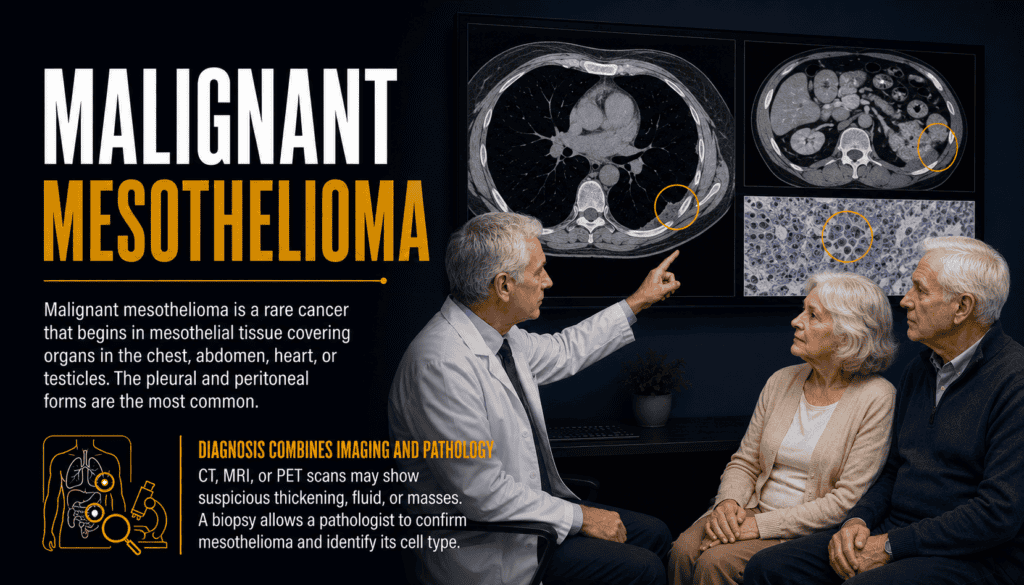
Malignant Mesothelioma
Types, symptoms, diagnosis and treatment options
Malignant mesothelioma is a rare cancer that begins in the mesothelium, the thin tissue covering several internal organs and body cavities. It most often develops in the lining around the lungs after asbestos exposure, but it can also begin in the abdomen, around the heart or around a testicle.
The cancer’s location, cell type, stage and a person’s overall health all affect treatment decisions. Because mesothelioma is uncommon and can resemble other diseases, evaluation by an experienced multidisciplinary team can help confirm the diagnosis and identify appropriate options.
🧬 What Is Malignant Mesothelioma?
Mesothelial cells form a slippery protective membrane that helps organs move against nearby structures. Malignant mesothelioma develops when these cells acquire changes that allow uncontrolled growth, invasion of surrounding tissue and, in some cases, spread to lymph nodes or distant organs.
The word malignant means cancerous. It distinguishes this disease from rare noninvasive or lower-risk mesothelial tumors. A pathology report must establish whether a tumor is malignant and identify its microscopic pattern.
Malignant disease may grow as many small nodules along a body-cavity lining rather than as one round mass. As these tumors thicken and join together, they can restrict an organ’s movement, produce fluid buildup and cause pain or pressure.
🫁 Types of Malignant Mesothelioma by Location
The main types of mesothelioma are named for the membrane where the cancer begins. Location affects symptoms, staging and which treatments may be possible.
| Type | Where It Begins | Common Effects | Typical Evaluation |
|---|---|---|---|
| Pleural mesothelioma | Pleura surrounding the lungs | Chest pain, breathlessness, cough and pleural fluid | Chest CT followed by tissue biopsy when appropriate |
| Peritoneal mesothelioma | Peritoneum lining the abdomen | Abdominal swelling, pain, digestive changes and ascites | Abdominal imaging and image-guided or surgical biopsy |
| Pericardial mesothelioma | Pericardium surrounding the heart | Shortness of breath, chest discomfort and fluid around the heart | Cardiac imaging, fluid analysis and tissue sampling when feasible |
| Testicular mesothelioma | Tunica vaginalis around a testicle | Scrotal swelling, hydrocele or a paratesticular mass | Ultrasound and pathologic examination of tissue |
Pleural mesothelioma is the most common form. Peritoneal disease is the next most common, while pericardial and tunica vaginalis mesotheliomas are exceptionally rare. Treatment evidence is therefore much stronger for pleural disease than for the rarest locations.
⚠️ Causes and Risk Factors
Asbestos exposure causes most mesothelioma cases. When microscopic asbestos fibers are inhaled or swallowed, some may remain in the body and contribute to long-lasting inflammation and cellular damage. Cancer can appear decades after exposure ends.
How Exposure Can Occur
- Occupational exposure: Work involving insulation, construction materials, shipbuilding, boilers, industrial equipment, brakes or other asbestos-containing products.
- Military exposure: Service aboard older ships, at bases or in jobs involving asbestos-containing machinery and building materials.
- Household exposure: Fibers carried home on contaminated clothing, shoes, hair or tools.
- Environmental exposure: Living near asbestos deposits, processing sites or contaminated buildings and materials.
Not everyone exposed to asbestos develops mesothelioma, and some people diagnosed with the disease do not recall a specific exposure. Risk may also be influenced by age, exposure intensity and duration, inherited changes involving genes such as BAP1, prior radiation treatment and exposure to certain naturally occurring mineral fibers. These less common factors do not explain most cases.
Smoking does not cause mesothelioma. However, smoking and asbestos together greatly increase the risk of lung cancer, which is a separate disease.
🩺 Malignant Mesothelioma Symptoms and Warning Signs
Mesothelioma symptoms vary by tumor location and often overlap with more common conditions. They may develop gradually and become more noticeable as fluid accumulates or tumors restrict nearby organs.
| Location | Possible Symptoms | Urgent Warning Signs |
|---|---|---|
| Pleura | Shortness of breath, chest or shoulder pain, persistent cough, fatigue and weight loss | Severe breathing difficulty, blue lips, confusion or sudden chest pain |
| Peritoneum | Abdominal swelling or pain, early fullness, appetite loss, nausea, bowel changes and weight changes | Severe abdominal pain, repeated vomiting, inability to pass stool or gas, or fainting |
| Pericardium | Breathlessness, chest pressure, fatigue, palpitations and swelling | Fainting, severe chest pain, very low blood pressure or rapidly worsening breathlessness |
| Tunica vaginalis | Painless scrotal swelling, a lump, heaviness, discomfort or hydrocele | Sudden severe scrotal pain, rapid swelling, fever or vomiting |
Symptoms alone cannot diagnose mesothelioma. A person with persistent breathing, chest, abdominal or scrotal changes should seek medical evaluation, especially when there is a history of asbestos exposure.
🔬 How Malignant Mesothelioma Is Diagnosed
Diagnosis usually begins with a medical history, physical examination and imaging. Doctors ask about symptoms, past jobs, military service, home renovations and other possible asbestos exposure. Because the disease can resemble pneumonia, heart disease, liver disease and other cancers, several steps may be needed.
Imaging Tests
X-rays, ultrasound, CT, PET/CT and MRI can identify fluid, membrane thickening, tumor deposits and possible spread. The tests chosen depend on where symptoms occur. Imaging can strongly suggest mesothelioma, but it generally cannot establish the final diagnosis.
Fluid Tests and Biopsy
Doctors may drain pleural fluid, abdominal fluid or fluid around the heart to relieve symptoms and examine the cells. A negative fluid cytology result does not reliably exclude mesothelioma. A mesothelioma biopsy that provides enough tissue for microscopic and molecular testing is usually required.
A pathologist uses tumor appearance and a panel of immunohistochemical markers to confirm mesothelial origin and rule out cancers that have spread from another organ. BAP1 loss, MTAP loss or CDKN2A deletion may support malignancy in selected cases, but no single test should be interpreted by itself.
Get Help After a Mesothelioma Diagnosis
Our team can help you organize questions, locate information and understand possible legal options related to asbestos exposure.
Call 800.291.0963 Submit Your Case
Live chat is available 24/7/365.
🧫 Mesothelioma Cell Types
The pathology report identifies the tumor’s histologic type. Cell type helps doctors estimate tumor behavior and select treatment, but it is only one part of an individual’s outlook.
| Cell Type | Microscopic Pattern | General Clinical Meaning |
|---|---|---|
| Epithelioid | Cells often form sheets, tubules or papillary structures | Most common pattern and generally more responsive to treatment than nonepithelioid disease |
| Sarcomatoid | Spindle-shaped cells growing in connective-tissue-like patterns | Often more aggressive and less likely to be treated with major tumor-removing surgery |
| Biphasic | Contains both epithelioid and sarcomatoid components | Behavior depends partly on the proportion and distribution of each component |
Small samples may not represent every part of a heterogeneous tumor. When the diagnosis or cell type is uncertain, an expert pathology review can be valuable before major treatment decisions.
📊 Mesothelioma Stages and Prognosis
Mesothelioma staging describes how far cancer has grown and spread. The formal TNM stages I through IV are established for diffuse pleural mesothelioma. Peritoneal specialists assess the amount and distribution of disease within the abdomen, surgical resectability and spread outside the abdominal cavity. The rare pericardial and tunica vaginalis forms do not have universally accepted site-specific staging systems.
Doctors may evaluate:
- The location and size or distribution of tumors
- Invasion into the chest wall, diaphragm, organs or other nearby structures
- Regional lymph-node involvement
- Distant metastases
- Whether surgeons could remove all visible disease safely
Mesothelioma prognosis depends on stage, cell type, tumor location, age, general health, performance status and response to treatment. Statistics describe groups of previous patients and cannot determine how long one person will live. An experienced oncologist can interpret the available evidence in the context of the individual’s diagnosis.
Mesothelioma may return after treatment. If scans or symptoms suggest new disease, doctors determine whether it represents local progression, metastatic mesothelioma or recurrent mesothelioma and discuss another biopsy when needed.
💊 Malignant Mesothelioma Treatment and Supportive Care
Mesothelioma treatment must be matched to the tumor location, stage, histology and patient’s goals. A plan may use one treatment or combine surgery, systemic medication and radiation. Recommendations for pleural disease should not automatically be applied to peritoneal, pericardial or testicular disease.
Surgery
Selected patients with localized or regionally confined disease may be considered for tumor-removing surgery. For pleural mesothelioma, operations can include pleurectomy/decortication in experienced centers. For eligible peritoneal patients, cytoreductive surgery may be combined with heated intraperitoneal chemotherapy, known as HIPEC. Surgery for rare sites is individualized. Major procedures can carry serious risks and require careful review of expected benefits, lung or organ function and patient preferences.
Chemotherapy and Immunotherapy
Platinum chemotherapy with pemetrexed remains an important systemic option. For unresectable pleural mesothelioma, FDA-approved first-line choices include nivolumab plus ipilimumab and pembrolizumab combined with pemetrexed and platinum chemotherapy. Eligibility and side effects differ, so the oncology team should explain why a regimen fits a particular tumor and patient.
Evidence for immunotherapy and newer drug combinations is more limited in nonpleural mesothelioma. Specialists may use systemic therapies based on available studies, tumor biology, prior treatment and clinical judgment. Clinical trials can offer access to approaches under investigation, but experimental treatment is not guaranteed to help.
Radiation and Symptom-Directed Care
Radiation may help control pain or a specific tumor area and may be incorporated around surgery in selected cases. Symptom-directed procedures can drain fluid around the lungs, abdomen or heart; pleurodesis or an indwelling pleural catheter may help manage recurrent pleural fluid.
Palliative care can begin at any stage and may be provided alongside cancer treatment. It addresses pain, breathing, appetite, sleep, stress and caregiver needs. Hospice is different and is generally considered when the focus shifts fully from disease-directed treatment to comfort. Patients and families can find practical assistance through mesothelioma support resources.
Authoritative Medical Sources
- National Cancer Institute: Mesothelioma
- National Cancer Institute: Malignant Mesothelioma Treatment (PDQ)
- Centers for Disease Control and Prevention: Mesothelioma Basics
- American Cancer Society: Malignant Mesothelioma
- MedlinePlus: Mesothelioma
- U.S. Food and Drug Administration: Pembrolizumab With Chemotherapy for Pleural Mesothelioma
- ClinicalTrials.gov: Mesothelioma Studies
❓ Frequently Asked Questions About Malignant Mesothelioma
Is all mesothelioma malignant?
No. The term mesothelioma commonly refers to malignant cancer, but rare mesothelial tumors can be noninvasive or have lower malignant potential. A pathologist determines the exact diagnosis from tissue.
Is malignant mesothelioma a type of lung cancer?
No. Pleural mesothelioma starts in the lining around the lungs. Lung cancer starts within lung tissue. Their pathology, staging and treatments differ.
What is the main cause of malignant mesothelioma?
Asbestos exposure causes most cases. Disease may not appear until decades after exposure, and some patients do not remember when or where contact occurred.
Can a blood test diagnose mesothelioma?
No blood test can confirm mesothelioma by itself. Biomarkers may provide supporting information or help monitor selected patients, but diagnosis generally requires adequate tumor tissue examined by a pathologist.
Why is a biopsy important?
A biopsy confirms whether cells are malignant, establishes mesothelial origin and identifies the cell type. This information helps distinguish mesothelioma from other cancers and guides treatment planning.
Can malignant mesothelioma be treated?
Yes. Depending on the diagnosis, treatment may include surgery, chemotherapy, immunotherapy, radiation, fluid-control procedures and supportive care. The goal may be long-term control, slowing progression, relieving symptoms or a combination of these aims.
Should I seek a mesothelioma specialist?
A specialist consultation or second opinion is reasonable because the disease is rare and management differs by location and cell type. Expert pathology review can also help verify the diagnosis before major treatment.
What should I bring to a second-opinion appointment?
Bring pathology reports and slides, imaging reports and image files, operative notes, treatment records, medication lists, exposure history and a written list of questions. The receiving center can explain how to transfer large imaging and pathology files.
Talk With Our Mesothelioma Support Team
If you or a loved one has been diagnosed with malignant mesothelioma, we can help you find information and understand possible legal options related to asbestos exposure. There is no obligation.
Call 800.291.0963 Submit Your Case
Live chat is available 24/7/365.
Medical and legal disclaimer: This page provides general educational information and is not a substitute for advice from a licensed physician or attorney. Diagnosis and treatment decisions must be made with qualified health professionals. Case eligibility and legal rights depend on individual facts and applicable law; contacting us does not create an attorney-client relationship.