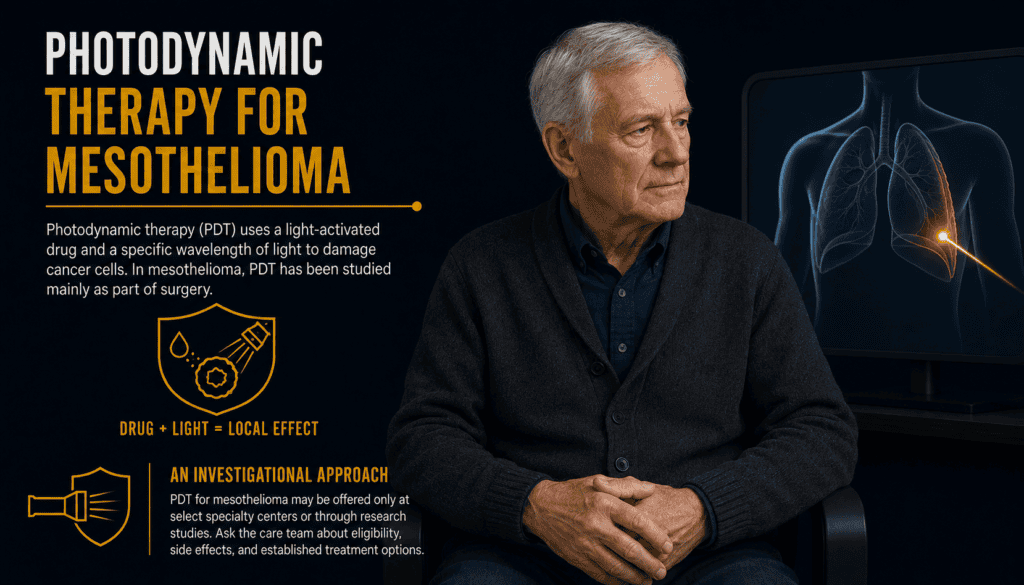
Photodynamic Therapy for Mesothelioma: How PDT Works, Risks and Research
A patient-focused guide to a light-activated treatment being investigated for selected people with pleural mesothelioma.
Key takeaway: Photodynamic therapy (PDT) combines a light-sensitive drug and a controlled light source to damage tumor cells. For mesothelioma, PDT remains an investigational approach, often studied during surgery; it is not a routine substitute for established treatments or a proven cure.
What Is Photodynamic Therapy?
Photodynamic therapy is a cancer treatment method that requires both a photosensitizing medicine and light of a specific wavelength. The drug is administered before light exposure; the illuminated drug triggers chemical reactions that can injure nearby cells. The National Cancer Institute (NCI) describes PDT as a localized treatment: light reaches only areas accessible to the delivery system, which is an important limitation for extensive disease.
In pleural mesothelioma research, clinicians have studied intraoperative PDT, delivering light inside the chest during surgery after visible tumor has been removed. The goal is to target microscopic residual disease; whether this improves survival for an individual is uncertain. PDT for mesothelioma is investigational, not an established first-line standard.
| Term | Meaning |
|---|---|
| Photosensitizer | A medicine that becomes active when illuminated by a suitable light source. |
| Intraoperative PDT | Light-based treatment delivered during an operation. |
| Pleura | The tissue lining the lungs and inner chest wall, where pleural mesothelioma develops. |
| Light dosimetry | Measurement of the light dose delivered to tissue. |
How PDT Works Against Tumor Cells
The drug is given first and accumulates in tissues. During treatment, clinicians expose a selected area to a controlled light source. When activated, the drug produces reactive oxygen species that can damage tumor cells and nearby blood vessels. Healthy tissue can also be affected; PDT is not perfectly cancer-specific.
Light penetrates tissue only to a limited depth, so PDT alone cannot reliably treat bulky tumors or cancer throughout the body. In surgical research, clinicians attempt to distribute light throughout the operative space while measuring its delivery.
| Component | Role | Important limitation |
|---|---|---|
| Photosensitizing drug | Makes exposed tissue responsive to light | Can also increase sensitivity of normal skin and eyes. |
| Specified light wavelength | Activates the drug | Cannot reach every deep or distant tumor site. |
| Oxygen in tissue | Participates in cell-damaging reaction | Treatment effects depend on local conditions. |
| Dosimetry equipment | Helps measure light delivery | Requires specialized expertise and equipment. |
What Happens Before, During and After PDT?
The exact protocol depends on the investigational drug and clinical study. For example, a registered mesothelioma trial of porfimer sodium administered the medicine intravenously and performed intraoperative PDT 24–48 hours later. This timing is a description of that trial, not instructions for every patient.
- Specialist review: The team confirms diagnosis, extent of disease, operative fitness and trial eligibility.
- Consent and planning: Patients discuss the experimental nature, surgery, light protection and alternatives.
- Drug administration: The photosensitizer is delivered according to the protocol.
- Surgery and light treatment: If the protocol calls for surgery, clinicians remove visible tumor as feasible and deliver carefully measured light to the operative area.
- Recovery and monitoring: Teams monitor surgical complications, treatment-related inflammation, breathing, pain and light sensitivity.
| Phase | Questions to ask |
|---|---|
| Before treatment | What is the trial ID, drug, and planned surgery? |
| During treatment | How is light dose measured and normal tissue protected? |
| After treatment | How long must I avoid sunlight and bright indoor light? |
| Follow-up | Which scans and appointments measure response and safety? |
Who May Be Considered for PDT?
Eligibility is determined by a multidisciplinary mesothelioma team and the exact clinical trial. Historical intraoperative studies have focused on selected people with pleural disease undergoing surgery. A person’s disease distribution, pathology, performance status, organ function, prior therapy and ability to comply with light precautions may matter. A patient with peritoneal mesothelioma should not assume that a pleural PDT protocol applies to them.
Being eligible for surgery does not automatically mean PDT is appropriate. Ask whether a trial is currently recruiting, what its inclusion and exclusion criteria require, and what happens if the procedure cannot be completed as planned.
| Assessment | Why it matters |
|---|---|
| Confirmed pathology | Ensures treatment is directed at the correct cancer. |
| Imaging and extent | Shows whether disease is localized enough for the study design. |
| Heart, lung and overall health | Helps assess surgical and anesthesia risks. |
| Prior treatments | May affect protocol eligibility and timing. |
| Medication and light sensitivity history | May affect drug safety and recovery precautions. |
Need help now? Call 800.291.0963 / Live chat available 24/7, 365 days a year / Submit Your Case.
Potential Benefits and What Research Has Actually Shown
Researchers are studying whether PDT can damage cancer cells remaining after surgery and improve local control. These are research goals, not established benefits for every patient. Earlier studies included small, highly selected groups, sometimes receiving several treatments at once; their results cannot isolate the effect of PDT or predict a particular patient’s survival.
A published phase III study compared surgery and postoperative therapy with or without intraoperative PDT. Its existence does not establish that modern PDT regimens are proven effective. A more recent phase I light-dosimetry study, ClinicalTrials.gov identifier NCT03678350, is listed as completed, with nine actual participants and no results posted on its registry record as checked in September 2026. Do not mistake a completed trial for proof of benefit or an open enrollment opportunity.
| Evidence type | What it can tell you | What it cannot establish |
|---|---|---|
| Laboratory studies | Biologic rationale | Patient survival benefit. |
| Phase I trial | Feasibility, dose and safety signals | Definitive comparative effectiveness. |
| Small surgical series | Outcomes in selected treated patients | Which part of combination treatment caused an outcome. |
| Randomized comparative trial | Can compare specified treatment strategies | May not apply to different modern protocols or populations. |
Risks, Side Effects and Safety Precautions
Risks include reactions to the photosensitizer, prolonged sensitivity to sunlight and strong indoor lighting, burns or injury to illuminated healthy tissue, swelling, inflammation and pain. When PDT is delivered during chest surgery, the operation itself adds risks such as infection, bleeding, respiratory complications and prolonged recovery. Risk depends on the drug, dose, illuminated area, operation and individual health.
Patients should receive a drug-specific written light-avoidance plan; do not assume a generic number of days is safe. Seek urgent medical attention for severe new breathlessness, chest pain, uncontrolled bleeding, high fever or other symptoms identified by your treatment team.
| Possible issue | What to discuss with the team |
|---|---|
| Skin and eye photosensitivity | Exact duration and methods for protecting against light. |
| Pain and tissue inflammation | Pain-control plan and symptoms requiring a call. |
| Breathing problems | Expected recovery versus urgent warning signs. |
| Surgical complications | Individual operative risk and hospital recovery. |
| Uncertain benefit | Study endpoints and available alternatives. |
How PDT Compares With Other Mesothelioma Treatments
Established mesothelioma care is individualized. Depending on disease type, stage, resectability, pathology and health, options may include systemic immunotherapy, chemotherapy, selected surgery, radiation for specific indications and symptom-directed procedures. PDT should be considered in that broader discussion, not as a replacement chosen without specialist advice.
Read more about mesothelioma treatment options, multimodal therapy, immunotherapy and radiation therapy.
| Approach | Main purpose | Key distinction |
|---|---|---|
| PDT in research | Locally damage illuminated tumor cells | Investigational for mesothelioma. |
| Systemic therapy | Treat cancer throughout the body | Selection depends on clinical factors and approvals. |
| Surgery | Remove visible tumor in selected patients | Major procedure with individual risks. |
| Radiation | Target a defined area | Different energy source and treatment planning. |
| Supportive care | Relieve symptoms and improve comfort | Appropriate alongside cancer-directed care. |
Finding Clinical Trials and Questions to Ask
Ask a mesothelioma specialist to search current studies rather than relying on an old article’s trial list. The NCI mesothelioma clinical-trials directory provides a starting point; ClinicalTrials.gov NCT03678350 illustrates a completed PDT dosimetry study, not an enrollment offer. Verify a study’s current status directly with its coordinator before making travel plans.
Bring these questions: Is PDT available only in a trial? What is the study identifier and phase? What surgery is required? What is known about benefit and complications? Who pays for the investigational procedure, routine care, travel and complications? How does participation affect standard treatment timing? What happens if I withdraw?
| Trial detail | Verify before enrollment |
|---|---|
| Status | Recruiting, not yet recruiting, completed or closed. |
| Eligibility | Pathology, disease location, prior treatments and fitness. |
| Treatment plan | Drug, light delivery, surgery and follow-up. |
| Costs | Insurance coverage, sponsor responsibilities and travel. |
| Informed consent | Known risks, unknowns and alternatives. |
Frequently Asked Questions
Is photodynamic therapy approved for mesothelioma?
PDT is not an established, FDA-approved mesothelioma treatment. It has been studied in clinical research; ask a specialist about currently available trials and standard alternatives.
Can PDT cure mesothelioma?
There is no reliable evidence that PDT cures mesothelioma. Its potential role in selected treatment combinations remains under investigation.
Is PDT the same as radiation therapy?
No. PDT activates a photosensitizing drug with specific light; radiation therapy uses ionizing radiation to damage cancer cells.
Does PDT require surgery?
Mesothelioma studies have commonly investigated intraoperative PDT during chest surgery. Whether a different protocol exists depends on the specific study.
Can PDT treat peritoneal mesothelioma?
Do not assume evidence from pleural mesothelioma applies to peritoneal disease. Ask a peritoneal mesothelioma specialist about evidence and available studies.
What is the biggest side effect?
Light sensitivity can be important, but surgery and local tissue injury may also pose serious risks. Ask for the exact drug-specific precautions and personalized risk assessment.
How long do light precautions last?
The period varies by photosensitizer and protocol. Follow your treatment team’s written instructions rather than a general timeline.
Where can I find a PDT trial?
Search NCI and ClinicalTrials.gov and confirm recruitment with the study team. A listed completed study is not open for enrollment.
Medical Sources and Research Records
- National Cancer Institute: Photodynamic Therapy to Treat Cancer — general mechanism, limitations and safety.
- NCI: Intraoperative PDT light-dosimetry trial — trial protocol and investigational context.
- ClinicalTrials.gov: NCT03678350 — registry status and study information.
- PubMed: randomized surgery with or without PDT study — historical comparative research.
- NCI: Mesothelioma clinical trials — search for studies; verify current status.
Research and trial status reviewed September 17, 2026. Trial listings and treatment availability can change.
Get Help Understanding Your Options
Call 800.291.0963. Live chat is available 24/7, 365 days a year. Submit Your Case.
We can help you explore information about asbestos exposure and potential legal options. No compensation or outcome is guaranteed. For medical treatment decisions, speak with your mesothelioma care team.
⚕️ Legal & Medical Information Disclaimer
This page is educational and is not medical or legal advice. A qualified clinician should evaluate treatment options and a licensed attorney should evaluate individual legal rights.