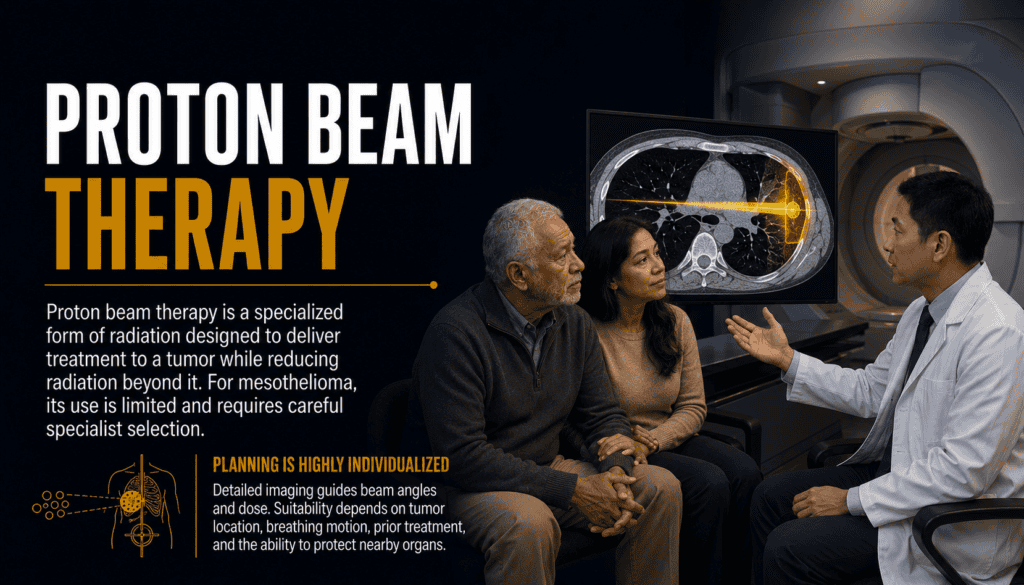
Proton Beam Therapy for Mesothelioma: Benefits, Risks and Evidence
A patient-focused explanation of where proton radiation may fit into pleural mesothelioma care—and what remains uncertain.
Key takeaway: Proton beam therapy is a specialized form of external-beam radiation. Its physical properties can reduce radiation beyond a target, but a more favorable dose plan does not by itself establish better survival or fewer complications for mesothelioma. Experienced multidisciplinary evaluation is essential.
What Is Proton Beam Therapy?
Proton beam therapy uses accelerated, positively charged particles to deliver radiation to a planned area. Like conventional external-beam radiation, it damages cancer cells in the treated region; it is not a medication that circulates throughout the body. A characteristic of protons is that much of their dose can be deposited near a chosen depth, followed by a steep decrease in dose. This may help protect selected healthy structures, depending on the patient’s anatomy and treatment plan.
Pleural mesothelioma often grows across the lining of the lung rather than as one compact mass. Covering this broad, irregular surface while protecting the remaining lung, heart, esophagus and other organs makes radiation planning challenging. Proton treatment is therefore a specialized consideration—not a routine replacement for all other mesothelioma treatments.
| Term | Plain-language meaning |
|---|---|
| Proton beam therapy | Radiation delivered using protons rather than x-ray photons. |
| Bragg peak | A depth at which proton energy deposition peaks before falling off. |
| Pencil-beam scanning | A method that directs small proton spots across a planned treatment volume. |
| Intensity-modulated proton therapy (IMPT) | A planning and delivery approach that varies proton intensity to shape the dose. |
For general background, see the National Cancer Institute explanation of external-beam radiation.
Protons vs. Standard Radiation
Conventional radiation generally uses photons (x-rays). Photon beams continue through tissue beyond the tumor, while proton beams can be designed to stop near a selected depth. This physical distinction may reduce exposure to some organs. However, a proton plan can still irradiate healthy tissue, and whether its theoretical advantage translates into better outcomes for a particular patient requires individualized assessment.
| Feature | Photon radiation (such as IMRT) | Proton radiation |
|---|---|---|
| Beam | X-ray photons | Charged proton particles |
| Dose beyond target | Can continue beyond the target | May have less exit dose |
| Mesothelioma evidence | Longer clinical experience; still requires careful selection | More limited clinical evidence for comparative outcomes |
| Practical issues | More widely available | Specialized centers, insurance review and travel may be needed |
A radiation oncologist may generate and compare both plans. The relevant question is not simply whether proton technology is newer, but whether the plan covers the intended disease while keeping doses to critical organs within acceptable limits.
What the Evidence Shows—and Does Not Show
Research in pleural mesothelioma has investigated proton radiation in carefully selected patients, often after surgery and alongside other treatments. Planning studies and small clinical series suggest potential reductions in dose to certain nearby organs. They do not establish that proton therapy cures mesothelioma, extends survival more than photon therapy, or is safer for every patient.
The American Society of Clinical Oncology’s updated pleural mesothelioma guideline says proton therapy may be considered at centers with substantial experience, preferably in a clinical trial. An international radiation consensus likewise emphasizes specialist expertise and further research. These recommendations are not a blanket endorsement for every stage or disease site.
| Evidence type | What it can tell patients | What it cannot prove alone |
|---|---|---|
| Treatment-planning comparison | Whether one plan lowers estimated dose to specific organs | That a patient will live longer |
| Small patient series | Feasibility and observed complications in a selected group | Reliable comparative benefit for all patients |
| Clinical trial | Can test safety, treatment effects and selected outcomes | Results cannot be assumed before publication |
| Professional guideline | How experts interpret available evidence | That a technique is appropriate for every individual |
Sources: ASCO guideline update; multidisciplinary radiation consensus; NCI treatment clinical-trial listings. Trial eligibility and enrollment change; verify directly with the study team.
Who May Be Considered for Proton Therapy?
Eligibility depends on the exact disease location, extent, previous treatments, lung function, other health conditions, and the goal of radiation. A specialist team may consider proton therapy for selected pleural mesothelioma patients receiving radiation after surgery, or for another carefully defined treatment target. The role of proton treatment in peritoneal mesothelioma is not established by evidence about whole-pleural radiation.
| Factor reviewed | Why it matters |
|---|---|
| Disease type and distribution | A broad pleural target differs from a localized painful lesion or abdominal disease. |
| Surgery and remaining lung | Whether a lung remains affects dose constraints and pulmonary risk. |
| Prior radiation | Overlapping dose may increase damage to normal organs. |
| Breathing and imaging | Chest movement and changing anatomy can affect proton range. |
| Patient goals | Symptom relief and treatment after surgery have different aims. |
Ask whether your case has been reviewed by a mesothelioma-focused multidisciplinary team, including a radiation oncologist with direct experience in pleural radiation. Learn about mesothelioma doctors and specialist teams.
What Happens During Planning and Treatment?
Before treatment, the radiation team reviews pathology, recent scans, prior procedures and treatment records. A planning CT may be performed in a reproducible position; motion-management imaging may be necessary because breathing changes chest anatomy. The team outlines the target and nearby organs, calculates a dose distribution, checks uncertainties and conducts quality assurance.
| Step | What to expect |
|---|---|
| Specialist consultation | Discuss purpose, alternatives, expected benefit and risks. |
| Simulation and imaging | Positioning, planning CT and possible motion assessment. |
| Dose planning | Evaluate target coverage and normal-organ exposure. |
| Plan verification | Physics and clinical checks before delivery. |
| Treatment visits | External-beam sessions; number and schedule depend on the prescribed plan. |
| Follow-up | Review symptoms, adverse effects and subsequent scans. |
Because air, fluid, weight and tumor size can change during a course of treatment, repeat imaging or replanning may be required. Do not assume that the schedule used for another patient applies to you.
Need help now? Call 800.291.0963 / Live chat available 24/7, 365 days a year / Submit Your Case.
Side Effects, Risks and Practical Limitations
Proton radiation can still injure normal tissues. Risks depend on total dose, treated volume, organs exposed, prior therapy and individual health. Radiation-related lung inflammation (pneumonitis), fatigue, skin irritation, swallowing discomfort and later tissue scarring may be relevant when the chest is treated. Serious toxicity is possible, particularly with large pleural treatment fields.
| Issue | What to discuss with the team |
|---|---|
| Pneumonitis | Baseline lung function, warning symptoms and when to call. |
| Heart and esophagus exposure | Dose constraints and expected effects. |
| Motion and range uncertainty | How breathing, fluid and anatomy changes are handled. |
| Travel and access | Daily appointments, lodging and caregiver needs. |
| Insurance coverage | Authorization, appeals and out-of-pocket costs. |
Contact your treating team promptly for new or worsening shortness of breath, fever, chest pain or other concerning symptoms. Seek emergency care for severe breathing difficulty or severe chest pain. A reduced calculated dose does not eliminate the need for monitoring.
How Proton Therapy Fits With Other Mesothelioma Treatments
Treatment plans may include systemic medication, selected surgery, radiation for specific symptoms, clinical trials and supportive care. The right combination depends on disease characteristics and personal priorities. Proton therapy is one radiation technique, not a substitute for systemic treatment when cancer has spread beyond a radiation field.
| Approach | Possible role |
|---|---|
| Photon radiation / IMRT | An established radiation technique for selected targets and clinical scenarios. |
| Proton radiation | A specialized radiation option for selected cases at experienced centers. |
| Immunotherapy | Systemic treatment considered according to diagnosis and clinical circumstances. |
| Chemotherapy | Systemic treatment used in various mesothelioma treatment plans. |
| Palliative care | Relief of symptoms and support alongside other care or on its own. |
Read the broader mesothelioma treatment overview, radiation therapy guide, immunotherapy guide and multimodal treatment guide.
Questions to Ask Before Choosing Proton Therapy
Bring the latest pathology report, imaging, surgery notes, prior radiation details, medication list and insurance information. If you are considering travel, ask whether a remote review can determine whether an in-person consultation is worthwhile.
| Ask your radiation oncologist | Why ask |
|---|---|
| What is the specific goal of radiation in my case? | Clarifies whether the aim is symptom control or part of a larger plan. |
| Can you compare a proton and photon plan for me? | Shows whether organ-sparing benefits are meaningful in your anatomy. |
| What evidence supports this approach for my disease? | Separates research findings from assumptions. |
| How will you protect my remaining lung and heart? | Addresses key safety constraints. |
| Is a suitable clinical trial available? | Identifies research options without assuming enrollment. |
| What happens if my anatomy changes during treatment? | Explains imaging and replanning procedures. |
| What will insurance cover? | Avoids unexpected costs and treatment delays. |
For a second opinion or a trial search, start with the mesothelioma second-opinion guide and the NCI trial search. No particular center or trial is guaranteed to accept an individual patient.
Frequently Asked Questions
Is proton beam therapy a cure for mesothelioma?
No cure can be promised. Proton therapy is a form of localized radiation; available mesothelioma research does not establish it as a cure.
Is proton therapy FDA-approved for mesothelioma?
Proton radiation equipment is used in cancer care, but this does not mean proton treatment is proven superior or routinely indicated for mesothelioma. Ask your specialist about the evidence for your exact clinical scenario.
Is proton radiation safer than IMRT?
It may reduce calculated dose to some normal tissues in certain plans, but patient-level safety depends on the actual plan, anatomy and clinical circumstances. A dosimetric advantage does not guarantee fewer side effects.
Can proton therapy be given after surgery?
It may be considered in selected pleural mesothelioma cases after surgery at experienced centers, preferably in a clinical trial, based on specialist guidelines.
Does proton therapy work for peritoneal mesothelioma?
Evidence and recommendations for pleural mesothelioma cannot simply be applied to disease in the abdomen. Discuss abdominal disease with a specialist experienced in peritoneal mesothelioma.
How many proton sessions will I need?
There is no single schedule. The number of sessions depends on the goal, target, dose and clinical protocol established by your radiation team.
Will insurance pay for proton therapy?
Coverage varies by plan and medical indication. Ask the center for a written coverage review, prior authorization details and estimated patient costs before starting.
Should I seek a second opinion?
A second opinion at a center experienced in mesothelioma radiation can help clarify whether proton therapy, photon radiation, another treatment or symptom-focused care fits your circumstances.
Medical Sources and Further Reading
- National Cancer Institute: External Beam Radiation Therapy
- National Cancer Institute: Mesothelioma Treatment
- American Society of Clinical Oncology: Pleural Mesothelioma Guideline Update
- NCI / IASLC / MARF: Radiation Therapy Expert Consensus
- National Cancer Institute: Mesothelioma Treatment Trials
Medical research and trial status can change. This article does not imply that every listed technique or study is available or appropriate for every patient.
Get Help Understanding Your Options
Call 800.291.0963 for assistance. Live chat is available 24/7, 365 days a year. Submit Your Case to discuss potential next steps.
Eligibility for legal claims or compensation depends on individual facts and applicable law. No outcome or amount of compensation is guaranteed.
⚕️ Legal & Medical Information Disclaimer
This content provides general education, not individual medical or legal advice. Consult qualified healthcare and legal professionals about your circumstances. Never delay or replace recommended cancer care based on this article.