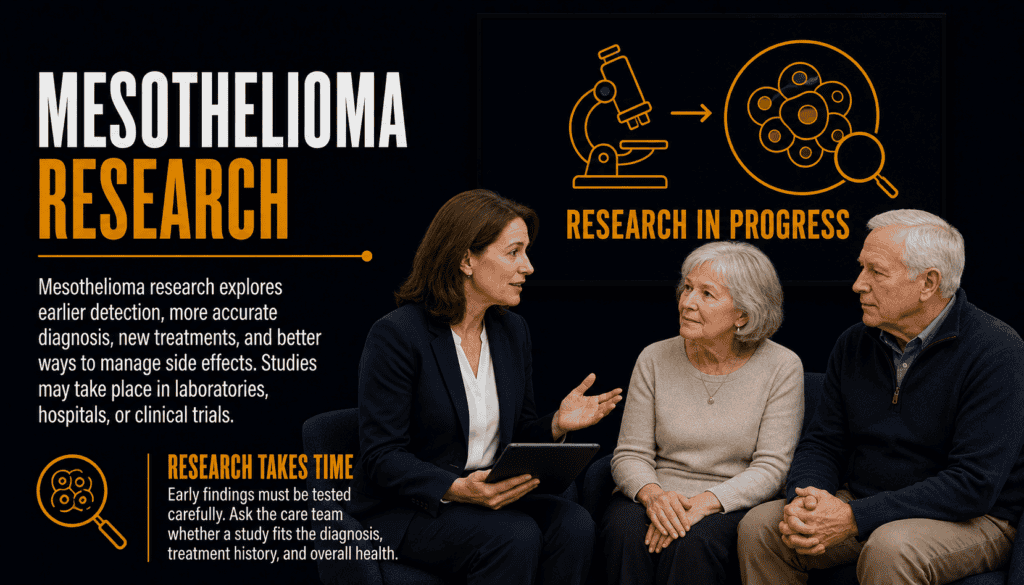
Mesothelioma Research
Clinical Trials, New Treatments and Hope for Patients
Mesothelioma research is advancing our understanding of this asbestos-related cancer. For patients and families, new studies can raise important questions: Are there better treatments? Could a clinical trial help? What do researchers know about finding the disease earlier?
This guide explains current research directions in clear language and connects you to more detailed articles. It also explains why promising early results need careful testing before a treatment becomes part of routine medical care.
🧭 On This Page
- What Mesothelioma Research Is Studying
- Clinical Trials and Participation
- Emerging Treatment Approaches
- Precision Medicine and Tumor Testing
- Research on Earlier and More Accurate Diagnosis
- Asbestos Exposure and Prevention Studies
- How to Evaluate a Research Headline
- Questions to Ask a Mesothelioma Specialist
- Mesothelioma Research Articles
What Mesothelioma Research Is Studying
Mesothelioma research is focused on helping people live longer, feel better during treatment, and receive a diagnosis sooner. Scientists study how mesothelioma develops, why some tumors respond to treatment while others do not, and how care can be matched more closely to each patient.
Research is important, but an experimental approach is not the same as a proven treatment. A study that looks promising in a laboratory may not help people when tested in clinical trials. Your specialist can explain which findings have changed standard care and which remain under investigation.
For a foundation in the disease, see What Is Mesothelioma? and Mesothelioma Treatments.
Clinical Trials and Participation
Clinical trials are carefully planned studies involving volunteers. Some compare treatments; others study side effects, quality of life, tests, or ways to prevent disease. Trials have eligibility rules, which may include cancer location, prior treatment, overall health, and specific laboratory results.
Joining a trial is a choice. Before enrolling, ask what treatment you might receive, what extra visits or tests are required, what costs may be covered, and whether the study involves random assignment. Standard treatment and supportive care may still be available if you decide not to participate.
Read Clinical Trials for Mesothelioma and Clinical Trials: How to Qualify and Participate. Your oncologist can help you search for recruiting studies and understand the possible benefits and risks.
Emerging Treatment Approaches
Researchers are evaluating new ways to use immunotherapy, targeted medicines, combinations of existing treatments, and different treatment sequences. Some studies also explore whether surgery or radiation can be combined with medicines more effectively for carefully selected patients.
Results can differ between pleural and peritoneal mesothelioma, and between tumor cell types. News headlines may report an early response in a small group, but larger trials and longer follow-up are often needed to understand survival, side effects, and who may benefit.
Explore Emerging Research in Mesothelioma Treatment. For currently established options and practical treatment questions, visit Mesothelioma Treatments.
Precision Medicine and Tumor Testing
Precision medicine looks for characteristics of a person’s cancer that may help guide care. Researchers study tumor genetics, proteins, and the surrounding immune environment to see whether certain findings predict response to a treatment.
A biomarker is a measurable feature of a tumor or the body. Not every biomarker is useful in mesothelioma, and having a genetic finding does not automatically mean an approved targeted drug exists. Ask whether your pathology report includes testing relevant to treatment decisions or clinical-trial eligibility.
See Precision Medicine & Pharmacogenomics in Mesothelioma. If you need help understanding a report, the Mesothelioma Diagnosis section explains pathology and second opinions.
Research on Earlier and More Accurate Diagnosis
Mesothelioma can be difficult to identify because its early symptoms resemble those of more common illnesses. Researchers are studying blood-based markers, imaging methods, and computer-assisted tools to improve how suspicious findings are recognized and evaluated.
Artificial intelligence may help specialists review images or tissue samples, but these tools are not substitutes for a complete medical assessment. A confirmed diagnosis commonly requires a tissue sample examined by an experienced pathologist.
Read AI-Driven Diagnosis: Detecting Mesothelioma Earlier. If you have persistent symptoms or known asbestos exposure, discuss them with a clinician rather than waiting for a new screening technology to become available.
Asbestos Exposure and Prevention Studies
Research also examines how asbestos fibers cause disease, why mesothelioma can appear decades after exposure, and which work environments historically created the greatest risks. These studies can improve prevention and help doctors understand patterns of illness.
An asbestos exposure history may include jobs, military service, household contact with dusty work clothing, or older building materials. Exposure does not mean someone will develop mesothelioma, and the timing and circumstances of exposure vary widely.
Learn more in Mesothelioma Studies, What Latest Asbestos Studies Reveal, and The Future of Mesothelioma Research and Prevention.
How to Evaluate a Research Headline
A headline describing a breakthrough can be encouraging, but it helps to ask what the researchers actually measured. Was the study done in cells, animals, or people? How many patients participated? Was the treatment compared with an established option?
A response rate describes tumor changes and is not the same as a cure. Overall survival, progression-free survival, symptoms, and side effects each tell a different part of the story. Findings presented at a conference may later change after peer review or additional follow-up.
Reliable starting points include the National Cancer Institute, ClinicalTrials.gov, and published studies discussed with your oncology team.
Questions to Ask a Mesothelioma Specialist
Bring a written list to your next appointment. Ask whether your diagnosis and pathology have been reviewed by a team experienced in mesothelioma, which treatments are standard for your specific disease, and whether any appropriate trials are recruiting.
It is also reasonable to ask what participation would mean for travel, time away from home, insurance, and other care. A trial coordinator can explain the informed-consent process, while a social worker may help identify transportation or lodging resources.
If your first treatment has stopped working, ask whether another standard treatment, a clinical trial, or symptom-focused care would best fit your goals. A second opinion can be useful when major decisions are being made.
Mesothelioma Research Articles
The following articles explore research topics in greater depth. Start with the subject most relevant to your questions and discuss any potential treatment changes with your medical team.
- Clinical Trials for Mesothelioma
- Mesothelioma Studies
- What Latest Asbestos Studies Reveal
- Clinical Trials: How to Qualify and Participate
- Emerging Research in Mesothelioma Treatment
- AI-Driven Diagnosis – Detecting Mesothelioma Earlier
- Precision Medicine & Pharmacogenomics in Mesothelioma
- The Future of Mesothelioma Research and Prevention
❓ Frequently Asked Questions
Is there a cure for mesothelioma?
There is no treatment that reliably cures every case. Some patients have long-lasting responses, and researchers continue to study better options. Your specialist can explain the goals of treatment for your situation.
Are clinical trials only for people who have exhausted treatment?
No. Some trials are for newly diagnosed patients, while others study treatment after a prior therapy. Eligibility depends on the individual study.
Does participating in a trial guarantee a new drug?
No. Some trials compare approaches or randomly assign treatments. The informed-consent documents explain what participants may receive.
Can I leave a clinical trial?
Participation is voluntary, and you can generally withdraw. Discuss how stopping may affect your ongoing medical care with the study team.
Can AI diagnose mesothelioma?
AI tools are being studied to support image and tissue review. They do not replace examination by qualified clinicians and pathologists.
What is precision medicine?
It is an approach that uses features of a tumor or patient to help guide care. Not every finding leads to an available mesothelioma treatment.
Where can I find active mesothelioma clinical trials?
ClinicalTrials.gov lists registered studies. A mesothelioma specialist can help identify trials that may fit your diagnosis and circumstances.
Should I change my treatment after reading a research article?
Do not change prescribed care based on a headline. Review the evidence, side effects, and alternatives with your treating team.
📚 Medical Sources
- National Cancer Institute — Mesothelioma
- ClinicalTrials.gov — Clinical Research Studies
- National Cancer Institute — Clinical Trials Information
Get Help After a Mesothelioma Diagnosis
If you or someone in your family has been diagnosed with mesothelioma, we can help you understand potential asbestos exposure and options for seeking legal guidance. Call 800.291.0963. Live chat is available 24/7, 365 days a year. You can also Submit Your Case. No compensation or legal outcome is guaranteed.
⚕️ Legal & Medical Information Disclaimer
This page is general educational information, not a substitute for individualized medical advice, diagnosis, treatment, or legal counsel. Research findings and trial availability change. Consult qualified medical and legal professionals about your circumstances.