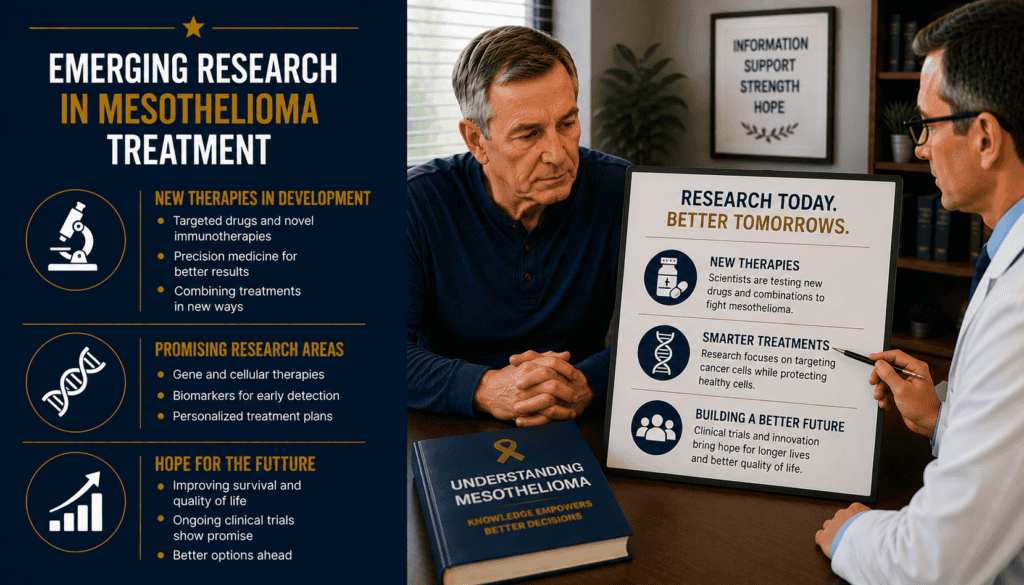
Emerging Research in Mesothelioma Treatment
Investigational therapies, combination strategies and clinical trials
Emerging mesothelioma research is testing new ways to activate the immune system, target tumor-associated proteins, exploit molecular vulnerabilities and deliver treatment more precisely. Some strategies build on established therapies, while others remain in early laboratory or clinical development.
Experimental does not mean better, safer or appropriate for every patient. The strength of evidence depends on the study phase, number of participants, comparison group, primary endpoint and whether results have been confirmed in a broader population.
🔬 Emerging Treatment Research Overview
Mesothelioma research includes established regimens being tested in new sequences as well as entirely investigational drugs and technologies. The site’s broader mesothelioma research overview explains laboratory research, clinical-trial phases, biomarkers and participation.
| Evidence Category | What It Means | What It Does Not Mean |
|---|---|---|
| Approved or established use | Regulators or guidelines recognize a treatment for a defined setting | It is appropriate for every patient or tumor location |
| Late-phase clinical research | A treatment is being compared in a larger, structured study | The final result will be positive or lead to approval |
| Early-phase clinical research | Investigators are evaluating safety, dose and preliminary activity | Effectiveness has been proven |
| Preclinical research | An approach has been studied in cells, tissue models or animals | It is safe or effective in people |
| Biomarker hypothesis | A measurable feature may relate to response or resistance | The marker is validated for routine treatment selection |
The primary site, stage, health, prior treatment and mesothelioma cell type can change how research evidence applies. Results from pleural mesothelioma cannot automatically be transferred to peritoneal, pericardial or testicular mesothelioma.
🛡️ Immunotherapy Research
Immune checkpoint inhibition is established in specified pleural mesothelioma settings. Current research asks why some tumors respond, why resistance develops and whether other immune strategies can produce deeper or longer-lasting control.
| Research Direction | Scientific Goal | Important Challenge |
|---|---|---|
| Checkpoint combinations | Block more than one signal that restrains immune cells | Greater immune activation can also increase toxicity |
| New checkpoint targets | Overcome resistance beyond established PD-1, PD-L1 or CTLA-4 pathways | Biological activity may not translate into clinical benefit |
| Neoadjuvant immunotherapy | Treat before surgery while the tumor remains present as an immune target | Timing and adverse effects can affect surgical plans |
| Adjuvant immunotherapy | Reduce recurrence risk after local treatment | Microscopic disease cannot be measured directly |
| Immunotherapy after progression | Find effective sequences after an earlier regimen stops working | Prior exposure may alter tumor and immune biology |
| Microenvironment research | Change immune suppression within and around the tumor | The microenvironment varies within a tumor and over time |
The CheckMate 743 trial established that nivolumab plus ipilimumab could improve overall survival compared with platinum-pemetrexed chemotherapy in previously untreated unresectable malignant pleural mesothelioma. That result is established evidence, while many newer immune combinations remain experimental.
Read the site’s guide to immunotherapy for mesothelioma for treatment uses, immune-related side effects and questions for the oncology team.
💉 Chemotherapy and Immunotherapy Combinations
Chemoimmunotherapy combines cytotoxic drugs with an immune checkpoint inhibitor. Researchers study whether chemotherapy can release tumor antigens or alter immune signaling in ways that complement immunotherapy.
| Research Question | Why It Is Studied | What Must Be Compared |
|---|---|---|
| Which checkpoint inhibitor? | Different agents target different immune pathways | Benefit, adverse events, labeling and patient characteristics |
| Which platinum drug? | Cisplatin and carboplatin have different toxicity profiles | Kidney function, hearing, neuropathy, blood counts and fitness |
| Concurrent or sequential treatment? | Timing may affect immune activation and tolerability | Control of disease, cumulative toxicity and later options |
| Maintenance treatment? | Continuing one component may prolong control | Benefit, duration, quality of life and cost |
| Histology-specific effects? | Epithelioid and nonepithelioid tumors may respond differently | Whether subgroup findings were prespecified and adequately powered |
| Pleural versus peritoneal use? | These are biologically and clinically distinct settings | Direct evidence for the specific primary site |
Current NCI treatment information includes first-line chemotherapy, chemoimmunotherapy and dual immune checkpoint inhibition for advanced pleural mesothelioma. The appropriate regimen depends on the exact diagnosis, treatment setting and patient health—not simply which approach is newest.
The site’s mesothelioma treatment overview explains how established systemic options fit with surgery, radiation, symptom procedures and supportive care.
Questions About Mesothelioma Treatment Information?
Our team can help you locate resources and understand possible legal options related to asbestos exposure.
Call 800.291.0963 Submit Your Case
Live chat is available 24/7/365.
🎯 Targeted and Molecular Therapies
Targeted therapy aims to interfere with a molecule or pathway important to tumor growth or survival. Mesothelioma commonly involves tumor-suppressor changes rather than a single dominant mutation that can be easily blocked, which makes drug development challenging.
| Target or Strategy | Research Rationale | Key Limitation |
|---|---|---|
| Mesothelin-directed therapy | Mesothelin is present at high levels on many mesothelioma cells | Expression varies, and normal tissues may also express the target |
| Angiogenesis pathways | Tumors require blood-vessel signaling to grow | Benefits may be modest and vascular toxicity can occur |
| DNA-damage vulnerabilities | Loss of tumor-suppressor function may create therapeutic dependencies | A genetic alteration does not guarantee drug sensitivity |
| Hippo pathway signaling | NF2-related and downstream signaling changes occur in some tumors | Pathway complexity and resistance complicate targeting |
| Epigenetic regulation | Gene-expression controls may contribute to tumor survival | Broad effects can cause toxicity and unpredictable responses |
| Antibody-drug conjugates | An antibody carries a drug toward cells with a selected surface target | Target density, payload delivery and off-target effects matter |
Molecular testing may identify a trial-relevant alteration, but many findings are not actionable outside a study. Patients should ask whether a proposed drug is approved for mesothelioma, used off-label or available only through a clinical trial.
A pathology second opinion for mesothelioma may help confirm that the tissue diagnosis, histology and molecular result support the research option being considered.
🧬 Cellular, Gene and Vaccine Approaches
Cellular, gene-based and vaccine strategies attempt to create a more specific antitumor response. These approaches are scientifically distinct, and most remain investigational for mesothelioma.
| Approach | How It Is Intended to Work | Research Challenge |
|---|---|---|
| CAR T-cell therapy | Engineer a patient’s T cells to recognize a tumor-associated target | Trafficking into solid tumors, persistence, inflammation and manufacturing |
| T-cell receptor therapy | Modify T cells to recognize tumor-derived peptides | Requires compatible antigen presentation and careful target selection |
| Dendritic-cell vaccines | Present tumor antigens to stimulate an immune response | Immune suppression may weaken or shorten the response |
| Oncolytic viruses | Infect tumor cells and potentially stimulate local immunity | Delivery, antiviral immunity and control of inflammation |
| Gene-transfer therapy | Deliver genetic material intended to kill tumor cells or activate immunity | Efficient delivery, durability and unintended effects |
| Personalized vaccines | Target tumor-specific molecular features selected for one patient | Time, tissue requirements, cost and uncertain effectiveness |
Early trials may focus primarily on safety and feasibility. A report that treatment was successfully manufactured or delivered does not by itself show that it controls cancer or extends survival.
Patients considering cellular therapy should ask about hospitalization, immune or neurologic toxicity, manufacturing time, bridging treatment, travel and what happens if the final cell product cannot be given.
☢️ Surgery, Radiation and Local Treatment Research
Local-treatment research examines how surgery, radiation and treatment delivered directly into the chest or abdomen can be combined with systemic therapy. These strategies require careful selection because mesothelioma often spreads across a broad tissue surface.
| Research Strategy | Potential Goal | Important Consideration |
|---|---|---|
| Neoadjuvant systemic therapy | Treat microscopic or visible disease before surgery | Progression or toxicity may prevent the planned operation |
| Adjuvant systemic therapy | Treat disease that may remain after surgery | Recovery can affect timing and tolerability |
| Advanced radiation planning | Improve dose delivery while limiting exposure to nearby organs | Technical precision does not eliminate toxicity |
| Radiation-immunotherapy combinations | Pair local tumor injury with systemic immune activation | Best dose, sequence and patient group remain under study |
| Intrapleural therapy | Deliver treatment directly into the chest cavity | Distribution across tumor surfaces can be uneven |
| Intraperitoneal therapy | Treat abdominal disease within the peritoneal cavity | Evidence from pleural disease may not apply |
Major mesothelioma surgery should be evaluated by an experienced multidisciplinary team. A trial involving surgery should clearly describe the operation, treatment sequence, expected recovery, alternatives and how complications are managed.
Novel radiation techniques may improve dose shaping, but terms such as proton therapy or intensity-modulated radiation do not automatically mean better outcomes. Evidence must address the clinical endpoint, not only the treatment plan.
🧪 Biomarkers and Treatment Selection
A biomarker is a measurable characteristic that may provide information about diagnosis, prognosis or treatment response. Predictive biomarkers are especially challenging because they must distinguish patients who benefit from a treatment from those who do not.
| Biomarker Type | Possible Research Use | Why Caution Is Needed |
|---|---|---|
| Histology | Compare outcomes among epithelioid and nonepithelioid tumors | Biopsy sampling may not capture the entire tumor |
| PD-L1 expression | Study association with immune response | Assay, cutoff, sampling and treatment context affect interpretation |
| Tumor mutations or deletions | Identify biological pathways or trial eligibility | Prognostic information is not automatically predictive |
| Immune-cell patterns | Characterize the tumor microenvironment | Patterns can change by tumor area and over time |
| Blood proteins | Explore monitoring or prognosis | May lack sensitivity or specificity for treatment selection |
| Circulating tumor DNA | Track molecular features through blood | Mesothelioma may release limited detectable DNA |
| Imaging features | Develop quantitative measures of response | Inflammation and irregular pleural growth complicate measurement |
A tissue mesothelioma biopsy remains central to diagnosis. Experimental biomarkers should not be presented as a substitute unless they have been validated for that exact clinical purpose.
Stage and disease distribution still matter when evaluating treatment. The mesothelioma staging guide explains how pleural disease extent is assessed.
📋 Evaluating Emerging-Treatment Trials
- Identify the exact treatment status. Ask whether the intervention is approved, off-label or investigational.
- Request the NCT number. Use it to locate the official ClinicalTrials.gov record and protocol details.
- Confirm the trial phase and primary endpoint. Safety, response, progression and survival are different questions.
- Compare with standard care. Ask what evidence supports the available nontrial options.
- Review eligibility and logistics. Consider pathology, prior therapy, tests, travel, costs and caregiver burden.
- Ask about the next step. Understand what happens after toxicity, progression or withdrawal.
Authoritative Medical and Research Sources
- National Cancer Institute: Malignant Mesothelioma Treatment (PDQ), Health Professional Version
- National Cancer Institute: Cancer Clinical Trials Information
- ClinicalTrials.gov: Mesothelioma Studies
- ClinicalTrials.gov: CheckMate 743 Study Record
- U.S. Food and Drug Administration: Clinical Research
- National Library of Medicine PubMed: Mesothelioma Treatment Research
❓ Frequently Asked Questions
What are the most important emerging mesothelioma treatments?
Major research areas include new immunotherapy combinations, chemoimmunotherapy, mesothelin-targeted treatments, engineered immune cells, vaccines, gene-based therapy and biomarker-guided trials.
Is every new mesothelioma treatment experimental?
No. Some immunotherapy and systemic-treatment combinations are established for defined pleural mesothelioma settings. Other combinations or uses remain investigational.
What is CAR T-cell therapy for mesothelioma?
CAR T-cell therapy modifies a patient’s immune cells to recognize a tumor-associated target. It remains investigational for mesothelioma and presents manufacturing, delivery and toxicity challenges.
Can molecular testing choose the best mesothelioma treatment?
It may provide useful information or identify trial eligibility, but many alterations do not have a proven matched treatment. Results require specialist interpretation.
Are cancer vaccines available for mesothelioma?
Several vaccine concepts have been studied, but they are generally investigational. Patients should review the exact study, phase, target and evidence with their oncology team.
Does promising early research mean a treatment will be approved?
No. Many treatments that show laboratory activity or early responses do not demonstrate sufficient effectiveness or safety in later trials.
How can I find an emerging-treatment clinical trial?
Search ClinicalTrials.gov or the NCI trial search, then confirm recruiting status and preliminary eligibility directly with the study site.
Should I get a second opinion before joining a trial?
A second opinion can help confirm the diagnosis and compare the trial with standard options, especially when participation requires travel, extra biopsies or delaying another treatment.
Talk With Our Mesothelioma Support Team
If you or a loved one has been diagnosed with mesothelioma, we can help you find information and understand possible legal options related to asbestos exposure. There is no obligation.
Call 800.291.0963 Submit Your Case
Live chat is available 24/7/365.
Medical and legal disclaimer: This page provides general educational information and is not a substitute for advice from a licensed physician or attorney. Emerging treatments and clinical-trial participation must be discussed with qualified health professionals. Trial eligibility and legal rights depend on individual facts; contacting us does not create an attorney-client relationship.