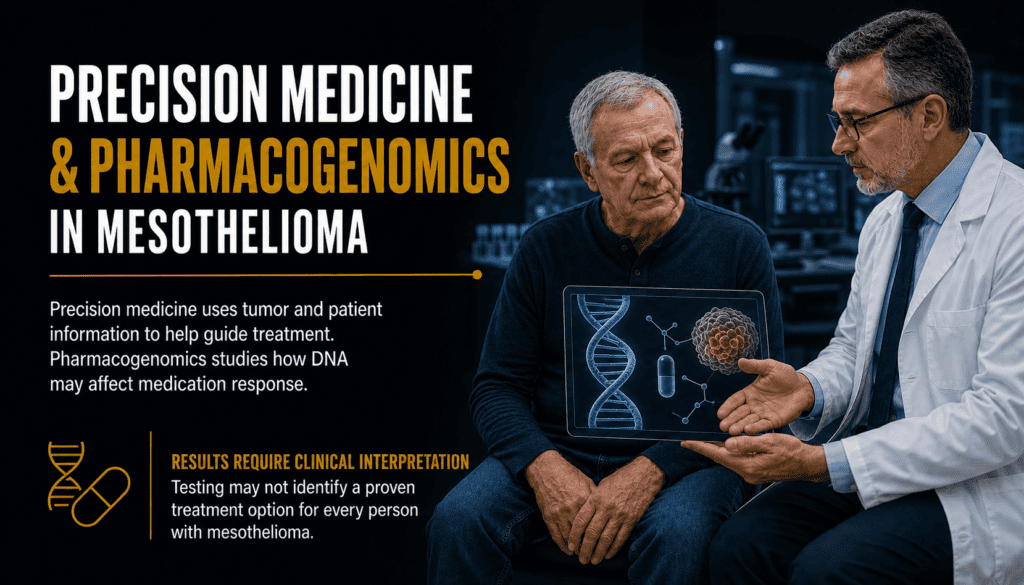
Precision Medicine & Pharmacogenomics in Mesothelioma
What tumor biomarkers, inherited variants and drug-response research can—and cannot—tell patients
Precision medicine uses information about a cancer and the patient to guide care. In mesothelioma, researchers study tumor DNA, proteins, immune features and clinical characteristics to improve diagnosis, classify disease and identify possible clinical trials.
Pharmacogenomics is narrower: it studies how inherited genetic differences may affect drug response or toxicity. It should not be confused with tumor genomic profiling. No genetic report can guarantee that a treatment will work, and many findings in mesothelioma remain investigational or have no matched therapy.
🧬 Precision Medicine Overview
Precision medicine is an approach, not a single test. It may combine tumor location, histology, stage, biomarkers, previous treatment, organ function and patient goals. In cancer care, biomarker testing looks for genes, proteins or other tumor characteristics that might help answer a clinical question.
| Precision-Medicine Input | Possible Question | Important Limitation |
|---|---|---|
| Histology | Is the tumor epithelioid, sarcomatoid or biphasic? | A small biopsy may not represent the entire tumor |
| Stage and imaging | Where is the disease and how extensive is it? | Imaging cannot identify every microscopic tumor deposit |
| Tumor biomarkers | Does the cancer have a potentially relevant molecular feature? | Most findings do not produce an approved mesothelioma treatment match |
| Germline testing | Is an inherited cancer-predisposition variant present? | Tumor findings must often be confirmed in a separate normal sample |
| Pharmacogenomics | Could an inherited variant affect a medicine’s handling or toxicity? | Clinical guidance is drug-specific and limited in mesothelioma |
| Patient factors | Can the person safely receive a treatment? | Genes do not replace assessment of kidneys, liver, heart, lungs and daily function |
The site’s mesothelioma research overview explains clinical-trial phases, biomarkers and the difference between experimental evidence and established care.
🔍 Tumor, Germline and Pharmacogenomic Testing
Several tests may involve genes, but they answer different questions. Using the correct term helps patients understand who is being tested—the tumor, the person or both—and what a result may mean for relatives.
| Testing Type | Typical Sample | Primary Purpose | Can It Affect Family Members? |
|---|---|---|---|
| Tumor genomic profiling | Biopsy or surgical tumor tissue | Find acquired tumor alterations and possible trial matches | Usually not, but some findings may suggest an inherited variant |
| Protein biomarker testing | Tumor tissue | Measure protein expression or loss for diagnosis or research | Usually no |
| Liquid biopsy | Blood or another body fluid | Look for tumor-derived material when present | Not by itself; confirm suspected inherited findings separately |
| Germline genetic testing | Blood, saliva or normal tissue | Identify an inherited cancer-predisposition variant | Yes, biological relatives may share the variant |
| Pharmacogenomic testing | Usually blood or saliva | Study inherited variants associated with drug metabolism, response or toxicity | Variants are inherited, but interpretation is medication-specific |
| Pathology molecular testing | Tumor tissue | Support diagnosis by assessing selected deletions, mutations or protein loss | Usually no unless a possible germline finding is identified |
Biomarker testing for treatment is different from inherited-risk testing. If tumor profiling suggests a possible inherited alteration, confirmatory germline testing and genetic counseling may be appropriate. Read more about genetic testing and mesothelioma risk.
🧫 Mesothelioma Molecular Findings
Mesothelioma research frequently examines tumor-suppressor pathways. Loss or inactivation of a tumor-suppressor gene is different from an activating mutation that can be directly blocked with an available targeted drug. The presence of a finding therefore does not automatically create a treatment option.
| Finding or Biomarker | Current Relevance | What It Does Not Prove |
|---|---|---|
| BAP1 alteration or protein loss | May support diagnostic work and research; some findings raise a germline question | Does not establish that a PARP inhibitor or another targeted drug will work |
| CDKN2A deletion | Can support a malignant mesothelial diagnosis in the proper pathology context | Does not independently diagnose mesothelioma or select a standard targeted therapy |
| NF2 pathway alteration | Common research focus involving cell-growth regulation | Does not by itself identify an approved mesothelioma drug |
| PD-L1 expression | Research and prognostic interest; may be reported on tumor tissue | Does not perfectly predict immunotherapy response or nonresponse |
| Tumor mutational burden | Broad biomarker studied across cancers | A low or high value alone should not override mesothelioma-specific evidence |
| Microsatellite instability or mismatch-repair deficiency | May have tissue-agnostic treatment implications if valid criteria are met | These findings are not common defining features of mesothelioma |
| Variant of uncertain significance | Finding whose clinical meaning is not established | Should not be treated as a proven drug target or inherited diagnosis |
A pathology report may include biomarkers used to support diagnosis rather than select therapy. The mesothelioma pathology review guide explains why morphology, immunohistochemistry and molecular findings must be interpreted together.
Cell type remains clinically important. Compare epithelioid, sarcomatoid and biphasic mesothelioma before interpreting a molecular report.
🧪 How Biomarker Testing Works
Testing begins with a defined clinical question. The oncology and pathology teams assess whether enough suitable tissue exists, which method is appropriate and whether the result could change management. Broad testing without a clear plan may produce uncertain findings, cost and delay.
| Step | What Happens | Question to Ask |
|---|---|---|
| 1. Confirm diagnosis | Experienced pathology establishes mesothelioma and histology | Is the tissue diagnosis final? |
| 2. Define purpose | Team identifies a diagnostic, inherited-risk, treatment or trial question | What decision could this test change? |
| 3. Check specimen | Laboratory evaluates tumor content, quality and quantity | Will testing consume tissue needed for other studies? |
| 4. Select assay | Single-marker, panel, sequencing or protein test is chosen | Is the laboratory qualified and the assay validated? |
| 5. Interpret result | Findings are classified by evidence and clinical relevance | Is the alteration actionable, investigational or uncertain? |
| 6. Confirm germline concern | Separate normal-sample testing may determine whether a finding is inherited | Should I meet with a genetic counselor? |
| 7. Review options | Team compares standard care, trials, off-label use and no change | What evidence supports the recommendation in mesothelioma? |
Liquid biopsy can be useful in selected cancers, but a negative blood result may reflect low tumor shedding rather than absence of an alteration. It also does not replace the representative tissue needed to diagnose and classify mesothelioma. See the site’s mesothelioma biopsy guide.
Questions After a Mesothelioma Diagnosis?
Our team can help you find information and understand possible legal options related to asbestos exposure.
Call 800.291.0963 Submit Your Case
Live chat is available 24/7/365.
🎯 How Results May Affect Care
A clinically useful result must connect a validated biomarker to a meaningful decision. That connection can be strong, preliminary or absent. The treating team should explain the evidence level and whether it applies to the patient’s tumor location, histology and treatment setting.
| Possible Result | Potential Next Step | Caution |
|---|---|---|
| Diagnostic molecular finding | Support classification with morphology and immunostains | No single result should be interpreted outside pathology context |
| FDA-recognized biomarker and matching indication | Discuss an approved treatment if all criteria are met | Approval may be cancer-specific or tissue-agnostic with exact thresholds |
| Clinical-trial biomarker | Check trial status, eligibility, location and treatment requirements | A molecular match does not guarantee enrollment or benefit |
| Alteration with early laboratory evidence | Consider research discussion rather than routine treatment | Preclinical activity may not translate into patient benefit |
| Possible inherited variant | Refer for genetic counseling and confirmatory germline testing | Tumor-only testing cannot always determine inheritance |
| No actionable finding | Continue evidence-based care and reassess trials when appropriate | This does not mean that standard treatment cannot help |
| Variant of uncertain significance | Monitor for laboratory reclassification when appropriate | Do not use it alone to select treatment or test relatives |
Most patients still receive treatment based primarily on mesothelioma location, stage, histology, health and established clinical evidence. Biomarker testing may add information, but it should not delay necessary care without a clear reason.
Review established mesothelioma treatments and discuss whether a specialist second opinion would clarify a complex result.
💊 Pharmacogenomics and Its Limits
Pharmacogenomics studies how inherited variants influence drug absorption, distribution, metabolism, targets or toxicity. Some genotype-drug relationships are well established in medicine, but evidence is specific to the exact drug, variant, population and clinical setting.
| Claim | Accurate Interpretation |
|---|---|
| “A DNA test will choose the best mesothelioma drug.” | No routine pharmacogenomic test guarantees the most effective mesothelioma treatment. |
| “Testing can prevent chemotherapy side effects.” | Testing may estimate selected drug risks when validated, but it cannot eliminate toxicity. |
| “Tumor sequencing is pharmacogenomics.” | Not usually. Tumor profiling studies cancer alterations; pharmacogenomics generally evaluates inherited drug-response variation. |
| “A mutation means a targeted drug will work.” | A treatment match requires clinical evidence, not only a pathway hypothesis. |
| “PD-L1 determines immunotherapy eligibility.” | PD-L1 is an imperfect biomarker, and mesothelioma treatment indications must be checked directly. |
| “Normal pharmacogenomic results mean treatment is safe.” | Kidney, liver, heart, lung, immune and blood-related risks still require monitoring. |
| “Consumer genetic testing is enough.” | Medical decisions require validated testing, appropriate consent and professional interpretation. |
Doses of platinum chemotherapy, pemetrexed, immunotherapy and other treatments are commonly influenced by clinical factors such as kidney function, blood counts, prior toxicities and overall health. Patients should not change a medicine or dose based on a consumer report or online interpretation.
The FDA maintains a table of pharmacogenetic associations, but the table does not mean that every listed relationship requires testing or that unlisted drugs have no genetic influences. Mesothelioma-specific decisions should remain with the oncology and pharmacy team.
🔭 Clinical Trials and Emerging Research
Precision-medicine trials may enroll patients because of a tumor alteration, immune feature or molecular pathway. Some are mesothelioma-specific; others are basket trials that include several cancers sharing a biomarker.
| Research Strategy | Scientific Goal | Key Uncertainty |
|---|---|---|
| DNA-repair targeting | Exploit vulnerabilities associated with selected repair-pathway alterations | A biomarker may not reliably predict response |
| Hippo/NF2-pathway targeting | Interrupt signaling altered in some mesotheliomas | Pathway complexity and resistance may limit benefit |
| Epigenetic therapy | Change gene regulation rather than DNA sequence | Best drug, dose, combination and biomarker remain under study |
| Immune profiling | Identify features associated with immunotherapy response or resistance | No single immune marker perfectly predicts outcome |
| Circulating tumor DNA | Study disease monitoring through blood-based signals | Low shedding can produce false-negative results |
| Proteomics and multi-omics | Combine DNA, RNA, proteins and clinical data | Complex models require independent validation |
| Adaptive or basket trials | Match treatment to emerging molecular evidence | Eligibility and benefit are not guaranteed by a test result |
Trial status changes, and a listing does not mean that a site is actively enrolling. The team should confirm eligibility, required testing, travel, costs, randomization, standard-care alternatives and whether tissue must be submitted.
Explore emerging mesothelioma treatment research and the site’s overview of clinical trials for mesothelioma.
📋 Questions and Authoritative Medical Sources
Questions to Ask Before Testing
- Is this tumor profiling, inherited genetic testing or pharmacogenomic testing?
- What exact clinical decision could the result change?
- Is there enough tissue, and will testing leave material for other necessary studies?
- How does the laboratory classify actionable, investigational and uncertain findings?
- Could the test reveal an inherited finding, and is genetic counseling available?
- Does a suggested treatment have evidence in mesothelioma or only another cancer?
- Will insurance cover the test, interpretation and any matched treatment?
- Could testing delay standard care or require a new biopsy?
Authoritative Medical and Research Sources
- National Cancer Institute: Biomarker Testing for Cancer Treatment
- National Cancer Institute: Malignant Mesothelioma Treatment (PDQ), Health Professional Version
- U.S. Food and Drug Administration: Table of Pharmacogenetic Associations
- National Library of Medicine GeneReviews: BAP1 Tumor Predisposition Syndrome
- ClinicalTrials.gov: Mesothelioma Biomarker Studies
- National Cancer Institute: Clinical Trials Information
❓ Frequently Asked Questions
What is precision medicine in mesothelioma?
It is an approach that combines tumor features, clinical evidence and patient characteristics to guide care. Biomarker testing may contribute, but it is only one part of the decision.
Is tumor genomic testing the same as inherited genetic testing?
No. Tumor testing mainly looks for changes acquired by cancer cells. Germline testing looks for variants a person was born with that may be shared by relatives.
What is pharmacogenomics?
Pharmacogenomics studies how inherited genetic differences may affect medication response or toxicity. Its usefulness depends on a validated relationship for the specific drug and clinical setting.
Can genomic testing identify the best mesothelioma treatment?
Not reliably for every patient. A test may identify a trial or selected treatment consideration, but many alterations have no proven therapy and no result guarantees benefit.
Does a BAP1 alteration mean the cancer is inherited?
No. A BAP1 alteration may exist only in the tumor. Separate germline testing and genetic counseling are needed to determine whether it is inherited.
Does PD-L1 testing prove immunotherapy will work?
No. PD-L1 is an imperfect biomarker. Patients with high expression may not respond, while some patients with low expression may benefit.
Can a liquid biopsy replace a tissue biopsy?
No. A blood-based test may provide selected molecular information, but it cannot reliably replace tissue needed to diagnose mesothelioma, assess invasion and determine histology.
How can molecular testing help find a clinical trial?
A report may identify a biomarker used in trial eligibility. The research site must still confirm the finding and assess disease type, health, prior treatment and all other criteria.
Talk With Our Mesothelioma Support Team
If you or a loved one has been diagnosed with mesothelioma, we can help you find information and understand possible legal options related to asbestos exposure. There is no obligation.
Call 800.291.0963 Submit Your Case
Live chat is available 24/7/365.
Medical and legal disclaimer: This page provides general educational information and is not a substitute for advice from a licensed physician, genetic counselor, pharmacist or attorney. Testing, treatment, trial eligibility and legal rights depend on individual facts; contacting us does not create an attorney-client relationship.