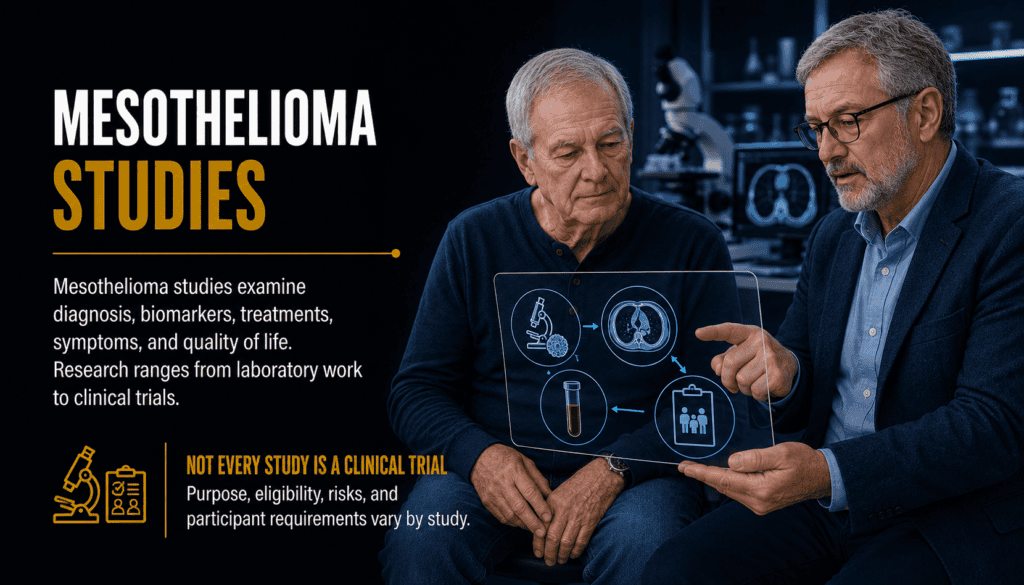
📚 Mesothelioma Studies
From Historic Breakthroughs to Modern Innovation
Since the first recognized link between asbestos and mesothelioma in the mid-20th century, research has advanced significantly. Earlier work focused on identifying asbestos exposure and tumor biology. Today, studies span immunology, AI diagnostics, genetics, and novel therapies, offering hope for better detection, treatment, and survival outcomes.
20 Studies on Mesothelioma
1. AI-Driven Detection of Mesothelioma Using Multi‑Modal Imaging
Read Study
This 2025 study integrates CT and PET data using neural networks to improve early-stage detection. The model enhances diagnostic sensitivity and reduces false negatives by combining anatomical and metabolic information.
-
Trains on diverse imaging datasets
-
Detects stage 1–2 lesions with ~10% better accuracy
-
Reduces biopsy necessity through confident AI triage
This multi-modal AI approach offers a significant leap forward in identifying early mesothelioma non-invasively.
2. Pembrolizumab + Cisplatin Phase II Trial (Nov 2024–Ongoing)
Read Study
Initiated in November 2024, this Phase II study tests pembrolizumab combined with cisplatin or carboplatin in advanced mesothelioma. Early findings indicate improved tumor response and manageable safety profiles.
-
Combines immunotherapy with platinum chemotherapy
-
Demonstrates tumor shrinkage in previously resistant cases
-
Maintains acceptable toxicity levels
Encouraging mid-stage results suggest this combo may enhance outcomes in chemotherapy-resistant patients.
3. Pembrolizumab Trial 248TiP in Relapsed Disease
Read Study
Trial 248TiP represents the first to evaluate pembrolizumab monotherapy specifically in relapsed pleural mesothelioma. Interim analysis on three patients highlights promising safety and early signs of anti-tumor activity.
-
First pembrolizumab-focused relapsed pleural study
-
No grade 4/5 adverse events reported
-
Two patients experienced partial responses
These initial findings support continued investigation into immune therapies for relapsed disease.
4. FDA Approves Pembrolizumab + Pemetrexed‑Platinum (Sept 2024)
Read Study
In September 2024, FDA approved pembrolizumab with pemetrexed-platinum as first-line for unresectable pleural mesothelioma, based on trials showing improved survival and tumor control versus chemo alone.
-
Shows significantly longer median OS
-
Higher overall response rates than standard therapy
-
Well-tolerated across age groups
This milestone approval opens immunotherapy access for newly diagnosed unresectable patients.
5. Phase III CONFIRM Nivolumab Trial (2025)
Read Study
The CONFIRM Phase III study shows that nivolumab significantly extends overall survival (10.2 vs. 6.9 months) compared to placebo in relapsed pleural mesothelioma, with improved quality-of-life measures.
-
Demonstrates survival benefit in second/third line
-
Improves symptom-related Quality-of-Life scores
-
Confirms immune checkpoint efficacy
The positive Phase III data positions nivolumab as a proven option for relapse-care.
6. Immunotherapy Innovations Update (Apr 2025)
Read Study
An April 2025 review summarizes FDA-approved regimens and emerging checkpoint therapies, highlighting combination immunotherapies with chemo and emerging biomarkers that predict response.
-
Outlines current FDA-approved combos
-
Discusses emerging PD-L1 and TMB markers
-
Forecasts new indications on the horizon
This review underscores immunotherapy’s expanding role and personalized treatment approaches.
7. Malignant Pleural Mesothelioma 2025 Surgical Update
Read Study
A 2025 surgical update compares extended pleurectomy/decortication (P/D) combined with chemotherapy versus chemotherapy alone (MARS2 Trial), demonstrating enhanced survival and moderate morbidity.
-
Improved median survival in extensive surgery group
-
Morbidity lower than earlier surgical reports
-
Identifies ideal patient selection factors
Supports multimodal therapy for select surgical candidates.
8. DREAM & PrE0505 Chemo‑Durva Trials (2024)
Read Study
Two Phase II trials combining chemotherapy with durvalumab show objective response rates of ~50–56% and median survival of 18–20 months, bridging immunotherapy and chemo.
-
Higher response than chemo alone
-
Acceptable immune-related toxicity
-
Improved progression-free survival
Results suggest chemo + durvalumab is a strong option in first-line settings.
9. Anetumab Ravtansine + Pembrolizumab Combo
Read Study
This trial explores combining anti-mesothelin antibody-drug conjugate with pembrolizumab. Safety was confirmed but did not yet improve progression-free survival compared to historical controls.
-
Innovative targeted-immunotherapy combo
-
Favorable safety profile observed
-
Biomarker-based future customization suggested
Highlights potential, though further trials needed for efficacy confirmation.
10. PROMISE‑Meso Real‑World Pembrolizumab Outcomes
Read Study
Real-world data indicates pembrolizumab did not significantly outperform chemotherapy in second-line pleural mesothelioma, prompting reassessment of optimal second-line use.
-
No significant PFS difference seen
-
Shows importance of real-world validation
-
Subgroup benefit observed in PD-L1 High
Suggests careful patient selection is critical for pembrolizumab in relapse settings.
11. ATOMIC‑Meso Pegargiminase Trial (2021–2024)
Read Study
The ATOMIC-Meso Phase II/III trial tests pegargiminase plus chemo, showing doubled three-year survival and high disease control rates—pivotal JAMA Oncology results in Feb 2024.
-
Significant long-term survival improvement
-
Synergistic mechanism with arginine depletion
-
Low-grade side effects noted
Representing a major step toward metabolic-targeted mesothelioma therapy.
12. CheckMate 743 Follow-Up (4-Year)
Read Study
Four-year data from CheckMate 743 confirms nivolumab + ipilimumab offers durable survival benefit in pleural mesothelioma, particularly in patients with favorable immune gene signatures.
-
Sustained survival beyond two years
-
Better outcomes linked to immune profiles
-
Highlights need for biomarker-guided therapy
Strengthens case for immunotherapy as standard initial treatment.
13. Extended P/D vs. Chemo Only (MARS2)
Read Study
Phase III data from MARS2 demonstrates extended pleurectomy/decortication plus chemotherapy yields significant survival gains over chemotherapy alone, with acceptable safety.
-
15% survival benefit at 2 years
-
Lower morbidity than past EPP results
-
Defines surgical eligibility
Solidifies multimodal surgery as a valid option in Stage 2–3.
14. Asbestos.com 2025 Remission Survey
Read Study
An independent survey reports that 11% of mesothelioma patients achieve remission following multimodal therapy, highlighting the value of aggressive treatment in select patients.
-
Patient-reported remission rate quantified
-
Highlights survival of long-term responders
-
Encourages broadening treatment access
A powerful testament to the impact of focused, aggressive care.
15. MesoGraph AI Histology Tool (Feb 2023)
Read Study
MesoGraph uses graph neural networks on histology slides to automate subtype detection and survival prediction, improving pathologist efficiency and diagnostic consistency.
-
Automates epithelioid vs. sarcomatoid classification
-
Correlates architecture with prognosis
-
Potential integration into diagnostic workflow
Offers scalable pathology support and prognostic insights.
16. CNN-Based CT Segmentation (Nov 2023)
Read Study
This deep-learning model segments pleural tumors on CT automatically, enabling accurate volume measurement and potentially standardizing response assessments.
-
High dice score in segmentation tests
-
Improves inter-reader consistency
-
Enables fast, reproducible tumor tracking
A promising step toward AI-driven tumor quantification in clinical practice.
17. MicroRNA‑Loaded Minicell Trial (2017–2019)
Read Study
Phase I minicell-based microRNA therapy delivery to malignant pleural mesothelioma showed safety and preliminary tumor suppressive signals, paving the way for RNA therapeutics.
-
Innovative miRNA delivery system
-
No serious adverse events
-
Early tumor stabilization in some patients
Pioneers RNA-based strategies in mesothelioma therapy.
18. Machine Learning Diagnosis Predictor (2021)
Read Study
This study uses AdaBoost and SVM models on clinical data to predict mesothelioma with ~71% accuracy, demonstrating the potential of ML in screening high-risk patients.
-
High recall and precision on training data
-
Predictive features include exposure history
-
Suggests electronic health record integration
A promising foundation for AI-guided screening tools.
19. Longitudinal MiRNA Biomarker Study (2020)
Read Study
A longitudinal miRNA profiling study finds panels of circulating miRNAs (e.g., miR-103a-3p) can predict disease progression and monitor treatment response.
-
Shows biomarker levels correlate with tumor load
-
Enables non-invasive serial monitoring
-
Differentiates responders vs. non-responders
Marks progress toward liquid biopsy options for clinical management.
20. Circulating Tumor DNA Study (2019)
Read Study
This pilot study found detectable ctDNA in pleural mesothelioma patients, suggesting potential for non-invasive disease monitoring and early recurrence detection.
-
Detects tumor-specific mutations in blood
-
Correlates ctDNA levels with disease burden
-
Could reduce reliance on imaging scans
Lays groundwork for future blood-based surveillance tools.
🔬 Mesothelioma Studies Overview
A mesothelioma study is a structured investigation designed to answer a defined question. Laboratory research may examine cancer cells, genes, proteins, or immune pathways. Translational research tries to move laboratory findings toward patient care. Clinical research involves people or information collected from people. Epidemiologic research may examine asbestos exposure, disease patterns, and risk.
Clinical studies generally fall into two broad categories. In an interventional study, researchers assign an intervention according to a protocol. In an observational study, researchers collect information without assigning the participants’ care. Both can be important, but they answer different questions.
Patients who want broader context can review the mesothelioma research overview and discuss both established care and research options with a specialist.
🧭 Types of Mesothelioma Studies
Not every study tests a drug. Some evaluate surgery, radiation, combinations of existing treatments, symptom control, diagnostic methods, blood or tissue biomarkers, or ways to improve daily functioning. Others use registries, questionnaires, stored tissue, or medical records to identify trends.
| Study type | Main question | What participation may involve |
|---|---|---|
| Treatment trial | Is a new treatment, combination, dose, or sequence acceptably safe and effective? | Assigned treatment, scheduled tests, imaging, symptom reporting, and safety monitoring |
| Diagnostic or screening study | Can a test identify disease or characterize it more accurately? | Imaging, blood collection, tissue analysis, or comparison with a reference method |
| Supportive or palliative-care study | Can an intervention reduce symptoms, side effects, or caregiver burden? | Medicines, rehabilitation, counseling, symptom surveys, or remote monitoring |
| Biomarker study | Does a measurable feature predict diagnosis, prognosis, or treatment response? | Blood, tissue, or fluid samples; sometimes genetic or molecular testing |
| Observational study or registry | What patterns appear in exposures, care, outcomes, or quality of life? | Records review, questionnaires, follow-up, or sample collection without assigned treatment |
Research may include people with pleural or peritoneal disease, a particular histology, or specific treatment history. Articles on emerging mesothelioma treatments and precision medicine explain two active areas of investigation.
📊 Clinical Trial Phases
Treatment trials are commonly described by phase. The phase indicates the primary research purpose; it is not a rating of how promising a treatment is. Some protocols combine phases, and rare-cancer trials may enroll several tumor types when they share a molecular feature.
| Phase | Primary purpose | What the result can and cannot show |
|---|---|---|
| Phase 1 | Study safety, dose, scheduling, and how the body handles an intervention | Can identify dose-limiting effects and a dose for later research; usually cannot establish comparative effectiveness |
| Phase 2 | Look for evidence of activity in a defined patient group while continuing safety evaluation | May show tumor response or another signal; smaller or single-arm studies cannot reliably prove superiority |
| Phase 3 | Compare an approach with a control, often the current standard, in a larger group | Can provide stronger comparative evidence when well designed; applicability still depends on who was enrolled |
| Phase 4 | Study an approved treatment in routine or broader use | Can reveal longer-term or uncommon effects and real-world patterns |
Randomized trials assign participants to study groups by chance, which helps reduce bias. A control group may receive standard treatment, a different active treatment, or—when ethically appropriate—placebo with or without usual care. Ask whether the study is randomized, blinded, single-arm, or open-label and what each group receives.
🧬 Eligibility and Screening
Eligibility criteria protect participants and help researchers answer a focused question. Meeting the brief description on a trial listing does not confirm enrollment. The research team must review records and complete screening tests.
| Factor | Why it may matter | Records or tests commonly reviewed |
|---|---|---|
| Disease site and histology | A protocol may require pleural or peritoneal disease and a confirmed cell type | Pathology report, slides, tissue block, and sometimes central pathology review |
| Stage or disease extent | Some studies require resectable, unresectable, recurrent, or metastatic disease | CT, PET, MRI, operative notes, and the treating team’s staging assessment |
| Prior therapy | A trial may require or exclude previous chemotherapy, immunotherapy, radiation, or surgery | Treatment names, dates, doses, response, and side effects |
| Biomarkers | Some studies target a molecular alteration or require a specific laboratory result | Tumor profiling, immunohistochemistry, blood testing, or new biopsy |
| Health and organ function | Heart, lung, liver, kidney, blood counts, and daily activity can affect safety | Physical exam, laboratory tests, pulmonary testing, ECG, and performance-status assessment |
| Logistics | Visit frequency, required procedures, and location may affect practical eligibility | Calendar review, travel planning, caregiver availability, and insurance discussion |
A mesothelioma second opinion may help confirm pathology and clarify options. Ask before transferring tissue or repeating a biopsy, because the trial may have exact specimen requirements.
📈 Understanding Study Results
A press release, conference abstract, journal article, and regulatory review provide different levels of detail. Early findings may change after longer follow-up or full peer review. Look for the number and characteristics of participants, the comparison group, the planned endpoint, follow-up time, missing data, side effects, and whether the findings were statistically and clinically meaningful.
| Term | What it measures | Interpretation caution |
|---|---|---|
| Overall survival (OS) | Time from a defined starting point until death from any cause | Results depend on follow-up, subsequent treatment, and study population |
| Progression-free survival (PFS) | Time until documented progression or death, as defined by the protocol | Imaging rules and assessment timing matter; longer PFS does not always mean longer life |
| Objective response rate (ORR) | Percentage with a predefined amount of tumor shrinkage | Response does not necessarily predict symptom relief or survival |
| Duration of response (DOR) | How long a qualifying response lasts | Usually applies only to participants who responded |
| Quality of life | Patient-reported function, symptoms, or well-being | The questionnaire, completion rate, and size of the change are important |
| Adverse events | Health problems occurring during a study, graded by severity | An adverse event is not always caused by the intervention; compare rates and serious events |
Mesothelioma imaging can be difficult to measure because tumors may grow along body-cavity surfaces rather than form a single round mass. Ask which response criteria the protocol uses and whether scans receive independent review. Absolute numbers are usually more informative than relative percentages alone.
🔎 Finding a Mesothelioma Study
Start with a mesothelioma specialist who knows your pathology and treatment history. Then search official registries and cancer-center listings. Trial availability changes, and a listing marked “recruiting” does not guarantee that a particular location has an open slot. Contact the study site to confirm.
- Gather the pathology report, imaging reports, treatment summary, medicine list, and relevant laboratory results.
- Search by disease location, treatment status, geographic radius, age, and recruitment status.
- Record the official study identifier, site, principal investigator, and contact information.
- Ask the treating oncologist whether the scientific rationale and eligibility criteria fit your situation.
- Contact the trial coordinator and request the current consent form and visit schedule.
- Compare the trial with standard mesothelioma treatment options and other available trials.
Useful starting points include the National Cancer Institute’s trial search and ClinicalTrials.gov’s mesothelioma search. ClinicalTrials.gov is a registry and results database; a listing is not an endorsement, and its presence does not establish that an intervention is safe or effective.
🛡️ Participation, Safety, and Costs
Before enrollment, the research team should explain the purpose, procedures, foreseeable risks, potential benefits, alternatives, privacy protections, costs, compensation if any, and whom to contact. This is the informed-consent process, not merely a signature. Participants may ask questions and can generally leave a study at any time, although the team should explain safe discontinuation and follow-up procedures.
What to clarify before signing
- Which care is experimental and which is standard?
- Is assignment randomized, and can participants choose their study group?
- What side effects have been observed, and how are emergencies handled?
- How often are visits, scans, biopsies, and blood draws required?
- What happens if the cancer progresses or side effects become unacceptable?
- Which costs are paid by the sponsor, insurance, or the participant?
- Are travel, lodging, meals, parking, or caregiver costs reimbursed?
- Who will coordinate care with the regular oncology team?
Trial sponsors often cover research-specific costs, while insurance may cover routine patient care. Coverage varies, and travel or caregiving expenses may remain. Request a written cost review from the study’s financial counselor and the health plan before enrolling. Do not assume that all trial-related care is free.
💬 Questions to Ask and Trusted Sources
Bring a written list and, if possible, another person to take notes. Ask the investigator to explain why the study might fit, what evidence supports it, what uncertainties remain, and how participation compares with receiving standard care now. Also ask whether delaying another treatment could affect later options.
Authoritative resources
- National Cancer Institute: What Are Clinical Trials?
- National Cancer Institute: Mesothelioma Treatment
- National Cancer Institute: Who Pays for Clinical Trials?
- ClinicalTrials.gov: Mesothelioma Studies
- U.S. Food and Drug Administration: Clinical Trials—What Patients Need to Know
For developing topics, distinguish a laboratory concept from a validated clinical tool. The guide to AI-driven mesothelioma diagnosis research explains why external validation and clinical testing matter before a technology becomes routine care.
❓ Frequently Asked Questions
What is a mesothelioma clinical trial?
It is an interventional study in people that follows a protocol to evaluate a medical approach, such as a drug, procedure, radiation strategy, treatment combination, or supportive-care intervention. Observational studies collect information without assigning the participant’s treatment.
Are clinical trials only for people who have no treatment options?
No. Some trials enroll people before their first treatment, while others focus on recurrent disease, a particular prior therapy, surgery candidates, symptom management, or long-term follow-up. Timing is part of the eligibility criteria.
Does “recruiting” mean I can enroll?
Not necessarily. Recruitment status can change, individual sites may differ, and screening must confirm every eligibility requirement. Contact the listed site and provide the official study identifier.
Will I receive a placebo?
Some trials use a placebo, but many cancer trials compare an investigational approach with active standard treatment or add a placebo to standard care. The consent form should explain the groups, randomization, and whether a placebo is used.
Who pays for care in a mesothelioma trial?
The sponsor may pay research-specific expenses, while health insurance may be billed for routine care. Travel, lodging, medicines, tests, and out-of-network charges require advance clarification. Ask for a written breakdown.
Can I leave a study after enrolling?
Participation is voluntary, and a participant can generally withdraw. Tell the research team so it can explain safe discontinuation, follow-up, alternative care, and how information already collected may be handled.
Does an early positive result prove a treatment works?
No. A small or early study may identify safety, feasibility, or a signal of activity. Stronger conclusions usually require adequate follow-up, appropriate comparisons, transparent reporting, and confirmation in additional patients or studies.
How should I compare a trial with standard treatment?
Ask a mesothelioma specialist about the goals, evidence, known and unknown risks, time commitment, alternatives, and how each option could affect later treatment. A second opinion can be especially useful when the decision is complex.