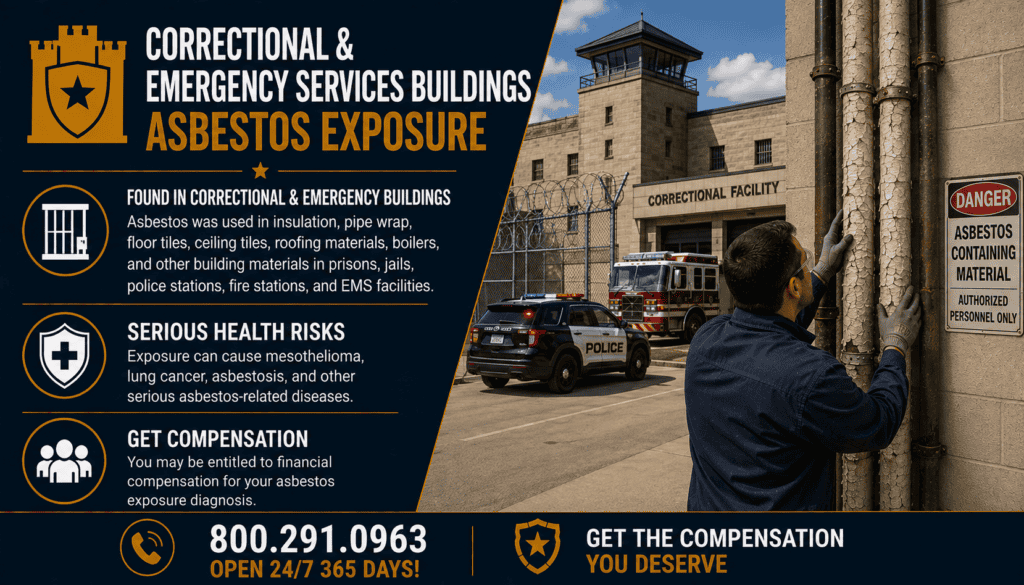
🚨 Correctional & Emergency Services Buildings Asbestos Exposure
Correctional and emergency services facilities can include police stations, fire stations, fire training centers, jails, prisons, detention buildings, administrative offices, maintenance areas, mechanical rooms, kitchens, dormitories, locker rooms and other specialized spaces. Many facilities remain in continuous service for decades, making repairs and renovations while employees, inmates, detainees or emergency personnel continue to occupy other parts of the property.
Depending on a building’s age, construction history and installed products, some older correctional and emergency services buildings may have contained asbestos-containing materials. Working in, responding from, maintaining, renovating, being housed in or visiting an older facility does not by itself prove asbestos exposure. A stronger investigation connects a person to a specific facility, building area, dates, work or activity, material and disturbance event.
See the broader Buildings Asbestos Exposure resource for additional building categories and exposure-investigation guidance.
🚨 Correctional and Emergency Services Building Asbestos Exposure
Potential exposure depended on whether asbestos-containing material was actually present and whether maintenance, repair, renovation or demolition disturbed it. Correctional and emergency services facilities can be especially complex because many operate around the clock and contain secure or mission-critical areas that may be renovated in phases.
Projects worth investigating include:
- Cell block, dormitory or detention-area renovation.
- Police station office, locker-room and evidence-area remodeling.
- Fire station apparatus-bay, dormitory and kitchen renovations.
- Fire training center building repair or demolition.
- Kitchen, laundry, shower and restroom modernization.
- Boiler, heating, HVAC and ventilation work.
- Plumbing and electrical upgrades.
- Floor, wall and ceiling replacement.
- Roofing and exterior work.
- Expansion, redevelopment and demolition.
EPA states that renovation, remodeling and replacement of utility systems increase the potential for disturbing ACM. Before renovation, EPA recommends reviewing asbestos inspection and assessment records and evaluating suspect or assumed ACM that could be affected.
🏢 Correctional and Emergency Services Buildings to Investigate
🚔 Police Stations
Police facilities can include administrative offices, briefing rooms, locker rooms, evidence storage, holding areas, garages and mechanical spaces. Long-term occupancy and repeated technology, security and building-system upgrades can create a layered renovation history.
🔥 Fire Stations
Fire stations may combine apparatus bays, offices, kitchens, sleeping quarters, locker rooms, workshops and mechanical spaces. Renovations may affect floors, walls, ceilings, plumbing, electrical systems and heating or ventilation equipment.
🧯 Fire Training Centers
Training facilities may include classrooms, administrative buildings, towers, workshops and support structures. Exposure investigations should distinguish asbestos associated with permanent buildings from unrelated smoke, combustion products or other training hazards.
🔒 Jails and Detention Facilities
Jails may contain cell blocks, booking areas, kitchens, laundries, showers, medical areas, corridors, utility chases and mechanical rooms. Secure construction can make renovation projects extensive and highly phased.
🏛️ Prison Buildings
Prison campuses can include housing units, administrative buildings, kitchens, industries or vocational areas, medical facilities, chapels, maintenance shops, warehouses and central utility buildings constructed during different eras.
Different structures on the same correctional or emergency services property may have different construction dates and material histories. Exposure should therefore be investigated building by building and project by project.
🧱 Asbestos-Containing Materials and Building Systems
No material should be identified as asbestos-containing solely because a facility is old. Historical specifications, asbestos surveys, professional inspections, sampling records and appropriate laboratory analysis provide stronger evidence.
| Building Area | Material or System to Investigate | Potential Disturbance |
|---|---|---|
| Mechanical and utility rooms | Pipe, boiler, tank or duct insulation where present | Repair, removal or replacement |
| Cells, offices, dormitories and corridors | Certain historical flooring and associated mastics | Removal, cutting or renovation |
| Walls and ceilings | Certain compounds, plasters, panels or ceiling materials | Drilling, cutting or demolition |
| Large institutional spaces | Certain surfacing, acoustical or fireproofing materials | Renovation or demolition |
| Heating and HVAC systems | Certain thermal insulation and associated materials | Maintenance or modernization |
| Roofs and exteriors | Certain historical roofing, siding or cement products | Repair, removal or replacement |
EPA identifies surfacing materials, thermal-system insulation and miscellaneous ACM as major building-material categories for asbestos operations and maintenance. Examples of miscellaneous ACM can include certain ceiling or floor tiles, cement panels, siding, roofing materials and electrical or sound insulation.
OSHA defines thermal-system insulation as ACM applied to pipes, fittings, boilers, tanks, ducts or other structural components to prevent heat loss or gain. OSHA’s Class II asbestos-work definition includes removal of asbestos-containing wallboard, floor tile and sheeting, roofing, siding shingles and construction mastics.
Under OSHA’s construction standard, thermal-system insulation and surfacing material in buildings constructed no later than 1980 are presumed asbestos-containing material unless that presumption is properly rebutted. OSHA also addresses asphalt and vinyl flooring installed no later than 1980 under its asbestos requirements.
For a broader historical-material review, see Common Asbestos Materials Found in Pre-1970s Buildings.
👷 Workers Potentially at Risk in Correctional and Emergency Services Buildings
Potential building exposure can differ substantially by occupation and task. Workers who directly cut, removed, repaired or disturbed installed materials may have had different exposure opportunities from personnel working around intact finished surfaces.
- Facilities and maintenance workers — walls, ceilings, floors, roofs and mechanical systems.
- Plumbers and pipefitters — kitchens, showers, laundries, restrooms and utility areas.
- HVAC and boiler technicians — heating, ventilation, ducts, piping and mechanical rooms.
- Electricians — panels, conduit, lighting, walls and ceilings.
- Carpenters and remodelers — offices, housing areas, partitions and institutional spaces.
- Flooring workers — removal or alteration of historical flooring and associated mastics.
- Roofers — older roofing systems and equipment penetrations.
- Construction and demolition workers — expansion, renovation and demolition projects.
- Correctional maintenance or prison-industry workers — only where specific tasks involved disturbance of ACM or PACM.
- Police officers, firefighters, correctional officers, administrative employees, inmates and detainees — building exposure requires evidence that asbestos-containing material was disturbed in or near occupied areas.
For broader occupation-specific information, see High-Risk Jobs for Asbestos Exposure.
🔨 Maintenance, Renovation and Emergency Facility Work
Correctional and emergency services buildings may remain operational during renovations. Work can be performed wing by wing, floor by floor or during limited shutdown periods. This makes project dates, exact building areas and maintenance records particularly important when reconstructing potential exposure.
EPA states that renovations and replacement of utility systems increase the potential for disturbing ACM. EPA recommends that asbestos inspection and assessment records be reviewed before renovation and that suspect or assumed ACM likely to be disturbed be sampled and analyzed or treated as asbestos-containing.
OSHA’s asbestos construction standard covers demolition, alteration, repair, maintenance and renovation involving asbestos. OSHA defines Class III asbestos work as repair and maintenance operations where ACM, including thermal-system insulation, surfacing ACM or PACM, is likely to be disturbed.
Before work subject to OSHA’s standard begins, building and facility owners must determine the presence, location and quantity of ACM and/or PACM at the work site and provide required information to specified employers, employees and tenants.
Projects worth investigating include:
- Cell-block and housing-unit renovation.
- Police and fire station modernization.
- Kitchen, laundry, shower and restroom reconstruction.
- Security, communications and electrical upgrades.
- Boiler, heating and HVAC replacement.
- Plumbing and utility work.
- Floor, wall and ceiling projects.
- Roof repairs and replacement.
- Facility additions and adaptive reuse.
- Demolition of older institutional buildings.
See Historic Building Renovation Job Sites Asbestos Exposure.
📂 Records and Evidence for Exposure Investigations
A stronger reconstruction moves beyond “I worked in an old jail, prison, police station or fire station” toward:
Person → Facility → Building/Area → Date → Job/Task → Material → Disturbance
- Identify the facility and exact historical address.
- Identify the exact building, wing, cell block, station area or mechanical space.
- List employment, assignment, incarceration or contractor dates relevant to the investigation.
- Identify the person’s occupation, assignment and specific tasks.
- List renovations, repairs, utility upgrades and demolition projects.
- Search for asbestos surveys, inspection reports and sample results.
- Locate architectural, mechanical and renovation drawings.
- Review facilities work orders, maintenance logs, permits, contracts and abatement records.
- Identify government agencies, contractors, facilities departments, asbestos consultants and abatement companies.
- Locate coworkers, maintenance personnel, tradespeople or other witnesses.
Government-operated facilities may have records distributed across facilities departments, public works agencies, corrections departments, police or fire departments, procurement offices, archives and outside contractors. Privately operated correctional facilities may have different record custodians.
OSHA requires written records of required notifications concerning the identification, location and quantity of ACM and PACM to be maintained by the building owner for the duration of ownership and transferred to successive owners. Where those records survive, they may help identify known or presumed materials and their locations.
Other useful evidence can include asbestos surveys, bulk-sample results, abatement records, renovation plans, maintenance logs, procurement files, work orders, historical photographs, employment records and witness statements.
❓ Correctional & Emergency Services Buildings Questions
Did every older jail, prison, police station or fire station contain asbestos?
No. Building age can justify investigation, but it does not prove that any particular installed material contained asbestos.
Why can correctional facilities require detailed exposure research?
Large correctional properties may contain many buildings constructed and renovated at different times. Identifying the exact building, wing and project can substantially strengthen an exposure reconstruction.
Which workers may have had more direct exposure opportunities?
Maintenance workers, plumbers, HVAC technicians, electricians, carpenters, flooring workers, roofers and construction or demolition workers may have directly worked on installed materials.
Could police officers, firefighters or correctional officers have building-related exposure?
Potentially, if asbestos-containing material was disturbed in or near their work areas. Employment in an older facility alone does not prove exposure.
Could inmates or detainees have had building-related asbestos exposure?
Potentially, but presence in an older correctional building alone is not proof. Evidence should identify ACM or PACM, its location and a disturbance event affecting the person’s occupied area.
Why are boiler and mechanical rooms important?
Older institutional buildings may contain pipes, boilers, tanks, ducts and other mechanical systems. Thermal-system insulation may warrant investigation through records, professional assessment, testing or applicable regulatory presumptions.
What records may help document exposure?
Asbestos surveys, architectural plans, maintenance logs, work orders, procurement files, contracts, abatement records, photographs, employment records and witness accounts may help reconstruct exposure.
Can a closed or demolished correctional or emergency services facility still be investigated?
Potentially. Historical surveys, plans, government records, contractor files, photographs, employment records and witnesses may survive after closure, redevelopment or demolition.
🚀 Build a Clear Correctional or Emergency Services Exposure Record
📞 Review the Facility, Work Areas, Projects and Evidence
If you or a loved one worked in a correctional or emergency services building and later developed mesothelioma or asbestos-related lung cancer, a focused review can help identify possible exposure sources and surviving records.
- Facility — name, exact historical address, building or wing and dates.
- Work — employer or agency, occupation, assignment, duties and maintenance projects.
- Exposure — insulation, flooring, ceilings, walls, heating systems, HVAC and roofing.
- Projects — renovations, utility upgrades, security modernization, repairs and demolition.
- Evidence — surveys, plans, maintenance logs, work orders, contracts, abatement files and witnesses.
Call 800.291.0963 now, use live chat 24/7, 365 days a year, or Submit Your Case for a free, confidential case review.
Compensation is not guaranteed. Potential legal options depend on the diagnosis, exposure evidence, potentially responsible parties, applicable law and filing deadlines.
⚕️ Legal & Medical Information Disclaimer
This page provides general educational information and is not legal or medical advice. Working in, responding from, maintaining, renovating, being housed in or visiting a correctional or emergency services facility does not by itself prove asbestos exposure, disease causation, legal liability or eligibility for compensation.