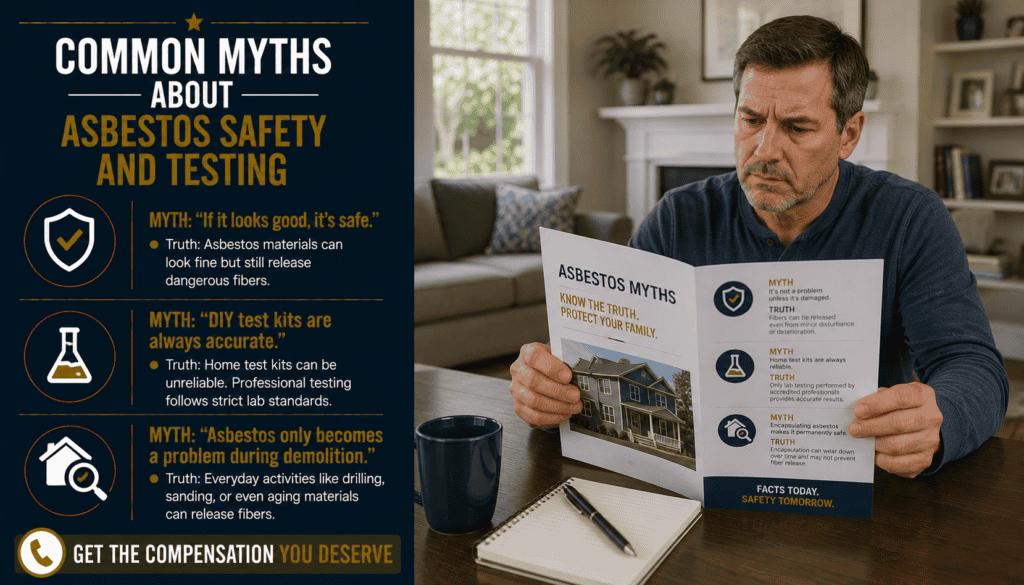
Common Myths About Asbestos Safety and Testing
Common myths about asbestos safety and testing can lead people to mistake an old material for confirmed asbestos, overlook hidden exposure risks, or attempt unsafe sampling. Understanding what laboratory results, building surveys, and workplace records actually establish helps families and workers make informed decisions without disturbing suspect materials.
This guide explains why appearance alone cannot identify asbestos, when professional testing may be appropriate, and why a current negative sample cannot rule out historical exposure. It also shows how to preserve reports, photos, and job records for an asbestos exposure investigation while keeping medical evidence and legal responsibility separate.
🧭 Common Asbestos Myths at a Glance
Many asbestos safety myths confuse a material’s appearance with its composition or mistake a workplace exposure limit for a guarantee of safety. A sound assessment separates material identification, the likelihood of disturbance, any available exposure measurements, and the person’s actual activities.
| Myth | More accurate explanation | What to check |
|---|---|---|
| “I can recognize asbestos by sight.” | Visual inspection cannot confirm asbestos content. | Qualified inspection and appropriate laboratory analysis. |
| “If it is in the building, everyone was exposed.” | Presence alone does not establish airborne exposure. | Condition, disturbance, location and tasks. |
| “An intact product can never be a concern.” | Damage or later renovation can change the situation. | Maintenance and renovation history. |
| “A negative sample proves the whole building is clear.” | A result applies to the material and location sampled. | Sampling plan and report scope. |
| “A legal exposure limit means zero risk.” | Occupational limits are regulatory controls, not proof of no risk. | Applicable standard and representative monitoring. |
👀 Myth: You Can Identify Asbestos by Appearance or Age
EPA says a person generally cannot tell whether a material contains asbestos just by looking at it. Old floor tile, pipe insulation or ceiling materials may warrant investigation, but age, color and texture cannot establish composition. Conversely, a newer-looking finish may cover an older layer.
For a specific site, seek a building survey, material specification, purchase record or laboratory report. The historical-photo evidence guide explains why a photo can help locate material without identifying its mineral content. Do not scrape, drill or break a suspect material to find out what it contains.
🏠 Myth: Any Asbestos in a Building Means Immediate Exposure
EPA explains that asbestos-containing material in good condition and left undisturbed is unlikely to release fibers. This does not mean a building is automatically safe for demolition, maintenance or renovation: cutting, sanding, drilling and improper removal can change the risk.
| Situation | What it establishes | Practical response |
|---|---|---|
| Intact, undisturbed material | Presence does not prove inhalation. | Do not disturb; follow a qualified management plan. |
| Damaged pipe covering | Potential for fiber release warrants assessment. | Restrict disturbance and contact a qualified professional. |
| Planned renovation | Work may disturb hidden layers. | Review surveys and arrange professional assessment first. |
| Past demolition | Possible historical disturbance, not proof for every worker. | Seek work orders, dates, reports and witnesses. |
For claims research, see the difference between exposure and disease. A diagnosed illness, a suspect material and a documented exposure event are related but distinct facts.
🧪 Myth: Any Home Test or Single Sample Settles the Question
EPA recommends that trained, accredited asbestos professionals collect samples when testing is appropriate, with analysis by a qualified laboratory. Incorrect sampling can release fibers. A sample from one room or one flooring layer does not necessarily describe another room, a concealed layer or material that was removed years earlier.
| Report detail | Question to ask |
|---|---|
| Sample location | Which building, floor, room and material? |
| Collection date | Was the sample taken before or after the relevant work? |
| Material description | Which layer or component was analyzed? |
| Laboratory and method | Who performed the analysis, and what was its scope? |
| Chain of custody | Can the sample be connected to the reported location? |
See chain-of-custody best practices for preserving existing reports and sample records. Do not collect suspect debris yourself for a potential lawsuit.
🌬️ Myth: One Air Test Proves There Was Never Exposure
An air measurement describes conditions at the place and time tested, under the method used. It cannot automatically reconstruct a dusty repair performed decades earlier or establish another worker’s personal exposure. Likewise, a historical material result does not by itself quantify how many fibers someone inhaled.
OSHA’s asbestos standards use defined sampling and exposure limits for covered work. Those limits are not a declaration that every exposure below a number is risk-free. For more context, read airborne asbestos fiber levels and safety.
🦺 Myth: A Dust Mask or Quick Cleanup Eliminates the Risk
Ordinary dust masks, household vacuums and dry sweeping should not be assumed adequate for asbestos work. EPA advises against sweeping or vacuuming debris that may contain asbestos and recommends qualified professionals for major repair or removal. Occupational asbestos work has task-specific controls, training and respiratory-protection requirements.
When reviewing past work, document the actual respirator or controls used rather than assuming a mask was effective. Record whether insulation was cut, material was wetted, the area was isolated, and who performed cleanup. These details are leads for a qualified exposure review, not a retrospective measurement of dose.
📅 Myth: A Current Negative Test Rules Out Past Asbestos Use
Buildings and equipment change. A survey conducted after renovation may describe replacement materials, not the insulation or flooring present when a worker was there. Historical photos, invoices, maintenance logs and coworkers’ accounts may help reconstruct the earlier setting, but each record needs a date and location.
Use guidance on authenticating photos and logs and building an exposure timeline to keep the evidence tied to the correct period. Do not describe a material as asbestos-containing unless the available evidence supports that identification.
📂 What Safety and Testing Records Can Show in a Claim
For an individual asbestos claim, material testing can help establish composition; employment records can place a person at a site; and task records or witnesses can describe potential disturbance. None of those records, standing alone, establishes every element of legal responsibility.
| Question | Potential record | Important limit |
|---|---|---|
| Was asbestos present? | Material survey or qualified laboratory report. | Check location, layer and date. |
| Was the person there? | Payroll, union, service or access record. | Presence does not prove disturbance. |
| What work occurred? | Job ticket, renovation file or firsthand witness. | Match the precise room and dates. |
| Who supplied the material? | Invoice, product label or specification. | A nearby equipment brand may be unrelated. |
| What illness was diagnosed? | Medical and pathology records. | Medical evidence does not identify a defendant. |
The lawsuit evidence and documentation hub and exposure-history documentation guide explain how to organize these records. Applicable legal standards and deadlines require an individual review.
✅ Safe Next Steps When You Suspect Asbestos
Do not disturb suspect material to prove a point or collect a sample. If a material is damaged or a project may disturb it, ask a trained, accredited asbestos professional about inspection and appropriate testing. Preserve existing reports, photos and work records without entering a restricted area or handling debris.
| Do | Avoid |
|---|---|
| Record the location and visible condition from a safe position. | Breaking material to inspect its interior. |
| Ask for prior surveys and abatement reports. | Assuming one negative test covers all materials. |
| Use qualified professionals for sampling or removal. | Dry sweeping or household vacuuming suspect debris. |
| Keep originals and document where records came from. | Changing dates or labeling untested material as confirmed asbestos. |
❓ Frequently Asked Questions
Can I tell whether insulation contains asbestos by looking at it?
No. Appearance alone cannot confirm asbestos. A qualified professional can determine whether appropriate laboratory testing is needed.
Should I test every intact material in an older home?
EPA generally advises leaving undamaged, undisturbed suspect material alone; testing may be appropriate if damage or planned work could disturb it.
Does a negative test prove my old workplace never contained asbestos?
No. Check the sample location, date, material layer and whether renovations occurred after your employment.
Can I take a sample myself for a legal claim?
EPA does not recommend do-it-yourself sampling because improper collection can release fibers. Use qualified professionals and preserve existing records.
Does an OSHA exposure limit mean exposure below it is harmless?
No. A regulatory limit is a workplace control requirement, not a guarantee of zero health risk.
Does finding asbestos prove that a particular person inhaled fibers?
No. The person’s tasks, location, dates, material condition and disturbance must be evaluated separately.
Can a photograph prove a product contained asbestos?
A photo may help identify a product or site, but composition generally requires reliable product records or suitable analysis.
What records should I preserve first?
Existing surveys, laboratory reports, renovation files, dated photos, work assignments and firsthand witness details.
📞 Submit Your Case
If you have an asbestos-related diagnosis and questions about an earlier workplace or household exposure, organize your diagnosis, work dates, site details and any existing asbestos surveys or product records. You can request a case review without collecting physical samples yourself; an inquiry does not file a lawsuit or stop a deadline.
Call 800.291.0963
Live chat is available 24/7, 365 days a year.
Submit Your Case
📝 Summary
Asbestos cannot be identified reliably by sight, a single test has a defined scope, and intact material is not the same as material disturbed during work. Seek qualified professional advice for suspect materials and preserve historical records without handling debris.
🔗 Confirmed Sources
- U.S. EPA — Protect Your Family from Exposures to Asbestos
- U.S. EPA — How Do I Know if I Have Asbestos?
- U.S. EPA — Asbestos Professionals and Laboratories
- OSHA — Asbestos Overview
- OSHA — Asbestos in Construction
General educational information only; not legal or medical advice. Material condition, exposure, claim eligibility and deadlines require an individual assessment.