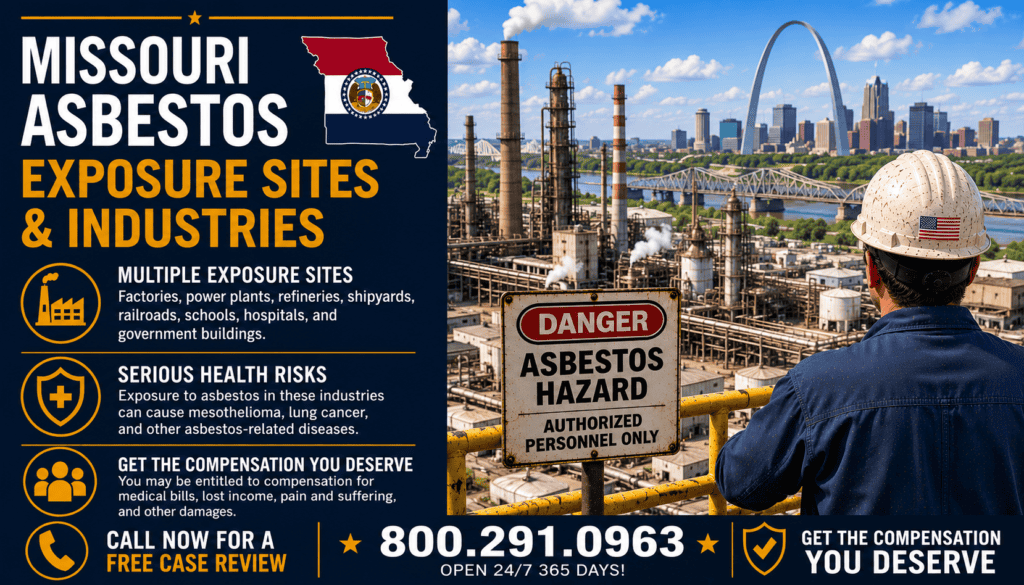
🏭 Missouri Asbestos Exposure Sites & Industries
Missouri asbestos exposure occurred across power plants, factories, manufacturing facilities, construction projects, railroad operations, industrial plants, public buildings, automotive facilities, utilities, and other workplaces throughout the state. During much of the 20th century, asbestos-containing insulation, gaskets, packing, fireproofing, flooring, roofing, cement materials, friction products, and other heat-resistant materials were widely used in American industry and construction.
Missouri workers could encounter asbestos while operating equipment, repairing machinery, maintaining steam systems, renovating buildings, servicing vehicles, removing insulation, or working near other trades that disturbed asbestos-containing materials.
The Missouri Department of Natural Resources notes that asbestos was used in thousands of commercial applications and identifies historical materials including boiler insulation, HVAC insulation, pipe insulation, flooring, fireproofing, roofing, joint compounds, ceiling materials, and brake pads.
🗺️ Where Asbestos Exposure Occurred in Missouri
Potential historical exposure occurred throughout Missouri in workplaces and buildings where asbestos-containing products were installed or used.
These environments included:
- Power plants
- Manufacturing facilities
- Factories
- Industrial plants
- Railroad facilities
- Construction sites
- Automotive repair shops
- Utility facilities
- Mechanical rooms
- Commercial buildings
- Schools
- Hospitals
- Government buildings
- Warehouses
- Institutional buildings
Different industries created different exposure pathways.
A pipefitter at a power plant could encounter insulation and gaskets.
A factory mechanic could rebuild pumps and valves.
A railroad mechanic could work with friction and mechanical components.
A construction worker could disturb flooring, insulation, fireproofing, or cement products.
The actual work performed at the site matters more than the facility name alone.
For the statewide parent resource, see Missouri Asbestos Exposure Lawsuits.
⚡ Missouri Power Plant Asbestos Exposure
Power generation was historically one of the industrial environments where heat-resistant insulation and mechanical sealing materials were especially important.
Power plants contained equipment such as:
- Boilers
- Turbines
- Generators
- Pumps
- Valves
- Condensers
- Heat exchangers
- Steam piping
- Electrical systems
Potential historical asbestos-containing materials could include certain:
- Boiler insulation
- Pipe insulation
- Turbine insulation
- Gaskets
- Packing
- Refractory materials
- Electrical insulation
- Fireproofing
Workers potentially affected included:
- Boilermakers
- Pipefitters
- Steamfitters
- Millwrights
- Electricians
- Insulators
- Maintenance mechanics
- Welders
- Operators
- Laborers
Maintenance shutdowns could be particularly important because multiple systems might be opened, dismantled, repaired, or reinsulated simultaneously.
For deeper research, see Missouri Power Plant Asbestos Exposure, Missouri Power Plant Workers Mesothelioma, and Missouri Power Generation Equipment Asbestos Exposure.
🔥 Boiler Rooms & Steam Systems
Boiler rooms were found far beyond power plants.
They could also operate in:
- Factories
- Manufacturing plants
- Hospitals
- Schools
- Government buildings
- Commercial properties
- Institutional facilities
Potential asbestos-containing materials historically associated with boiler and steam systems included certain:
- Boiler insulation
- Pipe insulation
- Gaskets
- Packing
- Insulating cement
- Refractory materials
- Thermal coverings
Missouri DNR specifically identifies boiler and pipe insulation among historical asbestos-containing materials.
Workers could disturb these materials during boiler maintenance, steam-line repair, valve work, equipment replacement, or insulation removal.
Related equipment information is available at Missouri Boiler Equipment Asbestos Exposure and Missouri Asbestos Insulation Products.
🏭 Missouri Manufacturing Asbestos Exposure
Missouri manufacturing facilities could contain asbestos in both the buildings and the equipment used for production.
Potential exposure sources included:
- Boilers
- Furnaces
- Industrial ovens
- Pumps
- Valves
- Compressors
- Production machinery
- Steam piping
- Electrical equipment
- Insulation
- Gaskets
- Packing
- Fireproofing
- Building materials
Manufacturing exposure could affect:
- Production workers
- Maintenance mechanics
- Millwrights
- Electricians
- Machinists
- Pipefitters
- Welders
- Insulators
- Laborers
- Supervisors
Maintenance workers could experience direct contact with asbestos-containing components while production workers could experience nearby or environmental exposure within the same facility.
See Missouri Manufacturing Asbestos Exposure, Missouri Factory Workers Asbestos Exposure, and Missouri Industrial Machinery Asbestos Exposure.
⚙️ Missouri Industrial Asbestos Exposure
Industrial operations often required equipment capable of handling heat, pressure, friction, steam, chemicals, and electricity.
Historically, asbestos-containing products were useful in these environments because of their resistance to heat and chemical damage.
Potential industrial applications included certain:
- Thermal insulation
- Gaskets
- Packing
- Millboard
- Refractory materials
- Electrical insulation
- Cement products
- Friction materials
- Fireproofing
EPA historical documentation confirms substantial industrial use of asbestos in gaskets and packing because of properties including heat resistance, strength, resilience, and chemical resistance.
Industrial exposure research should identify the particular facility and work performed rather than assuming every industrial worker encountered the same products.
For related statewide information, review Missouri Industrial Asbestos Exposure and Missouri Industrial Asbestos Products.
🏗️ Missouri Construction Asbestos Exposure
Construction workers could encounter asbestos-containing materials during new construction as well as later renovations and demolition.
Potential historical materials included certain:
- Pipe insulation
- Boiler insulation
- HVAC insulation
- Floor tile
- Flooring mastics
- Roofing materials
- Cement siding
- Cement panels
- Joint compounds
- Ceiling materials
- Fireproofing
- Textured coatings
Missouri DNR identifies these and other building products among materials historically associated with asbestos.
Related pages include Missouri Construction Asbestos Exposure, Missouri Construction Workers Mesothelioma, and Missouri Asbestos Products Used in Construction.
Potentially affected trades included:
- Carpenters
- Electricians
- Plumbers
- Pipefitters
- Insulators
- Roofers
- Flooring installers
- HVAC workers
- Laborers
- Demolition workers
- Maintenance workers
🔨 Renovation & Demolition Exposure
Renovation and demolition deserve separate attention because previously installed asbestos-containing materials could be disturbed years after the original construction.
Exposure could occur while workers:
- Removed pipe insulation
- Tore out flooring
- Demolished walls
- Removed ceilings
- Cut roofing
- Removed boilers
- Dismantled mechanical systems
- Drilled older building materials
- Removed fireproofing
EPA explains that asbestos fibers can be released when asbestos-containing materials are disturbed during demolition, building maintenance, repair, or remodeling.
Today, Missouri regulates asbestos activities associated with covered demolition, renovation, and abatement projects.
Modern requirements should not be used to assume what conditions existed decades ago, but they underscore the importance of controlling disturbance of asbestos-containing materials.
🚆 Missouri Railroad Asbestos Exposure
Railroad operations created another potential historical exposure environment.
Asbestos-containing products could be associated with certain:
- Locomotive systems
- Boilers
- Steam piping
- Brake components
- Gaskets
- Packing
- Electrical equipment
- Insulation
- Railroad buildings
Potentially affected workers included:
- Locomotive mechanics
- Machinists
- Electricians
- Pipefitters
- Brake repair workers
- Maintenance workers
- Shop employees
- Laborers
Exposure research should identify:
Railroad → Facility → Occupation → Equipment → Component → Task → Years
Simply having worked for a railroad does not establish which asbestos products, if any, a worker encountered.
See Missouri Railroad Asbestos Exposure and Missouri Railroad Workers Asbestos Exposure.
🚗 Missouri Automotive & Vehicle Repair Exposure
Asbestos was historically used in certain automotive friction materials because of its resistance to heat and friction.
Potential components included certain:
- Brake linings
- Brake shoes
- Brake pads
- Clutch facings
- Gaskets
- Other friction products
EPA identifies automobile clutch, brake, and transmission components among historical asbestos applications.
Potentially exposed Missouri workers included:
- Automotive mechanics
- Brake technicians
- Fleet mechanics
- Truck mechanics
- Bus mechanics
- Heavy-equipment mechanics
- Garage workers
Exposure could occur while removing, cleaning, sanding, grinding, or replacing older friction components.
Related resources include Missouri Automotive Brake Equipment Asbestos Exposure and Missouri Automotive Asbestos Products.
🏢 Missouri Commercial Building Asbestos Exposure
Asbestos exposure was not limited to heavy industry.
Older commercial buildings could contain certain asbestos-containing:
- Floor tile
- Flooring mastics
- Ceiling materials
- Pipe insulation
- Boiler insulation
- HVAC insulation
- Roofing
- Fireproofing
- Joint compounds
- Cement materials
Workers potentially affected included:
- Building engineers
- Custodians
- Maintenance workers
- Electricians
- Plumbers
- HVAC technicians
- Remodelers
- Demolition workers
Workers performing maintenance above ceilings or inside mechanical rooms could encounter asbestos materials that were hidden from ordinary building occupants.
🏫 Missouri Schools & Educational Buildings
Schools constructed or renovated during periods of extensive asbestos use could contain asbestos-containing building and mechanical materials.
Potential historical locations included:
- Boiler rooms
- Mechanical rooms
- Classrooms
- Hallways
- Auditoriums
- Cafeterias
- Utility spaces
- Roofs
Potential materials included certain:
- Pipe insulation
- Boiler insulation
- Floor tile
- Ceiling tile
- Fireproofing
- HVAC insulation
- Roofing
- Joint compounds
Potentially affected workers could include:
- Custodians
- Maintenance employees
- Teachers
- Contractors
- Electricians
- Plumbers
- HVAC workers
- Renovation crews
The presence of an older school building alone does not establish exposure. Product condition, work activity, location, and time period matter.
🏥 Missouri Hospitals & Healthcare Facilities
Hospitals and other large healthcare facilities could contain extensive mechanical systems requiring boilers, steam piping, HVAC equipment, electrical systems, and fire-resistant construction materials.
Potential asbestos-containing materials could historically include certain:
- Pipe insulation
- Boiler insulation
- HVAC insulation
- Flooring
- Ceiling materials
- Fireproofing
- Roofing
- Mechanical components
Maintenance personnel and contractors could encounter these materials during repairs and renovations.
Healthcare workers could have different exposure circumstances depending on whether asbestos-containing materials were disturbed near occupied work areas.
🏛️ Missouri Government & Public Buildings
Government buildings, courthouses, municipal facilities, public works buildings, and other older public structures could contain asbestos-containing building materials.
Potential locations included:
- Boiler rooms
- Mechanical rooms
- Utility tunnels
- Offices
- Basements
- Roofs
- Electrical rooms
Potentially affected workers included:
- Maintenance personnel
- Custodians
- Electricians
- Plumbers
- HVAC workers
- Construction contractors
- Demolition workers
Again, the building’s age is a research clue—not proof that a particular material contained asbestos.
For statewide public-facility research, see Missouri Public & Government Buildings Asbestos Exposure.
🏭 Missouri Factories & Mechanical Rooms
Mechanical rooms concentrated equipment and thermal systems within relatively confined areas.
Potential equipment included:
- Boilers
- Pumps
- Valves
- Compressors
- HVAC equipment
- Steam piping
- Electrical systems
Potential asbestos-containing components included certain:
- Insulation
- Gaskets
- Packing
- Seals
- Electrical materials
Workers performing maintenance could work very close to materials being removed or replaced.
These locations can therefore be important when reconstructing historical exposure.
🔩 Pumps, Valves & Industrial Systems
Pumps and valves were used across Missouri power plants, factories, utilities, manufacturing facilities, and other industrial sites.
Certain historical pumps and valves used asbestos-containing:
- Packing
- Gaskets
- Flange materials
EPA records document asbestos packing in rotary, centrifugal, and reciprocating pumps, valves, expansion joints, and other mechanical equipment.
Workers could disturb these materials during:
- Pump rebuilding
- Valve repacking
- Flange separation
- Gasket removal
- Equipment overhauls
♨️ Furnaces, Kilns & High-Temperature Operations
High-temperature industrial operations could require extensive heat-resistant materials.
Potential equipment included:
- Furnaces
- Kilns
- Industrial ovens
- Boilers
- Dryers
- Process equipment
Potential historical asbestos-containing materials could include certain:
- Insulation
- Millboard
- Gaskets
- Packing
- Refractory materials
- Heat barriers
EPA documentation identifies historical millboard applications in boilers, kilns, foundries, electrical equipment, and other industrial environments.
🔌 Electrical & Utility Facilities
Asbestos also had historical electrical applications.
Potential uses included certain:
- Electrical insulation
- High-grade electrical paper
- Arc-resistant components
- Switchgear components
- Heat-resistant panels
- Generator components
Potentially affected workers included:
- Electricians
- Utility workers
- Power plant workers
- Electrical technicians
- Maintenance workers
Electrical workers could also experience nearby exposure while pipefitters, insulators, or other trades disturbed asbestos in shared mechanical spaces.
Occupation-specific resources include Missouri Electricians Asbestos Exposure and Missouri Pipefitters Mesothelioma.
🏭 Missouri Industrial Facility Example: Bannister Federal Complex
The former Bannister Federal Complex in Kansas City provides a documented Missouri example of asbestos-containing building materials at a major industrial and federal facility.
Missouri DNR states that various manufacturing operations occurred at the complex and that asbestos-containing building materials were located throughout facility buildings.
This illustrates an important point for Missouri exposure research:
A large site may contain multiple buildings, departments, employers, operations, equipment systems, and products.
👷 Missouri Workers at Higher-Risk Historical Sites
Potentially exposed occupations varied by industry but could include:
- Boilermakers
- Pipefitters
- Steamfitters
- Millwrights
- Electricians
- Insulators
- Maintenance mechanics
- Factory workers
- Machinists
- Welders
- Railroad workers
- Construction workers
- Automotive mechanics
- HVAC technicians
- Plumbers
- Equipment operators
- Custodians
- Demolition workers
- Laborers
Occupation should be combined with worksite and task information.
🧱 Asbestos Products Used Across Missouri Industries
Different industries could use many of the same product categories.
Potential historical asbestos-containing materials included certain:
- Pipe insulation
- Boiler insulation
- HVAC insulation
- Gaskets
- Packing
- Fireproofing
- Flooring
- Roofing
- Cement products
- Joint compounds
- Brake products
- Electrical insulation
- Millboard
- Refractory materials
Missouri DNR notes that manufacturers used asbestos in more than 3,000 commercial applications.
Not every product within these categories contained asbestos.
Explore Missouri Asbestos Products for the statewide product silo.
🛠️ Maintenance Workers & Missouri Asbestos Sites
Maintenance personnel deserve particular attention because they often moved throughout an entire facility.
A maintenance worker might service:
- Boilers
- Pumps
- Valves
- Steam piping
- Furnaces
- Compressors
- Production machinery
- Electrical systems
- HVAC systems
Potential exposure tasks could include:
- Scraping gaskets
- Removing packing
- Removing insulation
- Rebuilding pumps
- Repacking valves
- Repairing boilers
- Dismantling machinery
This could produce a broader exposure history than that of a worker assigned to a single production station.
🛑 Plant Shutdowns & Industrial Overhauls
Scheduled shutdowns could involve intensive maintenance across an industrial facility.
Work could include:
- Boiler overhauls
- Turbine maintenance
- Pump rebuilding
- Valve replacement
- Pipe replacement
- Furnace repairs
- Insulation removal
- Equipment demolition
- Electrical upgrades
Multiple trades could work simultaneously.
Workers who remember participating in annual or periodic shutdowns should document:
- Facility
- Approximate year
- Department
- Equipment
- Job assignment
- Contractors
- Nearby trades
- Products disturbed
Each shutdown may represent a separate historical exposure period.
👥 Bystander Exposure at Missouri Worksites
A worker did not necessarily need to personally install or remove an asbestos-containing product.
Potential examples include:
- An electrician working beside pipe insulation removal
- An operator near pump rebuilding
- A welder beside boiler repairs
- A laborer cleaning after maintenance
- A supervisor entering an overhaul area
🏠 Take-Home Exposure from Missouri Worksites
Historically, asbestos fibers could settle on:
- Work clothes
- Boots
- Gloves
- Hair
- Tools
- Personal belongings
Workers could carry dust away from industrial or construction sites.
Family members who handled contaminated work clothing could potentially experience secondary exposure.
A useful household exposure chronology is:
Worker → Employer → Site → Occupation → Product/Task → Household Member
📂 Records That Can Help Identify Missouri Asbestos Sites
Historical exposure research can use:
- Social Security employment records
- Personnel records
- Union records
- Pension records
- W-2 forms
- Contractor records
- Maintenance logs
- Work orders
- Equipment manuals
- Engineering drawings
- Purchasing records
- Architectural plans
- Historical photographs
- Product catalogs
- Coworker statements
A record does not need to contain the word “asbestos” to be valuable.
Proof that someone worked as a millwright in a particular Missouri factory during specific years can establish a critical part of the exposure chronology.
👥 Former Coworkers Can Help Identify Missouri Exposure Sites
Coworkers may remember:
- Departments
- Buildings
- Machinery
- Contractors
- Product names
- Manufacturers
- Shutdown procedures
- Maintenance practices
- Insulation work
- Equipment brands
A former coworker can sometimes provide details missing from employment records.
Those recollections can then be compared with available historical documentation.
🏢 What If a Missouri Asbestos Site Closed?
A closed factory, power plant, railroad shop, industrial facility, or other workplace can still potentially be researched.
Evidence may survive through:
- Employment records
- Union records
- Corporate records
- Government records
- Engineering records
- Equipment manuals
- Historical photographs
- Contractor records
- Product catalogs
- Former workers
🔄 What If a Missouri Facility Changed Names or Owners?
Industrial facilities can operate for decades under multiple owners.
A worker may remember one company name while historical records identify another.
Document:
- Facility name
- Employer name
- Parent company
- Approximate employment dates
- Ownership changes
- Department
- Occupation
Do not automatically assume that a later owner was responsible for products or working conditions from an earlier period.
Corporate history and exposure history should be researched separately.
🩺 Diseases Associated With Missouri Asbestos Exposure
Asbestos exposure can cause serious diseases that may develop long after the original workplace exposure.
These include:
- Mesothelioma
- Asbestos-related lung cancer
- Asbestosis
- Pleural disease
Missouri DNR states that asbestos fibers are small enough to be inhaled into the lungs and can eventually lead to disease.
A diagnosis does not establish which Missouri site or product caused or contributed to exposure.
That requires separate historical investigation.
⚖️ Missouri Exposure Sites & Mesothelioma Claims
Worksite identification can provide an important foundation for an asbestos claim, but a facility name alone generally does not answer the critical exposure questions.
Research should determine:
- Where did the person work?
- Who employed the worker?
- During what years?
- What occupation?
- Which department?
- What equipment?
- What products?
- What maintenance activities?
- Which contractors?
- Which manufacturers or suppliers?
- Which coworkers can confirm conditions?
Related legal resources include Missouri Mesothelioma Statute of Limitations and Missouri Wrongful Death Mesothelioma Lawsuits.
🏦 Missouri Worksites & Asbestos Trust Fund Research
A Missouri worksite may have used products associated with companies that later entered bankruptcy and established asbestos trusts.
Potential research can proceed:
Worksite → Department → Equipment → Product → Manufacturer → Company Status
A single facility could have used products from multiple manufacturers.
Therefore, working at a particular Missouri site does not automatically establish eligibility for a particular asbestos trust.
Eligibility depends on the trust’s requirements and supporting medical and exposure evidence.
For Missouri-specific claim information, see Missouri Asbestos Trust Fund Claims and Missouri Mesothelioma Lawsuits & Claims.
❓ Frequently Asked Questions About Missouri Asbestos Exposure Sites & Industries
Which Missouri industries historically had asbestos exposure risks?
Potential exposure environments included power generation, manufacturing, construction, railroads, automotive repair, utilities, industrial operations, and building maintenance.
Did every Missouri factory contain asbestos?
No. A facility’s age or industry alone does not prove asbestos was present. Specific materials, equipment, work practices, and time periods should be researched.
Why were power plants important asbestos exposure environments?
Historical power plants used extensive high-temperature steam and electrical systems where certain insulation, gaskets, packing, refractory materials, and other heat-resistant products could contain asbestos.
Could construction workers encounter asbestos?
Yes. Certain historical insulation, flooring, roofing, fireproofing, joint compounds, cement products, and other construction materials contained asbestos.
Could railroad workers encounter asbestos?
Potentially. Historical railroad equipment and facilities could involve certain brake, insulation, gasket, packing, electrical, and building materials.
Could Missouri mechanics encounter asbestos?
Certain historical brake, clutch, and other friction products contained asbestos.
Could public buildings contain asbestos?
Yes. Certain historical flooring, insulation, fireproofing, ceiling, roofing, cement, and mechanical materials used in public and commercial buildings contained asbestos.
Does working at a known asbestos site prove exposure?
No. Individual exposure depends on the person’s work location, occupation, tasks, products, proximity, and time period.
What if the plant closed decades ago?
Historical employment, union, corporate, equipment, contractor, government, product, photograph, and coworker records may still help reconstruct the site.
What if I remember the factory but not the asbestos product?
Start with the employer, department, occupation, equipment, maintenance tasks, contractors, coworkers, and employment years.
Can nearby work create exposure?
Potentially. Workers could be present while other trades disturbed asbestos-containing materials in shared work areas.
Can family members have secondary exposure?
Potentially. Historically, asbestos dust could leave workplaces on contaminated clothing and other belongings.
Missouri Asbestos Exposure Site & Industry Pages
Explore the primary pages in this Missouri exposure-site and industry silo:
- Missouri Asbestos Exposure Sites
- Missouri Power Plant Asbestos Exposure
- Missouri Manufacturing Asbestos Exposure
- Missouri Construction Asbestos Exposure
- Missouri Railroad Asbestos Exposure
- Missouri Public & Government Buildings Asbestos Exposure
Related statewide resources include Missouri Workers & Occupational Asbestos Exposure, Missouri Equipment & Machinery Asbestos Exposure, Missouri Industrial Asbestos Exposure, Missouri Asbestos Products, Missouri Counties Asbestos Exposure & Lawsuits, and Missouri Mesothelioma Lawsuits & Claims.
☎️ Call 800.291.0963 — Open 24/7, 365 Days
If you or someone you love has been diagnosed with mesothelioma or another asbestos-related disease after working in Missouri, documenting employers, facilities, industries, occupations, departments, equipment, products, manufacturers, contractors, coworkers, and exposure periods can help reconstruct possible historical asbestos exposure.
MesotheliomaHelp.Center provides legal and medical information to help Missouri residents and families understand asbestos exposure, mesothelioma lawsuits, asbestos trust claims, filing deadlines, and potential next steps.
[forminator\_form id=”633″]