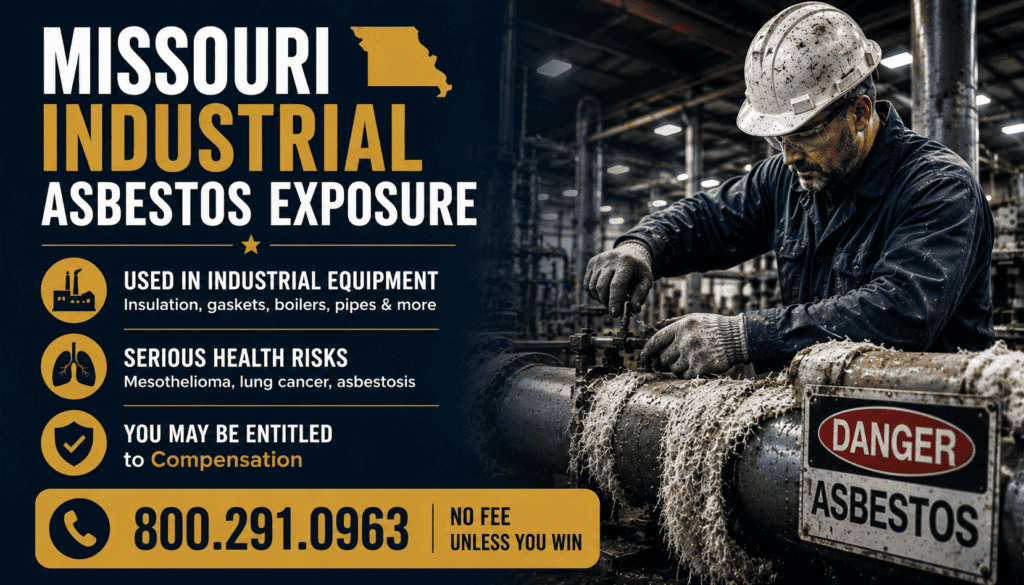
🏭 Missouri Industrial Asbestos Exposure
How Missouri Industrial Workers Were Exposed to Asbestos and Developed Mesothelioma, Lung Cancer, and Other Asbestos-Related Diseases
For decades, Missouri’s industrial economy depended on manufacturing plants, steel fabrication facilities, machine shops, food processing plants, power generation equipment, chemical facilities, warehouses, and heavy industrial operations that relied extensively on asbestos-containing materials.
Industrial employers used asbestos because it was durable, inexpensive, and highly resistant to heat, fire, electricity, and chemicals. Boilers, steam systems, turbines, pumps, valves, industrial machinery, electrical equipment, furnaces, pipe insulation, refractory materials, and thousands of other industrial products routinely contained asbestos throughout much of the twentieth century.
Unfortunately, industrial workers often performed maintenance, repairs, equipment installations, and renovations that disturbed these materials and released microscopic asbestos fibers into the air. Most employees had no idea they were breathing asbestos while simply performing routine job duties.
Today, many former Missouri industrial workers have been diagnosed with mesothelioma, asbestos-related lung cancer, asbestosis, and other serious illnesses decades after their workplace exposure.
Whether someone worked in a manufacturing plant, processing facility, industrial warehouse, machine shop, fabrication facility, maintenance department, refinery, utility, or another industrial workplace, understanding how exposure occurred can help identify potential historical asbestos sources.
For the statewide overview, review Missouri Asbestos Exposure Lawsuits. Because this page is part of the equipment silo, also see Missouri Equipment & Machinery Asbestos Exposure.
🏗️ Why Missouri Industries Relied on Asbestos
Industrial facilities throughout Missouri generated enormous amounts of heat while operating around the clock. Boilers produced steam, turbines generated power, furnaces processed materials, and production machinery operated continuously under demanding conditions.
To improve safety and reduce equipment failures, industrial companies insulated high-temperature equipment with asbestos-containing products.
Asbestos was commonly selected because it:
- Resisted extreme heat
- Reduced fire hazards
- Protected workers from burns
- Helped conserve energy
- Improved equipment efficiency
- Reduced maintenance costs
- Withstood chemical exposure
- Provided electrical insulation
- Lasted for decades
Because of these advantages, asbestos became one of the most widely used industrial materials in Missouri throughout much of the twentieth century.
Although these products were intended to improve workplace safety, disturbing aging asbestos materials during maintenance or repairs frequently released dangerous airborne fibers.
Many of these industrial materials are discussed in greater detail in Missouri Industrial Asbestos Products and Missouri Asbestos Products.
⚙️ Common Industrial Equipment That Contained Asbestos
One reason industrial asbestos exposure was so widespread is that asbestos was incorporated into thousands of pieces of industrial equipment—not just building materials.
Workers throughout Missouri regularly encountered asbestos while servicing equipment such as:
- Industrial boilers
- Steam generators
- Steam pipes
- Turbines
- Pumps
- Valves
- Heat exchangers
- Compressors
- Industrial furnaces
- Kilns
- Drying ovens
- Process vessels
- Storage tanks
- Mechanical seals
- Pipe insulation
- Expansion joints
- Industrial gaskets
- Packing materials
- Electrical switchgear
- Electrical panels
- HVAC equipment
- Industrial refrigeration systems
- Conveyor systems
- Material handling equipment
- Hydraulic systems
Maintenance employees often removed deteriorated insulation, replaced gaskets, rebuilt pumps, repaired valves, and serviced boilers during scheduled shutdowns. These activities could disturb asbestos materials that had remained in place for decades.
Industrial machinery itself also contained numerous asbestos products. Learn more in Missouri Industrial Machinery Asbestos Exposure and Missouri Equipment & Machinery Asbestos Exposure.
🏭 Missouri Manufacturing and Heavy Industry
Missouri’s manufacturing sector has employed generations of workers producing automobiles, aircraft components, agricultural equipment, machinery, food products, steel products, chemicals, electrical equipment, paper products, and countless other industrial goods.
Many manufacturing facilities contained extensive steam systems, industrial boilers, production machinery, conveyor systems, compressed air systems, mechanical rooms, and maintenance shops where asbestos-containing materials were routinely installed.
Industrial maintenance departments frequently repaired:
- Steam distribution systems
- Production equipment
- Industrial piping
- Boilers
- Pumps
- Valves
- Compressors
- Electrical equipment
- Mechanical seals
- Industrial ovens
- Hydraulic systems
Each repair project increased the likelihood of disturbing aging asbestos insulation and mechanical components.
Workers employed in these environments should also review Missouri Manufacturing Asbestos Exposure, Missouri Factory Workers Asbestos Exposure, and Missouri Asbestos Exposure Sites & Industries.
🔧 Industrial Maintenance Departments
Industrial maintenance workers experienced some of the highest potential asbestos exposures because they repaired equipment throughout an entire facility rather than remaining in one production area.
Routine maintenance often included:
- Replacing steam pipe insulation
- Repairing industrial boilers
- Rebuilding pumps
- Servicing valves
- Installing new gaskets
- Repacking valves
- Rebuilding compressors
- Repairing heat exchangers
- Replacing mechanical seals
- Servicing electrical equipment
- Maintaining HVAC systems
- Repairing conveyor equipment
Many of these repairs required workers to remove deteriorated asbestos insulation before maintenance could begin.
During major plant shutdowns, maintenance personnel often worked extended shifts replacing worn equipment throughout the facility, increasing both the frequency and duration of potential asbestos exposure.
🏢 Machine Shops and Industrial Repair Facilities
Machine shops supported nearly every major industrial employer in Missouri by rebuilding equipment, fabricating replacement parts, repairing pumps, rebuilding valves, machining shafts, resurfacing mechanical components, and repairing production machinery.
Although machining itself did not always involve asbestos, repair work frequently required removing asbestos-containing gaskets, insulation, packing materials, and friction products before rebuilding industrial equipment.
Workers in machine shops often serviced equipment removed from factories, power plants, processing facilities, railroads, and other industrial operations where asbestos-containing materials were commonly used.
Because these facilities repaired equipment from multiple industries, workers could encounter a wide variety of asbestos-containing products throughout their careers.
🏭 Industrial Processing Facilities
Industrial processing facilities—including food processing plants, chemical facilities, agricultural processing operations, and manufacturing plants—depended upon extensive mechanical systems to maintain continuous production.
Potential asbestos-containing materials included:
- Steam lines
- Boiler insulation
- Industrial ovens
- Processing equipment
- Pumps
- Valves
- Mechanical seals
- Pipe insulation
- Heat exchangers
- Industrial dryers
- Electrical equipment
- Refrigeration systems
Maintenance personnel, mechanics, electricians, pipefitters, millwrights, welders, engineers, and laborers often worked directly with these systems while performing routine repairs and equipment upgrades.
Workers involved with boilers and steam systems should also review Missouri Boiler Equipment Asbestos Exposure and Missouri Pipefitters Mesothelioma.
👷 Missouri Industrial Occupations with the Highest Asbestos Exposure
Industrial asbestos exposure was rarely limited to one occupation. Because asbestos-containing materials were used throughout entire facilities, workers in many different trades could inhale asbestos fibers while performing routine job duties.
Occupations that historically experienced elevated exposure risks included:
- Industrial maintenance workers
- Millwrights
- Pipefitters
- Electricians
- Boiler operators
- Boiler mechanics
- Stationary engineers
- Welders
- Mechanics
- Machinists
- Industrial laborers
- HVAC technicians
- Plumbers
- Maintenance supervisors
- Plant engineers
- Equipment operators
- Insulators
- Utility workers
- Fabrication workers
- Production workers
Many employees worked alongside one another during maintenance shutdowns, meaning workers who never directly handled asbestos could still inhale airborne fibers released by nearby repairs.
Workers in specialized industrial trades should also review:
- Missouri Pipefitters Mesothelioma
- Missouri Electricians Asbestos Exposure
- Missouri Construction Workers Mesothelioma
🔥 Industrial Boilers and Steam Systems
Boilers and steam systems were among the largest users of asbestos in Missouri industrial facilities.
Industrial boilers operated under extremely high temperatures and pressures, making thermal insulation essential for efficient and safe operation. Asbestos insulation was commonly installed around:
- Boilers
- Steam drums
- Steam headers
- Steam pipes
- Expansion joints
- Pressure vessels
- Blowdown systems
- Feedwater equipment
- Condensate systems
- Steam valves
Routine boiler maintenance often required workers to remove old insulation before repairs could begin.
During scheduled shutdowns, maintenance crews frequently replaced deteriorated insulation, rebuilt valves, installed new gaskets, and repaired piping systems. These activities often generated airborne asbestos dust throughout boiler rooms and mechanical spaces.
Additional information is available in Missouri Boiler Equipment Asbestos Exposure.
⚙️ Pumps, Valves, and Industrial Piping
Industrial facilities depended on extensive piping systems to transport steam, chemicals, water, fuel, compressed air, and production materials throughout the plant.
Many of these systems contained asbestos in:
- Pipe insulation
- Valve packing
- Pump packing
- Flange gaskets
- Mechanical seals
- Expansion joints
- Thermal insulation
- Protective coverings
Replacing worn packing materials or rebuilding industrial pumps often required mechanics to scrape away deteriorated asbestos products before installing replacement components.
Pipefitters, mechanics, millwrights, engineers, and maintenance personnel frequently completed these repairs while working only inches away from asbestos-containing materials.
Workers repairing industrial machinery should also review Missouri Industrial Machinery Asbestos Exposure and Missouri Equipment & Machinery Asbestos Exposure.
⚡ Power Generation Equipment Inside Industrial Plants
Many Missouri manufacturing facilities generated their own steam or electrical power to support production operations.
Powerhouses located within industrial plants commonly contained:
- Turbines
- Generators
- Boilers
- Condensers
- Heat exchangers
- Steam piping
- Cooling equipment
- Electrical switchgear
- Control equipment
Because these systems operated continuously under high temperatures, asbestos insulation surrounded much of the equipment.
During maintenance outages, crews often removed insulation, rebuilt turbines, repaired generators, replaced gaskets, and serviced mechanical equipment.
Employees who worked in these environments may also wish to review:
- Missouri Power Plant Asbestos Exposure
- Missouri Power Plant Workers Mesothelioma
- Missouri Power Generation Equipment Asbestos Exposure
🔌 Electrical Equipment and Control Rooms
Electrical systems inside industrial facilities also contained numerous asbestos products.
Electrical workers may have encountered asbestos while servicing:
- Electrical panels
- Switchgear
- Motor control centers
- Transformers
- Cable insulation
- Arc-resistant panels
- Electrical room fireproofing
- Industrial wiring systems
Many older electrical rooms also contained asbestos ceiling materials, flooring products, fireproofing, pipe insulation, and mechanical equipment.
Electricians working throughout industrial plants often entered nearly every production area during maintenance projects, increasing the variety of asbestos-containing materials they encountered.
Additional information is available in Missouri Electricians Asbestos Exposure.
🏭 How Missouri Industrial Workers Were Exposed
Most industrial asbestos exposure occurred during routine maintenance rather than unusual workplace accidents.
Common activities that disturbed asbestos-containing materials included:
- Removing boiler insulation
- Replacing pipe insulation
- Installing new gaskets
- Repacking valves
- Rebuilding pumps
- Servicing compressors
- Repairing heat exchangers
- Rebuilding turbines
- Replacing expansion joints
- Removing refractory materials
- Demolishing mechanical equipment
- Cleaning maintenance areas
- Sweeping insulation debris
- Using compressed air around contaminated equipment
Maintenance shutdowns often required dozens of skilled trades to work simultaneously in confined mechanical spaces. As insulation was removed from boilers, piping, and equipment, asbestos fibers could remain suspended in the air long after repairs were completed.
Because asbestos fibers are microscopic and odorless, workers generally had no way of knowing they had inhaled them.
🏠 Secondary Household Asbestos Exposure
Industrial asbestos exposure did not always end when the workday was over.
Before protective clothing programs became common, many Missouri workers drove home wearing dusty work clothes contaminated with asbestos fibers.
Family members could unknowingly be exposed while:
- Washing contaminated uniforms
- Cleaning dusty work boots
- Handling lunch boxes and tools
- Riding in contaminated personal vehicles
- Hugging family members after work
Although household exposure generally involved fewer fibers than occupational exposure, repeated secondary exposure has been associated with mesothelioma and other asbestos-related diseases in some family members.
🏭 Industrial Exposure Often Overlapped Other Missouri Workplaces
Many industrial workers built careers across multiple industries. A maintenance mechanic might begin work in a manufacturing plant, later move to a power station, and eventually maintain equipment at a railroad facility or government building.
Because asbestos-containing materials were widely used across Missouri industries, workers often experienced exposure at more than one type of workplace over several decades.
For additional information, explore these Missouri resources:
- Missouri Asbestos Exposure Sites
- Missouri Manufacturing Asbestos Exposure
- Missouri Factory Workers Asbestos Exposure
- Missouri Asbestos Exposure Sites & Industries
🫁 Diseases Linked to Missouri Industrial Asbestos Exposure
Industrial asbestos exposure often occurred over many years, with workers repeatedly inhaling microscopic asbestos fibers while maintaining machinery, repairing steam systems, replacing insulation, servicing boilers, rebuilding pumps, and working throughout Missouri’s industrial facilities.
One of the most challenging aspects of asbestos-related diseases is their long latency period. Most illnesses do not develop immediately after exposure. Instead, symptoms often appear 20 to 50 years after workers were first exposed to asbestos.
Former employees from Missouri manufacturing plants, industrial facilities, machine shops, processing plants, power generation facilities, warehouses, and maintenance departments have later been diagnosed with serious asbestos-related diseases.
Mesothelioma
Mesothelioma is a rare and aggressive cancer affecting the lining surrounding the lungs, abdomen, heart, or testes. Nearly every confirmed case has been linked to asbestos exposure.
Industrial maintenance workers, mechanics, millwrights, electricians, welders, pipefitters, engineers, boiler operators, machinists, and production employees have all been diagnosed with mesothelioma decades after working around asbestos-containing industrial equipment.
Asbestos-Related Lung Cancer
Workers who inhaled asbestos fibers over many years may also face an increased risk of asbestos-related lung cancer.
Individuals seeking information about legal options should also review Missouri Asbestos Lung Cancer Lawsuits.
Asbestosis
Asbestosis is a chronic lung disease caused by inhaling asbestos fibers over an extended period. Progressive scarring of the lungs can lead to shortness of breath, reduced lung capacity, and increasing respiratory difficulties.
Pleural Plaques and Pleural Thickening
Many industrial workers develop pleural plaques or thickening of the lung lining after years of occupational asbestos exposure. Although these conditions are not cancer, they often indicate significant previous exposure and may accompany other asbestos-related diseases.
⚖️ Compensation Options for Missouri Industrial Workers
Workers diagnosed with mesothelioma, asbestos-related lung cancer, or another asbestos disease may investigate several potential legal options depending on where they worked, the products involved, applicable law, and other case-specific facts.
Potential claim types or benefit programs may include:
- Personal injury lawsuits
- Product liability claims
- Premises liability lawsuits
- Asbestos bankruptcy trust fund claims
- Veterans benefits for qualifying military service
- Wrongful death lawsuits filed by surviving family members
Many industrial workers spent decades employed at several different facilities, resulting in exposure to asbestos products manufactured by numerous companies.
Employment records, union records, maintenance logs, product identification, military service records, and coworker testimony can often help establish occupational asbestos exposure.
For broader legal information, review Missouri Mesothelioma Lawsuits & Claims and Missouri Asbestos Exposure Lawsuits.
💰 Missouri Asbestos Trust Fund Claims
Many manufacturers that supplied asbestos-containing industrial equipment, insulation, gaskets, packing materials, pumps, valves, and other industrial products later entered bankruptcy and established asbestos trust funds.
Former Missouri industrial workers may qualify to file claims with one or more asbestos trusts if the applicable medical and exposure requirements are satisfied.
Industrial maintenance employees, manufacturing workers, power plant employees, mechanics, millwrights, electricians, pipefitters, machinists, welders, boiler operators, and production workers often worked with products manufactured by companies that later established asbestos trust funds.
Learn more by visiting Missouri Asbestos Trust Fund Claims.
⏳ Missouri Mesothelioma Statute of Limitations
Missouri law establishes deadlines for filing asbestos-related legal claims.
Because filing requirements vary depending on the facts of each case, individuals diagnosed with mesothelioma or another asbestos-related disease should become familiar with Missouri’s filing deadlines as soon as possible.
Waiting too long may affect whether a claim can proceed.
Learn more by visiting Missouri Mesothelioma Statute of Limitations.
🕊️ Missouri Wrongful Death Lawsuits
Sadly, many Missouri families have lost loved ones to mesothelioma and other asbestos-related illnesses decades after occupational exposure occurred.
In certain situations, surviving spouses, children, or other eligible family members may have legal options involving a wrongful death claim, depending on the facts and applicable law.
These claims may seek compensation for financial losses and other damages recognized under Missouri law.
Learn more by visiting Missouri Wrongful Death Mesothelioma Lawsuits.
❓ Frequently Asked Questions
Which Missouri industrial workers had the highest risk of asbestos exposure?
Maintenance mechanics, millwrights, pipefitters, electricians, boiler operators, machinists, welders, engineers, maintenance supervisors, insulators, production workers, and industrial laborers often worked around asbestos-containing equipment throughout Missouri’s industrial facilities.
What industrial equipment commonly contained asbestos?
Common asbestos-containing equipment included boilers, steam pipes, turbines, pumps, valves, compressors, heat exchangers, industrial furnaces, electrical equipment, HVAC systems, gaskets, packing materials, and industrial insulation.
Can industrial maintenance workers develop mesothelioma decades later?
Yes. Mesothelioma frequently develops 20 to 50 years after occupational asbestos exposure. Many former industrial maintenance workers were diagnosed long after retiring.
Could workers be exposed without handling asbestos directly?
Yes. Employees working near insulation removal, boiler repairs, machinery maintenance, or renovation projects could inhale airborne asbestos fibers released by nearby work.
Can family members experience secondary asbestos exposure?
Yes. Family members could unknowingly inhale asbestos fibers carried home on contaminated work clothing, boots, tools, lunch boxes, or personal vehicles.
Where can I learn about other Missouri industrial workplaces?
Our Missouri resource center includes detailed information about industrial facilities, manufacturing plants, power plants, machine shops, railroads, automotive facilities, government buildings, and many other asbestos exposure locations throughout the state.
🔗 Related Missouri Resources
Continue your research with these Missouri asbestos resources:
- Missouri Equipment & Machinery Asbestos Exposure
- Missouri Industrial Machinery Asbestos Exposure
- Missouri Boiler Equipment Asbestos Exposure
- Missouri Power Generation Equipment Asbestos Exposure
- Missouri Automotive Brake Equipment Asbestos Exposure
- Missouri Workers & Occupational Asbestos Exposure
- Missouri Factory Workers Asbestos Exposure
- Missouri Electricians Asbestos Exposure
- Missouri Pipefitters Mesothelioma
- Missouri Power Plant Workers Mesothelioma
- Missouri Asbestos Exposure Sites & Industries
- Missouri Manufacturing Asbestos Exposure
- Missouri Power Plant Asbestos Exposure
- Missouri Asbestos Products
- Missouri Industrial Asbestos Products
- Missouri Asbestos Insulation Products
- Missouri Mesothelioma Lawsuits & Claims
- Missouri Asbestos Trust Fund Claims
- Missouri Asbestos Lung Cancer Lawsuits
- Missouri Wrongful Death Mesothelioma Lawsuits
- Missouri Mesothelioma Statute of Limitations
Call 800.291.0963 — Open 24/7, 365 Days
MesotheliomaHelp.Center provides legal and medical information to help Missouri industrial workers and families understand historical asbestos exposure, related diseases, filing deadlines, compensation options, and possible next steps.