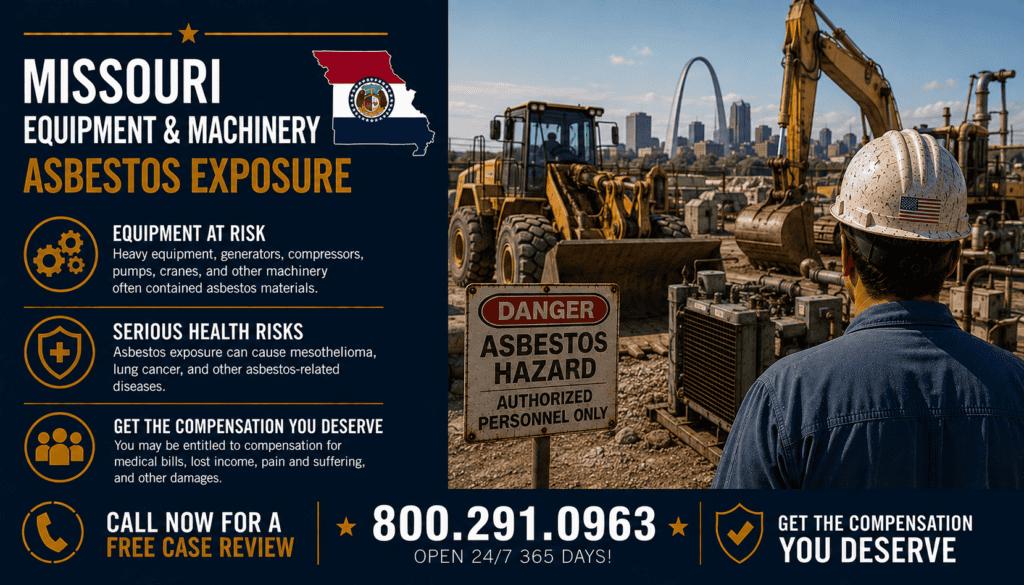
⚙️ Missouri Equipment & Machinery Asbestos Exposure
Missouri equipment and machinery asbestos exposure affected workers in power plants, factories, manufacturing facilities, industrial plants, railroad operations, automotive shops, construction environments, utilities, and other workplaces where heat-resistant asbestos materials were historically incorporated into mechanical systems. Boilers, pumps, valves, turbines, generators, industrial machinery, brake systems, and related equipment could contain or operate alongside asbestos-containing insulation, gaskets, packing, friction materials, and other components.
For decades, asbestos was used around machinery because of its resistance to heat, fire, electricity, friction, and chemical damage. Workers could be exposed when asbestos-containing components deteriorated or were disturbed during maintenance, repair, removal, replacement, rebuilding, or equipment overhauls.
For the statewide parent resource, see Missouri Asbestos Exposure Lawsuits. Related research is available through Missouri Workers & Occupational Asbestos Exposure, Missouri Asbestos Exposure Sites & Industries, and Missouri Asbestos Products.
🏭 Why Industrial Equipment Used Asbestos
Industrial equipment often operated under demanding conditions involving:
- Extreme heat
- Steam
- Pressure
- Friction
- Vibration
- Electrical current
- Chemical exposure
Historically, asbestos-containing materials could be used to insulate hot equipment, control heat transfer, provide sealing surfaces, reduce fire risks, or withstand friction.
Potential asbestos-containing machinery materials included certain:
- Thermal insulation
- Pipe insulation
- Boiler insulation
- Gaskets
- Packing
- Seals
- Brake linings
- Friction materials
- Electrical insulation
- Refractory materials
- Heat-resistant panels
- Insulating cement
Not every piece of older machinery contained asbestos.
The specific equipment, manufacturer, component, replacement parts, application, and time period should be investigated.
🔧 How Missouri Equipment & Machinery Workers Were Exposed
Equipment-related asbestos exposure frequently occurred during ordinary maintenance rather than a single major incident.
Potential exposure tasks included:
- Removing insulation
- Opening equipment
- Scraping old gaskets
- Replacing flange gaskets
- Removing packing
- Repacking valves
- Repacking pumps
- Repairing boilers
- Servicing turbines
- Rebuilding machinery
- Replacing friction components
- Cleaning equipment
- Performing shutdown maintenance
- Demolishing obsolete mechanical systems
Repeated maintenance over a long industrial career could create numerous opportunities for exposure.
Workers performing repairs could experience direct exposure, while employees working nearby could experience bystander exposure.
🔥 Missouri Boiler Equipment Asbestos Exposure
Boilers are one of the most important types of equipment in historical asbestos research.
Boilers generated extreme heat and frequently operated as part of extensive steam systems.
Potential historical asbestos-containing materials could include certain:
- Boiler insulation
- Pipe insulation
- Gaskets
- Packing
- Insulating cement
- Refractory materials
- Thermal blankets
- Rope seals
- Nearby steam-system insulation
Workers potentially affected included:
- Boilermakers
- Pipefitters
- Steamfitters
- Maintenance mechanics
- Operators
- Insulators
- Millwrights
- Electricians
- Welders
Exposure could occur while boilers were opened, cleaned, repaired, rebuilt, insulated, or removed.
Learn more at Missouri Boiler Equipment Asbestos Exposure and Missouri Pipefitters Mesothelioma.
🏭 Missouri Industrial Machinery Asbestos Exposure
Industrial machinery used throughout Missouri manufacturing and processing facilities could incorporate heat-resistant, sealing, electrical, and friction components.
Potential equipment included:
- Production machinery
- Pumps
- Valves
- Compressors
- Furnaces
- Ovens
- Presses
- Conveyors
- Material-handling equipment
- Mechanical drive systems
- Motors
- Industrial fans
- Process equipment
Asbestos-containing components were not necessarily visible from outside the machine.
Gaskets, packing, insulation, and seals could be located inside equipment housings or mechanical connections.
Maintenance employees who dismantled machinery could therefore encounter materials that production workers rarely saw.
See Missouri Industrial Machinery Asbestos Exposure, Missouri Industrial Asbestos Exposure, and Missouri Factory Workers Asbestos Exposure.
⚡ Missouri Power Generation Equipment Asbestos Exposure
Power-generation equipment operated under high temperatures, pressure, steam, vibration, and electrical load.
Potential equipment included:
- Boilers
- Steam turbines
- Generators
- Pumps
- Valves
- Condensers
- Heat exchangers
- Steam piping
- Electrical equipment
- Auxiliary mechanical systems
Potential historical asbestos-containing components could include certain:
- Insulation
- Gaskets
- Packing
- Seals
- Electrical materials
- Refractory products
- Heat-resistant components
Exposure could increase during:
- Planned shutdowns
- Turbine overhauls
- Boiler repairs
- Pump rebuilding
- Valve maintenance
- Steam-line repairs
- Electrical upgrades
- Equipment replacement
Multiple trades could work simultaneously during outages, increasing opportunities for both direct and nearby exposure.
Related resources include Missouri Power Generation Equipment Asbestos Exposure, Missouri Power Plant Asbestos Exposure, and Missouri Power Plant Workers Mesothelioma.
🚗 Missouri Automotive Brake Equipment Asbestos Exposure
Asbestos was historically used in certain automotive friction materials because of its ability to withstand heat generated during braking.
Potentially affected workers included:
- Automotive mechanics
- Brake technicians
- Fleet mechanics
- Truck mechanics
- Bus mechanics
- Heavy-equipment mechanics
- Garage employees
- Maintenance workers
Potential historical asbestos-containing components could include certain:
- Brake shoes
- Brake linings
- Brake pads
- Brake blocks
- Clutch facings
- Other friction components
Exposure could occur while workers:
- Removed brake drums
- Replaced brake shoes
- Cleaned brake assemblies
- Sanded friction products
- Ground linings
- Replaced clutches
- Swept accumulated brake dust
The vehicle manufacturer alone does not identify the manufacturer of the replacement brake or clutch component.
See Missouri Automotive Brake Equipment Asbestos Exposure and Missouri Automotive Asbestos Products.
🔩 Pumps & Asbestos Exposure
Pumps were essential throughout Missouri industrial facilities.
They moved:
- Water
- Steam condensate
- Oil
- Chemicals
- Cooling fluids
- Process liquids
- Other materials
Historical pumps could use certain asbestos-containing packing or gaskets.
Potential exposure could occur when mechanics:
- Opened pump housings
- Removed old packing
- Installed new packing
- Removed gaskets
- Scraped gasket surfaces
- Rebuilt pumps
- Disconnected flanges
🔧 Valves & Asbestos Exposure
Industrial valves regulated steam, liquids, gases, and process materials.
Certain historical valves could use asbestos-containing:
- Valve-stem packing
- Bonnet gaskets
- Flange gaskets
- Insulation
- Sealing materials
Maintenance tasks could include:
- Removing old packing
- Repacking valve stems
- Opening flanges
- Removing flange gaskets
- Scraping sealing surfaces
- Rebuilding valves
Pipefitters, maintenance mechanics, and plant workers could perform these tasks repeatedly throughout a career.
Occupation-specific research includes Missouri Pipefitters Mesothelioma and Missouri Workers & Occupational Asbestos Exposure.
⚡ Turbines & Generators
Steam turbines and generators were central to power generation and some large industrial operations.
Potential exposure could occur around:
- Turbine insulation
- Steam piping
- Gaskets
- Auxiliary pumps
- Valves
- Electrical systems
- Heat-resistant components
Major turbine outages could require extensive disassembly.
Workers involved might include:
- Millwrights
- Electricians
- Pipefitters
- Insulators
- Mechanics
- Maintenance personnel
- Contractors
The specific maintenance task is therefore particularly important when reconstructing turbine or generator exposure.
Electrical workers can also review Missouri Electricians Asbestos Exposure.
♨️ Furnaces, Ovens & High-Temperature Machinery
Missouri industrial facilities also operated furnaces, ovens, kilns, dryers, and other high-temperature equipment.
Potential historical asbestos-containing materials could include certain:
- Insulation
- Gaskets
- Sealing materials
- Heat-resistant panels
- Refractory products
- Electrical insulation
- Thermal barriers
Workers could encounter these materials during:
- Maintenance
- Rebuilding
- Insulation replacement
- Refractory removal
- Equipment modernization
- Demolition
Not all furnace or oven materials contained asbestos, so product-specific evidence remains important.
⚙️ Gaskets in Missouri Industrial Equipment
Gaskets are particularly important in equipment-related asbestos investigations.
They were used to create seals between mechanical surfaces such as:
- Pipe flanges
- Pumps
- Valves
- Boilers
- Furnaces
- Heat exchangers
- Compressors
- Turbines
- Process equipment
A gasket in place and undisturbed presents a different exposure scenario from one being scraped, cut, ground, or removed during maintenance.
Workers could generate dust while:
- Scraping hardened gasket residue
- Wire brushing flange surfaces
- Grinding sealing surfaces
- Cutting replacement material
- Removing old gasket fragments
These maintenance activities should be documented carefully.
🧵 Packing in Pumps & Valves
Packing was used to seal moving mechanical components while allowing shafts or valve stems to operate.
Potential historical applications included:
- Pumps
- Valves
- Expansion joints
- Compressors
- Other mechanical equipment
Workers might use:
- Picks
- Hooks
- Scrapers
- Hand tools
to remove old packing before installing replacement material.
A worker who repacked hundreds of pumps or valves over decades could have a very different exposure history from someone who merely operated the equipment.
🧱 Insulation Around Missouri Equipment
Not all machinery-related exposure came from components inside the equipment.
Workers could encounter asbestos-containing insulation installed around:
- Boilers
- Steam pipes
- Furnaces
- Turbines
- Generators
- Tanks
- HVAC systems
- Mechanical systems
- High-temperature equipment
Insulation could deteriorate because of:
- Age
- Heat
- Vibration
- Moisture
- Maintenance
- Repeated removal
- Equipment replacement
Workers repairing machinery could therefore encounter asbestos insulation even when the machine itself did not contain asbestos.
👷 Missouri Workers Who Serviced Equipment & Machinery
Potentially exposed occupations included:
- Millwrights
- Maintenance mechanics
- Boilermakers
- Pipefitters
- Steamfitters
- Electricians
- Machinists
- Welders
- Insulators
- Power plant workers
- Factory workers
- Railroad workers
- Automotive mechanics
- Equipment operators
- HVAC technicians
- Industrial laborers
- Maintenance supervisors
- Instrument technicians
Different occupations could encounter different components of the same equipment. Related worker pages include Missouri Electricians Asbestos Exposure, Missouri Pipefitters Mesothelioma, Missouri Factory Workers Asbestos Exposure, Missouri Power Plant Workers Mesothelioma, and Missouri Railroad Workers Asbestos Exposure.
🏭 Missouri Industries Where Asbestos-Containing Equipment Was Used
Equipment-related exposure could occur across many Missouri industries.
Potential settings included:
- Power plants
- Manufacturing facilities
- Factories
- Industrial plants
- Railroad facilities
- Utility operations
- Automotive repair facilities
- Chemical plants
- Food-processing facilities
- Commercial mechanical systems
- Public facilities
Different industries used different combinations of equipment. Related site research includes Missouri Manufacturing Asbestos Exposure, Missouri Power Plant Asbestos Exposure, Missouri Railroad Asbestos Exposure, and Missouri Public & Government Buildings Asbestos Exposure.
🛠️ Maintenance & Repair Created Important Exposure Opportunities
Routine maintenance could disturb asbestos-containing materials repeatedly over a worker’s career.
Potential maintenance activities included:
- Opening pump housings
- Repacking valves
- Removing flange gaskets
- Scraping gasket residue
- Repairing boilers
- Removing insulation
- Replacing brake components
- Servicing furnaces
- Rebuilding compressors
- Replacing electrical components
- Dismantling machinery
Maintenance workers could experience exposure that differed substantially from workers who only operated the equipment.
For that reason, the exposure investigation should document:
What was operated?
What was repaired?
What was dismantled?
What materials were removed?
🛑 Plant Shutdowns & Major Equipment Overhauls
Industrial shutdowns could create concentrated periods of maintenance activity.
Workers might simultaneously perform:
- Boiler overhauls
- Turbine rebuilding
- Pump rebuilding
- Valve replacement
- Pipe replacement
- Insulation removal
- Furnace maintenance
- Electrical modernization
- Machinery demolition
Multiple trades could work in confined or adjoining areas.
Workers who participated in annual or periodic shutdowns should document:
- Facility
- Year
- Department
- Equipment
- Contractor
- Job assignment
- Nearby trades
- Products disturbed
Each shutdown can represent a separate exposure period.
👥 Bystander Exposure Around Missouri Machinery
A worker did not necessarily need to touch an asbestos-containing component directly.
Potential examples include:
- An operator near pump maintenance
- An electrician beside insulation removal
- A welder near boiler repairs
- A laborer cleaning after gasket work
- A machinist near valve rebuilding
- A supervisor walking through shutdown areas
The worker’s own duties and surrounding maintenance activities should both be considered.
🏠 Take-Home Asbestos Exposure
Historically, equipment maintenance could generate dust that settled on:
- Work clothing
- Boots
- Gloves
- Hair
- Tools
- Tool bags
- Personal vehicles
- Other work belongings
Workers could leave industrial facilities wearing contaminated clothing.
Family members could potentially encounter fibers while handling or laundering those clothes.
🏷️ Equipment Manufacturer vs. Asbestos Product Manufacturer
The company that manufactured the equipment was not necessarily the company that manufactured every asbestos-containing component used with it.
For product-specific research, see Missouri Industrial Asbestos Products, Missouri Asbestos Insulation Products, and Missouri Asbestos Products.
For example, a pump might use:
- Packing from one manufacturer
- Gaskets from another manufacturer
- External insulation from another company
A boiler could similarly contain or be surrounded by:
- Insulation
- Gaskets
- Refractory products
- Pipe covering
from several suppliers.
Exposure research should therefore distinguish among:
Equipment Manufacturer
Component Manufacturer
Replacement Component Manufacturer
Insulation Manufacturer
Supplier or Distributor
🔄 Replacement Parts & Long-Term Equipment Exposure
Industrial equipment often remained in service for decades.
During that time:
- Gaskets were replaced
- Packing was replaced
- Insulation was repaired
- Pumps were rebuilt
- Valves were repacked
- Boilers were overhauled
- Turbines were rebuilt
- Electrical components were modernized
A worker’s asbestos exposure could therefore involve replacement materials rather than the components originally installed with the equipment.
When possible, document:
- Equipment manufacturer
- Model
- Approximate installation date
- Maintenance dates
- Replacement components
- Parts suppliers
- Contractors
- Coworkers
📂 Records That May Help Identify Missouri Equipment Exposure
Historical machinery exposure may be reconstructed using:
- Employment records
- Social Security work history
- Union records
- Maintenance records
- Work orders
- Equipment manuals
- Parts lists
- Engineering drawings
- Purchasing records
- Plant photographs
- Shutdown records
- Contractor records
- Manufacturer catalogs
- Coworker statements
A record does not necessarily need to mention asbestos to be useful.
An equipment manual identifying the exact machinery used at a Missouri facility can provide a path toward researching historically compatible components.
🏢 What If the Missouri Plant or Equipment No Longer Exists?
Many industrial facilities have:
- Closed
- Changed ownership
- Modernized
- Demolished old buildings
- Replaced machinery
Historical equipment can still potentially be researched.
Evidence may survive through:
- Former employees
- Historical photographs
- Engineering records
- Maintenance logs
- Equipment manuals
- Purchasing documents
- Corporate records
- Contractor files
- Manufacturer catalogs
- Union records
The equipment itself does not need to remain in service for its history to be investigated.
🩺 Diseases Associated With Equipment-Related Asbestos Exposure
Asbestos exposure is associated with serious diseases that may not develop until many years after exposure.
These include:
- Mesothelioma
- Asbestos-related lung cancer
- Asbestosis
- Pleural plaques
- Pleural thickening
A diagnosis does not by itself identify the equipment, product, or company associated with exposure.
That requires reconstructing the worker’s occupational history separately.
🎗️ Mesothelioma in Missouri Machinery Workers
Mesothelioma can develop decades after asbestos exposure.
For a former Missouri machinery worker diagnosed today, useful questions include:
- Which employers?
- Which facilities?
- Which departments?
- Which equipment?
- Which manufacturers?
- Which components?
- Which maintenance duties?
- Which shutdowns?
- Which contractors?
- Which coworkers?
- Which years?
These details can help narrow possible historical exposure sources.
🫁 Asbestos-Related Lung Cancer
Industrial and machinery workers could potentially inhale asbestos fibers while:
- Scraping gaskets
- Removing packing
- Repairing boilers
- Removing insulation
- Servicing brake systems
- Repairing furnaces
- Dismantling older machinery
Smoking and asbestos exposure are separate lung cancer risk factors and should both be accurately documented when relevant.
🌬️ Asbestosis
Asbestosis is chronic lung scarring caused by substantial asbestos exposure.
Workers with long-term histories involving dusty maintenance, insulation removal, boiler repairs, mechanical work, or equipment overhauls may have experienced repeated exposure.
Former workers concerned about respiratory symptoms should provide healthcare professionals with a complete occupational history.
⚖️ Missouri Equipment Exposure & Mesothelioma Lawsuits
A machinery-related asbestos investigation can involve several types of companies. For broader legal information, review Missouri Mesothelioma Lawsuits & Claims.
Depending on the facts, research may examine:
- Equipment manufacturers
- Component manufacturers
- Insulation manufacturers
- Product suppliers
- Contractors
- Distributors
- Other potentially responsible companies
Simply identifying a piece of equipment does not establish asbestos exposure or legal responsibility.
A stronger investigation asks:
Was asbestos-containing material present?
Which component contained it?
Who manufactured or supplied it?
What did the worker do around it?
When did the exposure occur?
What evidence supports the history?
🗺️ Missouri County & Equipment Exposure Research
The county where someone worked can help narrow historical research.
A useful chronology is:
County → Employer → Facility → Department → Equipment → Component → Product
This can be particularly helpful when a worker moved among several Missouri facilities during a career.
County information provides the geographic starting point, while employment, equipment, and task information provide the more specific exposure evidence. See Missouri Counties Asbestos Exposure & Lawsuits.
❓ Frequently Asked Questions About Missouri Equipment & Machinery Asbestos Exposure
What types of Missouri equipment could historically involve asbestos?
Potential examples include boilers, pumps, valves, turbines, generators, industrial machinery, furnaces, ovens, compressors, and automotive brake equipment.
Did every old boiler or industrial machine contain asbestos?
No. Equipment type alone does not prove asbestos content. Manufacturer, model, component, installation period, replacement materials, and maintenance history matter.
Where could asbestos be located in a pump?
Certain historical pumps used asbestos-containing packing and gaskets. Product-specific evidence is necessary for a particular pump or application.
Could valves contain asbestos?
Certain historical valves used asbestos-containing packing or gaskets.
Could boilers contain asbestos products?
Certain historical boilers used or were surrounded by asbestos-containing insulation, gaskets, packing, refractory materials, and related thermal products.
Could brake equipment expose Missouri mechanics?
Potentially. Certain historical brake and clutch friction products contained asbestos.
What if I remember the machine but not the product?
Start with the equipment manufacturer, model, worksite, employment period, maintenance tasks, coworkers, contractors, and replacement parts.
Can replacement parts matter?
Yes. Long-lived machinery could receive several generations of gaskets, packing, insulation, or other replacement components.
Could workers be exposed without performing repairs themselves?
Potentially. Nearby employees could experience bystander exposure when maintenance personnel disturbed asbestos-containing materials.
Could family members experience take-home exposure?
Historically, asbestos dust could leave workplaces on clothing, footwear, tools, and other belongings.
Can equipment still be researched if a plant closed decades ago?
Potentially. Employment, union, maintenance, engineering, corporate, contractor, equipment, and coworker records may still exist.
Does knowing the equipment manufacturer identify the asbestos-product manufacturer?
No. Replacement components could come from separate manufacturers and suppliers.
Missouri Equipment & Machinery Pages
Explore the primary pages in this Missouri equipment and machinery silo:
- Missouri Industrial Asbestos Exposure
- Missouri Boiler Equipment Asbestos Exposure
- Missouri Industrial Machinery Asbestos Exposure
- Missouri Power Generation Equipment Asbestos Exposure
- Missouri Automotive Brake Equipment Asbestos Exposure
Related statewide resources include Missouri Workers & Occupational Asbestos Exposure, Missouri Asbestos Exposure Sites & Industries, Missouri Asbestos Products, and Missouri Mesothelioma Lawsuits & Claims.
Call 800.291.0963 — Open 24/7, 365 Days
If you or a loved one has been diagnosed with mesothelioma or another asbestos-related disease after working around equipment or machinery in Missouri, documenting employers, facilities, occupations, machinery, equipment manufacturers, components, products, maintenance duties, contractors, coworkers, and exposure periods can help reconstruct possible historical asbestos exposure.
MesotheliomaHelp.Center provides legal and medical information to help Missouri workers and families understand asbestos exposure, mesothelioma, asbestos claims, trust funds, filing deadlines, and related options.