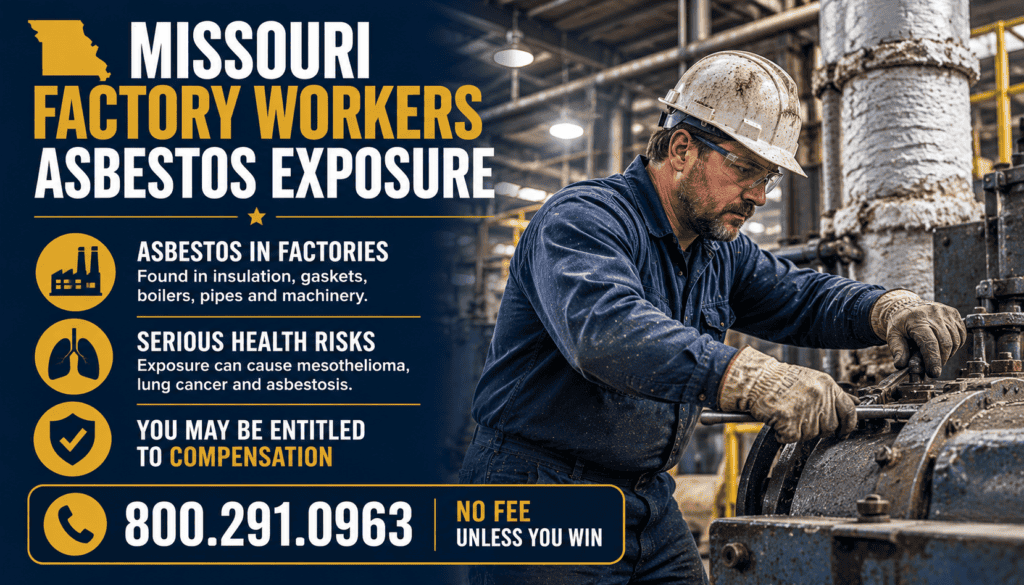
🏭 Missouri Factory Workers Asbestos Exposure
How Missouri Manufacturing, Production, Processing, and Maintenance Workers Were Exposed to Asbestos
For much of the twentieth century, asbestos-containing materials were widely used inside Missouri factories, manufacturing plants, mills, processing facilities, assembly plants, warehouses, and production buildings.
Factories depended on boilers, furnaces, steam systems, industrial machinery, pumps, valves, ovens, dryers, electrical equipment, conveyors, and other high-temperature systems. Asbestos was commonly used around this equipment because it resisted heat, reduced friction, insulated machinery, and helped protect buildings from fire.
Missouri factory workers could encounter asbestos during:
- Daily production work
- Machinery operation
- Equipment maintenance
- Boiler repairs
- Pipe replacement
- Furnace servicing
- Electrical work
- Production-line repairs
- Plant shutdowns
- Building renovations
- Equipment removal
- Factory demolition
Machine operators, maintenance mechanics, millwrights, electricians, pipefitters, boiler operators, welders, production workers, custodians, inspectors, and outside contractors could all work near asbestos-containing materials.
When insulation, gaskets, packing, brake components, fireproofing, flooring, or machinery parts became damaged or were disturbed, microscopic asbestos fibers could enter the air.
Workers might inhale these fibers without realizing they had been exposed because asbestos dust often produced no immediate symptoms.
For a broader overview of occupational exposure throughout the state, review Missouri Workers & Occupational Asbestos Exposure and Missouri Asbestos Exposure Lawsuits.
🔥 Why Asbestos Was Used in Missouri Factories
Factories operated powerful equipment under demanding conditions. Machinery generated heat, vibration, friction, steam, and electrical energy throughout the workday.
Manufacturers added asbestos to industrial products because it:
- Resisted extreme temperatures
- Reduced heat transfer
- Insulated steam systems
- Reduced friction
- Strengthened gaskets and seals
- Protected electrical components
- Resisted chemical damage
- Reduced fire risks
- Increased product durability
- Helped control operating costs
Asbestos-containing materials could be found throughout an entire factory, from boiler rooms and mechanical spaces to production lines, warehouses, maintenance shops, and administrative buildings.
A single Missouri factory could contain asbestos in machinery, insulation, piping, flooring, walls, ceilings, roofing, fireproofing, and electrical equipment.
Additional information about products used in Missouri factories is available in Missouri Industrial Asbestos Products and Missouri Asbestos Products.
⚙️ Industrial Machinery and Production Equipment
Missouri factories relied on machinery to cut, shape, press, grind, mix, heat, cool, package, and transport manufactured products.
Factory equipment that could contain asbestos included:
- Industrial presses
- Lathes
- Grinding machines
- Milling machines
- Textile machinery
- Printing presses
- Packaging equipment
- Mixers
- Dryers
- Ovens
- Kilns
- Conveyors
- Compressors
- Pumps
- Generators
- Motors
Asbestos was used in or around machinery as:
- Gaskets
- Seals
- Packing
- Brake linings
- Clutch components
- Heat shields
- Insulation
- Electrical barriers
- Friction materials
Machine operators could work beside this equipment for years while asbestos-containing components deteriorated from heat, vibration, and ordinary wear.
Maintenance workers faced additional exposure when they opened machinery, removed worn gaskets, replaced packing, repaired brakes, or cleaned accumulated dust.
Learn more at Missouri Industrial Machinery Asbestos Exposure and Missouri Equipment & Machinery Asbestos Exposure.
🔥 Boilers, Furnaces, Kilns, and Industrial Ovens
Factories needed boilers and high-temperature equipment to generate steam, heat buildings, dry materials, cure products, and support manufacturing processes.
Asbestos-containing materials were commonly installed around:
- Industrial boilers
- Furnaces
- Kilns
- Ovens
- Dryers
- Steam drums
- Fireboxes
- Burners
- Hot-water tanks
- Heat exchangers
- Refractory systems
- Exhaust equipment
Workers could encounter asbestos in:
- Boiler insulation
- Furnace insulation
- Refractory cement
- Firebrick mortar
- Boiler doors
- Gaskets
- Rope seals
- Thermal blankets
- Protective panels
- Heat-resistant cloth
Boiler repairs often required workers to remove insulation, replace gaskets, open fireboxes, repair tubes, or remove refractory materials.
These tasks could release significant amounts of asbestos dust, especially inside enclosed boiler rooms and mechanical areas.
Additional information is available in Missouri Boiler Equipment Asbestos Exposure.
🔩 Steam Pipes and Process Piping
Missouri factories used extensive piping systems to carry:
- Steam
- Hot water
- Fuel
- Chemicals
- Compressed air
- Process liquids
- Waste materials
- Cooling water
Asbestos insulation was commonly wrapped around pipes, elbows, valves, flanges, and fittings to reduce heat loss and protect workers from burns.
Pipefitters, plumbers, insulators, maintenance mechanics, and boiler operators could disturb asbestos while:
- Repairing steam leaks
- Replacing pipe sections
- Removing insulation
- Servicing valves
- Replacing gaskets
- Repacking valves
- Repairing pumps
- Opening flanges
- Installing new equipment
Aging pipe insulation could become dry and brittle. Even minor contact, vibration, or water damage could cause pieces to break away and release fibers.
Workers maintaining these systems should also review Missouri Pipefitters Mesothelioma.
🔧 Pumps, Valves, Compressors, and Gaskets
Pumps, valves, compressors, and other mechanical equipment were essential to factory operations.
These systems frequently contained asbestos in:
- Flange gaskets
- Pump packing
- Valve packing
- Compressor gaskets
- Mechanical seals
- Expansion joints
- Insulating pads
- Heat-resistant covers
Maintenance mechanics often removed old gasket material by scraping, sanding, grinding, or using wire brushes.
Packing material could also be pulled from valves and pumps in dry, deteriorated pieces.
These activities could release asbestos fibers directly into a worker’s breathing area and contaminate nearby workbenches, tools, clothing, and machinery.
⚡ Electrical Systems and Factory Equipment
Factories required powerful electrical systems to operate machinery, lighting, motors, conveyors, controls, and production equipment.
Potential asbestos-containing electrical products included:
- Electrical panels
- Arc shields
- Switchgear
- Circuit breakers
- Motor controls
- Transformers
- Cable insulation
- Wiring insulation
- Electrical cloth
- Fire-resistant boards
- Generator components
Electricians could also be exposed while working near insulated pipes, boilers, furnaces, and fireproofing materials.
Opening walls, ceilings, control cabinets, and mechanical spaces sometimes disturbed nearby asbestos-containing materials.
Factory electricians should also review Missouri Electricians Asbestos Exposure.
🚚 Conveyors, Brakes, Clutches, and Friction Materials
Factories used conveyors, hoists, cranes, forklifts, industrial vehicles, and production equipment to move materials throughout the plant.
Asbestos could be present in:
- Brake linings
- Clutch facings
- Conveyor brakes
- Hoist brakes
- Crane brakes
- Elevator brakes
- Friction pads
- Heat-resistant belts
- Machinery linings
Mechanics could be exposed while replacing worn brake or clutch components.
Using compressed air to clean brake assemblies or machinery could spread asbestos dust throughout a maintenance shop.
Machine operators and nearby workers could also experience bystander exposure when dusty friction components were repaired.
🧱 Factory Insulation and Fireproofing
Factories contained many surfaces and systems that required insulation or fire protection.
Asbestos-containing insulation and fireproofing could be found on:
- Structural steel
- Boilers
- Furnaces
- Pipes
- Tanks
- Ductwork
- Ovens
- Kilns
- Mechanical equipment
- Fire-rated walls
- Ceilings
- Equipment enclosures
Asbestos might be installed as:
- Pipe covering
- Block insulation
- Insulating cement
- Spray-applied fireproofing
- Thermal blankets
- Asbestos cloth
- Insulating board
- Fire-resistant panels
Insulators and maintenance crews faced direct exposure while installing, repairing, or removing these products.
Factory workers in nearby production areas could also inhale fibers released during maintenance or renovation work.
🏢 Factory Buildings and Construction Materials
Asbestos was not limited to production machinery. The factory building itself could contain asbestos in:
- Floor tiles
- Flooring adhesive
- Ceiling tiles
- Wall panels
- Plaster
- Joint compound
- Roofing materials
- Siding
- Cement board
- Fire doors
- HVAC insulation
- Electrical panels
Factories were frequently expanded or renovated as production needs changed.
Construction workers, maintenance employees, custodians, electricians, plumbers, and outside contractors could disturb hidden asbestos while opening walls, replacing flooring, repairing roofs, or modernizing building systems.
Workers involved in factory renovations should also review Missouri Construction Workers Mesothelioma, Missouri Construction Asbestos Exposure, and Missouri Asbestos Products Used in Construction.
🏭 Missouri Manufacturing and Processing Facilities
Factory asbestos exposure could occur across many types of Missouri manufacturing and processing operations, including:
- Automobile plants
- Aircraft component plants
- Chemical plants
- Food-processing facilities
- Textile mills
- Paper mills
- Printing plants
- Metal fabrication plants
- Machinery manufacturers
- Electrical equipment plants
- Rubber-product plants
- Plastics manufacturers
- Glass plants
- Cement plants
- Appliance factories
- Agricultural equipment plants
- Packaging facilities
- Warehouses and distribution centers
Different factories used different products and processes, but most relied on mechanical systems, heat-producing equipment, steam lines, electrical controls, and fire-resistant building materials.
For additional information, visit Missouri Manufacturing Asbestos Exposure, Missouri Industrial Asbestos Exposure, and Missouri Asbestos Exposure Sites & Industries.
🛠️ Maintenance Shops and Repair Departments
Factory maintenance departments performed continuous repairs to keep production equipment operating.
Maintenance shops commonly handled:
- Machinery rebuilding
- Pump repairs
- Valve repairs
- Motor maintenance
- Welding
- Gasket replacement
- Brake repairs
- Electrical repairs
- Pipe replacement
- Boiler servicing
- Equipment fabrication
- Preventive maintenance
Workers sometimes used grinders, wire brushes, scrapers, drills, saws, and compressed air while servicing asbestos-containing components.
Dust from these activities could collect on:
- Workbenches
- Tool cabinets
- Machinery
- Floors
- Clothing
- Ventilation systems
- Nearby production equipment
Maintenance mechanics, millwrights, electricians, welders, and pipefitters generally faced some of the most frequent and concentrated exposure inside factories.
⏸️ Plant Shutdowns and Equipment Overhauls
Factories periodically stopped production so workers and contractors could inspect, repair, replace, or rebuild major equipment.
Shutdown work could involve:
- Boiler replacement
- Furnace rebuilding
- Machinery removal
- Pipe replacement
- Insulation removal
- Electrical upgrades
- Conveyor repairs
- Roof replacement
- Structural renovations
- Equipment demolition
These projects often disturbed several asbestos-containing systems at the same time.
Large maintenance crews and outside contractors could work in confined areas while insulation, gaskets, fireproofing, and machinery components were removed.
Fibers released during a shutdown could spread into adjacent production areas and settle on equipment, tools, scaffolding, and workers’ clothing.
🧹 Factory Cleaning and Dust Exposure
Factory custodians, laborers, production workers, and maintenance employees were sometimes instructed to clean dusty machinery and work areas without being told the debris contained asbestos.
High-risk cleaning methods included:
- Dry sweeping
- Brushing machinery
- Shoveling debris
- Cleaning boiler rooms
- Removing insulation scraps
- Emptying dust collectors
- Using compressed air
- Cleaning maintenance shops
Dry sweeping and compressed air could cause settled fibers to become airborne again.
Workers performing cleanup could therefore experience exposure even when they had not participated in the original maintenance or repair work.
👷 Missouri Factory Occupations with the Highest Asbestos Exposure
Missouri factories depended on thousands of skilled workers to operate machinery, maintain production equipment, repair mechanical systems, and keep manufacturing lines running efficiently.
Because asbestos-containing materials were used throughout industrial equipment, boilers, steam systems, pumps, valves, electrical equipment, conveyors, ovens, furnaces, and factory buildings, employees from many different occupations could experience repeated occupational exposure.
High-risk factory occupations included:
- Production workers
- Machine operators
- Maintenance mechanics
- Millwrights
- Boiler operators
- Pipefitters
- Plumbers
- Electricians
- Welders
- Machinists
- Instrument technicians
- HVAC mechanics
- Industrial mechanics
- Utility workers
- Plant engineers
- Process operators
- Conveyor mechanics
- Equipment installers
- Custodians
- Laborers
- Warehouse employees
- Shipping and receiving workers
- Supervisors
- Quality inspectors
- Outside contractors
Major maintenance projects often required several trades to work together inside production areas, mechanical rooms, boiler rooms, maintenance shops, and utility tunnels.
When one crew removed insulation, replaced gaskets, repaired boilers, or rebuilt industrial machinery, asbestos fibers could spread into surrounding work areas and expose employees performing unrelated jobs.
⚙️ Machine Operators and Production Workers
Machine operators spent entire shifts working beside industrial equipment that often generated significant heat, vibration, and mechanical wear.
Equipment commonly included:
- Assembly machinery
- Industrial presses
- Milling machines
- Lathes
- Mixers
- Packaging equipment
- Textile machinery
- Printing presses
- Conveyor systems
- Processing equipment
- Dryers
- Industrial ovens
- Kilns
- Compressors
- Pumps
Although operators did not always repair machinery themselves, they frequently worked around equipment that contained asbestos insulation, brake components, gaskets, packing materials, and heat-resistant products.
Routine maintenance performed nearby could release airborne asbestos fibers into production areas.
Operators working beside deteriorating equipment could experience long-term bystander exposure over many years.
Workers should also review Missouri Industrial Machinery Asbestos Exposure.
🔧 Maintenance Mechanics and Industrial Mechanics
Maintenance mechanics were responsible for keeping factory equipment operating safely and efficiently.
Routine maintenance included:
- Pump rebuilding
- Valve repairs
- Boiler maintenance
- Conveyor repairs
- Compressor rebuilding
- Motor replacement
- Gasket replacement
- Packing replacement
- Machinery rebuilding
- Equipment alignment
- Preventive maintenance
- Emergency repairs
Many repairs required workers to remove asbestos-containing insulation before servicing equipment.
Maintenance mechanics frequently scraped gaskets, removed valve packing, replaced brake components, repaired pumps, rebuilt compressors, and serviced industrial boilers.
These activities could release asbestos fibers directly into confined work areas.
🛠️ Millwrights
Millwrights specialized in installing, dismantling, repairing, aligning, and rebuilding large industrial machinery.
Their work commonly involved:
- Production equipment
- Heavy presses
- Industrial motors
- Conveyors
- Gearboxes
- Pumps
- Compressors
- Turbines
- Mixers
- Crushers
- Manufacturing lines
Many machines used asbestos-containing:
- Gaskets
- Packing
- Brake materials
- Clutches
- Heat shields
- Insulation
Removing worn components often required scraping old gasket material, grinding metal surfaces, replacing packing, and cleaning machinery with compressed air.
Millwrights often worked during plant shutdowns when multiple asbestos-containing systems were dismantled simultaneously.
🔥 Boiler Operators and Steam Plant Employees
Many Missouri factories operated large boiler systems that supplied steam for manufacturing processes, heating, and power generation.
Boiler operators routinely maintained:
- Boilers
- Steam drums
- Burners
- Fireboxes
- Steam valves
- Heat exchangers
- Feedwater systems
- Steam piping
- Hot-water systems
- Pressure vessels
Boiler insulation, refractory materials, thermal blankets, rope seals, gaskets, and pipe insulation frequently contained asbestos.
Routine servicing often disturbed deteriorating insulation that had become brittle after years of exposure to heat.
Workers maintaining boiler systems should also review Missouri Boiler Equipment Asbestos Exposure.
🔩 Pipefitters and Plumbers
Factory pipefitters and plumbers installed and repaired systems carrying:
- Steam
- Hot water
- Compressed air
- Fuel
- Chemicals
- Process liquids
- Cooling water
- Wastewater
Pipefitters routinely worked around:
- Pipe insulation
- Valves
- Pumps
- Expansion joints
- Flanges
- Pipe elbows
- Gaskets
- Valve packing
- Steam traps
Older steam systems often required workers to remove asbestos insulation before replacing damaged sections of pipe.
Repair work could release asbestos fibers throughout boiler rooms, mechanical spaces, and production areas.
Additional information is available in Missouri Pipefitters Mesothelioma.
⚡ Electricians and Instrument Technicians
Electricians maintained the electrical systems that powered manufacturing equipment.
Their work frequently involved:
- Switchgear
- Electrical panels
- Circuit breakers
- Motor controls
- Generators
- Transformers
- Production controls
- Instrumentation
- Lighting systems
- Cable trays
- Emergency power systems
Older electrical equipment sometimes contained asbestos insulation, arc barriers, electrical cloth, and fire-resistant components.
Electricians also worked throughout boiler rooms, mechanical areas, utility tunnels, and production floors where insulated piping and equipment were common.
Factory electricians should also review Missouri Electricians Asbestos Exposure.
🔥 Welders, Machinists, and Metal Fabricators
Welders and machinists repaired and fabricated industrial equipment throughout Missouri factories.
Their work commonly included:
- Pipe welding
- Structural repairs
- Equipment fabrication
- Pump rebuilding
- Valve repairs
- Boiler repairs
- Conveyor repairs
- Machine rebuilding
- Metal cutting
- Grinding
- Surface preparation
Before welding or machining began, workers often removed insulation, fireproofing, gaskets, and protective covers.
Grinding, cutting, and machining near asbestos-containing products could release dust into the surrounding work area.
📦 Warehouse, Shipping, and Receiving Employees
Warehouse personnel moved raw materials, finished products, machinery, replacement parts, and industrial supplies throughout factory facilities.
Although warehouse employees generally did not repair equipment, they could encounter asbestos through:
- Dust from maintenance work
- Older warehouse buildings
- Damaged insulation
- Contaminated machinery
- Industrial products
- Mechanical equipment
- Building renovations
Warehouse employees often worked near maintenance departments and production areas where asbestos fibers could spread beyond the immediate repair location.
🧹 Custodians, Utility Workers, and Laborers
Custodians and laborers cleaned production areas, maintenance shops, boiler rooms, warehouses, and factory buildings.
Typical duties included:
- Sweeping floors
- Cleaning machinery
- Removing debris
- Emptying dust collectors
- Cleaning maintenance shops
- Cleaning boiler rooms
- Handling insulation waste
- General housekeeping
Dry sweeping or using compressed air to clean machinery could reintroduce settled asbestos fibers into the air.
Cleanup crews sometimes experienced exposure even though they never handled the original asbestos-containing product.
📋 Supervisors, Engineers, and Quality Inspectors
Plant supervisors, engineers, production managers, inspectors, and quality-control personnel often spent decades walking through production areas, maintenance shops, boiler rooms, warehouses, and mechanical spaces.
Although they generally performed less hands-on maintenance, repeated visits to active repair projects could result in long-term bystander exposure.
Inspectors often entered work areas while insulation removal, boiler repairs, machinery rebuilding, or pipe replacement was taking place.
🏗️ Outside Contractors During Plant Shutdowns
Many Missouri factories hired outside contractors during scheduled shutdowns or major equipment overhauls.
Contractors frequently performed:
- Boiler replacement
- Pipe replacement
- Equipment removal
- Machinery installation
- Electrical upgrades
- Insulation removal
- Demolition
- Structural renovations
- HVAC replacement
- Roof replacement
Shutdown projects often disturbed numerous asbestos-containing products at the same time.
Contractors, maintenance crews, electricians, pipefitters, welders, millwrights, and laborers frequently worked together inside confined mechanical spaces where airborne asbestos concentrations could become significant.
💨 How Missouri Factory Workers Were Exposed
Most occupational asbestos exposure occurred during routine maintenance and repair rather than a single catastrophic event.
Activities that commonly released asbestos fibers included:
- Removing pipe insulation
- Replacing boiler insulation
- Scraping old gaskets
- Replacing valve packing
- Rebuilding pumps
- Repairing compressors
- Servicing conveyors
- Replacing brakes
- Repairing clutches
- Grinding metal surfaces
- Removing fireproof panels
- Plant renovations
- Equipment demolition
- Sweeping maintenance debris
- Cleaning machinery with compressed air
Asbestos fibers are microscopic and odorless. Workers could inhale or swallow them without realizing exposure had occurred.
Dust released by one maintenance crew frequently settled throughout production areas, exposing nearby employees who never directly handled asbestos products.
🏠 Secondary Household Asbestos Exposure
Many Missouri factory workers unknowingly carried asbestos fibers home on:
- Work clothing
- Boots
- Gloves
- Hard hats
- Tool belts
- Lunch boxes
- Personal vehicles
Family members could be exposed while:
- Washing dusty uniforms
- Cleaning work boots
- Handling contaminated tools
- Cleaning vehicles
- Greeting workers after their shifts
Repeated household exposure has been associated with mesothelioma and other asbestos-related diseases in some spouses and family members.
##
🫁 Diseases Linked to Missouri Factory Worker Asbestos Exposure
For decades, Missouri factory workers operated and repaired machinery, boilers, furnaces, steam systems, pumps, valves, electrical equipment, conveyors, ovens, kilns, and other industrial systems that often contained asbestos.
Production employees, machine operators, maintenance mechanics, millwrights, boiler operators, pipefitters, electricians, welders, machinists, custodians, supervisors, and outside contractors could inhale asbestos fibers during normal factory operations and maintenance work.
Many workers were never told that insulation, gaskets, packing, friction products, fireproofing, electrical components, or building materials contained asbestos.
Asbestos-related diseases often have a long latency period. Symptoms may not appear until 20 to 50 years after exposure occurred.
Former Missouri factory employees may therefore receive a diagnosis decades after leaving the plant or retiring from industrial work.
🩺 Mesothelioma
Mesothelioma is a rare and aggressive cancer that develops in the thin tissue lining certain internal organs.
The primary types include:
- Pleural mesothelioma affecting the lining of the lungs
- Peritoneal mesothelioma affecting the abdominal lining
- Pericardial mesothelioma affecting the lining around the heart
- Testicular mesothelioma affecting the tissue surrounding the testes
Most diagnosed mesothelioma cases are associated with previous asbestos exposure.
Missouri factory workers could encounter asbestos while working around:
- Boiler insulation
- Steam pipe insulation
- Furnace materials
- Industrial ovens
- Kilns
- Pumps
- Valves
- Gaskets
- Packing
- Compressors
- Conveyor brakes
- Clutch components
- Electrical equipment
- Fireproofing
- Factory construction materials
Workers did not need to handle asbestos products directly. Fibers released by maintenance crews could travel into production areas and expose machine operators, inspectors, supervisors, warehouse employees, and other nearby workers.
🫁 Asbestos-Related Lung Cancer
Occupational asbestos exposure can increase the risk of lung cancer.
Missouri factory workers may have inhaled asbestos while:
- Repairing boilers
- Rebuilding machinery
- Replacing gaskets
- Removing valve packing
- Repairing pumps
- Replacing brakes
- Servicing clutches
- Removing insulation
- Performing plant renovations
- Cleaning maintenance debris
- Working near repair crews
The risk can be especially serious for workers who experienced repeated exposure over many years.
Factory workers seeking information about potential claims should review Missouri Asbestos Lung Cancer Lawsuits.
🌬️ Asbestosis
Asbestosis is a chronic lung disease caused by inhaling asbestos fibers.
The fibers may become embedded in lung tissue and cause permanent scarring. As the disease progresses, breathing can become increasingly difficult.
Factory employees with substantial occupational exposure may develop symptoms such as:
- Shortness of breath
- Persistent coughing
- Chest discomfort
- Fatigue
- Reduced exercise tolerance
Boiler workers, insulators, maintenance mechanics, pipefitters, millwrights, and employees who removed deteriorating insulation may have faced particularly heavy exposure.
Asbestosis is not cancer, but it can cause serious and permanent lung damage.
🫀 Pleural Plaques and Pleural Thickening
Some former Missouri factory workers develop pleural plaques or pleural thickening after asbestos exposure.
These conditions affect the lining surrounding the lungs and may indicate a history of occupational exposure.
Pleural plaques are not cancer. However, they may appear in workers who were also exposed to levels of asbestos capable of causing mesothelioma, lung cancer, or asbestosis.
Medical documentation of pleural changes may help establish that previous asbestos exposure occurred.
⚖️ Compensation Options for Missouri Factory Workers
Missouri factory employees diagnosed with mesothelioma, asbestos-related lung cancer, asbestosis, or another qualifying disease may investigate several potential compensation paths.
The available claims depend on:
- Where the worker was employed
- Which machinery or products were present
- The manufacturers responsible
- How long exposure occurred
- The worker’s medical diagnosis
- Whether exposure occurred at more than one jobsite
Potential compensation sources may include:
- Personal injury lawsuits
- Product liability claims
- Premises liability claims
- Asbestos bankruptcy trust fund claims
- Workers’ compensation in qualifying situations
- Veterans benefits for eligible former service members
- Wrongful death lawsuits filed by surviving family members
A factory exposure investigation may involve manufacturers of insulation, boilers, pumps, valves, gaskets, packing, electrical equipment, machinery components, brakes, clutches, fireproofing, and factory construction materials.
For a broader explanation of Missouri legal options, review Missouri Mesothelioma Lawsuits & Claims and Missouri Asbestos Exposure Lawsuits.
🏭 Identifying Factory Exposure Sources
Factory workers may have held several positions or worked at multiple plants during their careers.
Identifying asbestos exposure may require reviewing:
- Employment records
- Social Security work histories
- Union records
- Plant maintenance records
- Equipment manuals
- Machinery specifications
- Purchase invoices
- Construction documents
- Product catalogs
- Coworker statements
- Supervisor testimony
- Jobsite photographs
Workers may not remember the exact brand name of every product they encountered.
However, information about the factory, department, machinery, occupation, and work performed may help determine which asbestos-containing products were likely present.
🏢 Claims Involving Manufacturers and Factory Owners
Depending on the facts, an asbestos claim may involve one or more potentially relevant companies.
Potentially relevant companies or compensation sources may include:
- Asbestos product manufacturers
- Boiler manufacturers
- Pump manufacturers
- Valve manufacturers
- Gasket manufacturers
- Machinery manufacturers
- Electrical equipment manufacturers
- Insulation suppliers
- Industrial contractors
- Plant owners
- Premises operators
- Product distributors
Potential responsibility depends on the products involved, applicable law, the worker’s exposure history, and other case-specific facts.
Factory employees often encountered products made by numerous companies during long careers, which may result in more than one potential claim.
💰 Missouri Asbestos Trust Fund Claims
Many companies that manufactured or supplied asbestos-containing industrial products later filed for bankruptcy.
Some of these companies established asbestos trust funds to compensate workers and families with qualifying claims.
Missouri factory workers may qualify for asbestos trust fund claims when documented exposure involved asbestos-containing:
- Boiler insulation
- Pipe insulation
- Gaskets
- Packing
- Fireproofing
- Cement products
- Electrical materials
- Machinery components
- Furnace products
- Pump components
- Valve components
- Friction products
A factory worker may qualify to file claims with multiple trusts when products from several bankrupt companies were present at one or more plants.
Trust claims generally require evidence of:
- A qualifying asbestos-related diagnosis
- Exposure to a covered company or product
- Employment or jobsite history
- Compliance with the trust’s filing requirements
Learn more at Missouri Asbestos Trust Fund Claims.
🪖 Missouri Veterans Who Later Worked in Factories
Some Missouri factory workers also served in the United States military.
Veterans may have experienced asbestos exposure during military service and again during civilian factory employment.
Military exposure may have occurred in:
- Naval vessels
- Shipyards
- Boiler rooms
- Military bases
- Barracks
- Aircraft facilities
- Vehicle repair shops
- Power plants
- Maintenance buildings
- Government housing
An eligible veteran may be able to pursue VA benefits while also investigating claims involving private asbestos manufacturers or bankruptcy trusts.
Military and civilian exposure histories should both be considered when identifying possible compensation sources.
Veterans can also review U.S. Military Veterans Asbestos Exposure.
⏳ Missouri Mesothelioma Statute of Limitations
Missouri law places deadlines on asbestos-related personal injury and wrongful death claims.
Because mesothelioma and other asbestos diseases may not develop until decades after factory exposure, filing deadlines are generally evaluated in connection with the diagnosis or discovery of the disease rather than the original exposure date.
The exact deadline can depend on:
- The date of diagnosis
- When the illness was linked to asbestos
- The type of claim
- Whether the injured person is living
- Where exposure occurred
- Which companies are involved
Waiting too long may affect whether a claim can proceed.
Former factory workers and families should begin gathering medical records, employment histories, union records, plant information, and product evidence as early as possible.
Additional information is available at Missouri Mesothelioma Statute of Limitations.
🕊️ Missouri Wrongful Death Lawsuits
Families may have legal options when a Missouri factory worker dies from mesothelioma or another asbestos-related disease.
Eligible surviving family members may be able to pursue a wrongful death claim against companies responsible for the exposure.
Potential compensation may include:
- Medical expenses
- Funeral expenses
- Burial costs
- Lost income
- Lost financial support
- Loss of companionship
- Loss of services
- Other damages allowed under Missouri law
A wrongful death claim may still be possible even when the worker’s factory exposure occurred many decades earlier.
Learn more at Missouri Wrongful Death Mesothelioma Lawsuits.
❓ Frequently Asked Questions
Which Missouri factory workers had the highest asbestos exposure?
Maintenance mechanics, millwrights, boiler operators, pipefitters, insulators, electricians, welders, machinists, custodians, equipment installers, and outside industrial contractors often faced significant exposure.
Could production workers and machine operators be exposed?
Yes. Production employees could inhale asbestos fibers released from machinery, insulation, brakes, gaskets, packing, boilers, pipes, or nearby maintenance work.
What factory products commonly contained asbestos?
Common products included boiler insulation, pipe covering, gaskets, valve packing, pump packing, brake linings, clutch facings, fireproofing, electrical insulation, furnace materials, and heat-resistant panels.
How did factory maintenance release asbestos?
Workers often scraped gaskets, removed insulation, pulled packing, repaired boilers, rebuilt machinery, replaced friction components, and cleaned dusty equipment.
Could asbestos spread outside the repair area?
Yes. Fibers could travel through open factory spaces, ventilation systems, foot traffic, machinery vibration, sweeping, and compressed-air cleaning.
Were custodians and cleanup workers exposed?
Yes. Custodians could inhale asbestos while sweeping floors, cleaning machinery, emptying dust collectors, removing insulation debris, or cleaning boiler and maintenance rooms.
Could supervisors and inspectors be exposed?
Yes. Supervisors, engineers, managers, and inspectors could experience repeated bystander exposure while entering active repair areas and mechanical spaces.
Can factory workers develop mesothelioma decades later?
Yes. Mesothelioma may develop 20 to 50 years after occupational exposure, meaning workers may be diagnosed long after retirement.
Could family members also be exposed?
Yes. Factory employees sometimes carried asbestos fibers home on work clothing, boots, tools, lunch containers, and personal vehicles.
Can a factory worker file several asbestos claims?
Possibly. Workers exposed to products from several manufacturers may qualify for lawsuits, trust fund claims, or other compensation from multiple sources.
What information helps document factory exposure?
Employment records, plant names, job titles, departments, machinery descriptions, union records, equipment manuals, coworkers, and maintenance records may help establish exposure.
🔗 Related Missouri Resources
Continue your research with these Missouri asbestos resources:
- Missouri Asbestos Exposure Lawsuits
- Missouri Workers & Occupational Asbestos Exposure
- Missouri Asbestos Exposure Sites & Industries
- Missouri Manufacturing Asbestos Exposure
- Missouri Industrial Asbestos Exposure
- Missouri Industrial Machinery Asbestos Exposure
- Missouri Equipment & Machinery Asbestos Exposure
- Missouri Industrial Asbestos Products
- Missouri Asbestos Products
- Missouri Boiler Equipment Asbestos Exposure
- Missouri Pipefitters Mesothelioma
- Missouri Electricians Asbestos Exposure
- Missouri Construction Workers Mesothelioma
- Missouri Public & Government Buildings Asbestos Exposure
- Missouri Asbestos Trust Fund Claims
- Missouri Asbestos Lung Cancer Lawsuits
- Missouri Wrongful Death Mesothelioma Lawsuits
- Missouri Mesothelioma Statute of Limitations
Call 800.291.0963 — Open 24/7, 365 Days
MesotheliomaHelp.Center provides legal and medical information to help Missouri factory workers, industrial workers, veterans, and families understand historical asbestos exposure, compensation options, filing deadlines, and possible next steps.