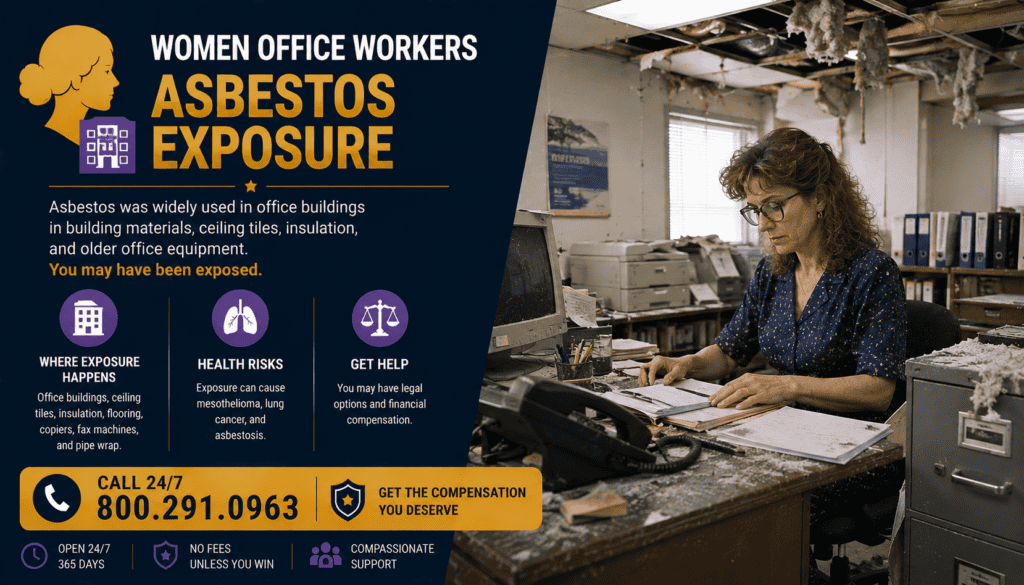
Women Office Workers Asbestos Exposure
Women who worked in offices, administrative departments, government buildings, corporate facilities, schools, hospitals or other commercial properties may have spent years in buildings containing asbestos materials. Office employment alone does not prove asbestos exposure. A useful investigation identifies the specific building, work dates, documented asbestos-containing materials, maintenance history and any renovation or damage that may have disturbed those materials.
Office-worker exposure histories are often different from construction or abatement work because the employee may not have handled asbestos directly. EPA specifically includes office buildings among facilities where asbestos-containing materials may be managed in place, and OSHA requires building owners and employers to communicate information about certain installed asbestos materials. This guide explains how building records, remodeling projects, housekeeping history and medical documentation can help reconstruct possible exposure.
🗄️ Women Office Workers: Exposure Overview
EPA provides operations-and-maintenance guidance for office buildings and similar facilities that may contain asbestos materials. OSHA’s general-industry asbestos standard also recognizes that employees in public and commercial buildings with installed asbestos-containing materials may encounter asbestos under certain conditions, particularly through housekeeping or disturbance of building materials.
Start with the Women’s Occupations & Workplace Asbestos Exposure hub. Record the employer, building address, floor or department, work dates, office moves, renovations and any known asbestos inspections or abatement projects.
| Question | Details to document |
|---|---|
| Where? | Employer, building, floor, office and common areas |
| When? | Employment dates and renovation periods |
| What happened? | Routine occupancy, maintenance, damage or remodeling |
| What material? | Surveyed ACM, insulation, surfacing, flooring or debris |
🏢 Office Buildings and Asbestos Materials
EPA identifies office buildings among facilities for which an asbestos operations-and-maintenance program may be appropriate. EPA describes building asbestos materials that can include surfacing materials and thermal-system insulation on pipes, boilers, tanks and ducts. The presence of an older-looking ceiling, floor or pipe covering is not enough to identify asbestos.
See Women Working in Asbestos-Containing Buildings. Useful records may include asbestos surveys, operations-and-maintenance plans, property-management files, floor plans, renovation specifications, laboratory results and abatement reports.
| Record | Potential value |
|---|---|
| Asbestos survey | May identify documented ACM and location |
| O&M record | May show monitoring and management practices |
| Renovation file | May identify disturbed materials and project dates |
| Abatement report | May document removal areas and controls |
🚪 Work Areas and Building Systems to Investigate
An office worker’s normal desk area may not have been the only relevant location. Employees may have used hallways, conference rooms, basements, file rooms, mechanical areas, cafeterias or shared spaces. OSHA requires owners to identify and communicate information about certain asbestos-containing and presumed asbestos-containing materials in covered buildings.
For buildings constructed no later than 1980, OSHA’s general-industry standard treats installed thermal-system insulation and sprayed- or troweled-on surfacing material as presumed asbestos-containing material for purposes of the standard unless the presumption is rebutted. Older asphalt and vinyl flooring is also addressed by the rule. These regulatory presumptions are not proof of individual exposure.
| Area | Question to investigate |
|---|---|
| Ceiling/overhead space | Was documented surfacing material damaged or disturbed? |
| Mechanical areas | Was pipe, boiler or duct insulation documented as ACM? |
| Flooring | Was flooring or associated mastic documented or presumed ACM? |
| Shared areas | Did renovation or maintenance affect occupied spaces? |
🔨 Renovation, Remodeling and Maintenance
Office renovations can involve ceilings, walls, flooring, pipes, HVAC systems and other building components. When asbestos-containing material is actually disturbed, fibers can become airborne. A historical investigation should compare the woman’s work schedule and office location with renovation dates and project areas rather than assuming that any remodeling caused asbestos exposure.
Preserve notices to employees, contractor names, building permits, asbestos surveys, project specifications, air-monitoring results and abatement records when available. Coworkers may also help identify where employees were working while a project occurred.
| Question | Evidence |
|---|---|
| What work occurred? | Ceiling, flooring, wall, pipe or HVAC project |
| Where? | Floor, office suite and proximity to employee |
| When? | Project dates compared with employment schedule |
| Was asbestos identified? | Survey, laboratory, notification or abatement record |
🧹 Housekeeping, Flooring and Dust
OSHA’s general-industry standard contains specific housekeeping requirements for asbestos-containing waste, debris and dust. It also contains requirements for asbestos-containing flooring, including restrictions on sanding and procedures for stripping and buffing. These rules can be useful when reconstructing historical cleaning or floor-care activities in an office building.
Office workers who did not perform cleaning may still remember recurring dust, damaged materials or maintenance work, but those observations require corroboration. For workers who performed cleaning duties themselves, see Women Custodial Workers Asbestos Exposure.
🗂️ Employment and Building Evidence
Build a chronological work history linking the woman to a specific building, floor and department. Preserve personnel files, payroll records, office directories, leases, photographs, employee notices, coworker names, asbestos surveys, O&M files, renovation documents, work orders and abatement reports. Building ownership records may help identify who controlled the property during the relevant period.
The Mesothelioma Lawsuit Evidence & Documentation hub provides additional record-gathering guidance. Keep firsthand memories separate from facts verified through building, laboratory or project records.
🫁 Medical Documentation and Exposure History
The National Cancer Institute classifies asbestos as a known human carcinogen and states that asbestos exposure causes mesothelioma and cancers including lung, laryngeal and ovarian cancer. NCI explains that fibers can become airborne when asbestos-containing products are disturbed and that asbestos-related disease can develop decades after exposure.
Use the Women’s Asbestos Diseases hub for focused health information. Medical records establish diagnosis and treatment, while workplace and building records address whether a particular office location can be documented as an exposure source.
⚖️ Potential Claim Questions
An office-worker claim investigation may examine an employer, building owner, property manager, renovation contractor, asbestos-product manufacturer, supplier or bankruptcy trust depending on the documented source and governing law. The entity responsible for a building condition may be different from the company that employed the office worker.
Review the Women’s Asbestos Legal Options hub and Mesothelioma Lawsuits in All 50 States. Potential workers’ compensation, civil and asbestos trust routes have different requirements. Compensation is not guaranteed.
🛡️ Current Office-Building Asbestos Management
EPA describes an asbestos operations-and-maintenance program as a plan of training, cleaning, work practices and surveillance designed to keep asbestos-containing materials in good condition and minimize exposure of building occupants. OSHA separately assigns building owners duties involving identification, recordkeeping and communication of certain installed asbestos materials.
Do not disturb a suspect ceiling, floor, insulation or other building material today to investigate a historical exposure. Existing surveys, O&M records, laboratory reports and qualified asbestos professionals are safer sources of information.
❓ Frequently Asked Questions
Could women office workers have encountered asbestos?
Potentially, particularly in buildings where documented asbestos-containing materials were damaged or disturbed during maintenance or renovation. Individual evidence is required.
Does working in an older office building prove asbestos exposure?
No. Building age is a research clue, not proof that asbestos was present or that fibers became airborne.
Does EPA asbestos guidance cover office buildings?
Yes. EPA specifically identifies office buildings among facilities where an asbestos operations-and-maintenance program may be appropriate.
Could office renovations be relevant?
Yes, if documented asbestos-containing material was actually disturbed and the employee was present under relevant circumstances.
Could old office flooring contain asbestos?
Some historical flooring materials did. OSHA addresses older asphalt and vinyl flooring and associated housekeeping practices, but material-specific evidence is still important.
What building records are useful?
Asbestos surveys, O&M plans, renovation files, laboratory reports, work orders and abatement records can help reconstruct conditions.
What if the employer or office no longer exists?
Personnel records, directories, property records, permits, former coworkers, historical surveys and contractor files may still provide evidence.
Is compensation guaranteed?
No. Exposure evidence, responsible parties, medical documentation, deadlines and applicable law affect whether a claim is available.
📞 Submit Your Case
If you or a loved one has a mesothelioma diagnosis and a history of office work in an older building, gather employer names, building addresses, work dates, floor or department information, renovation history and any known asbestos-management records. Unknown details should remain research leads rather than guesses.
Call 800.291.0963 for a no-obligation case evaluation. Live chat is available 24/7, 365 days a year. Submit your case here.
📝 Summary
Women office workers may have encountered asbestos when documented materials in older commercial buildings were damaged or disturbed during maintenance, housekeeping or renovation. A reliable investigation connects the worker to a specific building, time period, location and event using employment, property, asbestos-management, renovation, witness and medical records.
🔗 Confirmed Sources
- OSHA — 29 CFR 1910.1001 Asbestos
- U.S. EPA — Information for Owners and Managers of Buildings That Contain Asbestos
- U.S. EPA — What Is an Asbestos Operations and Maintenance Program?
- National Cancer Institute — Asbestos Exposure and Cancer Risk
This page provides general information, not legal or medical advice. This website is not a law firm. Exposure, eligibility, filing deadlines and compensation depend on individual facts and applicable law. No outcome is guaranteed.