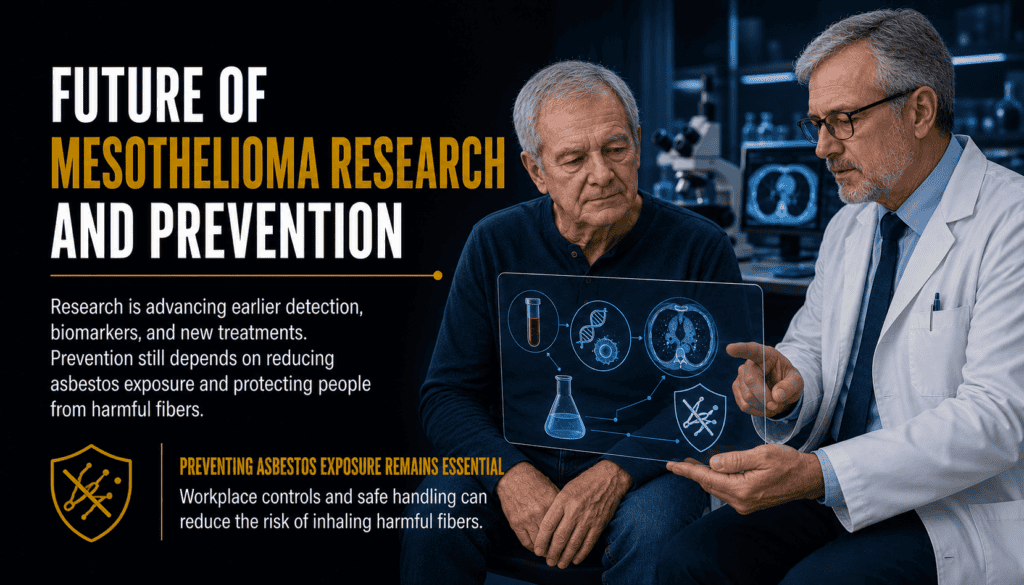
The Future of Mesothelioma Research and Prevention
Earlier detection, better treatment evidence and fewer future asbestos exposures
Future progress against mesothelioma depends on several connected goals: preventing new asbestos exposures, recognizing disease more accurately, developing treatments that help more patients and learning why some tumors respond while others resist therapy.
Research is advancing, but important limits remain. There is no routine screening test proven to prevent mesothelioma deaths, no blood marker that replaces biopsy and no experimental treatment that guarantees a cure. Patients should distinguish validated care from promising laboratory or early-trial findings.
🔭 Future Research Priorities
Mesothelioma is rare, biologically diverse and often diagnosed after it has spread along pleural or abdominal surfaces. These features make large trials, early detection and consistent tumor measurement difficult. Progress requires laboratory science, carefully designed clinical studies and collaboration among specialized centers.
| Research Priority | Central Question | Meaningful Success |
|---|---|---|
| Exposure prevention | How can inhalation and household transfer of asbestos fibers be reduced? | Fewer new occupational, environmental and renovation-related exposures |
| Risk assessment | Which exposed people have the greatest disease risk? | Validated models that guide—not merely increase—testing |
| Earlier detection | Can disease be found before symptoms or extensive spread? | Improved outcomes with acceptably few false alarms |
| Accurate diagnosis | Can difficult tumors be classified faster and more reproducibly? | Adequate tissue, expert pathology and validated decision support |
| Treatment selection | Which patient is most likely to benefit from each therapy? | Predictive biomarkers confirmed in appropriate clinical studies |
| Resistance research | Why does treatment stop working? | New combinations or sequences that delay or overcome resistance |
| Quality of life | How can symptoms and treatment burdens be reduced? | Better breathing, function, comfort and patient-reported outcomes |
The site’s mesothelioma research overview explains clinical-trial phases, study endpoints and why early findings require confirmation.
🛡️ Preventing Asbestos Exposure
Reducing exposure remains the clearest prevention strategy because asbestos causes most mesothelioma cases. Prevention protects workers, families and communities from future risk; it cannot remove fibers already inhaled or guarantee that a previously exposed person will not develop disease.
| Setting | Prevention Approach | Important Safety Point |
|---|---|---|
| Workplace | Exposure assessment, engineering controls, regulated work areas, training and required protective equipment | Employers must follow standards applicable to the industry and task |
| Renovation or demolition | Identify suspect materials before disturbing them | Do not drill, sand, cut or remove suspected material without qualified guidance |
| Older homes and buildings | Leave intact, undisturbed material alone or use accredited professionals | Improper sampling or removal can increase fiber release |
| Household transfer | Prevent contaminated clothing, tools and dust from entering vehicles and homes | Do not shake or launder visibly contaminated work clothing with household laundry |
| Automotive work | Use methods designed to control brake and clutch dust | Compressed air and ordinary dry cleanup can disperse dust |
| Natural deposits or contaminated sites | Follow public-health advisories and dust-control measures | Risk depends on disturbance and airborne fibers, not simply living in a named area |
| Disaster cleanup | Use official hazard assessment and trained remediation teams | Damaged older materials may create mixed and poorly characterized hazards |
The EPA advises that suspected asbestos-containing materials in good condition are generally best left undisturbed and that sampling or major repair should be performed by trained professionals. Regulations and licensing rules vary, so property owners and workers should check current federal, state and local requirements.
Learn about asbestos exposure, asbestos in homes and secondhand asbestos exposure.
🩻 Surveillance and Earlier Detection
Mesothelioma can develop decades after exposure, but exposure alone does not identify who will become ill. Researchers are studying risk models, imaging strategies and blood-based signals. A useful screening program must detect clinically important disease early enough to improve outcomes while limiting radiation, invasive procedures, anxiety and false-positive findings.
| Research Approach | Potential Value | Current Limitation |
|---|---|---|
| Exposure-risk models | Combine job, duration, intensity, age and other factors | Historical exposure information may be incomplete or uncertain |
| Low-dose CT research | Study pleural and lung findings in selected high-risk groups | No routine CT screening protocol is proven specifically for mesothelioma |
| Blood proteins | Measure signals associated with mesothelial disease | Individual markers may lack adequate sensitivity or specificity |
| Circulating tumor DNA | Search for tumor-derived genetic material in blood | Early tumors may release too little material to detect |
| Autoantibodies or immune signals | Identify immune responses that precede clinical diagnosis | Findings require prospective validation in relevant populations |
| Serial monitoring | Look for meaningful change over time | More testing can also produce incidental findings and procedures |
| Combined models | Integrate exposure, imaging and several biomarkers | Complex models can overfit small datasets and fail at new centers |
There is currently no single blood test, scan or home test that can reliably rule in or rule out early mesothelioma. People with past exposure should document it, avoid further exposure and discuss symptoms or individualized follow-up with a clinician. New or worsening shortness of breath, persistent cough, chest or abdominal pain, fluid buildup or unexplained weight loss warrants medical evaluation.
Review the site’s guidance about mesothelioma screening appointments and blood tests and biomarkers.
🔬 Biomarkers, Pathology and AI
Future diagnostic research aims to obtain adequate tissue sooner, distinguish malignant from reactive mesothelial growth and make interpretation more reproducible. Digital pathology and artificial intelligence may help specialists locate suspicious areas or quantify features, but they do not replace representative tissue and accountable expert review.
| Technology | Research Goal | Validation Requirement |
|---|---|---|
| Digital pathology | Share high-resolution slides and support remote specialist review | Image quality, workflow and diagnostic performance must be validated |
| AI slide analysis | Flag tumor regions or quantify stained cells | External testing across laboratories, scanners and histologies |
| Radiomics | Extract quantitative shape, intensity and texture from scans | Reproducibility across scanners, protocols and patient groups |
| Molecular pathology | Use selected protein loss or genetic deletion to support diagnosis | Interpretation with morphology, invasion and immunohistochemistry |
| Liquid biopsy | Detect or monitor tumor-derived material without repeated tissue procedures | Adequate sensitivity, especially when disease burden is low |
| Multimodal models | Combine imaging, tissue, molecular and clinical data | Prospective evidence that the model improves a real decision |
| Automated measurement | Measure irregular pleural tumor more consistently | Human correction and clinically meaningful response thresholds |
AI can reproduce bias or technical errors in its training data. Researchers must report false negatives, false positives, subgroup performance and whether a tool works outside the institution that developed it.
Read more about AI-assisted mesothelioma diagnosis research, pathology review and the mesothelioma biopsy process.
Questions After a Mesothelioma Diagnosis?
Our team can help you find information and understand possible legal options related to asbestos exposure.
Call 800.291.0963 Submit Your Case
Live chat is available 24/7/365.
💊 Treatment Research
Treatment research includes new medicines, combinations, sequences, local procedures and symptom-focused care. A future advance should improve outcomes that matter to patients, not only produce a short-term scan response.
| Research Direction | Goal | Major Question |
|---|---|---|
| Immunotherapy combinations | Increase response or overcome immune resistance | Which patients benefit enough to justify added toxicity? |
| Chemoimmunotherapy | Combine direct cancer-cell injury with immune activation | What regimen, sequence and duration provide the best balance? |
| Targeted agents | Block a pathway important to a molecularly defined tumor | Is the biomarker predictive or only biologically associated? |
| Cell-based therapy | Engineer or activate immune cells against tumor targets | Can cells reach heterogeneous tumors safely and remain active? |
| Cancer vaccines | Train immune responses against selected tumor antigens | Can immune activation produce durable clinical benefit? |
| Oncolytic or gene therapy | Deliver therapeutic material or selectively disrupt tumor cells | How can delivery, immune response and safety be controlled? |
| Surgery and radiation studies | Refine selection, technique, sequencing and symptom control | Which patients gain meaningful benefit over less invasive care? |
| Supportive-care research | Improve breathlessness, pain, fatigue and function | How can symptom benefit be integrated early and measured well? |
Established treatments should not be presented as obsolete simply because new trials are underway. Surgery, systemic therapy, radiation, pleural-fluid procedures and palliative care continue to have patient-specific roles.
Explore emerging treatment research and the current mesothelioma treatment overview.
🧬 Precision, Cell and Gene Research
Precision research examines whether a tumor’s molecular or immune features can predict benefit. Mesothelioma commonly involves loss of tumor-suppressor functions, which can be harder to target than an activated protein with an available inhibitor.
| Approach | Potential Contribution | Reason for Caution |
|---|---|---|
| Tumor genomic profiling | Identify alterations and possible biomarker-defined trials | Many findings have no proven mesothelioma therapy |
| Germline testing | Investigate inherited predisposition in selected patients or families | Most tumor alterations are not inherited |
| Immune profiling | Study markers of response and resistance | No single marker perfectly predicts immunotherapy benefit |
| CAR T-cell or related therapies | Direct engineered immune cells toward a tumor-associated target | Target variation, trafficking, persistence and toxicity remain challenges |
| Gene-delivery approaches | Alter tumor or immune biology inside the chest or abdomen | Delivery and control must be demonstrated in clinical trials |
| DNA-repair strategies | Exploit selected repair vulnerabilities | A BAP1 or related finding does not guarantee drug sensitivity |
| Multi-omics | Combine DNA, RNA, protein and clinical information | Complex signatures may fail without independent validation |
A molecular report can support a trial search but cannot promise eligibility or response. Read the site’s guide to precision medicine and pharmacogenomics in mesothelioma.
📊 Clinical Trials and Research Data
Rare cancers need multicenter cooperation because a single institution may see too few patients to answer a question reliably. Shared definitions, high-quality tissue, complete follow-up and patient-reported outcomes can make results more useful.
| Research Need | Why It Matters | Quality Check |
|---|---|---|
| Multicenter enrollment | Recruits enough patients and improves geographic diversity | Sites use consistent eligibility and assessment methods |
| Representative participation | Results should apply across age, sex, race, health and exposure backgrounds | Enrollment and outcomes are reported by relevant subgroups |
| Central pathology review | Reduces diagnostic and histology misclassification | Adequate tissue and standardized criteria are available |
| Biobanks | Connect stored tissue and blood with clinical outcomes | Consent, privacy, specimen quality and annotation are maintained |
| Patient-reported outcomes | Measures symptoms and function directly from participants | Validated tools and meaningful time points are used |
| Real-world data | Studies care outside narrowly selected trials | Missing data and treatment-selection bias are addressed |
| Negative results | Prevents repetition and improves future trial design | Completed studies report results regardless of outcome |
Trial eligibility can depend on tumor location, histology, stage, previous treatment, organ function and biomarkers. Recruitment status can change, so patients should contact the listed research site and review standard-care alternatives with their oncologist.
Use the site’s clinical-trials guide to prepare questions about phases, randomization, costs, travel and informed consent.
📋 Next Steps and Authoritative Medical Sources
Practical Next Steps
- Prevent further asbestos exposure and avoid disturbing suspect materials.
- Record employment, military, residential and household exposure history.
- Report persistent or worsening symptoms rather than waiting for a future screening test.
- Seek expert pathology review when the diagnosis or cell type is uncertain.
- Ask which treatments are established and which are available only through research.
- Discuss trials before starting therapy if trial participation is important.
- Ask how a study measures survival, symptoms, function and serious adverse effects.
- Do not alter medical care based on an experimental biomarker or consumer test alone.
Authoritative Medical and Government Sources
- National Cancer Institute: Malignant Mesothelioma Treatment (PDQ), Health Professional Version
- National Cancer Institute: Asbestos Exposure and Cancer Risk
- Centers for Disease Control and Prevention: Mesothelioma Basics
- U.S. Environmental Protection Agency: Protect Your Family From Asbestos Exposure
- National Cancer Institute: Cancer Screening and Early Detection Research
- National Cancer Institute: Cancer Treatment Research
- ClinicalTrials.gov: Mesothelioma Studies
❓ Frequently Asked Questions
Can mesothelioma be prevented?
Preventing asbestos exposure can reduce future risk, but no intervention can guarantee that a previously exposed person will not develop mesothelioma.
Is there a screening test for people exposed to asbestos?
No routine screening test has been proven specifically to reduce mesothelioma deaths. An exposed person should discuss individual history, symptoms and follow-up with a clinician.
Can a blood test detect mesothelioma early?
No available blood test can independently and reliably diagnose early mesothelioma. Biomarker panels remain an important research area.
Will artificial intelligence diagnose mesothelioma sooner?
AI may assist imaging or pathology review, but mesothelioma-specific tools require external validation and cannot replace appropriate tissue sampling and expert interpretation.
What treatment research looks most promising?
Researchers are studying immunotherapy combinations, biomarker-guided treatment, cell therapies, gene-delivery approaches and better local treatment. “Promising” does not mean proven superior.
Can tumor sequencing find a targeted treatment?
Sometimes it may identify a trial or selected treatment consideration, but many mesothelioma alterations have no established drug match and no result guarantees benefit.
Why are mesothelioma clinical trials difficult?
Mesothelioma is rare and includes different locations, stages and histologies. Trials may need many centers and careful standardization to recruit enough comparable participants.
How can patients contribute to future research?
Depending on eligibility and preference, patients may join a clinical trial, allow samples to be stored, complete quality-of-life surveys or participate in registries after informed consent.
Talk With Our Mesothelioma Support Team
If you or a loved one has been diagnosed with mesothelioma, we can help you find information and understand possible legal options related to asbestos exposure. There is no obligation.
Call 800.291.0963 Submit Your Case
Live chat is available 24/7/365.
Medical and legal disclaimer: This page provides general educational information and is not a substitute for advice from a licensed physician, occupational-safety professional or attorney. Screening, treatment, trial eligibility, exposure controls and legal rights depend on individual facts; contacting us does not create an attorney-client relationship.