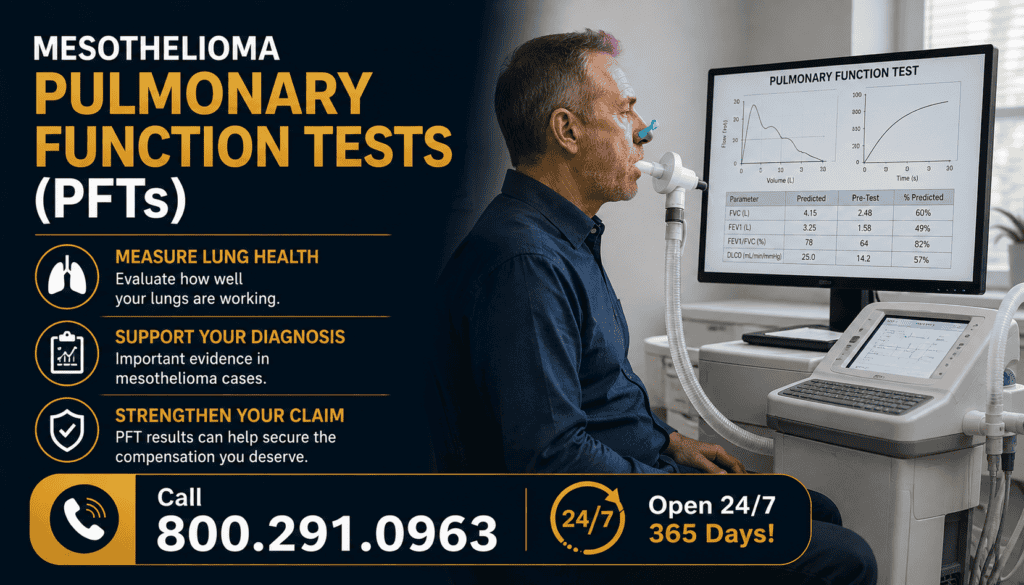
Pulmonary Function Tests (PFTs) for Mesothelioma
How spirometry, lung volumes and gas-transfer testing help clinicians assess breathing and plan care
Pulmonary function tests (PFTs) measure how well the lungs move air and transfer gas. In people with suspected or confirmed pleural mesothelioma, they help explain breathing limitations, establish a baseline and inform decisions about treatment. They do not diagnose mesothelioma or determine cancer stage on their own. Diagnosis generally requires assessment of imaging and tissue or cell samples. See our mesothelioma diagnosis guide.
Seek emergency care for sudden or severe shortness of breath, chest pain, fainting or blue lips. Contact your cancer team promptly for new or worsening breathlessness rather than waiting for a scheduled PFT.
What Pulmonary Function Tests Measure
PFTs are a group of breathing measurements, not one single cancer test. Depending on the clinical question, a respiratory therapist may measure the amount of air a person exhales, total lung volume or how efficiently gas passes from the lungs into the blood. The American Cancer Society identifies PFTs as particularly important when surgery is being considered for mesothelioma because surgeons need to understand baseline lung function.
| Question | What PFTs can help answer | What they cannot answer |
|---|---|---|
| How much air moves? | Spirometry measures airflow and exhaled volume. | Whether a pleural abnormality is malignant. |
| How much air can the lungs hold? | Lung-volume testing assesses total capacity and trapped air. | The location or extent of tumor. |
| How well does gas transfer? | DLCO estimates gas-transfer capacity. | The exact cause of an abnormal result by itself. |
| Is surgery physiologically feasible? | Results contribute to a broader risk assessment. | Whether surgery is appropriate without imaging, staging and specialist review. |
For a separate explanation of what scans show, read imaging tests for mesothelioma. Imaging describes anatomy; PFTs describe physiology. Clinicians often need both.
Why PFTs Matter in Mesothelioma
Pleural mesothelioma develops in the lining around the lungs. Pleural thickening, chest-wall restriction, pain or fluid around a lung can limit breathing. However, breathlessness can also reflect anemia, infection, a blood clot, heart disease, chronic obstructive pulmonary disease or treatment effects. A PFT result must be interpreted alongside symptoms, examination and other tests; it cannot establish which explanation applies by itself.
| Clinical situation | How testing may help | Additional information needed |
|---|---|---|
| Breathlessness at diagnosis | Document a functional baseline and pattern of impairment. | Symptoms, examination and chest imaging. |
| Before a major operation | Estimate respiratory reserve and help determine further assessment. | Surgical plan, heart health, performance status and cancer extent. |
| After treatment or drainage | Compare lung function over time when clinically useful. | Timing, imaging, symptoms and procedure details. |
| Existing lung disease | Identify obstruction or reduced diffusion that may complicate care. | Prior results, smoking and occupational history, medication review. |
Breathing difficulty deserves evaluation even when an earlier PFT was normal. See shortness of breath in mesothelioma and mesothelioma-related fluid management for symptom-focused information.
Types of Lung Function Tests
Spirometry
You take a deep breath and exhale forcefully through a mouthpiece. The test records measures such as forced vital capacity (FVC) and forced expiratory volume in one second (FEV1). The ratio FEV1/FVC helps clinicians assess airflow obstruction. Repeated attempts are usually needed to obtain reliable results.
Lung volumes
Methods such as body plethysmography or gas-dilution testing estimate total lung capacity (TLC) and residual volume. Low TLC confirms a restrictive ventilatory defect; a low FVC alone does not prove restriction. The laboratory chooses methods appropriate for the patient.
Diffusing capacity (DLCO)
During this test, you briefly hold a breath containing a small amount of test gas, then exhale. DLCO estimates how efficiently gas transfers across the lung into blood. It can be affected by several conditions and by hemoglobin level, so interpretation needs context.
| Test | Common reported measures | Practical meaning |
|---|---|---|
| Spirometry | FEV1, FVC, FEV1/FVC | Airflow and exhaled volume. |
| Lung volumes | TLC, RV | Overall capacity and possible air trapping. |
| Gas-transfer test | DLCO | Gas transfer efficiency; not a cancer marker. |
| Oxygen assessment, if ordered | Pulse oximetry or blood gases | Oxygenation or ventilation in a specific clinical setting. |
Not every patient needs every component. Some laboratories also perform a bronchodilator response test or exercise assessment if a clinician orders it. A PFT is different from mesothelioma blood biomarker testing, which examines blood-based substances rather than breathing mechanics.
Preparing for and Taking the Tests
Follow the testing laboratory’s instructions exactly. They may ask about recent illness, inhaler use, smoking, exercise or a large meal. Do not stop prescribed inhalers or other medications on your own; ask the ordering clinician which medications, if any, should be withheld and for how long.
| Before the visit | What to do |
|---|---|
| Medication list | Bring inhalers and a complete medication list; follow individualized instructions. |
| Clothing | Wear comfortable clothing that does not restrict deep breathing. |
| Recent symptoms | Report fever, respiratory infection, chest pain or significant worsening of breathing. |
| Recent procedures | Tell staff about recent chest, abdominal or eye surgery and any history of pneumothorax. |
| Mobility or fatigue | Request breaks, seating or other accommodations in advance. |
During spirometry, a technician usually places a clip on the nose, fits a mouthpiece and coaches you through repeated breathing efforts. Lung-volume and DLCO tests involve different breathing patterns. You can tell staff if you feel dizzy, uncomfortable or too breathless to continue. The team may postpone or modify testing if it is unsafe or results are unlikely to be reliable.
Need help now? Call 800.291.0963 / Live chat available 24/7, 365 days a year / Submit Your Case.
Understanding PFT Results
Clinicians compare measured results with reference values that consider characteristics such as age and height and examine the pattern across several measurements. A single percentage or a patient-portal flag is not a complete interpretation. Ask for the laboratory’s written interpretation and whether the test met quality standards.
| Finding | Possible interpretation | Important caution |
|---|---|---|
| Low FEV1/FVC | May indicate airflow obstruction. | Needs appropriate reference limits and clinical context. |
| Low FVC | May suggest restriction or another cause of reduced exhaled volume. | TLC is needed to confirm restriction. |
| Low TLC | Supports a restrictive ventilatory defect. | Does not identify the cause. |
| Low DLCO | May indicate impaired gas transfer. | Anemia and several lung or vascular conditions can affect it. |
| Change from prior test | May document improvement or deterioration. | Technique, timing and laboratory differences matter. |
For example, a person with pleural fluid may have reduced expansion, but only their clinical team can determine whether fluid, pleural disease or another condition explains a particular pattern. Chest X-rays and other imaging may help identify fluid or structural changes. A biopsy, not PFTs, is used to establish a tissue diagnosis when indicated.
PFTs and Treatment Planning
When a person is being evaluated for surgery, clinicians consider pulmonary reserve together with heart function, overall health, tumor extent, expected benefit and the specific operation. A lung-sparing pleurectomy/decortication differs substantially from extrapleural pneumonectomy, which removes a lung along with other tissues. The American Cancer Society notes that major mesothelioma surgery requires specialist experience and careful selection.
| Treatment decision | Role of PFTs | Other deciding factors |
|---|---|---|
| Pleurectomy/decortication | Provide baseline respiratory information. | Tumor extent, symptoms, operative risks and team expertise. |
| Extrapleural pneumonectomy | Help assess whether remaining lung function may be sufficient. | Extensive cardiopulmonary and multidisciplinary assessment. |
| Systemic therapy | May clarify underlying breathing problems when relevant. | Cancer subtype, stage, treatment goals and other conditions. |
| Pleural-fluid procedures | Can help document functional changes in selected patients. | Imaging, symptom severity and fluid recurrence. |
| Supportive care | May help explain limitations and guide referrals. | Patient goals, oxygen needs and symptom assessment. |
There is no universal PFT number that automatically makes someone eligible for mesothelioma surgery. A multidisciplinary team should interpret the actual test and proposed procedure. Explore mesothelioma treatments and getting a second opinion before making a major treatment decision.
Limitations, Safety and Next Steps
PFTs do not show where cancer is located, whether it has spread or which cells are present. They cannot replace imaging studies, pathology, or the procedures described in thoracoscopy and laparoscopy. They also do not directly assign a mesothelioma stage; see mesothelioma staging.
| Potential problem | What patients should know |
|---|---|
| Temporary dizziness or cough | Tell the technician immediately; testing can be paused. |
| Chest pain or severe breathlessness | Stop and seek prompt assessment; sudden severe symptoms warrant emergency care. |
| Recent surgery or pneumothorax | Inform the lab beforehand so the team can evaluate safety. |
| Poor-quality effort | A repeat attempt or different approach may be needed; do not interpret a poor-quality value in isolation. |
| Normal PFT result | Does not exclude mesothelioma or explain away persistent symptoms. |
Primary medical references
- American Cancer Society: Early Detection, Diagnosis, and Staging of Mesothelioma — describes PFTs and their preoperative role.
- National Cancer Institute: Mesothelioma Diagnosis and Prognosis — explains diagnostic testing and factors affecting treatment planning.
- American Cancer Society: Surgery for Mesothelioma — describes surgical options, selection and risks.
Frequently Asked Questions
Can a pulmonary function test diagnose mesothelioma?
No. PFTs measure breathing performance. Mesothelioma diagnosis generally depends on imaging, clinical evaluation and examination of tissue or cells by a pathologist.
Why are PFTs ordered before mesothelioma surgery?
They help the surgical team understand baseline respiratory function and estimate whether the lungs may tolerate the proposed procedure. They are one part of a larger assessment.
What is the difference between spirometry and a full PFT?
Spirometry measures airflow and exhaled volume. A full evaluation may also include lung volumes and diffusing capacity, depending on the order.
Does a low FVC mean mesothelioma is advanced?
No. Low FVC has multiple possible causes and does not assign cancer stage. A clinician may need TLC, imaging and other information.
What does a low DLCO mean?
It suggests reduced gas-transfer capacity but does not identify one diagnosis. Anemia and several lung or vascular conditions can influence results.
Can pleural effusion affect breathing-test results?
Fluid around the lung can restrict expansion, but a clinician must interpret any PFT change alongside imaging, symptoms and other conditions.
Should I stop my inhaler before the test?
Only if your ordering clinician or laboratory specifically instructs you to do so. Do not independently stop prescribed medications.
What if I am too short of breath to finish?
Tell the technician immediately. The team can stop, rest, modify or reschedule testing and determine whether you need urgent medical evaluation.
Get Help and Related Resources
For more context, start with our mesothelioma diagnosis overview, symptom guide and second-opinion resources. PFTs provide valuable information, but they are only one piece of the diagnostic and treatment-planning process.
Call 800.291.0963 for help understanding possible legal options after asbestos exposure. Live chat is available 24/7, 365 days a year. Submit Your Case using the form below. Contacting us does not guarantee eligibility, compensation or a particular outcome.
⚕️ Legal & Medical Information Disclaimer
This page is general information, not medical or legal advice. A qualified medical team should interpret your test results and advise on urgent symptoms or treatment. A licensed attorney can assess legal deadlines and eligibility for your individual circumstances.