Chronic Cough in Mesothelioma
Why a Persistent Cough Happens, How It Is Evaluated and Ways to Find Relief
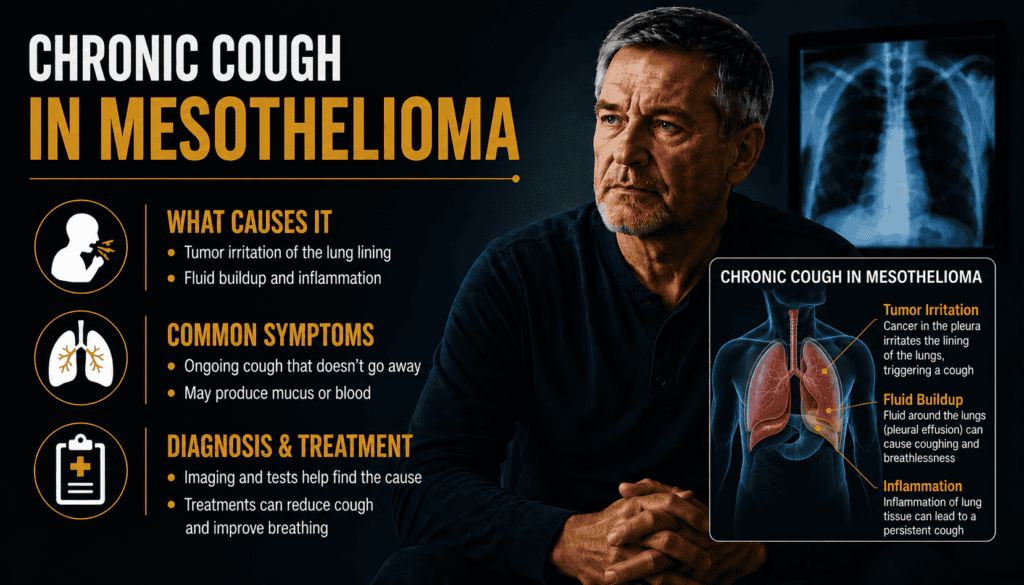
A persistent or worsening cough can occur with pleural mesothelioma, a cancer involving the lining around the lungs. Coughing may be associated with irritation in the chest or fluid collecting around a lung. However, cough is common and has many other possible causes. A cough alone cannot diagnose mesothelioma, determine its stage or establish that asbestos exposure caused it.
If a cough continues, changes noticeably or occurs with breathlessness or chest discomfort, contact a healthcare professional. Share any known occupational, military or household asbestos exposure. For a broader overview, read the mesothelioma symptoms guide and recognizing early symptoms.
🫁 What a Chronic Cough May Mean
A chronic cough is a cough that persists rather than clearing as expected. Clinicians often use an eight-week threshold for chronic cough in adults, but people with cancer or a history of asbestos exposure should not wait eight weeks to report a new or worsening symptom. The timing of evaluation depends on the entire clinical picture.
| What you notice | What it tells the clinician |
|---|---|
| Dry cough | A cough without obvious mucus; does not establish the cause. |
| Productive cough | Mucus amount, color and accompanying fever may guide evaluation. |
| Cough with chest pain | Requires assessment for pleural disease and other potentially serious causes. |
| Cough with breathlessness | May accompany fluid around the lung, infection or other conditions. |
Mesothelioma can cause symptoms that overlap with more common illnesses. The National Cancer Institute lists cough and trouble breathing among possible symptoms, while emphasizing that symptoms may arise from other conditions. See chest pain and shortness of breath for symptom-specific information.
| Question | Practical answer |
|---|---|
| Does every patient cough? | No. Symptoms differ among individuals. |
| Can a cough be the only symptom? | It may be prominent, but the cause cannot be identified from one symptom. |
| Does cough severity indicate cancer stage? | No. Staging requires a separate medical evaluation. |
🔎 Why Mesothelioma May Cause Cough
Pleural mesothelioma affects the lining of the chest cavity and lungs. Changes in pleural tissue and associated complications can contribute to cough. A pleural effusion—extra fluid in the space around a lung—may produce cough, breathlessness and chest discomfort. Not every cough in someone with mesothelioma is caused by the tumor or an effusion.
| Potential contributor | Why it matters |
|---|---|
| Pleural irritation or disease | Changes in the lining of the chest may be associated with coughing. |
| Pleural effusion | Extra fluid may compress the lung and contribute to cough or breathlessness. |
| Respiratory infection | Can occur independently and may need prompt treatment. |
| Medication or treatment effect | Some medicines and cancer treatments can contribute to respiratory symptoms; the care team must assess this. |
The pleural effusion guide explains fluid-related symptoms. The National Cancer Institute notes that identifying the cause of a pleural effusion is important because treatment differs depending on whether fluid is cancer-related or has another cause.
| Finding | What it does not prove |
|---|---|
| Cough improves after fluid treatment | Does not independently prove why the fluid developed. |
| Cough persists after fluid treatment | Does not automatically mean cancer progression; another cause may coexist. |
| No visible fluid on an earlier scan | Does not rule out a later change or another cough cause. |
📋 Cough Patterns to Record
A short symptom diary can make appointments more productive. Record changes without trying to diagnose yourself. Tell your clinician whether coughing interrupts sleep, makes eating difficult or causes chest pain. Describe whether symptoms are new since a treatment or medication change.
| Diary item | Example of useful detail |
|---|---|
| Onset | Approximate date and whether symptoms began suddenly or gradually. |
| Frequency | Occasional, daily, during conversations or throughout the night. |
| Mucus | Dry versus productive; note any blood. |
| Associated symptoms | Fever, chest pain, breathlessness, wheezing, weight change. |
| Functional impact | Sleep disruption, fatigue or inability to finish normal activities. |
A cough that disrupts sleep can contribute to exhaustion. Discuss this with your team and see difficulty sleeping and severe fatigue.
| Pattern | What to report |
|---|---|
| Worse lying down | Mention position and any breathing changes. |
| Worse with activity | Describe activity level and recovery time. |
| After a new medication | Give the name and start date; do not stop prescriptions without advice. |
| Alongside fever | Report promptly, especially during cancer treatment. |
Need help now? Call 800.291.0963
Live chat is available 24/7, 365 days a year.
Submit Your Case
🩺 Other Causes Doctors Consider
Common causes of persistent cough include respiratory infections, asthma, upper-airway conditions, acid reflux and certain medications. People with cancer may also develop treatment-related inflammation, fluid accumulation or a blood clot. The history, examination and tests—not a symptom checklist—help distinguish possibilities.
| Possible cause | Clues the clinician may investigate |
|---|---|
| Infection | Fever, mucus, recent exposure and examination findings. |
| Asthma or airway disease | Wheezing, triggers and breathing tests when appropriate. |
| Reflux or upper-airway irritation | Meal-related symptoms, nasal drainage or throat irritation. |
| Medication effect | Timing relative to starting a drug. |
| Pleural fluid or other chest problem | Breathing symptoms and imaging findings. |
Do not assume that a new cough is “just mesothelioma,” even after diagnosis. New infections, blood clots and other conditions can require different treatment. Read the pleural mesothelioma overview to understand the affected tissue.
| Avoid this assumption | Safer approach |
|---|---|
| Every cough after asbestos exposure means mesothelioma. | Discuss exposure and symptoms with a clinician; obtain an individualized assessment. |
| A normal home oxygen reading rules out illness. | Report persistent or worsening symptoms even if one reading seems reassuring. |
| Over-the-counter cough medicine treats the cause. | Ask the care team whether symptom medicine is appropriate and what underlying issue needs treatment. |
🚨 When to Seek Urgent Care
Call 911 or seek emergency care for sudden or severe difficulty breathing, severe or persistent chest pain, fainting, new confusion, or coughing up a large amount of blood. If you cough up even a small amount of blood, contact your healthcare team promptly for guidance. New fever during chemotherapy or other cancer treatment also needs immediate instructions from the oncology team.
| Situation | Recommended response |
|---|---|
| Sudden severe shortness of breath or difficulty speaking | Emergency care immediately. |
| Severe chest pain, fainting or confusion | Emergency care immediately. |
| Large amount of coughed-up blood | Emergency care immediately. |
| Any blood in sputum without severe symptoms | Prompt medical contact; follow clinician advice on urgency. |
| New or worsening cough without emergency signs | Contact your treating clinician for timely assessment. |
A blood clot in the lung and severe infection can sometimes produce cough or breathing changes and cannot be ruled out at home. For associated symptoms, see chest pain guidance and breathlessness guidance.
| Before calling | Information to have ready |
|---|---|
| Symptom onset | When the change started and how quickly it worsened. |
| Cancer treatment | Recent infusion, surgery, radiation or medication changes. |
| Measurements if available | Temperature or oxygen reading, without delaying emergency help. |
| Other symptoms | Pain, fever, blood, dizziness or leg swelling. |
🏥 Medical Evaluation and Tests
Doctors start with a history and physical examination, including cough timing, other symptoms, smoking history, medications and possible asbestos exposure. They may recommend a chest X-ray, CT scan, infection testing or other studies depending on findings. A suspected mesothelioma diagnosis generally requires tissue sampling and pathology; cough and imaging alone cannot confirm it.
| Assessment | What it can help determine |
|---|---|
| History and examination | Pattern of symptoms and possible alternative explanations. |
| Chest X-ray | Potential fluid or other chest changes. |
| CT scan | More detailed evaluation of pleural and chest abnormalities. |
| Fluid sampling when indicated | Helps assess the cause of an effusion; may not independently establish mesothelioma. |
| Biopsy and pathology | Can establish a tissue diagnosis when mesothelioma is suspected. |
See mesothelioma diagnosis and mesothelioma biopsy for the larger diagnostic process. If you already have mesothelioma, your team may compare new imaging with earlier studies and review whether the cough relates to disease, treatment or another problem.
| Question for the visit | Why ask it |
|---|---|
| What are the leading possible causes of my cough? | Clarifies the differential diagnosis. |
| Do I need imaging or infection testing? | Identifies an individualized evaluation plan. |
| Could treatment or a medicine be contributing? | Helps assess side effects without unsupervised changes. |
| When should I call back? | Creates a follow-up and escalation plan. |
💙 Cough Relief and Treatment Planning
The most useful treatment depends on the cause. If fluid is contributing, clinicians may discuss procedures to manage the effusion. If an infection is present, treatment differs. The care team may consider cough-suppressing medicine or other symptom management based on the patient’s medical history and medication list. Do not start prescription cough medicines, sedatives or oxygen without guidance.
| Care approach | Important qualification |
|---|---|
| Treat an identified cause | Infection, pleural fluid or medication effects require different plans. |
| Discuss cough medicine | Choice depends on cough type, other medicines and clinical condition. |
| Adjust daily activities | Rest breaks and avoiding personally identified irritants may improve comfort. |
| Coordinate supportive care | Palliative care can help manage symptoms alongside cancer-directed treatment. |
Ask about palliative care early when cough, pain or breathlessness affects quality of life. Palliative care is symptom-focused support and can be provided alongside cancer treatment. The mesothelioma treatment overview discusses the broader treatment pathway.
| At-home measure | Safe boundary |
|---|---|
| Drink fluids if permitted | Ask about restrictions if you have heart, kidney or other conditions. |
| Avoid smoke and strong fumes | Do not enter hazardous areas or attempt asbestos cleanup. |
| Use prescribed medicines as directed | Check before combining with over-the-counter cough products. |
| Keep a symptom log | Seek care promptly for worsening symptoms; do not wait for a diary to be complete. |
Questions about fluid-related cough
If imaging shows a pleural effusion, ask whether fluid treatment might help symptoms and what risks or alternatives apply. The appropriate procedure depends on the individual; fluid removal is not automatically needed for every effusion.
| Discussion topic | Example question |
|---|---|
| Cause | What do we know about why fluid accumulated? |
| Expected benefit | Which symptoms might improve if fluid is treated? |
| Risks | What complications or recurrence should I understand? |
| Follow-up | How will we check whether the plan worked? |
❓ Frequently Asked Questions
Can mesothelioma cause a chronic cough?
Yes. Cough is a recognized possible symptom, particularly with pleural disease. It is not specific to mesothelioma.
Is a mesothelioma cough usually dry or productive?
Either pattern may occur, and the pattern alone cannot identify the cause. Tell your clinician about mucus, fever or blood.
Does a persistent cough mean mesothelioma is getting worse?
Not necessarily. Infection, fluid, medications and other conditions can also change coughing. Your team must assess the cause.
Can pleural effusion cause coughing?
Yes. Fluid around a lung may be associated with cough, shortness of breath and chest discomfort.
When should I call a doctor about a cough?
Contact your clinician for a new, persistent or worsening cough, especially with cancer or asbestos exposure. Do not wait for a chronic-cough time threshold.
Is coughing up blood an emergency?
Large amounts of blood, particularly with breathlessness, require emergency care. Report any blood in sputum promptly to a clinician.
Can cough medicine cure a mesothelioma-related cough?
Medicine may relieve symptoms in some cases, but it does not necessarily treat the underlying cause. Ask your team before taking it.
Can a cough alone diagnose mesothelioma?
No. Clinicians use history, examination, imaging and usually tissue pathology to establish a diagnosis.
Related mesothelioma resources
Explore pleural effusion, early versus late symptoms, diagnosis, treatment and support for patients and families.
Confirmed medical sources
📨 Submit Your Case
Call 800.291.0963
Live chat is available 24/7, 365 days a year.
Submit Your Case
If you or a family member has been diagnosed with mesothelioma after possible asbestos exposure, you can ask about available legal options. Eligibility and compensation depend on individual facts, applicable law and evidence; no outcome is guaranteed.
⚕️ Legal & Medical Information Disclaimer
This page provides general information, not medical diagnosis, treatment advice or legal advice. Seek individualized guidance from qualified medical and legal professionals. For severe symptoms, obtain emergency medical care.