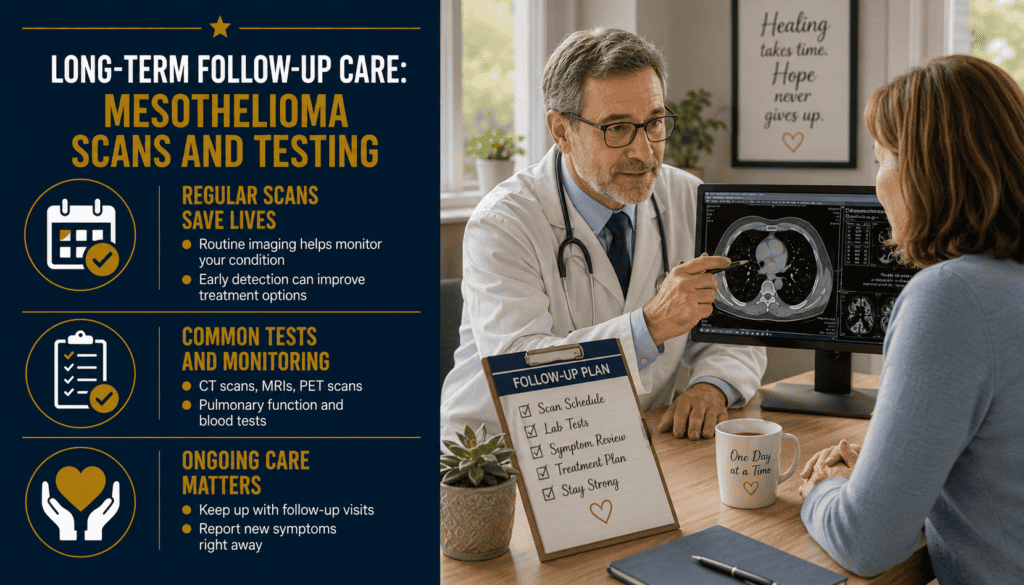
Long-Term Follow-Up Care for Mesothelioma: Scans and Testing
A practical guide to surveillance appointments, imaging, symptoms, test results, and coordinated care after treatment.
Follow-up care after a mesothelioma diagnosis is more than waiting for the next scan. It is an ongoing plan for checking the cancer, identifying treatment effects, managing symptoms, and making sure the right specialists review new information. The plan differs for someone recovering from surgery, receiving maintenance or ongoing systemic treatment, or receiving care focused on comfort.
There is no single scan timetable that fits every patient. The cancer’s location, treatment received, previous scan findings, symptoms, and individual goals all affect the schedule. Use this guide to prepare for conversations with your oncology team; do not replace a personalized plan with a generic calendar. Start with the mesothelioma diagnosis overview if you are still confirming the diagnosis.
Why Follow-Up Matters
Follow-up appointments create a baseline against which clinicians can compare later findings. They also give patients time to report changes that may not appear on a scan, including breathlessness, abdominal swelling, pain, weight changes, sleep problems, and reduced activity. Follow-up is important whether a person currently has no evidence of disease, has stable disease, or is receiving ongoing treatment.
| Purpose | What the team checks | Why it matters |
|---|---|---|
| Assess disease status | Symptoms, examination, and imaging compared with earlier studies | A change may prompt closer review or treatment discussion. |
| Monitor treatment effects | Recovery, blood counts, organ function, and side effects when indicated | Some effects require attention even when cancer is stable. |
| Support daily function | Breathing, nutrition, mobility, sleep, and emotional well-being | Symptom control can improve everyday life. |
| Coordinate care | Oncology, surgery, pulmonary care, primary care, and supportive services | Different teams may address different needs. |
A scan report may use terms such as “stable,” “response,” or “progression.” These terms describe the comparison being made; they do not independently tell you how you will feel or what treatment is appropriate. Ask your clinician to explain the result in the context of your history. For background on how disease extent is assessed, see mesothelioma stages.
Follow-Up Schedule and Care Plan
Ask for a written follow-up plan before leaving a treatment program or changing providers. It should identify who orders each test, where results will be reviewed, which symptoms warrant an earlier call, and how urgent concerns are handled after hours. Surveillance intervals are individualized: a treating specialist may recommend more frequent imaging during active therapy or when a finding needs clarification and a different cadence after treatment.
| Plan element | Question to ask |
|---|---|
| Next visit | When is the next appointment, and is it in person or remote? |
| Imaging | Which scan is planned, and what previous study will be used for comparison? |
| Laboratory work | Are blood tests needed because of my treatment or other conditions? |
| Care-team contact | Who should I call for new symptoms, including evenings and weekends? |
| Decision point | What finding would change the current plan? |
Patients may move between treatment phases. A follow-up plan should be updated after surgery, a new systemic treatment, a major side effect, or a change in goals. If care occurs at multiple facilities, request that reports and images—not just brief summaries—be available to the reviewing specialist. The second-opinion guide explains how to organize records when another specialist is involved.
| Situation | How follow-up may differ |
|---|---|
| After surgery | Healing, breathing, complications, and later imaging are considered together. |
| During immunotherapy or chemotherapy | Disease assessment and treatment-related safety checks may occur alongside each other. |
| After a treatment course | The team may focus on surveillance and lingering side effects. |
| When symptoms change | Assessment may occur before the next routine appointment. |
| Supportive-care focus | Visits emphasize symptom relief and patient-defined priorities; testing is used when it may change care. |
Imaging and What Scans Can Show
CT is commonly used to assess mesothelioma over time, but the choice of scan depends on the disease site and the clinical question. The same imaging technique and consistent comparisons can help the team interpret changes. A radiologist’s report is one piece of the picture; the oncology team considers symptoms, examination, treatment history, and previous scans.
| Imaging test | Potential role | Important limitation |
|---|---|---|
| CT scan | Shows anatomy and can track pleural or abdominal abnormalities. | Treatment-related changes and scarring can complicate interpretation. |
| PET/CT | May help investigate selected findings or assess disease extent when appropriate. | Inflammation can also cause uptake; it is not a stand-alone diagnosis. |
| MRI | May clarify selected areas or anatomy when the team needs additional detail. | Not needed at every routine visit. |
| Ultrasound | Can assess fluid or guide certain procedures. | Does not replace comprehensive disease assessment. |
| Chest X-ray | May help evaluate selected respiratory symptoms or fluid. | Less detailed than CT for mesothelioma surveillance. |
Read more in the imaging tests guide and mesothelioma X-ray guide. If a report describes a new abnormality, ask whether it represents a definite change, an uncertain finding needing repeat imaging, or a change that requires tissue sampling. A scan by itself may not distinguish every treatment effect from active cancer.
| Phrase you may hear | Useful follow-up question |
|---|---|
| Stable appearance | What exactly stayed the same, and compared with which scan? |
| Indeterminate finding | What are the possible explanations and when should it be rechecked? |
| New fluid | Could it be related to cancer, treatment, infection, or another cause? |
| Possible progression | What evidence supports that interpretation and what happens next? |
Blood Tests, Breathing Tests, and Biopsies
Tests beyond imaging are chosen for a reason. Routine blood work can help monitor treatment safety, anemia, kidney or liver function, and other concerns. Mesothelioma-associated biomarkers are not a substitute for imaging, examination, or pathology, and no single blood result can reliably establish whether a person has recurrent disease.
| Test or procedure | Possible reason to order it | What it cannot do alone |
|---|---|---|
| Complete blood count | Check anemia, infection-related concerns, or treatment effects. | Determine whether mesothelioma has recurred. |
| Kidney and liver tests | Assess organ function and medication safety. | Measure all cancer activity. |
| Selected biomarkers | Provide additional information in particular clinical circumstances. | Confirm or exclude recurrence independently. |
| Pulmonary function tests | Evaluate breathing capacity, especially around surgery or persistent respiratory symptoms. | Diagnose cancer or establish its stage. |
| Biopsy or fluid sampling | Clarify a suspicious finding when tissue or fluid information is needed. | Guarantee a diagnosis from every sample. |
The blood tests and biomarkers guide explains why results require clinical context. The pulmonary function tests guide covers lung function, and the biopsy guide describes tissue confirmation. Ask what question a test is intended to answer, whether it carries risks, and how the result could affect care.
If you receive a result through a patient portal before your appointment, do not assume a flagged number means cancer progression. Laboratory reference ranges, treatment effects, and other illnesses can influence results. Contact the ordering team for interpretation, particularly when the result accompanies new symptoms.
Symptoms That Need Attention
Do not wait for a scheduled scan if you develop a significant new symptom. Mesothelioma symptoms can reflect cancer, treatment effects, infection, blood clots, fluid buildup, or unrelated conditions. The appropriate response depends on severity and timing. Your oncology team should provide individualized instructions, particularly during chemotherapy or other immune-affecting treatments.
| Change | Suggested action |
|---|---|
| Sudden severe shortness of breath, chest pain, fainting, or stroke-like symptoms | Seek emergency care immediately. |
| New facial or arm swelling with breathing trouble | Seek urgent emergency assessment. |
| Fever during chemotherapy or while immunocompromised | Contact the cancer team immediately and follow its fever threshold instructions. |
| Increasing breathlessness, abdominal swelling, or persistent new pain | Contact the treating team promptly rather than waiting for routine imaging. |
| Ongoing weight loss, reduced appetite, or worsening fatigue | Report at the next appropriate clinical contact; ask for earlier review if rapid or severe. |
For symptom-specific information, see shortness of breath, fluid management, and severe fatigue. If the care team has provided an emergency plan or different fever threshold, follow that plan. New symptoms should not automatically be labeled recurrence without evaluation.
| Bring to the visit | Helpful detail |
|---|---|
| Symptom onset | When did it begin and was it sudden or gradual? |
| Severity | What activities are now difficult? |
| Associated signs | Fever, swelling, pain, cough, weight changes, or dizziness. |
| Recent treatment | Dates of medicines, procedures, and new prescriptions. |
| Measurements if available | Temperature or weight trend; avoid delaying care to collect numbers. |
Understanding Results and Possible Recurrence
Scan findings are usually compared with a previous baseline. A possible recurrence or progression may require a multidisciplinary review, additional imaging, a biopsy, or a repeat scan, depending on how certain the finding is and whether the result would change treatment. Do not interpret one sentence in a radiology report as a complete prognosis.
| Result category | What it may mean | What to clarify |
|---|---|---|
| No evident change | The measured or visible findings appear similar. | Does the plan remain the same? |
| Response | Some findings have decreased after treatment. | How will response be monitored? |
| Uncertain change | The finding may have more than one explanation. | Is repeat imaging or sampling needed? |
| Progression or recurrence suspected | The team sees a change concerning for cancer activity. | How certain is it and what are the options? |
A treatment decision may depend on disease location, prior therapy, performance status, other illnesses, and patient preferences. Ask about the expected benefit, burdens, alternatives, clinical trials where appropriate, and symptom-focused care. Review the mesothelioma treatment overview for a broader discussion.
For pleural disease, staging terminology may help explain disease extent, but stage is not a personal prediction. For peritoneal mesothelioma, clinicians use a different assessment approach; the pleural stage I–IV framework should not be applied automatically. A specialist can explain which classification applies to your diagnosis.
Long-Term Health and Coordinated Support
Long-term care includes more than cancer measurements. Patients may need help with persistent pain, breathlessness, fatigue, nutrition, sleep, anxiety, mobility, or medication side effects. Palliative care can be provided alongside disease-directed treatment; it is not limited to end-of-life care. Ask who will coordinate oncology follow-up with primary care and other specialists.
| Area | Follow-up conversation |
|---|---|
| Breathing and activity | Would pulmonary rehabilitation, breathing evaluation, or physical therapy be appropriate? |
| Nutrition | Should a dietitian assess weight change or difficulty eating? |
| Pain and sleep | What is the plan if symptoms interfere with daily life? |
| Emotional support | Are counseling, social work, or support groups available? |
| Medication review | Which medicines continue, change, or stop, and who manages refills? |
| Care transitions | Who is responsible for reviewing results and communicating changes? |
Keep a simple record of appointment dates, medications, symptoms, scan reports, and questions. If multiple specialists are involved, identify one clinician or team that coordinates the overall plan. The mesothelioma support resources and symptom overview can help patients and caregivers prepare for visits.
| Question for your next appointment | Reason to ask |
|---|---|
| What is the goal of my next scan? | Clarifies whether the test checks response, surveillance, or a specific symptom. |
| Who contacts me with results? | Prevents missed communication. |
| What symptoms mean I should call sooner? | Provides an action plan between visits. |
| What late effects should I watch for? | Supports recovery and treatment safety. |
| Can I receive a copy of my care plan? | Helps when changing facilities or seeking a second opinion. |
Medical references for further reading: National Cancer Institute: Malignant Mesothelioma Treatment (PDQ®), Patient Version; National Cancer Institute: Follow-Up Medical Care; American Cancer Society: Living as a Malignant Mesothelioma Survivor. Review these sources with your care team because recommendations and individual circumstances change.
Frequently Asked Questions
How often do people need scans after mesothelioma treatment?
There is no universal schedule. Your team sets the interval according to disease site, treatment, earlier findings, symptoms, and goals. Ask for the next scan date and the reason for that timing.
Does a clear scan mean mesothelioma cannot return?
No. A scan reflects what is detectable at that time. Your clinician can explain the finding and why continued follow-up may be recommended.
Can a blood test detect mesothelioma recurrence?
Blood tests may support selected aspects of care, but a biomarker result alone cannot reliably confirm or exclude recurrence. Imaging, clinical assessment, and sometimes tissue sampling may be needed.
Will I need CT, PET/CT, and MRI at every visit?
Usually not all of them. The care team selects imaging based on the clinical question and the value of additional information.
Should I wait for my next scan if I have new breathlessness?
No. Contact your team promptly for new or worsening breathlessness. Sudden severe breathing difficulty or chest pain requires emergency assessment.
What happens if my scan shows an uncertain spot?
Your team may compare earlier scans, arrange a repeat study, request a different imaging technique, or consider sampling when it would change management.
Can I receive palliative care while still having treatment?
Yes. Palliative care addresses symptoms and quality of life and can be provided alongside disease-directed therapy.
What records should I keep for a second opinion?
Collect pathology reports and slides when requested, imaging reports and image files, treatment summaries, medication lists, and your latest follow-up plan.
Get Help and Explore Your Options
A clear follow-up plan helps you understand what comes next and when to seek medical care. For questions about asbestos exposure and possible legal options, Call 800.291.0963. Live chat is available 24/7, 365 days a year. Submit Your Case using the form below. Compensation and case outcomes are not guaranteed; eligibility depends on individual facts.
⚕️ Legal & Medical Information Disclaimer
This article provides general educational information, not medical or legal advice. Your treating team should determine follow-up testing and urgent-care instructions. Consult qualified medical and legal professionals about individual circumstances.