Finger Clubbing in Mesothelioma
What Changes in Your Fingertips May Mean & When to See a Doctor
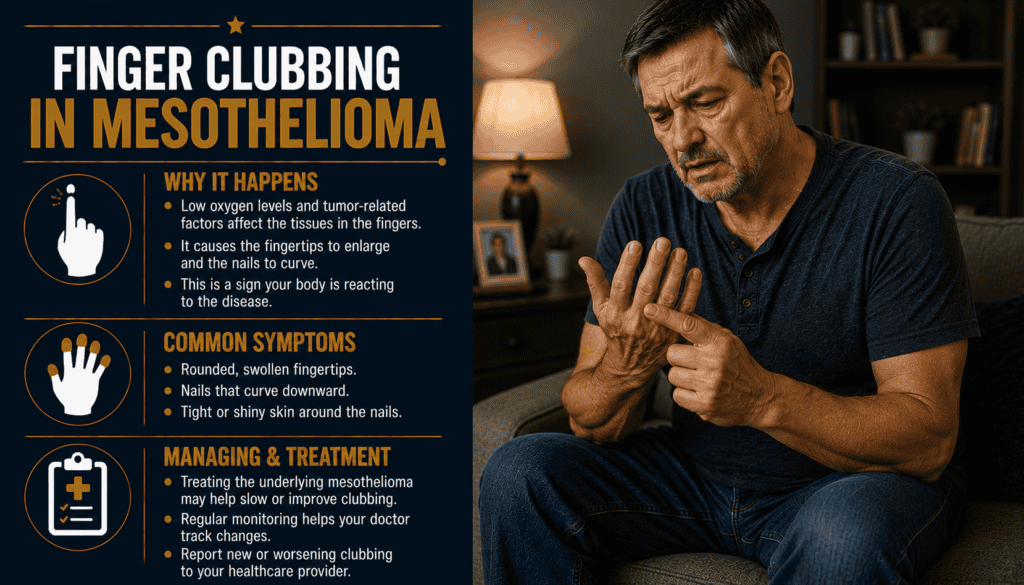
Finger clubbing is a change in the shape of the fingertips and nails: fingertips may become rounded or enlarged, nail beds may feel soft, and nails may curve more than usual. It can occur with mesothelioma, but it is not specific to mesothelioma and cannot diagnose cancer. A new change deserves a clinician’s assessment rather than self-diagnosis.
Mesothelioma begins in the tissue lining organs, often the lining around the lungs. Its more commonly described symptoms include breathlessness, chest discomfort, cough and unexplained weight loss. Clubbing is a less familiar possible finding. See the broader mesothelioma symptoms guide and early warning signs for context.
🖐️ What Finger Clubbing Looks Like
Clubbing (also called digital clubbing) usually affects several fingers on both hands, although a clinician must check the pattern. The nail-to-skin angle becomes less distinct, and the fingertips may appear bulbous. It can also affect toes. Nail polish, arthritis and ordinary nail curvature can make photographs misleading.
| Possible change | What someone might notice |
|---|---|
| Nail-bed texture | A softer or springier feel near the base of the nail. |
| Nail angle | The usual angle between nail and surrounding skin appears less defined. |
| Fingertip shape | The ends of fingers appear rounder or wider. |
| Nail curve | Nails curve more prominently over the fingertip. |
Is clubbing the same as swollen fingers?
No. General swelling may affect the whole hand and fluctuate during the day; clubbing changes the shape of the fingertip and nail relationship. A doctor can distinguish these findings during an examination.
| Feature | Clubbing | General swelling |
|---|---|---|
| Location | Often concentrated around fingertips and nails. | May affect entire finger, hand or both. |
| Nail appearance | Curvature and nail angle can change. | Nail shape may be unchanged. |
| Next step | Medical evaluation of underlying cause. | Medical evaluation if new, persistent or painful. |
🫁 How Clubbing Relates to Mesothelioma
Mesothelioma can be associated with clubbing, particularly when disease involves the chest. However, not everyone with mesothelioma develops it, and many other conditions can cause similar changes. The exact biological pathway is not fully established; proposed mechanisms involve signals that stimulate tissue and blood-vessel changes in the fingertips. A nail finding cannot reveal the cancer’s type, stage or prognosis.
| Question | Evidence-based answer |
|---|---|
| Does clubbing prove mesothelioma? | No. It is a physical sign shared by several diseases. |
| Is clubbing a routine early symptom? | No. Timing varies and it is not a reliable early-detection test. |
| Does clubbing establish cancer stage? | No. Staging relies on clinical assessment and appropriate tests. |
Compare asbestos-related lung cancer and asbestosis: these are distinct conditions that require different diagnostic assessments. An asbestos exposure history matters, but it does not identify the cause of clubbing on its own.
| Condition | Relationship to clubbing |
|---|---|
| Pleural mesothelioma | A possible associated finding; not diagnostic. |
| Lung cancer | A recognized potential cause. |
| Asbestosis or other fibrotic lung disease | Some chronic lung conditions can be associated. |
| Non-lung disease | Certain heart, liver, intestinal and thyroid disorders can also be associated. |
🔎 Changes to Watch and Document
Look for changes over time rather than relying on one photograph. If possible, record when the change first appeared and whether it affects fingers, toes or both. Do not delay care while collecting photos.
| Observation | Useful detail to record |
|---|---|
| First noticed | Approximate date or month. |
| Distribution | Which fingers or toes, one side or both. |
| Associated symptoms | Breathlessness, cough, chest pain, fatigue or fever. |
| Prior conditions | Known heart, lung, bowel, liver or thyroid conditions. |
Tell your care team about shortness of breath, persistent cough and chest pain even if the nail changes seem minor. These symptoms can have several causes, including conditions that require urgent treatment.
| Situation | Suggested action |
|---|---|
| New clubbing without acute symptoms | Arrange a timely appointment with a healthcare professional. |
| Rapidly worsening breathlessness or severe chest pain | Seek emergency care. |
| Blue lips, fainting or confusion | Seek emergency care immediately. |
Need help now? Call 800.291.0963
Live chat is available 24/7, 365 days a year.
Submit Your Case
🩺 Other Possible Causes
A clinician will not assume that asbestos exposure explains a changed nail. Lung cancer, chronic infections, certain heart disorders, inflammatory bowel disease, liver disease and some thyroid conditions may be relevant. Occasionally, clubbing occurs without an identifiable underlying disorder or runs in families.
| Possible cause group | Examples a clinician may consider |
|---|---|
| Lung and pleural disease | Lung cancer, pleural tumors, chronic lung infection, interstitial lung disease. |
| Heart disease | Certain congenital heart conditions or infective endocarditis. |
| Digestive or liver disease | Inflammatory bowel disease or cirrhosis. |
| Other | Some thyroid disorders or familial clubbing. |
Clubbing itself does not prove low blood oxygen. Oxygen levels may be normal in some people with clubbing, so home pulse-oximeter readings cannot rule out a serious underlying condition.
| Common misconception | More accurate interpretation |
|---|---|
| “Clubbing always means cancer.” | It has multiple possible causes. |
| “Normal oxygen rules it out.” | Oxygen readings alone cannot identify the cause. |
| “A home nail test confirms diagnosis.” | A clinician must interpret the finding with history and examination. |
🏥 How Doctors Evaluate Clubbing
Your doctor may inspect the nail angle, feel the nail bed and compare fingertips. They may ask about asbestos exposure, smoking, medications, previous imaging, occupational history and symptoms. Depending on the examination, testing may include chest imaging, oxygen assessment, blood tests or referral. These are selected for the individual—not every patient needs every test.
| Assessment | Purpose |
|---|---|
| History and physical examination | Confirm whether true clubbing is present and look for other findings. |
| Chest X-ray or CT when indicated | Evaluate possible chest or lung causes. |
| Blood or oxygen testing when indicated | Investigate specific suspected conditions. |
| Specialist referral | Obtain pulmonary, cardiac or other focused evaluation. |
For suspected mesothelioma, imaging alone cannot reliably establish the diagnosis; a tissue biopsy and pathology review may be needed. Read about mesothelioma diagnosis, imaging tests and biopsy procedures.
| Test or procedure | What it can and cannot establish |
|---|---|
| Chest imaging | May identify abnormalities; does not by itself confirm mesothelioma. |
| Biopsy and pathology | Can help establish the cancer diagnosis and distinguish tumor types. |
| Clubbing examination | Documents a physical sign; does not establish cancer diagnosis. |
📋 Care, Follow-Up and Symptom Relief
There is no standard treatment directed at the fingertip shape itself. Care focuses on finding and treating the underlying condition. Clubbing sometimes improves when the cause is treated, but improvement is not guaranteed. Do not take supplements, change cancer medicines or start oxygen solely to treat nail appearance.
| Care priority | Practical next step |
|---|---|
| Find the cause | Attend the recommended clinical evaluation. |
| Manage existing symptoms | Report breathlessness, pain, cough and fatigue. |
| Review the treatment plan | Discuss whether a new finding changes monitoring or referrals. |
| Follow up | Ask when to return if the changes persist or worsen. |
People with mesothelioma may also need evaluation for pleural effusion, which can worsen breathing. The treatment overview explains the broader care pathway; support resources can help families coordinate appointments and daily needs.
| At-home approach | Appropriate limit |
|---|---|
| Photograph nail changes | Useful for showing progression; not a diagnostic test. |
| Write down symptoms | Helps communicate patterns to clinicians. |
| Keep appointments | Necessary even if the nail appearance does not change. |
💬 Questions to Ask Your Care Team
Bring a brief list of concerns to your next appointment. A family member or caregiver can help record answers, especially when several tests or referrals are discussed.
| Ask your clinician | Why it matters |
|---|---|
| Is this true digital clubbing? | Confirms the physical finding. |
| What causes should we consider? | Prevents assuming cancer is the only explanation. |
| Do I need imaging or other tests? | Clarifies individualized next steps. |
| What symptoms require urgent care? | Creates a practical safety plan. |
Consider asking whether a specialist opinion is appropriate. Your mesothelioma care team can review new findings in the context of your diagnosis and current treatment.
| Bring to appointment | Examples |
|---|---|
| Medical history | Existing diagnoses and relevant procedures. |
| Exposure history | Jobs, military service and potential asbestos contact. |
| Medication list | Prescription, nonprescription and supplements. |
| Symptom timeline | When changes began and accompanying symptoms. |
❓ Frequently Asked Questions
Can mesothelioma cause finger clubbing?
Yes, clubbing can occur with mesothelioma, but it is not present in everyone and cannot confirm the disease.
Is finger clubbing an early sign of mesothelioma?
It is not a dependable early warning sign. New clubbing warrants assessment regardless of when it appears.
Does clubbing mean mesothelioma is advanced?
No. Finger appearance cannot determine stage or prognosis; clinicians use diagnostic and staging evaluations.
Can asbestos exposure alone cause clubbing?
An exposure history alone does not establish why clubbing developed. A clinician must evaluate other possible causes.
How do doctors confirm clubbing?
They examine nail-bed texture, nail angles and fingertip shape and interpret these findings alongside symptoms and medical history.
Will clubbed fingers return to normal?
They sometimes improve after treatment of an underlying cause, but this varies and cannot be promised.
Should I try a finger clubbing test at home?
A home comparison may prompt you to seek care but cannot confirm clubbing or diagnose mesothelioma.
When should I seek urgent help?
Seek emergency care for severe or sudden breathing difficulty, severe chest pain, fainting, blue lips or new confusion.
🧾 Finger Clubbing: Key Takeaways
| Key point | What to remember |
|---|---|
| Appearance | Bulbous fingertips and altered nail curvature can suggest clubbing. |
| Meaning | It is a nonspecific sign, not a mesothelioma test. |
| Evaluation | New clubbing should be assessed by a clinician. |
| Treatment | Care targets the underlying cause rather than the nail shape alone. |
🔗 Related Mesothelioma Resources
Explore mesothelioma symptoms, early versus late symptoms, diagnostic testing, asbestos-related lung cancer and family support. These links provide context without implying that clubbing alone establishes any diagnosis.
📚 Confirmed Medical and Government Sources
- MedlinePlus: Clubbing of the fingers or toes
- National Cancer Institute: Mesothelioma symptoms
- National Cancer Institute: Diagnosis and prognosis
- Cancer Research UK: Finger clubbing
📨 Submit Your Case
Call 800.291.0963
Live chat is available 24/7, 365 days a year.
Submit Your Case
Our team can help you discuss potential next steps after an asbestos-related diagnosis. Compensation depends on individual facts, applicable law, evidence and deadlines; no outcome is guaranteed. For new or worsening symptoms, contact your medical team rather than relying on a legal consultation.
⚕️ Legal & Medical Information Disclaimer
This page provides general information, not medical or legal advice. A qualified clinician should evaluate finger changes and symptoms; consult an appropriately licensed legal professional about individual claims.