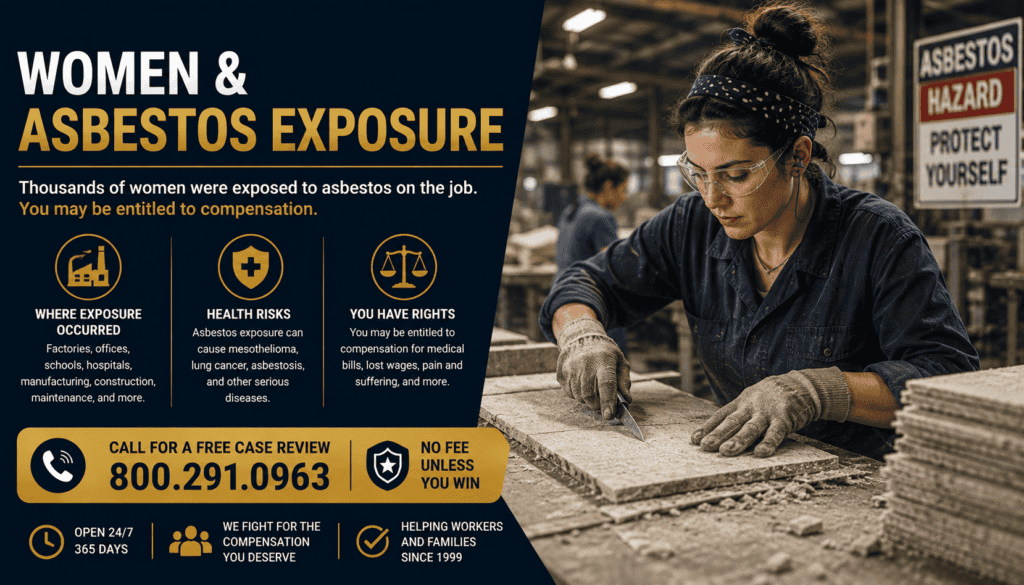
👩🏭 Women’s Occupations & Workplace Asbestos Exposure
For many years, asbestos exposure was viewed primarily as an occupational hazard affecting men working in construction, shipbuilding, manufacturing, mining, and the military. Today, researchers recognize that women also experienced significant occupational asbestos exposure across a wide range of industries and professions.
Millions of women worked in buildings, factories, hospitals, laboratories, schools, offices, military facilities, warehouses, and commercial workplaces where asbestos-containing materials were commonly used. Others encountered asbestos while maintaining equipment, cleaning contaminated work areas, handling industrial materials, or working near renovation and maintenance projects.
Unlike many male workers who experienced direct industrial exposure, women often experienced indirect or environmental workplace exposure over many years. These exposures frequently occurred without workers realizing asbestos fibers were present in building materials, insulation, heating systems, floor tiles, ceiling materials, pipe coverings, fireproof products, and mechanical equipment.
This Women’s Occupations & Workplace Asbestos Exposure authority hub explores occupations where women may have encountered asbestos, explains how exposure occurred, discusses associated health risks, and connects readers to detailed occupation-specific resources.
🎯 What You’ll Learn
This authority hub explains:
- Occupations where women commonly encountered asbestos
- How workplace exposure occurred
- High-risk industries employing women
- Older buildings and environmental exposure
- Military and government workplace exposure
- Occupation-specific health risks
- Diseases linked to workplace asbestos exposure
- Resources for understanding workplace exposure history
Throughout this guide you’ll find detailed resources covering individual occupations, workplaces, military installations, and asbestos-related diseases affecting women.
🏢 Why Workplace Exposure Occurred
Throughout much of the twentieth century, asbestos was incorporated into thousands of commercial and institutional buildings because it resisted heat, fire, moisture, and corrosion.
Women employed in these facilities often worked around asbestos-containing materials every day.
Common workplace asbestos sources included:
- Pipe insulation
- Boilers
- Heating systems
- HVAC equipment
- Ceiling tiles
- Floor tiles
- Roofing materials
- Wallboard
- Fireproof insulation
- Mechanical rooms
- Electrical equipment
- Laboratory equipment
- Industrial machinery
- Maintenance areas
- Utility tunnels
Even employees who never directly handled asbestos products could be exposed when building materials deteriorated or during maintenance, remodeling, or demolition activities.
Older facilities constructed before modern asbestos regulations frequently contained multiple asbestos-containing materials throughout the building.
🏭 Women Factory Workers
Manufacturing plants employed millions of women throughout the twentieth century.
Depending on the industry, women worked near:
- Industrial machinery
- Steam systems
- Boilers
- Pipe insulation
- Conveyor equipment
- Production lines
- Mechanical equipment
- Electrical systems
- Packaging operations
Asbestos-containing insulation and equipment were commonly installed throughout factories to reduce heat and fire hazards.
Factory maintenance, equipment repairs, and building renovations could release asbestos fibers into work areas.
Learn more in Women Factory Workers Asbestos Exposure.
🏥 Women Healthcare Workers
Hospitals, clinics, and medical centers were often constructed using asbestos-containing building materials.
Healthcare workers may have encountered asbestos while working near:
- Boiler rooms
- Steam tunnels
- Mechanical systems
- Ceiling materials
- Floor tiles
- Pipe insulation
- Fireproof doors
- Laboratory equipment
Building maintenance and renovation projects could disturb asbestos-containing materials while hospitals remained occupied.
Learn more in Women Healthcare Workers Asbestos Exposure.
🎓 Women Teachers and School Employees
Many schools built before the 1980s incorporated asbestos into classrooms, hallways, auditoriums, gymnasiums, and maintenance areas.
Teachers, administrators, librarians, and school support staff may have worked around asbestos contained in:
- Ceiling tiles
- Floor tile
- Pipe insulation
- Wall panels
- Roofing materials
- Heating systems
- Boiler rooms
Renovation projects often increased the potential for airborne asbestos fibers.
Learn more in Women Teachers Asbestos Exposure.
🏢 Women Office Workers
Office employees were generally not considered high-risk workers, yet many spent decades inside buildings constructed with asbestos-containing materials.
Potential exposure sources included:
- Ceiling systems
- Floor coverings
- HVAC systems
- Insulated piping
- Fireproof walls
- Electrical rooms
Office renovations and maintenance activities occasionally disturbed asbestos-containing materials while employees continued working.
Learn more in Women Office Workers Asbestos Exposure.
🧪 Women Laboratory Workers
Laboratories frequently used heat-resistant materials and specialized equipment that historically incorporated asbestos.
Potential exposure sources included:
- Laboratory ovens
- Furnaces
- Insulation
- Fireproof work surfaces
- Protective materials
- Heating equipment
Women employed in research laboratories, universities, hospitals, and industrial testing facilities may have experienced repeated occupational exposure over many years.
Learn more in Women Laboratory Workers Asbestos Exposure.
🛒 Women Retail Workers
Retail employees generally experienced lower occupational exposure than industrial workers.
However, women working in older department stores, shopping centers, warehouses, and commercial buildings sometimes worked around aging asbestos-containing materials.
Potential exposure sources included:
- Building renovations
- Ceiling materials
- Flooring
- Mechanical systems
- Heating equipment
- Utility areas
Learn more in Women Retail Workers Asbestos Exposure.
🧹 Women Custodial Workers
Custodians, janitorial personnel, and maintenance support staff often worked throughout older buildings where asbestos-containing materials were present.
Daily responsibilities sometimes involved:
- Sweeping dust
- Cleaning mechanical rooms
- Waxing asbestos floor tile
- Replacing ceiling tiles
- Cleaning renovation areas
- Emptying debris
Because custodial staff worked throughout entire facilities, they may have encountered asbestos in multiple locations.
Learn more in Women Custodial Workers Asbestos Exposure.
🏛️ Women Working in Older Buildings
Many women never worked in traditionally hazardous occupations but spent decades inside older commercial buildings containing asbestos.
Potential workplaces included:
- Government buildings
- Courthouses
- Universities
- Libraries
- Banks
- Insurance offices
- Municipal buildings
- Corporate offices
- Hotels
- Apartment complexes
These structures often contained asbestos insulation, flooring, ceiling materials, roofing products, and mechanical systems.
Learn more in Women Working in Asbestos-Containing Buildings.
🚢 Shipyards, Ports, and Civilian Contractors
Some women worked in occupations with more direct exposure to asbestos.
These included:
- Shipyard workers
- Port employees
- Military contractors
- Government contractors
- Industrial support personnel
These occupations sometimes involved work around ships, boilers, pumps, valves, insulation, machinery, and other asbestos-containing equipment.
Learn more:
👩⚕️ Workplace Exposure Can Occur Across Many Careers
One important lesson from asbestos research is that workplace exposure was not limited to traditionally hazardous jobs.
Women working in education, healthcare, government, research, administration, manufacturing, retail, maintenance, transportation, and military support positions may all have encountered asbestos under different circumstances.
The amount of exposure varied depending on the occupation, building conditions, years worked, maintenance activities, and the presence of asbestos-containing materials.
🏢 How Workplace Asbestos Exposure Occurred
Many women never handled raw asbestos or worked directly with insulation, yet they spent years inside buildings where asbestos-containing materials were present. Throughout much of the twentieth century, asbestos was incorporated into commercial construction because it provided fire resistance, insulation, and durability.
As buildings aged, normal wear, maintenance activities, equipment repairs, remodeling projects, and demolition work could disturb asbestos-containing materials and release microscopic fibers into the air.
Common workplace sources included:
- Pipe insulation
- Boiler insulation
- Steam lines
- HVAC systems
- Ceiling tiles
- Floor tile and mastic
- Roofing materials
- Fireproof wall systems
- Cement products
- Electrical insulation
- Mechanical equipment
- Laboratory equipment
Because these materials were often hidden behind walls, ceilings, and mechanical systems, employees usually had no idea asbestos was present.
🏭 High-Risk Workplace Environments
Although every workplace is different, certain environments historically contained large amounts of asbestos.
These included:
- Manufacturing plants
- Textile mills
- Hospitals
- Schools
- Universities
- Government buildings
- Military installations
- Shipyards
- Warehouses
- Power plants
- Research laboratories
- Office buildings
- Courthouses
- Municipal facilities
Women employed in these facilities often worked near maintenance personnel who regularly disturbed asbestos-containing materials during repairs and renovations.
🔧 Maintenance and Renovation Activities
Many workplace exposures occurred during building maintenance rather than routine job duties.
Examples included:
- Boiler replacement
- Pipe repairs
- Ceiling renovations
- HVAC maintenance
- Electrical upgrades
- Floor replacement
- Roof repairs
- Utility work
- Mechanical room maintenance
- Demolition projects
Even employees working in nearby offices, classrooms, laboratories, or hospital departments could potentially encounter airborne asbestos fibers if containment procedures were inadequate.
🏢 Older Commercial Buildings
Women who spent decades working in older buildings may have encountered asbestos in ways that were not immediately obvious.
Potential exposure sources included:
- Damaged ceiling tiles
- Aging pipe insulation
- Heating equipment
- Fire doors
- Elevator systems
- Mechanical rooms
- Floor tiles
- Wall insulation
- Spray-applied fireproofing
- Expansion joints
Employees generally continued working while maintenance projects took place nearby, often without knowing asbestos-containing materials were being disturbed.
Our Women Working in Asbestos-Containing Buildings guide explains these risks in greater detail.
🏥 Healthcare Facilities
Hospitals and medical centers were among the largest institutional users of asbestos-containing construction materials.
Asbestos was commonly found in:
- Boiler rooms
- Steam tunnels
- Heating systems
- Pipe insulation
- Fire doors
- Ceiling systems
- Floor coverings
- Laboratory equipment
- Utility systems
Healthcare workers often remained in occupied buildings while renovations occurred, increasing the possibility of incidental exposure.
Learn more in Women Healthcare Workers Asbestos Exposure.
🎓 Schools and Universities
Many schools and universities built before the 1980s incorporated asbestos throughout classrooms, auditoriums, cafeterias, gymnasiums, libraries, and maintenance areas.
Potential exposure sources included:
- Ceiling tiles
- Pipe insulation
- Floor tiles
- Boiler rooms
- Roofing materials
- Wall systems
- HVAC equipment
Teachers, librarians, administrative staff, custodians, and support personnel often spent decades working in these environments.
Learn more in Women Teachers Asbestos Exposure.
🏭 Manufacturing and Industrial Facilities
Women employed in manufacturing often worked near machinery and production equipment insulated with asbestos-containing materials.
Potential exposure sources included:
- Industrial boilers
- Steam systems
- Ovens
- Furnaces
- Pumps
- Valves
- Compressors
- Conveyor systems
- Mechanical equipment
- Electrical systems
Equipment repairs and routine maintenance frequently disturbed insulation and gasket materials.
Learn more in Women Factory Workers Asbestos Exposure.
🧪 Laboratories and Research Facilities
Scientific laboratories frequently used specialized equipment designed to withstand high temperatures.
Historical asbestos applications included:
- Laboratory ovens
- Drying equipment
- Furnace insulation
- Fireproof countertops
- Heat shields
- Electrical insulation
Researchers, technicians, and laboratory assistants may have experienced repeated low-level occupational exposure over many years.
See Women Laboratory Workers Asbestos Exposure.
🚢 Shipyards, Ports, and Military Support Facilities
Some occupations involved more direct exposure to asbestos-containing products.
Women working in shipyards, ports, military depots, and government contractor facilities may have encountered:
- Ship insulation
- Boilers
- Steam lines
- Pumps
- Valves
- Pipe covering
- Mechanical equipment
- Fireproof materials
Military support facilities frequently maintained ships and equipment that historically contained asbestos.
Related resources:
- Women in Shipyard and Port Work Asbestos Exposure
- Women Civilian Contractors Asbestos Exposure
- Women Working on Military Bases Asbestos Exposure
🩺 Diseases Associated with Workplace Asbestos Exposure
Occupational asbestos exposure has been linked to several serious diseases.
Women diagnosed after workplace exposure may develop:
- Mesothelioma
- Asbestos lung cancer
- Ovarian cancer associated with asbestos exposure
- Pleural plaques
- Pleural thickening
- Diffuse pleural disease
Because these diseases often develop decades after exposure, identifying previous workplaces can be an important part of understanding a diagnosis.
Learn more:
- Mesothelioma in Women
- Asbestos Lung Cancer in Women
- Ovarian Cancer and Asbestos Exposure
- Pleural Asbestos Disease in Women
📋 Documenting Workplace Exposure
Women researching possible occupational asbestos exposure should begin by creating a detailed employment history.
Helpful information may include:
- Employer names
- Job titles
- Employment dates
- Building locations
- Daily job responsibilities
- Renovation projects
- Maintenance activities
- Nearby industrial operations
- Union membership
- Employment records
- Personnel files
- Medical records
Creating a timeline often helps identify workplaces where asbestos-containing materials may have been present.
It can also be helpful to review:
❓ Frequently Asked Questions About Women’s Occupational Asbestos Exposure
Women often have questions about how occupational asbestos exposure occurred, especially if they never worked in construction, shipbuilding, or heavy industry. Research has shown that women developed asbestos-related diseases in many different professions where asbestos-containing materials were present.
Below are answers to some of the most common questions.
Can women develop mesothelioma without working directly with asbestos?
Yes.
Many women diagnosed with mesothelioma never handled asbestos insulation or industrial materials. Instead, exposure occurred while working in schools, hospitals, offices, laboratories, retail stores, factories, military facilities, and older commercial buildings where asbestos-containing materials were present.
Occupational exposure often resulted from working near maintenance projects, deteriorating building materials, or mechanical systems that released asbestos fibers into the workplace.
Which occupations placed women at the highest risk?
Historically, some occupations presented greater opportunities for asbestos exposure than others.
Higher-risk occupations included:
- Factory workers
- Healthcare workers
- Shipyard workers
- Laboratory personnel
- Custodial workers
- Civilian contractors
- Women working on military installations
- Building maintenance personnel
- Industrial manufacturing employees
Women employed in older commercial buildings, schools, and government facilities may also have experienced long-term environmental exposure.
Explore these occupation-specific resources:
- Women Factory Workers Asbestos Exposure
- Women Healthcare Workers Asbestos Exposure
- Women Teachers Asbestos Exposure
- Women Office Workers Asbestos Exposure
- Women Laboratory Workers Asbestos Exposure
Could simply working in an older building result in asbestos exposure?
Potentially, yes.
Many buildings constructed before modern asbestos regulations contained asbestos in:
- Pipe insulation
- Ceiling systems
- Floor tile
- Roofing products
- Heating systems
- Fireproofing materials
- Wall insulation
Exposure was more likely during renovations, maintenance work, equipment repairs, or when asbestos-containing materials deteriorated.
Learn more in Women Working in Asbestos-Containing Buildings.
Did hospitals and schools contain asbestos?
Yes.
Many hospitals, schools, universities, and government facilities built before the 1980s incorporated asbestos-containing materials throughout the buildings.
Healthcare professionals, teachers, administrators, laboratory personnel, and support staff often spent decades working inside these facilities before asbestos hazards became widely recognized.
Can workplace exposure lead to diseases decades later?
Yes.
Mesothelioma and many other asbestos-related diseases typically develop after a very long latency period.
Symptoms frequently appear:
- 20 years after exposure
- 30 years after exposure
- 40 years after exposure
- 50 years after exposure
- Or even longer
This delay often makes it difficult to connect a current diagnosis with employment that occurred many years earlier.
Our Latency Period of Asbestos Diseases in Women explains why these diseases often remain undetected for decades.
What information should I gather about my employment history?
Women researching occupational asbestos exposure should try to collect:
- Employer names
- Employment dates
- Job titles
- Building locations
- Departments worked in
- Daily responsibilities
- Renovation or maintenance activities
- Union records
- Personnel records
- Medical records
Even if exact product names are unknown, employment history can often help identify potential asbestos exposure sources.
⚠️ Common Misconceptions About Workplace Exposure
Myth: Only industrial workers were exposed.
Fact: Women working in schools, hospitals, laboratories, offices, retail stores, government buildings, and commercial facilities may also have encountered asbestos.
Myth: White-collar occupations were safe.
Fact: Office workers, teachers, nurses, administrative staff, and laboratory personnel often worked for decades in buildings that contained asbestos insulation, flooring, heating systems, and fireproofing materials.
Myth: If I never saw asbestos, I wasn’t exposed.
Fact: Asbestos was commonly hidden inside walls, ceilings, pipe insulation, boiler rooms, HVAC systems, and mechanical spaces. Employees often had no idea it was present.
Myth: Low-level exposure cannot cause disease.
Fact: The likelihood of disease depends on many factors, including the amount, duration, and circumstances of exposure. Researchers have documented asbestos-related diseases in individuals with occupational, household, and environmental exposure histories.
Myth: It is impossible to determine workplace exposure decades later.
Fact: Employment records, building histories, maintenance records, product information, and historical research often help reconstruct where asbestos exposure may have occurred.
🔗 Related Women’s Workplace Resources
Continue learning through these occupation-specific guides.
Workplace Occupations
- Women Factory Workers Asbestos Exposure
- Women Healthcare Workers Asbestos Exposure
- Women Teachers Asbestos Exposure
- Women Office Workers Asbestos Exposure
- Women Retail Workers Asbestos Exposure
- Women Laboratory Workers Asbestos Exposure
- Women Custodial Workers Asbestos Exposure
- Women Working in Asbestos-Containing Buildings
- Women in Shipyard and Port Work Asbestos Exposure
- Women Civilian Contractors Asbestos Exposure
Related Women’s Resources
- Women’s Asbestos Exposure
- Women’s Military & Secondary Exposure
- Women’s Consumer Products & Household Exposure
- Women’s Asbestos Diseases
- Women’s Asbestos Legal Options
🧠 What You Should Do Next
If you believe your occupation may have exposed you to asbestos, taking time to document your work history can help you better understand your potential exposure.
Consider the following steps:
- Prepare a complete employment timeline, including employers, job titles, departments, and years worked.
- Identify older buildings, factories, hospitals, schools, laboratories, offices, or military facilities where you worked.
- Gather employment records, personnel files, union records, and medical records if available.
- Review the occupation-specific resources throughout this Women’s Occupational & Workplace Exposure hub to identify industries and workplaces similar to your own.
- Learn about asbestos-related diseases, including mesothelioma, asbestos lung cancer, ovarian cancer associated with asbestos exposure, and pleural disease.
- If you have been diagnosed with an asbestos-related disease, explore available medical, financial, and legal resources to better understand your options.
If you have questions about women’s occupational asbestos exposure, asbestos-related diseases, or available resources, call 📞 800.291.0963 or complete the form below.