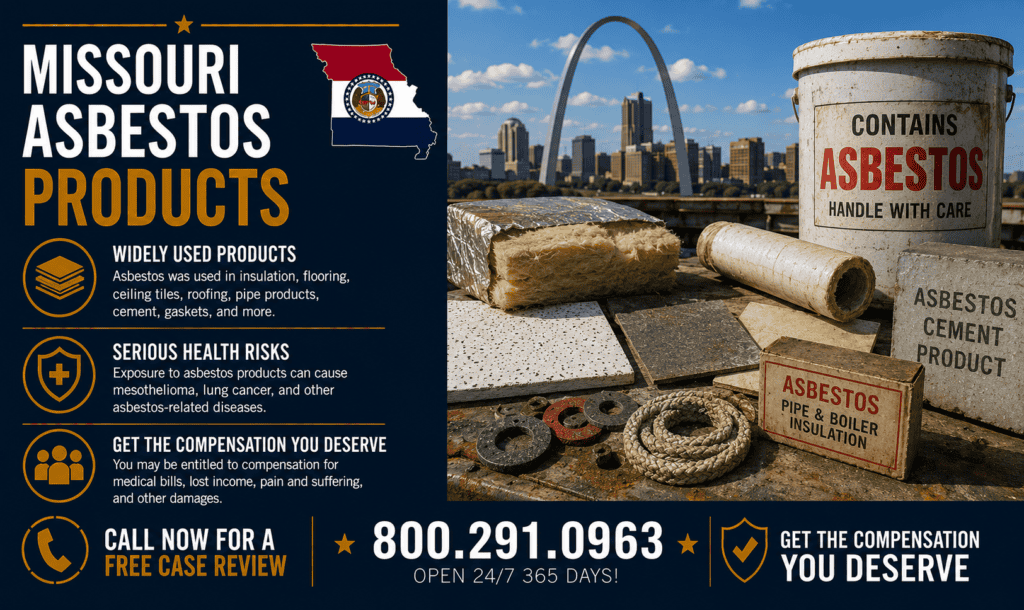
🧱 Missouri Asbestos Products
Missouri asbestos exposure occurred through thousands of products historically used in homes, commercial buildings, construction projects, factories, power plants, railroad facilities, automotive shops, industrial plants, schools, hospitals, and other workplaces throughout the state. Asbestos was incorporated into products because its fibers provided heat resistance, fire resistance, strength, insulation, and durability.
Historical asbestos-containing products included certain insulation materials, construction products, flooring, roofing, cement materials, gaskets, packing, brake and clutch components, fireproofing, electrical products, and industrial materials. Missouri’s Department of Natural Resources identifies examples including floor tile, flooring mastics, ceiling materials, fireproofing, insulation, roofing, joint compounds, boiler insulation, HVAC insulation, pipe insulation, gaskets, packing, cement products, and brake pads.
Exposure generally became a concern when asbestos-containing products were damaged, deteriorated, cut, sanded, ground, scraped, removed, repaired, or otherwise disturbed in ways that released fibers into the air.
For the statewide parent resource, see Missouri Asbestos Exposure Lawsuits. Related Missouri research includes Missouri Workers & Occupational Asbestos Exposure, Missouri Asbestos Exposure Sites & Industries, and Missouri Equipment & Machinery Asbestos Exposure.
🧰 Why Asbestos Was Used in So Many Products
Asbestos possessed several properties manufacturers considered valuable.
It could provide:
- Heat resistance
- Fire resistance
- Electrical insulation
- Tensile strength
- Friction resistance
- Chemical resistance
- Durability
These characteristics allowed asbestos to be incorporated into products used in very different environments.
A power plant might use asbestos-containing thermal insulation and gaskets.
A construction project might involve asbestos-containing flooring, roofing, cement, or joint compounds.
An automobile repair shop might service asbestos-containing brake or clutch components.
A factory could use asbestos-containing packing and gaskets inside mechanical systems.
EPA identifies historical asbestos use in building materials, floor tiles, insulation, shingles, textured paint, brakes, gaskets, and cement pipe, among numerous other applications.
🏗️ Missouri Asbestos Products Used in Construction
Construction was one of the major environments in which workers and building occupants could encounter asbestos-containing products.
Potential historical materials included certain:
- Floor tiles
- Sheet flooring
- Flooring mastics
- Roofing shingles
- Roofing felts
- Siding
- Cement sheets
- Wallboard
- Joint compounds
- Spackling compounds
- Textured coatings
- Acoustical materials
- Fireproofing
- Ceiling tiles
- Pipe insulation
- HVAC insulation
- Boiler insulation
Missouri DNR specifically identifies many of these materials among potential asbestos-containing products.
Workers could encounter them during:
- Installation
- Cutting
- Sanding
- Drilling
- Repair
- Renovation
- Remodeling
- Removal
- Demolition
The presence of an older construction product does not automatically establish that it contained asbestos. Manufacturer, product formulation, installation date, and other evidence should be considered.
See Missouri Asbestos Products Used in Construction and Missouri Construction Asbestos Exposure for related research.
🧱 Asbestos Cement Products in Missouri
Asbestos fibers were historically combined with cement to create durable products with resistance to heat, moisture, and deterioration.
Potential products included certain:
- Cement siding
- Wallboard
- Flat sheets
- Corrugated sheets
- Roofing products
- Cement shingles
- Water pipe
- Other cement pipe
Missouri DNR identifies cementitious siding and wallboard, sometimes called transite, among historical asbestos-containing materials and identifies asbestos cement wall or roof shingles, wallboard, and cement pipe as examples of Category II nonfriable materials.
Workers could disturb these products during:
- Cutting
- Drilling
- Sawing
- Breaking
- Removal
- Renovation
- Demolition
The method used to remove or alter the material can significantly affect whether fibers are released.
🧤 Missouri Asbestos Insulation Products
Insulation represents one of the most recognizable historical uses of asbestos.
Certain asbestos-containing insulation products were used around:
- Boilers
- Steam pipes
- Furnaces
- HVAC systems
- Ductwork
- Industrial equipment
- Mechanical systems
- High-temperature surfaces
Potential forms included:
- Pipe covering
- Block insulation
- Insulating cement
- Blankets
- Wrap
- Thermal insulation
- Boiler insulation
- HVAC insulation
Missouri DNR specifically identifies blown-in insulation, boiler insulation, HVAC duct insulation, and pipe insulation among materials that historically could contain asbestos.
Workers could experience exposure while installing insulation, but later maintenance and removal could also disturb old materials.
See Missouri Asbestos Insulation Products, Missouri Boiler Equipment Asbestos Exposure, and Missouri Pipefitters Mesothelioma.
🔥 Boiler & High-Temperature Insulation Products
Boilers and other high-temperature systems required substantial thermal protection.
Potential historical asbestos-containing materials could include certain:
- Boiler insulation
- Pipe covering
- Insulating cement
- Gaskets
- Packing
- Millboard
- Refractory materials
- Thermal blankets
- Heat-resistant cloth
Workers potentially affected included:
- Boilermakers
- Pipefitters
- Steamfitters
- Insulators
- Maintenance mechanics
- Millwrights
- Power plant workers
- Factory workers
Older insulation could deteriorate after years of heat, vibration, maintenance, and moisture.
Removing or repairing it could create a different exposure scenario from simply working near intact material.
⚙️ Missouri Industrial Asbestos Products
Missouri factories, power plants, manufacturing facilities, processing operations, utilities, and other industrial workplaces could use asbestos-containing products in both machinery and mechanical systems.
Potential historical products included certain:
- Gaskets
- Packing
- Thermal insulation
- Pipe insulation
- Boiler materials
- Millboard
- Friction products
- Electrical insulation
- Heat-resistant fabrics
- Cement products
- Industrial coatings
EPA records show that asbestos historically had extensive industrial uses, including packings in pumps and valves, friction materials in industrial machinery, high-grade electrical paper in heavy electrical apparatus, millboard in boilers and kilns, and other heat-resistant applications.
Industrial exposure research should identify the specific product rather than assuming all materials in a particular plant contained asbestos.
Related pages include Missouri Industrial Asbestos Products, Missouri Industrial Asbestos Exposure, and Missouri Industrial Machinery Asbestos Exposure.
🔩 Asbestos Gaskets
Gaskets were used to seal connections between stationary mechanical surfaces.
Historical asbestos-containing gaskets could be associated with:
- Boilers
- Pumps
- Valves
- Steam piping
- Pipe flanges
- Furnaces
- Compressors
- Turbines
- Engines
- Industrial machinery
Missouri DNR classifies asbestos-containing gaskets among Category I nonfriable asbestos-containing materials.
Workers could disturb old gaskets while:
- Opening equipment
- Separating flanges
- Removing gasket material
- Scraping sealing surfaces
- Wire brushing equipment
- Installing replacements
Gasket work can therefore be an important part of a historical industrial exposure investigation.
🧵 Asbestos Packing Products
Packing was used to help control leakage around moving mechanical components.
Historical applications included certain:
- Pumps
- Valves
- Expansion joints
- Soot blowers
- Mechanical equipment
EPA records describe asbestos packing used in rotary, centrifugal, and reciprocating pumps, valves, expansion joints, and numerous other mechanical applications.
Workers could remove old packing using picks, hooks, scrapers, or other hand tools.
Relevant occupations included:
- Pipefitters
- Millwrights
- Mechanics
- Maintenance workers
- Power plant workers
- Factory workers
A worker who remembers repeatedly repacking pumps or valves may have useful information even if the product manufacturer is no longer remembered.
🚗 Missouri Automotive Asbestos Products
Asbestos was historically incorporated into certain automotive and vehicle friction products because of its resistance to heat and friction.
Potential products included certain:
- Brake linings
- Brake shoes
- Brake pads
- Clutch facings
- Transmission components
- Other friction materials
EPA identifies automobile clutch, brake, and transmission parts among historical asbestos-containing manufactured goods.
Potentially affected Missouri workers included:
- Automotive mechanics
- Brake technicians
- Fleet mechanics
- Truck mechanics
- Bus mechanics
- Heavy-equipment mechanics
- Garage employees
Exposure could occur when friction products were removed, cleaned, ground, sanded, or otherwise disturbed.
See Missouri Automotive Asbestos Products and Missouri Automotive Brake Equipment Asbestos Exposure.
🚙 Brake Products & Asbestos Exposure
Brake servicing deserves separate attention because dust could accumulate inside brake assemblies.
Historical work practices could involve:
- Removing brake drums
- Cleaning assemblies
- Replacing brake shoes
- Removing brake pads
- Grinding linings
- Sanding friction surfaces
- Sweeping shop floors
Missouri DNR identifies brake pads among potential asbestos-containing materials.
A vehicle’s make and model alone may not establish the manufacturer of the brake component because replacement parts could have been installed repeatedly over the vehicle’s service life.
🏠 Missouri Flooring Products & Asbestos Exposure
Asbestos was historically incorporated into certain resilient flooring materials.
Potential products included:
- Vinyl-asbestos floor tile
- Asphalt floor tile
- Sheet flooring
- Flooring backing
- Flooring mastics
- Adhesives
These products could be found in:
- Homes
- Schools
- Hospitals
- Offices
- Factories
- Government buildings
- Commercial properties
Missouri DNR identifies asphalt and vinyl floor tile, sheet flooring, and flooring mastics among potential asbestos-containing materials.
Exposure concerns could arise when older flooring was:
- Sanded
- Ground
- Scraped
- Broken
- Removed
- Demolished
Intact flooring and flooring being aggressively disturbed represent different exposure conditions.
🏠 Missouri Roofing & Siding Products
Historical asbestos-containing exterior building products could include certain:
- Roofing shingles
- Roofing felts
- Roofing coatings
- Siding shingles
- Cement siding
- Corrugated cement panels
These materials could be encountered by:
- Roofers
- Carpenters
- Construction workers
- Remodelers
- Demolition workers
- Building maintenance personnel
Missouri DNR identifies roofing shingles and felts among potential asbestos-containing materials and asbestos cement roof shingles among Category II nonfriable materials.
Exposure potential depends heavily on the product’s condition and how it was handled.
🧱 Joint Compound, Plaster & Wall Materials
Certain historical wall and ceiling products could contain asbestos.
Potential materials included:
- Joint compound
- Spackling compound
- Textured coatings
- Acoustical plaster
- Wallboard
- Cement board
- Fireproofing
Workers could disturb these materials during:
- Sanding
- Drilling
- Cutting
- Renovation
- Repair
- Removal
- Demolition
Missouri DNR identifies joint compounds, spackling compounds, textured paints, acoustical plaster, and fireproofing among potential asbestos-containing materials.
🏫 Ceiling & Fireproofing Products
Asbestos-containing materials could historically be installed in schools, offices, industrial facilities, hospitals, government buildings, and other structures for sound control or fire resistance.
Potential materials included certain:
- Ceiling tiles
- Ceiling panels
- Acoustical materials
- Fireproofing
- Spray-applied materials
- Insulating coatings
Workers potentially affected included:
- Construction workers
- Custodians
- Electricians
- Maintenance workers
- HVAC technicians
- Renovation contractors
- Demolition workers
Work above suspended ceilings could also disturb nearby insulation or other older building materials.
⚡ Missouri Electrical Asbestos Products
Asbestos was historically used in certain electrical applications because of its heat resistance and poor electrical conductivity.
Potential products included certain:
- Electrical insulation
- High-grade electrical paper
- Arc chutes
- Insulating panels
- Millboard
- Wire and cable insulation
- Heat-resistant electrical components
EPA identifies high-grade electrical paper as historically used for insulation in motors, generators, transformers, switchgear, and other heavy electrical equipment.
Potentially affected workers included:
- Electricians
- Power plant workers
- Electrical maintenance technicians
- Industrial mechanics
- Generator technicians
- Utility workers
🧯 Fireproofing & Heat-Protection Products
Asbestos was widely valued for heat and fire resistance.
Historical heat-protection products could include certain:
- Spray fireproofing
- Millboard
- Fire-resistant panels
- Thermal cloth
- Heat-resistant fabrics
- Insulating blankets
- Protective materials
- High-temperature coatings
These products could appear in industrial buildings, mechanical rooms, power plants, commercial buildings, and other environments requiring heat or fire protection. Related site research includes Missouri Power Plant Asbestos Exposure, Missouri Manufacturing Asbestos Exposure, and Missouri Public & Government Buildings Asbestos Exposure.
EPA continues to identify legacy asbestos uses in materials such as insulation and heat-protective textiles.
🚆 Railroad Asbestos Products
Missouri railroad workers could encounter asbestos-containing products in locomotives, railcars, maintenance shops, roundhouses, and railroad facilities.
Potential historical products included certain:
- Brake components
- Gaskets
- Packing
- Pipe insulation
- Boiler insulation
- Electrical insulation
- Heat-resistant materials
- Building materials
Workers potentially affected included:
- Machinists
- Mechanics
- Electricians
- Pipefitters
- Maintenance workers
- Brake repair workers
- Shop employees
Railroad exposure research should identify the specific equipment, component, work location, and period rather than assuming all railroad equipment contained asbestos. See Missouri Railroad Asbestos Exposure.
👷 Missouri Workers Who Encountered Asbestos Products
Potential occupational exposure could involve:
- Construction workers
- Factory workers
- Pipefitters
- Steamfitters
- Boilermakers
- Electricians
- Millwrights
- Insulators
- Maintenance mechanics
- Power plant workers
- Railroad workers
- Automotive mechanics
- Roofers
- Flooring installers
- Plumbers
- HVAC workers
- Welders
- Demolition workers
Different workers could encounter the same product in different ways. Related occupation pages include Missouri Factory Workers Asbestos Exposure, Missouri Electricians Asbestos Exposure, Missouri Pipefitters Mesothelioma, Missouri Power Plant Workers Mesothelioma, and Missouri Railroad Workers Asbestos Exposure.
🔨 Installation vs. Maintenance vs. Removal Exposure
The same asbestos-containing product could create different exposure scenarios depending on how it was handled.
Installation
Workers could:
- Cut products
- Fit materials
- Mix compounds
- Trim insulation
- Drill panels
Maintenance
Workers could:
- Remove insulation
- Open equipment
- Scrape gaskets
- Repair flooring
- Replace mechanical components
Renovation & Demolition
Workers could:
- Break walls
- Remove flooring
- Tear out insulation
- Cut roofing
- Demolish mechanical systems
Exposure research should therefore identify what happened to the product, not merely whether it existed at the worksite.
📦 Packaging, Labels & Product Appearance
Workers sometimes remember how products were delivered rather than the manufacturer’s exact name.
Potential memories include:
- Bags
- Boxes
- Rolls
- Sheets
- Preformed pipe sections
- Buckets
- Drums
- Spools
- Cartons
- Printed labels
- Logos
Former coworkers may remember brand names or manufacturers that another worker has forgotten.
Historical photographs and product catalogs may also help identify materials.
🏭 Manufacturer vs. Supplier vs. Employer
Several different companies could be connected to one asbestos product.
These could include:
Manufacturer — produced the product.
Supplier or Distributor — sold or delivered it.
Contractor — installed or removed it.
Employer — employed the exposed worker.
Equipment Manufacturer — produced machinery that used the component.
These roles should not automatically be treated as the same.
Historical research should identify each company’s actual relationship to the product and worksite.
🔄 Replacement Products Can Matter
A piece of industrial equipment or a building could remain in use for decades.
During that time:
- Gaskets were replaced
- Packing was replaced
- Insulation was repaired
- Flooring was replaced
- Roofing was repaired
- Brake components were replaced
- Boilers were reinsulated
- Mechanical systems were rebuilt
The product present in 1975 might therefore differ from the material originally installed in 1955.
Replacement-product history can be particularly important when researching machinery and maintenance exposure.
📂 Records That May Help Identify Missouri Asbestos Products
Useful historical records can include:
- Employment records
- Union records
- Purchasing records
- Invoices
- Product catalogs
- Equipment manuals
- Maintenance logs
- Work orders
- Engineering specifications
- Architectural drawings
- Contractor records
- Plant photographs
- Construction records
- Building records
- Coworker statements
Even records that do not explicitly mention asbestos can provide useful clues.
👥 Coworkers Can Help Identify Products
Coworkers may remember:
- Brand names
- Packaging
- Manufacturers
- Suppliers
- Equipment
- Contractors
- Maintenance procedures
- Product appearance
- Where products were stored
A coworker who performed the same job during the same years may provide valuable historical context.
Product identification should still be supported by additional evidence whenever possible.
🏢 What If the Product Manufacturer No Longer Exists?
Many historical asbestos-product manufacturers:
- Closed
- Merged
- Changed names
- Sold divisions
- Reorganized
- Entered bankruptcy
That does not necessarily prevent historical product research.
Evidence may remain through:
- Product catalogs
- Corporate records
- Historical advertisements
- Distributor records
- Equipment manuals
- Invoices
- Worksite records
- Coworkers
- Bankruptcy records
- Trust documentation
The investigation can proceed:
Worker → Worksite → Product → Manufacturer → Corporate History
🏦 Missouri Asbestos Products & Trust Fund Claims
Some companies that historically manufactured asbestos-containing products later entered bankruptcy and established asbestos trusts.
Product identification can therefore become important when evaluating potential trust claims.
Different workplaces could involve products associated with different manufacturers.
A worker with a long occupational history could therefore have more than one potential exposure source.
Eligibility for a particular trust depends on its own medical and exposure requirements. See Missouri Asbestos Trust Fund Claims.
⚖️ Missouri Asbestos Products & Mesothelioma Lawsuits
Product identification can also be important in asbestos litigation.
An investigation may ask:
- What product was involved?
- Did that product contain asbestos at the relevant time?
- Who manufactured it?
- Who supplied it?
- Where was it used?
- When was it used?
- How did the worker encounter it?
- How was it disturbed?
- Are employment or worksite records available?
- Are coworkers available?
- What disease was diagnosed?
Simply showing that asbestos products existed somewhere within an industry does not establish an individual’s exposure. For broader legal information, review Missouri Mesothelioma Lawsuits & Claims, Missouri Mesothelioma Statute of Limitations, and Missouri Wrongful Death Mesothelioma Lawsuits.
🏠 Secondary Exposure from Asbestos Products
Asbestos fibers disturbed at Missouri workplaces could historically settle on:
- Work clothes
- Shoes
- Hair
- Gloves
- Tools
- Personal belongings
Workers could then carry dust away from the workplace.
Family members who handled contaminated work clothing could potentially experience secondary or take-home exposure.
🩺 Diseases Associated With Asbestos Product Exposure
Asbestos exposure is associated with serious diseases that can develop long after the original exposure.
These include:
- Mesothelioma
- Asbestos-related lung cancer
- Asbestosis
- Pleural disease
Missouri DNR states that asbestos fibers can be inhaled into the lungs and eventually lead to disease.
A diagnosis does not by itself establish which product caused or contributed to an individual’s exposure.
That requires a separate historical exposure investigation.
❓ Frequently Asked Questions About Missouri Asbestos Products
What products historically contained asbestos?
Historical asbestos-containing products included certain insulation, flooring, roofing, cement products, fireproofing, gaskets, packing, friction products, electrical materials, joint compounds, and other construction and industrial materials.
Did every older insulation product contain asbestos?
No. Product type alone does not establish asbestos content. Manufacturer, formulation, application, and period should be researched.
Did all old floor tiles contain asbestos?
No. Certain historical floor tiles and flooring materials contained asbestos, but not every flooring product did.
Could roofing products contain asbestos?
Certain historical roofing shingles, felts, coatings, and cement roofing products contained asbestos.
Could industrial gaskets contain asbestos?
Yes. Certain historical gaskets contained asbestos and were used in industrial and mechanical applications.
Could pumps and valves use asbestos products?
Certain historical pumps and valves used asbestos-containing packing and gaskets.
Could automotive products contain asbestos?
Certain historical brake, clutch, and other friction products contained asbestos.
What if I remember the product but not its manufacturer?
Record its appearance, application, packaging, worksite, years, coworkers, supplier, and equipment with which it was used. These details can help narrow identification.
What if I remember a manufacturer but not the exact product?
Document the manufacturer name exactly as remembered, but do not assume every product it made contained asbestos.
Can replacement products matter?
Yes. Equipment and buildings could receive replacement gaskets, packing, insulation, flooring, roofing, brake components, and other materials over many years.
Can family members have secondary exposure?
Potentially. Historical take-home exposure could occur when asbestos fibers were carried from workplaces on contaminated clothing or other materials.
Does finding asbestos at a Missouri worksite prove that I was exposed?
No. Individual exposure depends on the product, location, work activity, time period, proximity, and other evidence.
Missouri Asbestos Product Pages
Explore the primary pages in this Missouri asbestos products silo:
- Missouri Asbestos Products Used in Construction
- Missouri Asbestos Insulation Products
- Missouri Automotive Asbestos Products
- Missouri Industrial Asbestos Products
Related statewide resources include Missouri Equipment & Machinery Asbestos Exposure, Missouri Workers & Occupational Asbestos Exposure, Missouri Asbestos Exposure Sites & Industries, and Missouri Mesothelioma Lawsuits & Claims.
Call 800.291.0963 — Open 24/7, 365 Days
If you or someone you love has been diagnosed with mesothelioma or another asbestos-related disease after working with or around asbestos products in Missouri, documenting employers, worksites, occupations, products, manufacturers, suppliers, equipment, job duties, coworkers, and exposure periods can help reconstruct possible historical asbestos exposure.
MesotheliomaHelp.Center provides legal and medical information to help Missouri residents and families understand asbestos exposure, mesothelioma lawsuits, asbestos trust funds, filing deadlines, and potential next steps.