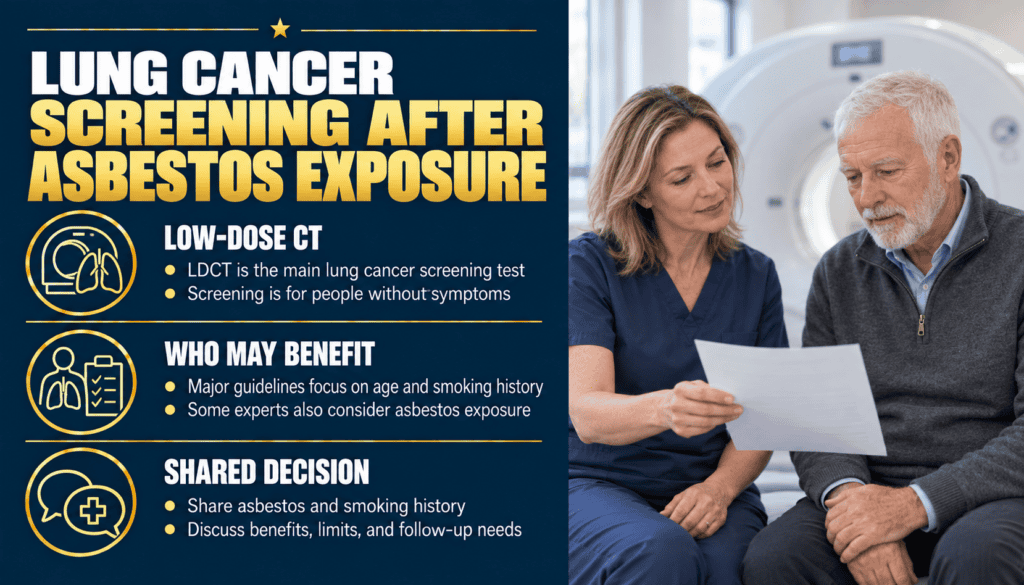
Lung Cancer Screening After Asbestos Exposure
People with a history of asbestos exposure may wonder whether they should be screened for lung cancer before symptoms appear. The recommended lung cancer screening test for people who meet established eligibility criteria is low-dose computed tomography (LDCT), not a standard chest X-ray.
Current U.S. screening recommendations are based primarily on age and cigarette-smoking history. Asbestos exposure is an important lung cancer risk factor, but asbestos exposure by itself does not automatically mean that a person meets standard population-screening criteria. People with substantial occupational or military exposure should discuss their complete risk history with a qualified healthcare professional.
Screening is also different from diagnostic testing. Screening is intended for eligible people who do not have symptoms. A person with a persistent cough, coughing up blood, unexplained weight loss, new shortness of breath, chest pain, or another concerning symptom needs medical evaluation rather than simply waiting for a routine screening test.
This page is part of the Asbestos Lung Cancer Symptoms & Diagnosis hub within the broader Diagnosed With Lung Cancer silo. Related pages cover Asbestos Lung Cancer Symptoms, Early Signs of Asbestos-Related Lung Cancer, and Diagnosing Asbestos-Related Lung Cancer.
🩺 What Is Lung Cancer Screening?
Lung cancer screening is testing performed before symptoms appear in people considered at elevated risk. The goal is to find some lung cancers at an earlier stage, when treatment may be more effective.
Screening is not the same as testing someone who already has symptoms. A person who develops persistent respiratory symptoms or another concerning change should seek medical evaluation even if they do not meet routine screening criteria.
| Situation | Purpose | Typical Next Step |
|---|---|---|
| No symptoms, meets screening criteria | Look for lung cancer before symptoms develop | Discuss annual LDCT screening with a healthcare professional |
| Persistent or concerning symptoms | Determine the cause of an existing medical problem | Diagnostic medical evaluation |
| Abnormal screening scan | Determine whether the finding requires additional evaluation | Follow-up imaging or other testing based on the finding |
🩻 Low-Dose CT Screening
Low-dose computed tomography uses X-rays to create detailed cross-sectional images of the lungs while using a lower radiation dose than a conventional diagnostic chest CT. LDCT can detect small lung nodules that may not be visible on a standard chest X-ray.
For people who meet evidence-based eligibility criteria, annual LDCT screening can reduce the risk of dying from lung cancer by detecting some cancers earlier.
Why chest X-rays are not the standard screening test
Standard chest X-rays are less sensitive for small lung cancers and have not demonstrated the same mortality benefit as LDCT in high-risk screening populations. A chest X-ray may still be ordered for many diagnostic reasons, but it is not a substitute for recommended LDCT lung cancer screening.
📋 Who Qualifies for Lung Cancer Screening?
In the United States, major screening recommendations generally focus on adults within a defined age range who have a substantial cigarette-smoking history and who currently smoke or quit within a specified period.
For example, the U.S. Preventive Services Task Force recommends annual LDCT screening for adults ages 50 through 80 who have at least a 20 pack-year smoking history and currently smoke or quit within the past 15 years, assuming they are otherwise appropriate candidates for screening.
A pack-year is a way of describing cumulative cigarette exposure. One pack per day for 20 years equals 20 pack-years; two packs per day for 10 years also equals 20 pack-years.
Screening guidelines can change over time, and other professional organizations may use somewhat different criteria. Eligibility should therefore be confirmed with a healthcare professional rather than relying on a website alone.
⚠️ How Asbestos Exposure Affects Lung Cancer Risk
Asbestos is an established cause of lung cancer. Risk generally increases with greater cumulative exposure, which can reflect exposure intensity, frequency, duration, and the work practices involved.
Historically exposed groups can include some shipyard workers, construction workers, insulators, pipefitters, plumbers, boilermakers, mechanics, machinists, industrial maintenance workers, refinery employees, power plant workers, railroad workers, and military veterans.
A job title alone does not prove exposure. Not every product, building, ship, machine, or workplace contained asbestos, and asbestos content varied by manufacturer, product, component, model, era, and location.
People with substantial exposure histories should discuss them with their healthcare providers even when the exposure occurred decades ago. Learn more at Asbestos Lung Cancer Risk and the Asbestos Lung Cancer Latency Period.
🚭 Asbestos Exposure Without a Smoking History
A person does not have to smoke for asbestos to increase lung cancer risk. Never-smokers with substantial occupational or military asbestos exposure can develop lung cancer.
However, current population screening criteria do not generally treat asbestos exposure alone as an automatic substitute for the smoking-history requirements used in standard recommendations. This can create an important question for asbestos-exposed never-smokers or people with limited smoking histories.
Rather than assuming that screening is or is not appropriate, an asbestos-exposed person should discuss individualized risk with a healthcare professional. Factors that may be relevant include age, exposure intensity and duration, time since first exposure, smoking history, other occupational carcinogens, family history, lung disease, and overall health.
People who experienced both tobacco and asbestos exposure can review Smoking and Asbestos Lung Cancer Risk.
🔬 Screening vs. Diagnostic Testing
This distinction is especially important for people researching early lung cancer detection.
| Screening | Diagnostic Evaluation |
|---|---|
| Performed before symptoms appear | Performed because symptoms or an abnormal finding already exist |
| Targets people meeting defined risk criteria | Based on the patient’s current clinical problem |
| LDCT is the recommended lung cancer screening test for eligible high-risk adults | May involve diagnostic CT, PET/CT, bronchoscopy, biopsy, or other testing |
| Does not itself diagnose every abnormality | Aims to determine what an abnormality or symptom represents |
A person with coughing up blood, persistent or worsening cough, unexplained weight loss, new or increasing shortness of breath, or significant chest symptoms should seek medical care rather than wait for a future screening appointment.
For more information about the diagnostic pathway, see Diagnosing Asbestos-Related Lung Cancer.
⚖️ Benefits and Limitations of Lung Cancer Screening
LDCT screening can provide an important benefit for eligible high-risk patients by detecting some lung cancers earlier. Screening also has limitations and potential harms that should be discussed as part of shared decision-making.
| Potential Benefit or Limitation | What It Means |
|---|---|
| Earlier detection | Some cancers may be found before symptoms develop |
| Mortality benefit | Screening appropriate high-risk populations can reduce lung cancer deaths |
| False-positive findings | Many lung nodules detected on screening are not cancer |
| Follow-up testing | Some findings require additional scans or procedures |
| Radiation exposure | LDCT uses a relatively low radiation dose, but repeated screening adds cumulative exposure |
| Overdiagnosis | Screening can identify some cancers that might not otherwise have caused harm during a person’s lifetime |
The balance of benefits and harms depends on the individual’s risk, health, age, ability to undergo treatment if cancer is found, and other clinical considerations.
👷 What Asbestos Exposure History Should You Tell Your Doctor?
Because asbestos-related lung cancer can develop after decades of latency, patients should not limit their medical history to their most recent job.
Useful information can include:
- Every major employer and occupation
- Years worked at each job or facility
- Military branch, ships, bases, units, duty stations, and occupational specialty
- Construction, renovation, demolition, insulation, or maintenance work
- Work around boilers, pipes, pumps, valves, furnaces, turbines, gaskets, or packing
- Historical brake, clutch, or mechanical work
- Nearby trades that generated heavy dust
- Known asbestos-containing materials or documented asbestos abatement
- Household exposure from contaminated work clothing when applicable
A detailed history helps the healthcare provider understand overall lung cancer risk. It does not itself establish that asbestos caused cancer.
Already diagnosed with lung cancer after an old asbestos exposure? Call 800.291.0963 or Submit Your Case. Live help is available 24/7, 365 days a year.
🔎 What Happens After an Abnormal Lung Cancer Screening Scan?
An abnormal LDCT does not automatically mean lung cancer. Lung nodules are common, and many are benign.
The next step depends on the size, appearance, growth, and other characteristics of the finding, as well as the person’s risk profile. Doctors may recommend repeat imaging after a defined interval, a diagnostic CT, PET/CT, referral to a specialist, or tissue sampling in appropriate cases.
If a biopsy confirms lung cancer, pathology helps determine the cancer type. Additional imaging, lymph-node evaluation, and molecular or biomarker testing may then be used to guide staging and treatment.
When the patient also has a significant asbestos history, medical diagnosis and exposure investigation remain separate questions. The diagnosis establishes the cancer; occupational, military, product, and jobsite evidence helps evaluate whether asbestos may have contributed.
❓ Frequently Asked Questions
Should everyone exposed to asbestos get annual lung cancer screening?
No. Asbestos exposure alone does not automatically place every person into standard population-screening criteria. Individual risk and eligibility should be discussed with a healthcare professional.
What test is used to screen for lung cancer?
Low-dose CT is the recommended screening test for people who meet established high-risk criteria. Standard chest X-rays are not recommended as a substitute for LDCT screening.
What are the current U.S. lung cancer screening criteria?
The U.S. Preventive Services Task Force recommends annual LDCT for adults ages 50 through 80 with at least a 20 pack-year smoking history who currently smoke or quit within the past 15 years. Individual eligibility should be confirmed with a healthcare professional because recommendations can change.
Can a nonsmoker exposed to asbestos get lung cancer?
Yes. Asbestos independently increases lung cancer risk. Never-smokers with significant exposure should discuss their individual risk with a qualified healthcare professional.
Does asbestos exposure qualify me for LDCT screening if I never smoked?
Not automatically under standard U.S. population-screening criteria. A clinician can evaluate the person’s overall risk and determine whether additional assessment is appropriate.
Is lung cancer screening the same as diagnosis?
No. Screening looks for cancer before symptoms develop in eligible high-risk people. Diagnostic testing evaluates symptoms or an abnormal finding that already exists.
What if my low-dose CT finds a lung nodule?
Most lung nodules are not cancer. Follow-up depends on the nodule’s size, appearance, growth, and the patient’s risk factors. A healthcare professional determines the appropriate next step.
Should I tell my doctor about asbestos exposure from decades ago?
Yes. Because asbestos-related lung cancer can have a long latency period, occupational or military exposure from decades earlier can remain relevant to risk assessment.
📞 Lung Cancer Diagnosis After Years of Asbestos Exposure?
Screening is intended to detect disease before symptoms appear. If you or a family member has already been diagnosed with lung cancer after work in construction, shipyards, industrial plants, military service, mechanical trades, power generation, refineries, or another potentially exposed environment, a separate asbestos exposure investigation may be appropriate.
Call 800.291.0963 to discuss jobs, military assignments, worksites, equipment, and materials that may help reconstruct historical asbestos exposure. Live help is available 24/7, 365 days a year.
Submit Your Case for a case-specific review of potential asbestos exposure and legal options. Eligibility depends on diagnosis, exposure evidence, responsible companies or trusts, jurisdiction, and applicable deadlines.
For additional legal information, visit Lung Cancer Asbestos Lawsuit.
⚕️ Legal & Medical Information Disclaimer
This page provides general educational information only. It does not establish a diagnosis, medical causation, legal liability, VA eligibility, or entitlement to compensation. Consult qualified medical and legal professionals for advice about your specific situation.