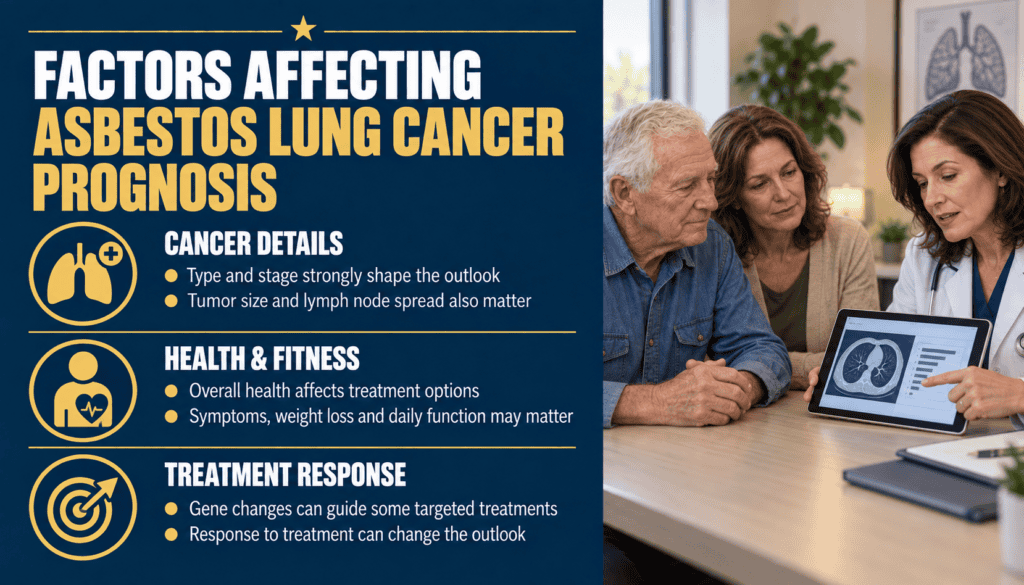
Factors Affecting Asbestos Lung Cancer Prognosis
Asbestos lung cancer prognosis is not determined by asbestos exposure alone. The outlook after diagnosis depends mainly on the lung cancer type, stage, tumor biology, molecular and biomarker findings, overall health, lung function, performance status, treatment options, and how the cancer responds to therapy.
Asbestos exposure is important when evaluating possible causation. However, two people with similar exposure histories can have very different prognoses if their cancers are diagnosed at different stages or have different biological characteristics.
This page is a child of the Asbestos Lung Cancer Prognosis & Survival hub. Related pages include Asbestos Lung Cancer Life Expectancy, Asbestos Lung Cancer Survival Rates, and Stage 4 Asbestos Lung Cancer Life Expectancy.
🗺️ Stage at Diagnosis
Stage is one of the most important factors affecting lung cancer prognosis. It describes the size and extent of the cancer and whether it has remained localized or spread to lymph nodes, nearby structures, or distant organs.
Earlier-stage lung cancers generally have more opportunities for treatment with curative intent. Advanced cancers usually require systemic treatment and have lower population-level survival rates.
| Extent of Disease | General Prognostic Significance | Typical Treatment Considerations |
|---|---|---|
| Localized | Generally the most favorable broad survival category. | Surgery or focused radiation may be possible, with additional therapy when indicated. |
| Regional | Prognosis depends heavily on lymph-node and nearby-structure involvement. | Combined surgery, chemotherapy, radiation, immunotherapy, or other approaches may be considered. |
| Distant | Generally has the lowest population-level survival. | Systemic therapy is usually central, with local treatment used selectively. |
For current population-level comparisons, see Asbestos Lung Cancer Survival Rates.
🫁 Cancer Type and Histology
Whether a patient has non-small cell lung cancer (NSCLC) or small cell lung cancer (SCLC) substantially affects prognosis and treatment.
NSCLC includes several histologic subtypes and accounts for most lung cancers. Selected early-stage NSCLC can sometimes be removed surgically or treated with curative-intent radiation. SCLC generally grows and spreads more rapidly and is usually treated primarily with systemic therapy and radiation rather than surgery.
Within NSCLC, pathology also matters because adenocarcinoma, squamous cell carcinoma, and other subtypes can have different molecular profiles and treatment options.
🧬 Tumor Biology, Molecular Changes, and Biomarkers
Modern lung cancer prognosis is increasingly influenced by the biological characteristics of the tumor. For advanced NSCLC in particular, molecular testing can identify alterations that may make targeted therapy possible.
| Tumor Factor | Why It Can Matter |
|---|---|
| Actionable molecular alterations | Some genetic changes can be treated with targeted drugs and may substantially affect treatment options. |
| PD-L1 expression | Can help guide the use of certain immune checkpoint inhibitors. |
| Histology | Can influence which systemic treatments are appropriate. |
| Tumor behavior | Growth rate and metastatic pattern can influence prognosis. |
Asbestos exposure does not replace tumor testing. A patient with a strong occupational asbestos history still needs appropriate pathology, staging, and molecular or biomarker evaluation.
🚶 Performance Status and Overall Health
Performance status describes how well a person can carry out normal daily activities. It is an important prognostic factor because it can reflect both the effects of cancer and a patient’s ability to tolerate treatment.
Patients who remain active and independent may be candidates for treatment options that would be difficult for someone who is severely weakened by cancer or other illnesses. Poor performance status can limit the intensity of chemotherapy, surgery, radiation, or combination therapy.
Performance status is not the same as age. An older adult who remains physically functional may be able to benefit from treatment, while a younger patient with severe medical problems may have fewer options.
💨 Lung Function and Other Respiratory Disease
Lung function can be especially important for asbestos-exposed patients. Some people with asbestos-related lung cancer also have asbestosis, pleural abnormalities, COPD, emphysema, or other respiratory disease.
Reduced pulmonary reserve can affect whether surgery is safe, how radiation is planned, and how well a patient tolerates systemic treatment.
| Respiratory Factor | Potential Prognostic Relevance |
|---|---|
| Asbestosis | May reduce pulmonary reserve depending on severity. |
| COPD or emphysema | Can affect breathing capacity and treatment tolerance. |
| Pleural disease | May complicate imaging or coexist with other asbestos-related conditions. |
| Pulmonary function | Can influence surgical candidacy and radiation planning. |
Having another lung condition does not automatically rule out cancer treatment. The medical team evaluates the entire clinical picture.
💊 Treatment Options and Response to Therapy
Available treatment and the cancer’s response to it can substantially change prognosis. Lung cancer treatment may include surgery, chemotherapy, radiation therapy, immunotherapy, targeted therapy, or combinations of these approaches.
Some localized cancers can be treated with curative intent. For advanced disease, effective systemic therapy can sometimes control cancer for meaningful periods, relieve symptoms, and extend survival.
A strong response to treatment may improve a patient’s outlook compared with what broad statistics suggested at diagnosis. Conversely, rapidly progressive or treatment-resistant disease can worsen prognosis.
See the Asbestos Lung Cancer Treatment hub for detailed treatment pages.
❤️ Age and Other Medical Conditions
Age can be relevant to treatment planning, but age alone should not be treated as a prognosis. Doctors also consider heart health, kidney and liver function, neurological conditions, frailty, nutrition, medications, and other illnesses.
Current lung cancer guidance emphasizes overall health and performance status rather than using chronological age alone to decide whether treatment may be beneficial.
Comorbid conditions can matter because they may increase the risks of surgery, influence drug selection or dosing, or affect the ability to complete treatment.
⚠️ Symptoms, Weight Loss, and Disease Burden
Symptoms and overall disease burden can provide additional prognostic information. NCI identifies pulmonary or constitutional symptoms as relevant prognostic factors in NSCLC, and poor performance status and substantial weight loss have historically been associated with worse outcomes in patients with inoperable disease.
Symptoms that may reflect greater disease burden include persistent breathing difficulty, significant weakness, loss of appetite, unexplained weight loss, and symptoms related to metastatic disease.
These findings do not determine an individual’s survival by themselves. Doctors interpret them together with imaging, pathology, stage, laboratory findings, performance status, and response to treatment.
👷 How Asbestos Exposure Relates to Prognosis
Asbestos exposure is highly relevant when investigating why lung cancer developed, but exposure history alone does not determine the cancer’s prognosis.
Duration, intensity, occupation, worksite, military service, materials handled, and latency may be important when reconstructing past exposure. However, once cancer is present, medical prognosis is driven more directly by stage, tumor type, biology, treatment response, and overall health.
The Asbestos Lung Cancer Latency Period is also separate from survival after diagnosis. A long latency period does not tell doctors how long a patient will live after cancer is found.
For information about how exposure relates to disease risk rather than prognosis, see Asbestos Lung Cancer Risk.
Diagnosed with lung cancer after occupational or military asbestos exposure? Call 800.291.0963 or Submit Your Case. Live help is available 24/7, 365 days a year.
❓ Frequently Asked Questions
What is the biggest factor affecting asbestos lung cancer prognosis?
Stage at diagnosis is one of the strongest prognostic factors, but cancer type, molecular features, performance status, overall health, treatment options, and response also matter.
Does asbestos exposure itself determine life expectancy?
No. Asbestos exposure can be relevant to lung cancer causation, but it does not establish a specific life expectancy after diagnosis.
Does NSCLC have a better prognosis than SCLC?
NSCLC generally has higher population survival than SCLC, but individual prognosis depends strongly on stage and other clinical factors.
Can biomarkers change prognosis?
They can. Certain molecular alterations can create targeted-treatment options, while biomarkers such as PD-L1 can help guide immunotherapy decisions.
Does age determine whether lung cancer can be treated?
No. Age is considered along with performance status, organ function, other medical conditions, and the likely benefits and risks of treatment.
Can asbestosis affect lung cancer treatment?
Potentially. Significant asbestosis can reduce pulmonary reserve and may influence surgery, radiation planning, or treatment tolerance.
Can prognosis improve after treatment begins?
A prognosis can change as doctors learn how the cancer responds to treatment. Durable tumor control or a strong treatment response can improve the outlook compared with initial expectations.
Are survival statistics an exact prediction?
No. Survival rates describe groups of patients and cannot predict exactly how long one person will live.
📞 Lung Cancer Prognosis After Years of Asbestos Exposure?
If you or a family member has lung cancer after years in construction, shipyards, industrial facilities, military service, mechanical trades, power generation, refineries, or another potentially exposed environment, your oncology team should evaluate prognosis using the exact medical findings. A separate investigation can examine whether historical asbestos exposure may also be legally relevant.
Call 800.291.0963 to discuss jobs, military assignments, worksites, equipment, and materials that may help reconstruct past exposure. Live help is available 24/7, 365 days a year.
Submit Your Case for a case-specific review. Eligibility for any claim depends on diagnosis, exposure evidence, responsible companies or trusts, jurisdiction, and applicable deadlines.
⚕️ Legal & Medical Information Disclaimer
This page provides general educational information only. It does not establish diagnosis, prognosis, medical causation, legal liability, VA eligibility, or compensation. Consult qualified medical and legal professionals about your situation.