🚂 Illinois Railroad Asbestos Exposure
Illinois has long been recognized as one of the nation’s most important railroad transportation hubs. For more than a century, railroads moved coal, steel, grain, petroleum products, automobiles, heavy machinery, and manufactured goods across the Midwest and throughout the United States. Maintaining this vast transportation network required thousands of workers to repair locomotives, service railcars, maintain rail yards, and rebuild equipment that frequently contained asbestos.
For decades, asbestos was considered an ideal material for railroad applications because it resisted heat, friction, fire, and electrical hazards. Manufacturers incorporated asbestos into locomotives, passenger cars, freight cars, brake systems, boilers, insulation, gaskets, electrical components, and countless other products used throughout the railroad industry.
Workers employed in roundhouses, locomotive repair shops, machine shops, maintenance facilities, and rail yards often encountered asbestos during routine maintenance, equipment overhauls, and rebuilding projects. Cutting insulation, replacing brake components, removing pipe covering, or repairing steam systems could release microscopic asbestos fibers into the surrounding air.
Industrial workers employed by railroads throughout Chicago, Joliet, Decatur, Rockford, East St. Louis, and other Illinois transportation centers may have been exposed while working on:
- Steam locomotives
- Diesel locomotives
- Passenger railcars
- Freight cars
- Roundhouses
- Rail yards
- Machine shops
- Brake systems
- Steam boilers
- Pipe insulation
- Electrical systems
- Maintenance buildings
Many railroad maintenance workers also repaired pumps, valves, compressors, boilers, steam lines, and electrical equipment insulated with asbestos-containing materials.
Learn more about exposure throughout the railroad industry on our Illinois Railroad Asbestos Exposure page:
If you worked directly for a railroad company, you can also visit our Illinois Railroad Workers Asbestos Exposure guide for additional information about occupations, job duties, and potential sources of exposure:
🚜 Heavy Equipment Manufacturing
Illinois has long been a leader in manufacturing heavy industrial equipment used in construction, agriculture, mining, transportation, and power generation. Factories throughout Peoria, Rockford, Decatur, Aurora, Moline, and other manufacturing centers produced machinery that operated under extreme temperatures and demanding conditions.
To improve durability and fire resistance, manufacturers frequently incorporated asbestos into heavy equipment components. Industrial workers involved in manufacturing, assembling, repairing, or rebuilding these machines often handled asbestos-containing products before the dangers of asbestos exposure became widely known.
Heavy equipment commonly manufactured or serviced in Illinois included:
- Bulldozers
- Excavators
- Cranes
- Loaders
- Backhoes
- Agricultural tractors
- Industrial engines
- Compressors
- Hydraulic systems
- Power generation equipment
- Industrial machinery
- Manufacturing equipment
Workers performing maintenance frequently removed worn gaskets, packing materials, insulation, brake components, clutch facings, and heat-resistant materials that released asbestos fibers into the workplace.
Additional information about industrial machinery can be found on our Illinois Equipment & Machinery Asbestos Exposure page:
Industrial generators and related systems are discussed in our Illinois Power Generation Equipment Asbestos Exposure guide:
🔥 Industrial Boilers
Industrial boilers were among the largest single sources of asbestos exposure throughout Illinois factories, steel mills, power plants, manufacturing facilities, refineries, and chemical plants.
Because boilers produced high-pressure steam and operated continuously under extreme heat, manufacturers insulated nearly every component with asbestos-containing materials. Maintenance crews regularly removed and replaced this insulation during inspections, repairs, and equipment overhauls.
Boilers commonly contained asbestos in:
- Exterior insulation
- Internal insulation
- Firebrick
- Refractory cement
- Boiler doors
- Rope seals
- Pipe insulation
- Gaskets
- Packing
- Expansion joints
- Steam fittings
Repairing industrial boilers often generated significant amounts of airborne asbestos dust. Workers performing these repairs frequently included mechanics, pipefitters, electricians, welders, millwrights, laborers, and maintenance technicians.
Nearby employees who were not directly involved in repairs could also inhale asbestos fibers while working in boiler rooms, powerhouses, or adjacent production areas.
Many Illinois power plants, manufacturing facilities, and industrial sites relied on large boiler systems throughout much of the twentieth century, making boiler maintenance one of the most common sources of occupational asbestos exposure.
💨 Industrial Steam Systems
Steam systems formed the backbone of countless industrial operations across Illinois.
Factories, steel mills, refineries, manufacturing facilities, food processing plants, paper mills, chemical plants, and electrical generating stations all depended on extensive steam distribution networks to power equipment and manufacturing processes.
Miles of insulated steam piping often ran throughout industrial buildings, carrying high-pressure steam between boilers, turbines, pumps, valves, condensers, and production equipment.
Steam systems commonly incorporated asbestos-containing:
- Pipe insulation
- Pipe elbows
- Block insulation
- Valve insulation
- Flange insulation
- Expansion joints
- Steam traps
- Pipe covering
- Gaskets
- Packing materials
Maintenance personnel frequently removed insulation to reach leaking valves, replace worn gaskets, repair pumps, or modify steam lines. Every time deteriorating insulation was cut, broken, or removed, microscopic asbestos fibers could become airborne.
Pipefitters, steamfitters, mechanics, millwrights, electricians, insulators, and laborers often worked side by side during these maintenance projects, increasing the number of workers potentially exposed.
Industrial shutdowns and plant turnarounds created particularly hazardous conditions because large sections of steam systems were dismantled simultaneously. Multiple trades frequently worked in confined mechanical rooms where asbestos dust accumulated throughout the workday.
If your work involved maintaining industrial steam systems, you may also want to read our Illinois Pipefitters Mesothelioma Lawsuit guide:
Likewise, workers who maintained boilers, turbines, and steam distribution equipment at electrical generating facilities should review our Illinois Power Plant Workers Mesothelioma page:
⚙️ Industrial Pumps
Industrial pumps were essential components in nearly every major manufacturing facility throughout Illinois. Steel mills, chemical plants, oil refineries, power plants, food processing facilities, paper mills, manufacturing plants, and public utilities relied on thousands of pumps to move water, steam, petroleum products, chemicals, compressed air, and industrial fluids throughout their operations.
Because many pumps operated under high temperatures and pressure, manufacturers frequently incorporated asbestos-containing components to improve durability, prevent leaks, and withstand heat. While the pumps themselves were often made from metal, many of the parts surrounding or sealing them contained asbestos.
Industrial pumps commonly contained:
- Asbestos gaskets
- Packing materials
- Mechanical seals
- Flange gaskets
- Thermal insulation
- Heat-resistant coverings
- Cement insulation
- Pipe insulation connected to pumps
Maintenance employees routinely dismantled pumps to replace worn packing, rebuild seals, install new gaskets, or repair leaking components. These repairs frequently disturbed asbestos-containing materials, releasing microscopic fibers into the surrounding work area.
Mechanics, millwrights, pipefitters, maintenance technicians, boiler operators, and stationary engineers often performed these repairs while other employees continued working nearby. Because many industrial facilities remained operational during maintenance, asbestos dust could spread throughout mechanical rooms and production areas.
Workers who regularly serviced pumps often also maintained steam systems, boilers, industrial valves, and power generation equipment, increasing the likelihood of repeated asbestos exposure over many years.
Learn more about machinery commonly found throughout Illinois industrial facilities on our Illinois Equipment & Machinery Asbestos Exposure page:
🚰 Industrial Valves
Thousands of industrial valves regulated steam, water, chemicals, petroleum products, compressed air, and other materials throughout Illinois manufacturing facilities.
Nearly every boiler room, powerhouse, refinery, chemical plant, factory, and industrial processing facility depended upon valves to safely control high-pressure systems.
Because these valves often operated under extreme temperatures, asbestos-containing materials were commonly installed to improve heat resistance and reduce leakage.
Industrial valves frequently contained:
- Asbestos packing
- Valve stem packing
- Flange gaskets
- Heat-resistant seals
- Thermal insulation
- Valve bonnet insulation
Replacing valve packing was one of the most common maintenance tasks performed by industrial mechanics and pipefitters. During these repairs, workers removed deteriorating packing with picks, wire brushes, knives, and compressed air before installing replacement materials.
These activities often generated visible dust that contained asbestos fibers.
Large facilities throughout Chicago, Joliet, Granite City, Rockford, Decatur, and other Illinois industrial centers contained thousands of valves throughout steam distribution systems, chemical processing equipment, and manufacturing operations.
Pipefitters, millwrights, welders, electricians, and maintenance mechanics frequently worked together during shutdowns, exposing multiple trades to airborne asbestos.
Workers responsible for maintaining industrial piping systems should also visit our Illinois Pipefitters Mesothelioma Lawsuit guide:
🌪️ Industrial Turbines
Steam turbines were among the largest and most complex pieces of equipment used in Illinois power plants and heavy manufacturing facilities.
These turbines converted high-pressure steam into mechanical energy that generated electricity or powered large industrial production systems.
Because steam turbines operated continuously under extreme temperatures, manufacturers surrounded them with extensive insulation systems designed to conserve heat and improve efficiency.
Workers maintaining turbines frequently encountered:
- Turbine insulation
- Steam pipe insulation
- Turbine gaskets
- Packing materials
- Expansion joints
- Fireproofing products
- Heat-resistant blankets
- Refractory materials
Major turbine overhauls often required removing large amounts of asbestos insulation before repairs could begin. Once maintenance was complete, new insulation was frequently installed around the equipment.
These projects often lasted several days or weeks and involved teams of:
- Millwrights
- Pipefitters
- Electricians
- Mechanics
- Welders
- Insulators
- Laborers
- Supervisors
Employees working nearby could also inhale asbestos fibers released during insulation removal.
Workers employed at electrical generating stations should also review our Illinois Power Plant Asbestos Exposure page:
🧰 Industrial Compressors
Industrial compressors supplied compressed air and gas throughout manufacturing plants, steel mills, refineries, chemical facilities, and power generation stations.
Many compressor systems incorporated asbestos-containing:
- Gaskets
- Packing
- Seals
- Insulation
- Heat shields
- Pipe coverings
Maintenance personnel frequently rebuilt compressors during scheduled shutdowns, replacing worn seals and gaskets that often contained asbestos.
Compressors were commonly installed alongside boilers, pumps, valves, turbines, and steam piping, exposing workers to multiple asbestos-containing systems during routine maintenance.
Mechanics and maintenance technicians responsible for compressor repairs frequently worked throughout mechanical rooms where asbestos insulation covered surrounding equipment and piping.
🔥 Industrial Furnaces and Kilns
Illinois steel mills, foundries, glass manufacturers, metal fabrication facilities, and heavy manufacturing plants depended upon industrial furnaces and kilns capable of reaching extremely high temperatures.
To withstand these conditions, manufacturers lined furnaces and kilns with asbestos-containing refractory materials designed to resist heat and prevent equipment failure.
Common asbestos-containing furnace components included:
- Firebrick
- Refractory cement
- Heat shields
- Expansion joints
- Door gaskets
- High-temperature insulation
- Thermal blankets
- Protective barriers
Maintenance projects often required removing deteriorating refractory materials before installing replacements. These repairs generated significant amounts of airborne dust that could expose furnace operators, mechanics, laborers, welders, and nearby employees.
Because furnaces were often located near boilers, steam systems, and manufacturing equipment, workers were frequently exposed to asbestos from multiple sources throughout the same facility.
🧱 Industrial Asbestos Products
Industrial facilities throughout Illinois relied on thousands of asbestos-containing products because they were inexpensive, durable, and highly resistant to heat, fire, and chemicals.
Products commonly found throughout industrial workplaces included:
- Pipe insulation
- Block insulation
- Boiler insulation
- Cement insulation
- Spray-on fireproofing
- Thermal insulation
- Ceiling tile
- Floor tile
- Roofing products
- Joint compound
- Industrial adhesives
- Gaskets
- Packing
- Refractory cement
- Firebrick
- Welding blankets
- Fire blankets
- Protective clothing
- Brake linings
- Clutch facings
Workers often handled these products during installation, maintenance, renovation, demolition, or equipment replacement.
For additional information, visit:
Illinois Industrial Asbestos Products
Illinois Asbestos Products Used in Construction
Illinois Asbestos Insulation Products
👷 High-Risk Industrial Occupations
Although asbestos exposure could occur throughout nearly every industrial facility, certain occupations consistently faced greater risks because workers regularly installed, repaired, or removed asbestos-containing equipment and materials.
Higher-risk occupations included:
- Factory workers
- Construction workers
- Pipefitters
- Electricians
- Power plant workers
- Mechanics
- Millwrights
- Welders
- Boiler operators
- Stationary engineers
- Industrial maintenance technicians
- Machinists
- Steamfitters
- Insulators
- Laborers
- Railroad workers
- Equipment operators
- Industrial supervisors
Each occupation encountered asbestos in different ways. Factory workers often worked around insulated machinery and steam lines, while pipefitters routinely repaired asbestos-covered piping systems. Electricians maintained electrical panels insulated with asbestos products, and power plant workers serviced boilers, turbines, condensers, and generators that relied heavily on asbestos insulation.
Learn more about these occupations by visiting our dedicated Illinois guides:
- Illinois Factory Workers Asbestos Exposure
- Illinois Construction Workers Mesothelioma
- Illinois Electricians Asbestos Exposure
- Illinois Pipefitters Mesothelioma Lawsuit
- Illinois Power Plant Workers Mesothelioma
- Illinois Railroad Workers Asbestos Exposure
🩺 Diseases Caused by Illinois Industrial Asbestos Exposure
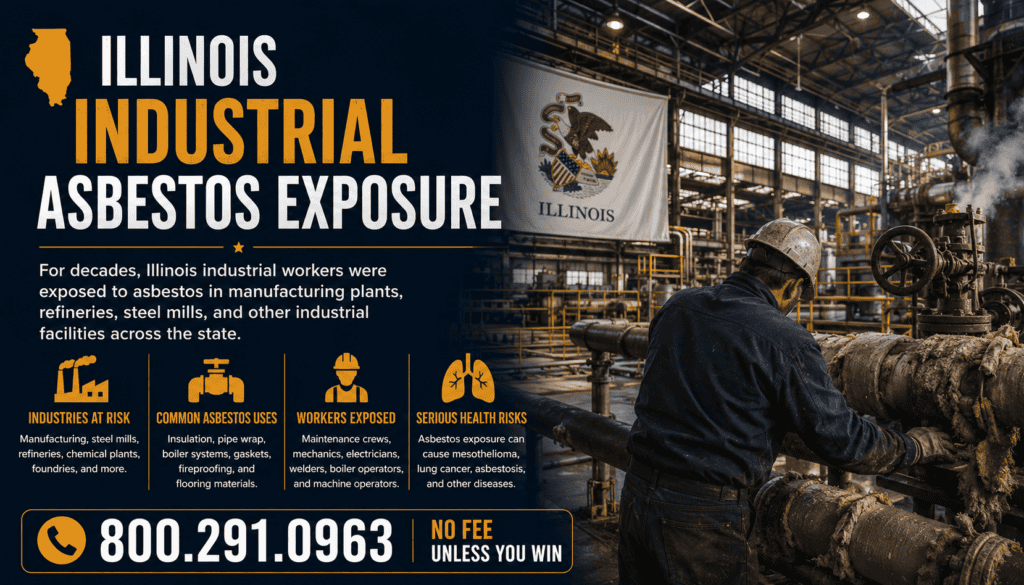
For decades, thousands of Illinois industrial workers unknowingly inhaled asbestos fibers while maintaining boilers, steam systems, turbines, pumps, valves, furnaces, manufacturing equipment, and industrial machinery. Once inhaled, these microscopic fibers can remain trapped inside the lungs and surrounding tissues for decades before symptoms appear.
Most asbestos-related diseases have an extremely long latency period of 20 to 50 years, meaning workers often develop symptoms long after retirement. Because of this delay, many people do not immediately connect their illness to industrial jobs they performed decades earlier.
The three diseases most commonly associated with industrial asbestos exposure include:
- Mesothelioma
- Asbestos-related lung cancer
- Asbestosis
Early diagnosis is important because symptoms often resemble other respiratory illnesses and may not become noticeable until the disease has progressed.
🎗️ Mesothelioma
Mesothelioma is a rare but aggressive cancer caused primarily by asbestos exposure. It develops in the mesothelium, the thin membrane surrounding the lungs, abdomen, heart, or testes. Most industrial workers diagnosed with mesothelioma developed the disease after repeated occupational exposure over many years.
Workers at Illinois steel mills, factories, foundries, power plants, refineries, chemical plants, railroad shops, and manufacturing facilities often worked around asbestos insulation, pipe covering, boilers, refractory materials, pumps, valves, and industrial equipment that released asbestos fibers during maintenance and repair.
Common symptoms include:
- Chest pain
- Persistent cough
- Shortness of breath
- Fluid around the lungs
- Fatigue
- Weight loss
Learn more:
Illinois Mesothelioma Lawsuits
🫁 Asbestos-Related Lung Cancer
Industrial asbestos exposure also significantly increases the risk of lung cancer. Workers who regularly inhaled asbestos fibers while repairing industrial equipment, replacing insulation, rebuilding boilers, or servicing steam systems may develop lung cancer decades later.
Unlike mesothelioma, lung cancer can also occur in individuals who smoked cigarettes. However, asbestos exposure itself is a recognized cause of lung cancer, and smoking combined with asbestos exposure greatly increases the overall risk.
Common symptoms include:
- Chronic cough
- Chest pain
- Wheezing
- Coughing up blood
- Unexplained weight loss
- Fatigue
- Shortness of breath
Learn more:
Illinois Asbestos Lung Cancer Lawsuits
🫀 Asbestosis
Asbestosis is a chronic, progressive lung disease caused by inhaling asbestos fibers over an extended period. Rather than forming tumors, asbestos fibers create scarring inside the lungs, making it increasingly difficult to breathe.
Industrial maintenance workers, insulators, pipefitters, mechanics, millwrights, and boiler operators experienced some of the highest risks because they frequently disturbed deteriorating insulation and other asbestos-containing materials.
Symptoms often include:
- Increasing shortness of breath
- Persistent dry cough
- Chest tightness
- Fatigue
- Reduced exercise tolerance
Although there is no cure for asbestosis, early diagnosis and medical treatment may help manage symptoms and improve quality of life.
📋 How Industrial Asbestos Exposure Is Proven
Because asbestos diseases often develop decades after exposure, investigators typically reconstruct a worker’s entire occupational history.
Evidence may include:
- Employment records
- Union records
- Social Security earnings history
- Military records
- Personnel files
- Job descriptions
- Maintenance records
- Product catalogs
- Industrial blueprints
- Plant maintenance schedules
- Coworker testimony
- Medical records
- Pathology reports
- CT scans
- Biopsy reports
Even workers who changed employers several times may qualify if asbestos exposure occurred at multiple industrial facilities throughout Illinois.
⏳ Illinois Statute of Limitations
Illinois law establishes deadlines for filing asbestos-related claims. Because every case is unique, the applicable filing period often depends on when the disease was diagnosed rather than when the asbestos exposure originally occurred.
Additional factors may include:
- Date of diagnosis
- Type of asbestos disease
- Wrongful death claims
- Employment history
- Individual circumstances
Learn more:
Illinois Mesothelioma Statute of Limitations
💰 Illinois Asbestos Trust Fund Claims
Many manufacturers of asbestos-containing industrial products later entered bankruptcy and established asbestos trust funds to compensate future victims.
Depending on your work history, you may qualify to file one or more trust fund claims in addition to other available legal options.
Learn more:
Illinois Asbestos Trust Fund Claims
👨👩👧 Wrongful Death Claims
When a family loses a loved one to mesothelioma or another asbestos-related disease, surviving spouses and eligible family members may have the right to pursue compensation through a wrongful death claim.
Potential damages may include:
- Medical expenses
- Funeral costs
- Loss of financial support
- Loss of companionship
- Other damages allowed under Illinois law
Learn more:
Illinois Wrongful Death Mesothelioma Lawsuits
❓ Frequently Asked Questions
Include the same 10–12 FAQ format used on your other Illinois authority pages, followed by the fully hyperlinked Illinois Resource Library (which we already rebuilt with all active links).
📞 Free Case Evaluation
If you or someone you love developed mesothelioma, lung cancer, or another asbestos-related disease after working in an Illinois industrial facility, you may have legal options.
A free case evaluation can help determine:
- ✅ Whether your work history involved asbestos exposure
- ✅ Which companies may be responsible
- ✅ Whether you may qualify for compensation
- ✅ Whether asbestos trust fund claims may be available
- ✅ Whether surviving family members may have wrongful death claims
📞 Call Today: 800-291-0963
Or complete our free online case evaluation: