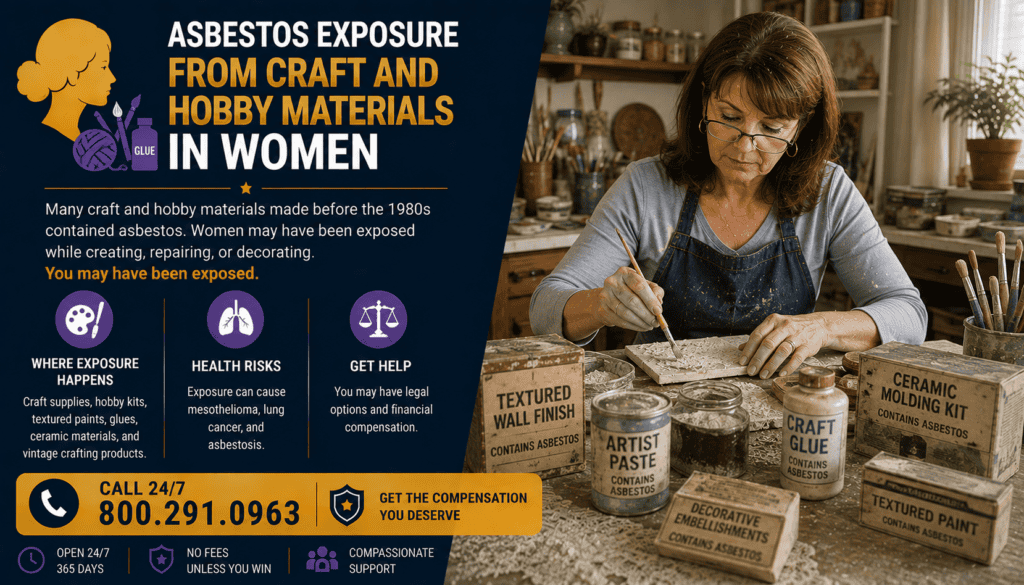
Asbestos Exposure From Craft and Hobby Materials in Women
Women who used older craft, art, hobby, repair or do-it-yourself materials may wonder whether a historical product contained asbestos. Some consumer products and materials used in past decades did contain asbestos or asbestos-contaminated mineral ingredients, but a product category alone does not prove exposure. The brand, formulation, purchase period, activity and reliable material evidence should be investigated.
Craft and hobby histories can be difficult to reconstruct because products may have been discarded decades ago and labels, formulas and manufacturers can change over time. Useful evidence may include packaging, catalogs, photographs, receipts, product literature, regulatory records and qualified laboratory findings. This guide explains how to investigate possible exposure without assuming that every craft material—or every dusty activity—involved asbestos.
🎨 Craft and Hobby Materials: Exposure Overview
The National Cancer Institute notes that asbestos was historically used in many commercial products, including paints, coatings, adhesives and plastics, and that asbestos has been found in some talc-containing crayons and vermiculite-containing garden products. CPSC historical records also identify certain artists’ materials among consumer-product categories once considered in asbestos risk-reduction work. These facts support product-specific research, not a conclusion that craft materials generally contained asbestos.
Start with the Women’s Consumer Products & Household Asbestos Exposure hub. Write down the activity, approximate year, brand, product name, where it was purchased, whether it was dry or pre-mixed, how it was used and whether visible dust was generated.
| Question | Details to document |
|---|---|
| What product? | Brand, name, package, formulation or catalog number |
| When? | Approximate purchase and use dates |
| How used? | Mixing, sanding, cutting, shaping or ordinary application |
| What evidence? | Label, catalog, testing, manufacturer or regulatory record |
🧵 Historical Products and Materials to Investigate
Historical investigation may involve paints and coatings, adhesives, patching compounds, mineral kits, certain older heat-resistant materials, vermiculite products or talc-containing items. NCI reports that CPSC banned asbestos in consumer wallboard patching compounds and artificial fireplace embers in the late 1970s because fibers could be released during use. CPSC continues to publish guidance on those bans.
Do not assume that a modern product has the same formulation as a historical version, or that all products within a category contained asbestos. For talc-specific histories, see Asbestos-Contaminated Talc Exposure in Women.
| Product/activity lead | Evidence to seek |
|---|---|
| Patching or repair compound | Brand, formulation date, CPSC records, package |
| Paint/coating/adhesive | Manufacturer literature, formula and period of sale |
| Mineral/science kit | Kit contents, catalog and manufacturer records |
| Vermiculite product | Source, packaging and reliable testing information |
✂️ Cutting, Sanding, Mixing and Dust
Asbestos becomes an inhalation concern when fibers are released into the air. NCI explains that disturbing an asbestos-containing product can release microscopic fibers that may be breathed in. For a historical craft activity, therefore, both material identity and the way the material was handled matter.
Mixing a dry powder, sanding a hardened compound, cutting or shaping a material, or cleaning accumulated dust may have created different conditions from leaving an intact material undisturbed. These activities are exposure-investigation questions; they do not establish that asbestos was actually present.
| Activity | Useful details |
|---|---|
| Mixing | Dry/premixed product, ventilation and frequency |
| Sanding | Product sanded, tools and dust generated |
| Cutting/shaping | Material, method and work location |
| Cleanup | Dust source and cleaning method |
🏠 Home Craft Areas and Household Exposure
Craft and hobby work often occurred in kitchens, garages, basements, workshops or shared rooms. If a verified asbestos-containing material was disturbed, an investigation may consider who used the product, who cleaned the area, how dust was handled and whether other household members were regularly present.
See Household Asbestos Exposure in Women for broader home-exposure evidence. NCI also recognizes household exposure as a possible pathway when asbestos fibers are carried home from occupational settings, illustrating why a detailed source and contact history matters.
🔎 Identifying a Historical Product
A remembered product name can be a valuable lead, but formulas may differ by year, plant or product line. Try to identify the exact historical version. Old catalogs, advertisements, packaging, instruction sheets, patents, manufacturer records, archived safety information and regulatory documents can help narrow the investigation.
For cosmetic-related histories, review Makeup and Cosmetic Asbestos Exposure in Women. Do not rely on the appearance of a powder, clay, plaster, textile or other material to determine whether it contained asbestos.
| Evidence | What it may show |
|---|---|
| Original package | Brand, manufacturer, formulation clues |
| Catalog/advertisement | Product sold during a particular period |
| Receipt/photo | Ownership, use or approximate date |
| Reliable test/record | Material composition for a relevant sample or product |
🗂️ Records and Evidence to Preserve
Create a timeline of hobbies, products, residences and use periods. Preserve photographs and packaging without opening, sanding, scraping or sampling suspect materials. Record which facts are personally remembered and which are confirmed by documents. Witnesses may help corroborate product use, but recollection should not be converted into a definitive material identification without supporting evidence.
The Mesothelioma Lawsuit Evidence & Documentation hub provides additional guidance for organizing product, medical and witness records.
🫁 Medical Documentation and Exposure History
NCI classifies asbestos as a known human carcinogen and states that exposure can cause mesothelioma as well as cancers of the lung, larynx and ovary. Risk depends on factors including the amount, duration and source of exposure. A diagnosis does not identify which historical consumer product, if any, was responsible for an individual’s exposure.
Use the Women’s Asbestos Diseases hub for focused health information. Pathology, imaging and treating-clinician records should be preserved separately from the product-exposure timeline, and individual medical questions should be discussed with qualified healthcare professionals.
⚖️ Potential Product and Claim Questions
A product-related legal review may examine whether a specific manufacturer, supplier or other entity can be reliably connected to an asbestos-containing product used by the individual. Product identification, relevant dates, exposure circumstances, medical evidence and applicable law can all matter. A general recollection of doing crafts is not enough to establish legal responsibility.
Review the Women’s Asbestos Legal Options hub. Depending on the documented facts, potential routes could include a civil claim or an asbestos bankruptcy trust claim, but eligibility and evidence requirements differ and compensation is not guaranteed.
🛡️ Handling Old or Suspect Materials Safely
Do not sand, scrape, crush, drill, open or otherwise disturb an old suspect material simply to determine what it contains. If an old product or material remains in the home, seek guidance from an appropriately trained asbestos professional when evaluation is warranted. Preserve identifying information without creating new dust.
CPSC’s current art-material guidance requires consumer art materials to undergo toxicological assessment for chronic hazards and provides labeling requirements. Those modern requirements should not be used to infer the formulation or safety of a product sold decades earlier.
❓ Frequently Asked Questions
Did craft and hobby products ever contain asbestos?
Some historical consumer products did. NCI identifies examples including paints, coatings, adhesives, plastics, some talc-containing crayons and vermiculite-containing garden products, but each product requires its own evidence.
Did all old craft materials contain asbestos?
No. Age or product category alone does not establish asbestos content.
Were asbestos-containing patching compounds sold to consumers?
Yes historically. CPSC banned consumer patching compounds containing respirable free-form asbestos in the late 1970s.
Can I tell whether an old craft material contains asbestos by looking at it?
No. Visual appearance is not a reliable asbestos identification method.
Should I test an old product myself?
Do not disturb a suspect material to collect a sample yourself. Qualified professionals can advise on safe evaluation when appropriate.
What if I no longer have the product?
Photographs, catalogs, receipts, packaging memories, witnesses and manufacturer or regulatory records may provide leads.
Can a product-related asbestos claim be possible?
Potentially, when evidence connects a specific asbestos-containing product and responsible entity to the individual’s exposure and applicable legal requirements are met.
Is compensation guaranteed?
No. Product identification, exposure, medical evidence, deadlines and governing law affect whether a claim is available and its outcome.
📞 Submit Your Case
If you or a loved one has a mesothelioma diagnosis and remembers using older craft or hobby products, gather the diagnosis date, product names, brands, approximate years, photographs, packaging, receipts and names of people who remember the activity. Unknown details should remain research leads rather than guesses.
Call 800.291.0963 for a no-obligation case evaluation. Live chat is available 24/7, 365 days a year. Submit your case here.
📝 Summary
Some historical consumer, art and hobby products contained asbestos or ingredients that could be contaminated with asbestos, but broad product categories do not prove individual exposure. A careful investigation identifies the exact product and time period, reconstructs how it was used, preserves reliable evidence and keeps medical documentation separate from the product-identification process.
🔗 Confirmed Sources
- National Cancer Institute — Asbestos Exposure and Cancer Risk
- U.S. CPSC — Asbestos Consumer Product Bans
- U.S. CPSC — Art Materials Guidance
- U.S. EPA — Asbestos Part 2 Risk Evaluation
This page provides general information, not legal or medical advice. This website is not a law firm. Product identification, exposure, eligibility, filing deadlines and compensation depend on individual facts and applicable law. No outcome is guaranteed.