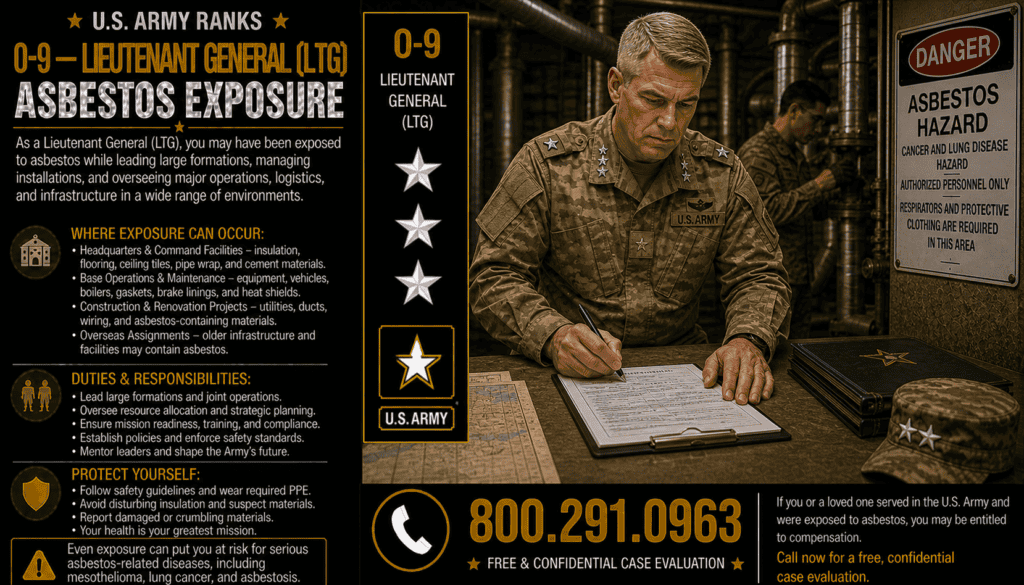
O-9 Army Lieutenant General (LTG) Asbestos Exposure
Army O-9 Lieutenant Generals are three-star general officers who may command corps-sized organizations or serve in other senior operational, institutional, staff, joint, logistics, or advisory assignments. Because O-9 duties are generally high-level command, planning, coordination, and oversight roles, historical asbestos research should distinguish organizational responsibility from actual physical presence around disturbed asbestos-containing materials.
This guide explains how to investigate possible asbestos exposure during an Army Lieutenant General’s career, including corps command, inspections, older facilities, maintenance and construction environments, overseas operations, earlier officer assignments, military records, VA disability evidence, and Army-specific resources for documenting a mesothelioma claim.
O-9 Army Lieutenant General Duties and Possible Asbestos Exposure
An O-9 Army Lieutenant General (LTG) is a three-star general officer. Official Army rank materials identify Lieutenant General as pay grade O-9. Army organizational guidance states that a corps is commanded by a Lieutenant General and generally includes two to five divisions and approximately 20,000 to 40,000 Soldiers. Another Army officer-rank reference describes Lieutenant Generals as typically commanding corps-sized units.
O-9 duties are normally senior command, planning, coordination, logistics, operational oversight, and strategic leadership rather than hands-on maintenance or construction. A credible asbestos history should therefore avoid assuming exposure because a Lieutenant General commanded organizations that used older buildings, vehicles, utilities, or equipment. Research should identify actual physical presence around disturbed asbestos-containing material.
This page is part of the U.S. Army ranks asbestos exposure series and connects O-9 service history with the broader U.S. Army asbestos exposure record.
Lieutenant General as an Army Corps Commander
Army guidance describes a corps as a deployable level of command that synchronizes and sustains combat operations and can provide the framework for multinational operations. A corps generally includes two to five divisions, provides command, control, and logistical support, and is commanded by a Lieutenant General with an extensive corps staff.
Corps command can require visits to divisions, brigades, headquarters, training areas, logistics sites, maintenance activities, transportation nodes, Army motor pools, warehouses, field command posts, construction projects, and installation infrastructure. The frequency and nature of those visits depend on the mission, era, deployment, organization, and individual assignment.
Command of a corps does not itself establish asbestos exposure. Research should document where the Lieutenant General was physically present, what work was underway, what material or component was involved, whether it was disturbed, and the officer’s proximity, duration, and frequency.
Senior Army Leadership Beyond Corps Command
Not every O-9 assignment is corps command. Lieutenant Generals can serve in high-level operational, institutional, staff, training, logistics, acquisition, installation, joint, or other senior leadership positions. These assignments can involve large organizations and extensive infrastructure without requiring routine presence in maintenance or construction areas.
Senior leaders may receive infrastructure briefings, conduct inspections, visit subordinate organizations, assess damaged facilities, observe training, review readiness, or travel to operational locations. These activities can help identify records worth researching, but organizational responsibility is not evidence of personal asbestos exposure.
Exposure analysis should remain assignment-specific and evidence-based. The important facts are the officer’s actual location, the condition of the material, the activity occurring nearby, and whether fibers could have become airborne.
From O-8 Major General to O-9 Lieutenant General
Promotion from Major General to Lieutenant General increases the scale of responsibility from division-level command and other O-8 positions to corps-level or comparable senior assignments. Army guidance describes a division as approximately 10,000 to 16,000 Soldiers under a Major General and a corps as approximately 20,000 to 40,000 Soldiers under a Lieutenant General.
Review the preceding O-8 Army Major General asbestos exposure, O-7 Army Brigadier General asbestos exposure, O-6 Army Colonel asbestos exposure, and earlier officer periods when applicable. Earlier service may involve substantially more frequent physical presence in maintenance bays, motor pools, construction areas, mechanical spaces, older facilities, and field environments.
A complete chronology should follow the officer from commissioning through O-9 rather than treating Lieutenant General service as the only potentially relevant period.
Why Earlier Army Service May Be More Important
A Lieutenant General reaches O-9 after a long commissioned career. Earlier assignments can include platoon leadership, company command, battalion and brigade staff work, battalion command, brigade command, division staff, division command, training, deployment, installation, and specialized branch positions.
Those earlier periods may place the veteran closer to vehicles, maintenance, construction, utility systems, older barracks, warehouses, equipment, and damaged infrastructure. Review O-3 Army Captain, O-4 Army Major, O-5 Army Lieutenant Colonel, O-6 Army Colonel, O-7 Army Brigadier General, and O-8 Army Major General records when applicable.
The Army asbestos exposure timeline can provide historical context, but personnel, unit, building, equipment, and technical records should establish the veteran’s individual circumstances.
Branch and Career Path Before O-9 Service
Branch history can materially affect historical exposure research. Engineer, ordnance, transportation, quartermaster, signal, armor, aviation-support, logistics, maintenance, and installation careers can involve very different buildings, equipment, vehicles, and work processes.
For engineer careers, compare the record with Army engineers and Army construction units. Maintenance-related careers may correspond with Army mechanics and Army maintenance workers. Logistics and sustainment careers may involve Army supply personnel and warehouse environments.
These resources provide context rather than proof. The veteran’s personnel records should establish actual units, installations, positions, dates, duties, and physical work-site presence.
Corps Inspections and Visits to Subordinate Commands
A corps commander or other O-9 leader may visit divisions and subordinate organizations for readiness inspections, training exercises, operational reviews, logistics assessments, safety evaluations, infrastructure reviews, and major events. These visits can generate schedules, travel records, photographs, briefing materials, inspection reports, and unit documentation.
A short visit to an intact facility is different from recurring presence during renovation, demolition, repair, or cleanup. Receiving a maintenance briefing in headquarters is different from entering a repair area while historical components or insulation were being removed.
Exposure reconstruction should identify what was happening during the visit, the work area, suspected material, disturbance mechanism, ventilation, proximity, duration, and frequency.
Headquarters, Installations, and Older Army Facilities
Lieutenant Generals may work in corps headquarters, senior installation offices, schools, command buildings, training facilities, and other Army structures. Older facilities may historically have incorporated asbestos in pipe and mechanical insulation, flooring, roofing, cement products, boiler materials, gaskets, or other legacy components.
VA Public Health explains that asbestos can create a serious health risk when asbestos-containing material is disturbed and fibers become airborne. Routine occupancy should therefore be distinguished from renovation, demolition, repair, maintenance, damaged materials, or cleanup.
For Army barracks asbestos exposure or other older structures, document the installation, building when available, dates, renovation or repair activity, material condition, and the Lieutenant General’s actual proximity.
Motor Pools, Vehicle Readiness, and Senior Visits
A corps commander may visit Army motor pools and maintenance areas during readiness reviews, exercises, deployment preparations, and subordinate-command visits. Earlier career assignments may involve substantially more frequent presence in these environments.
VA identifies clutch facings and brake linings among friction products associated with possible military asbestos exposure. Historical Army trucks and Jeeps and other Army vehicle equipment may warrant component-specific research when supported by the service record.
Do not assume every vehicle or component contained asbestos. Identify the equipment model, component, repair activity, date, location, and evidence concerning the historical material.
Maintenance and Logistics Readiness Oversight
A Lieutenant General commanding a corps can oversee readiness and sustainment across multiple divisions, but organizational responsibility is not equivalent to physical exposure. Exposure analysis should identify whether the officer actually entered maintenance areas while potentially asbestos-containing materials were being disturbed.
When records document recurring inspections or visits, compare the history with Army maintenance buildings, Army maintenance workers, and Army mechanics. Determine the repairs underway and whether insulation, gaskets, brakes, clutches, electrical components, or other suspect materials were involved.
The strongest account identifies location, work process, proximity, frequency, duration, ventilation, and supporting documentation.
Boilers, Generators, Electrical Systems, and HVAC
Large Army installations and operational organizations depend on boilers, generators, electrical equipment, HVAC systems, pumps, valves, and other mechanical systems. Historical versions of some equipment may have incorporated asbestos-containing insulation, gaskets, packing, electrical components, or heat-resistant materials.
An O-9 officer might encounter these systems during installation inspections, infrastructure reviews, damaged-facility assessments, exercises, or earlier engineer and operational assignments. Relevant Army resources include Army boiler equipment, Army generator equipment, Army electrical equipment, and Army HVAC equipment.
Research should identify specific components and dates rather than assuming an entire machine, utility system, or building contained asbestos.
Corps-Level Training and Large-Scale Exercises
A Lieutenant General may oversee or participate in large exercises involving multiple divisions, ranges, field sites, command posts, vehicle staging areas, maintenance locations, warehouses, classrooms, temporary structures, and support systems. Corps-level exercises can also involve multinational organizations and extensive logistical support.
Older Army training facilities may warrant investigation when renovation, demolition, utility work, damaged insulation, deteriorated building materials, or mechanical repairs occurred. Field exercises may involve generators, vehicles, heating equipment, shelters, and other support equipment.
Participation in an exercise does not establish asbestos exposure. Document the specific location, building or equipment, work being performed, suspected material, disturbance mechanism, proximity, duration, and frequency.
Construction, Demolition, and Infrastructure Oversight
Lieutenant Generals with operational, engineer, installation, or senior command responsibilities may review infrastructure projects, damaged facilities, construction, demolition, utilities, or recovery operations. Earlier engineer assignments may involve closer and more frequent contact with these environments.
VA identifies construction, carpentry, demolition of old buildings, insulation work, flooring, roofing, cement sheet, and pipe products among circumstances associated with possible military asbestos exposure.
When relevant, compare the veteran’s history with Army engineers and Army construction units. Determine project dates, building age, specifications, surveys, disturbance method, and the officer’s physical location.
Warehouses, Logistics, and Corps Sustainment
Corps-level command requires extensive logistics and sustainment across multiple divisions. A Lieutenant General may visit supply operations and Army warehouses during readiness reviews, inspections, exercises, deployment preparations, or operational planning.
Historical stock could include vehicle components, mechanical supplies, construction materials, gaskets, insulation products, and technical items. Handling intact packaged material is different from cutting, removing, grinding, or cleaning dust from damaged asbestos-containing material.
Stock numbers, procurement records, technical manuals, packaging information, photographs, inventories, property records, and witness statements may help identify historical products.
Power Plants, Utilities, and Installation Infrastructure
Lieutenant Generals serving in senior operational, installation, logistics, or infrastructure-related assignments may inspect utility areas and older Army power plants. Relevant systems can include boilers, generators, steam lines, pumps, valves, electrical equipment, and insulated piping.
Engineering specifications, maintenance records, technical manuals, construction documents, procurement information, and environmental surveys may help determine whether specific historical components contained asbestos.
Document whether the officer personally entered a mechanical or utility area during repairs, renovation, damage assessment, cleanup, or other work capable of disturbing asbestos-containing material.
Overseas Corps Operations and Damaged Older Buildings
Senior Army officers may serve overseas where older buildings are occupied, repaired, damaged, renovated, or demolished. VA states that veterans who served in Iraq or other countries in that region could have encountered asbestos when older buildings were damaged and contaminants were released into the air.
This does not establish exposure for every veteran who served overseas. Records should identify the location, building or structure, damage or work activity, dates, proximity, duration, and frequency.
Engineering assessments, environmental reports, after-action records, photographs, unit histories, command calendars, and witness statements may be useful when ordinary building records are unavailable.
Corps Command Does Not Automatically Establish Exposure
A Lieutenant General may command tens of thousands of Soldiers and oversee extensive facilities, vehicles, equipment, maintenance, construction, logistics, and training. That scale of responsibility can create substantial documentation, but it does not prove personal asbestos exposure.
A corps commander who reviewed a demolition project through staff briefings has a different history from one who entered a damaged structure while debris and suspect materials were present. An officer who received maintenance reports has a different history from one who repeatedly entered repair areas during component removal.
Exposure statements should focus on physical presence, material disturbance, proximity, duration, frequency, ventilation, and reliable identification of the suspected asbestos-containing material.
Military Records for Reconstructing O-9 Service
Useful records can include the DD-214, Official Military Personnel File, general-officer assignment history, Officer Evaluation Reports, orders, command calendars, staff duty descriptions, unit and command histories, inspection reports, travel documents, after-action reports, maintenance and logistics records, engineering documents, facility records, photographs, and witness statements.
Earlier officer records can be especially important because they may document closer work-site contact. Review the veteran’s O-8 Major General, O-7 Brigadier General, O-6 Colonel, O-5 Lieutenant Colonel, and earlier assignments when applicable.
The objective is to reconstruct the complete Army career and identify specific, supported exposure episodes rather than infer exposure from O-9 status.
Building a Strong Lieutenant General Exposure History
A detailed history identifies the installation, organization, assignment, dates, building or work area, equipment, component, material, work activity, proximity, frequency, duration, ventilation, and witnesses. It should distinguish strategic responsibility, command authority, inspections, and administrative oversight from actual physical presence.
Supporting evidence may include personnel records, orders, evaluations, command calendars, travel records, inspection documents, unit histories, technical manuals, procurement records, environmental reports, engineering surveys, photographs, and credible eyewitness statements.
VA states that service records listing the veteran’s job or specialty are relevant evidence for an asbestos disability claim. Veterans Benefits Administration guidance also states that military occupational specialty and duty location may help establish military asbestos exposure.
O-9 Army Lieutenant General Exposure-Evidence Checklist
| Question | Details to Document | Potential Evidence |
|---|---|---|
| What was the O-9 assignment? | Corps commander, senior operational, institutional, staff, joint, logistics or other leadership position | Personnel, evaluation, assignment and command records |
| Where was the LTG physically present? | Headquarters, divisions, subordinate units, maintenance areas, training sites, utilities or projects | Calendars, travel, inspection, unit and facility records |
| What activity was occurring? | Repair, renovation, demolition, inspection, cleanup, maintenance or training | Work orders, project files, maintenance and engineering records |
| What material was involved? | Insulation, pipe covering, gasket, brake, clutch, flooring or other material | Specifications, technical manuals, procurement and manufacturer records |
| How close was the LTG? | Physical location, proximity, duration and frequency | Personal statement, photographs, schedules and witness accounts |
| What medical evidence exists? | Diagnosis, pathology and documented exposure history | Pathology, oncology and treatment records |
The objective is to connect documented Army service with specific exposure circumstances and medically supported disease rather than relying on O-9 rank or corps command alone.
Mesothelioma and Long-Latency Asbestos Disease
VA Public Health states that symptoms of asbestos-related diseases often do not appear until 20 to 50 years after exposure. For an O-9 veteran, potentially relevant exposure may therefore have occurred during much earlier Army assignments.
This long latency makes historical personnel, unit, facility, equipment, maintenance, engineering, and medical records particularly important. Veterans should provide health care professionals with a complete military and civilian occupational history.
VA advises veterans concerned about health problems associated with military asbestos exposure to speak with a health care provider or local VA Environmental Health Coordinator.
VA Disability Compensation for Army O-9 Veterans
VA states that a veteran may be eligible for disability compensation based on asbestos exposure when the veteran has a health condition caused by asbestos and had contact with asbestos during military service. VA identifies medical records showing the condition, service records listing the veteran’s job or specialty, and a doctor’s statement connecting military asbestos contact with the condition as evidence for a claim.
Veterans Benefits Administration guidance states that evidence of military asbestos exposure may include military occupational specialty and where the veteran was stationed. Exposure by itself is not a condition subject to service connection; a disease or disability related to the exposure must be claimed.
Army veterans can review Army VA benefits for mesothelioma for additional Army-specific information.
Reconstruct the Lieutenant General’s Entire Army Career
For an O-9 veteran, the most relevant exposure period may have occurred decades before promotion to Lieutenant General. Platoon, company, battalion, brigade, division, staff, training, engineer, logistics, installation, deployment, and other assignments should all be considered.
Build a chronological table listing dates, ranks, units, installations, branches, positions, buildings, vehicles, equipment, construction or maintenance events, inspections, and witnesses. Add civilian employment before and after military service because nonmilitary exposure can also be relevant to medical and compensation evaluations.
This career-wide approach prevents the veteran’s highest rank from overshadowing earlier assignments that may have involved more direct contact with historical asbestos-containing materials.
Army Mesothelioma Claims and Other Compensation Options
A VA disability claim is distinct from a private asbestos lawsuit or bankruptcy trust claim. Depending on the complete exposure history, separate processes may evaluate military service, civilian employment, products, manufacturers, contractors, or other potentially responsible entities.
Keep exposure facts consistent across medical histories, VA submissions, trust claims, and civil litigation. Do not identify a manufacturer, employer, building, or product as an exposure source unless evidence supports that statement.
The Army asbestos legal options section contains Army-specific information concerning VA benefits and other potential compensation pathways.
Frequently Asked Questions
Did every Army O-9 Lieutenant General experience asbestos exposure?
No. Rank does not establish exposure. The officer’s complete career, assignments, locations, facilities, equipment, inspections, and actual physical presence must be evaluated.
What does an Army Lieutenant General commonly command?
Army guidance states that a corps is commanded by a Lieutenant General and generally includes two to five divisions and approximately 20,000 to 40,000 Soldiers.
Are O-9 duties usually hands-on?
Generally, O-9 duties involve senior command, planning, coordination, logistics, operations, or advisory responsibilities rather than hands-on maintenance work. Earlier career assignments may therefore be particularly important.
Can corps inspections be relevant to exposure research?
Yes, when records show the officer was physically present where asbestos-containing material was being disturbed. An inspection alone does not prove exposure.
Could vehicle maintenance involve asbestos?
Potentially. VA identifies clutch facings and brake linings among friction products associated with possible military asbestos exposure.
Does command of a corps prove personal asbestos exposure?
No. Command authority is different from physical exposure. Location, material disturbance, proximity, frequency, and duration should be documented.
What records can help reconstruct O-9 duties?
Personnel records, evaluations, assignment orders, command calendars, travel and inspection records, command histories, engineering records, photographs, facility documents, and credible witness statements may help.
Can an Army O-9 veteran with mesothelioma seek VA disability compensation?
Potentially. VA states that veterans with a health condition caused by asbestos contact during military service may qualify when applicable requirements are met.
Should a veteran disturb suspected asbestos to identify it?
No. Do not disturb suspected asbestos-containing material. Identification and assessment should rely on appropriate records and qualified professionals.
Review Your O-9 Army Service and Exposure History
If you or a family member has been diagnosed with mesothelioma after Army service, gather the DD-214, personnel file, branch records, complete officer assignment history, Officer Evaluation Reports, orders, command calendars, travel and inspection records, command and unit histories, installation records, vehicle and equipment documents, maintenance and logistics records, engineering records, technical manuals, work orders, facility records, witness statements, pathology reports, treatment records, VA correspondence, and civilian employment history. Give particular attention to earlier Army assignments where the veteran may have spent more time around maintenance, construction, older facilities, vehicles, mechanical equipment, or damaged infrastructure.
Call 800.291.0963 for a no-obligation case evaluation. Talk to a real person 24/7, 365 days a year. You can also submit your case here.
Many mesothelioma law firms handle qualifying civil cases on a contingency-fee basis; confirm fees and expenses with the firm you retain. Mesothelioma Help Center is not a law firm and does not provide legal or medical advice.
Summary
O-9 Army Lieutenant General rank does not by itself prove asbestos exposure. A useful history identifies the officer’s corps command, senior operational, staff, institutional, joint, or other assignments; earlier Army career; installations and dates; inspections; buildings, vehicles, and equipment; maintenance, construction, or demolition activity; physical work-site presence; and circumstances in which documented asbestos-containing material may have been disturbed.
For many O-9 veterans, earlier commissioned service may provide the most relevant exposure history. Veterans diagnosed with mesothelioma should preserve military and civilian exposure records, technical documentation, medical evidence, and witness information.
🔗 Confirmed Sources
- U.S. Army — U.S. Army Ranks and Corps Organization
- U.S. Army — Army Insignia of Rank
- U.S. Department of Veterans Affairs — Veterans Asbestos Exposure
- Veterans Benefits Administration — Asbestos Exposure Compensation
- VA Public Health — Asbestos
Disclaimer: General information only—not legal or medical advice. This website is not a law firm. Record availability, asbestos identification, exposure, VA eligibility, liability, and deadlines vary by individual circumstances. Do not disturb suspected asbestos. Past results do not guarantee future outcomes.