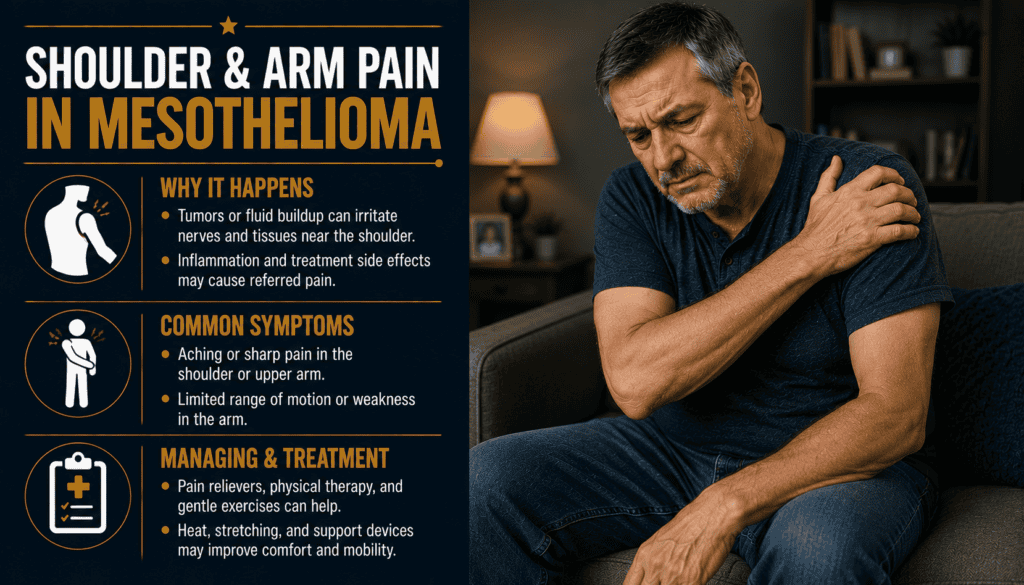
Shoulder and Arm Pain in Mesothelioma
Possible Causes, Red Flags, Diagnosis and Pain Relief
Shoulder or arm pain in a person with mesothelioma deserves careful evaluation, but it is not a specific sign of this cancer. Pleural mesothelioma commonly causes chest or back pain, and some people may describe discomfort that seems to extend toward the shoulder. Musculoskeletal problems, nerve irritation, treatment effects and urgent heart or lung conditions can produce similar symptoms. The location of pain alone cannot establish a diagnosis or cancer stage. Start with our mesothelioma symptoms overview and guide to chest pain in mesothelioma.
Emergency warning: Call 911 for sudden chest pressure or pain spreading to an arm, shoulder, back or jaw, especially with sweating, nausea, fainting or shortness of breath. Sudden severe breathlessness, coughing blood or a new arm weakness with facial droop or speech difficulty also requires emergency assessment. Do not assume these symptoms are caused by mesothelioma.
🩺 Understanding Shoulder and Arm Pain
Pleural mesothelioma develops in the lining around the lungs and inside the chest wall. Authoritative symptom lists emphasize chest or rib-area pain, cough and breathlessness; they do not identify shoulder or arm pain as a diagnostic sign on its own. Chest-wall discomfort may be perceived near the shoulder, while nerve-related or joint pain can occur independently. A clinician must determine which explanation fits your symptoms.
Report new pain even when you already have a mesothelioma diagnosis. A change in pain can signal a treatable complication, a medication problem or a condition unrelated to cancer. Review the pleural mesothelioma overview and early symptoms guide for context.
| Key question | Practical answer |
|---|---|
| Does shoulder pain prove mesothelioma? | No; many common and serious conditions can cause it. |
| Does arm pain reveal cancer stage? | No; staging requires clinical evaluation and appropriate testing. |
| Can two causes occur together? | Yes; cancer-related discomfort and an ordinary shoulder injury can coexist. |
| Location | Description to report | Why it matters |
|---|---|---|
| Shoulder tip | Deep ache or pain with breathing | May prompt evaluation of chest and other causes. |
| Shoulder joint | Pain with reaching or lifting | Can suggest a musculoskeletal source. |
| Arm or hand | Burning, tingling or weakness | Needs assessment for nerve, circulation or other problems. |
🔎 What Might Cause Shoulder or Arm Pain?
Potential explanations include chest-wall or pleural irritation, pain referred from structures in the chest, strain from coughing or altered posture, arthritis, rotator-cuff disease and nerve compression in the neck. Cancer treatment can also affect muscles or nerves in some patients. These are possibilities, not a way to diagnose yourself. Your team will assess the onset, examination findings and any associated symptoms.
Pleural fluid can contribute to chest discomfort and breathing difficulty, although shoulder pain alone cannot establish an effusion. Learn about pleural effusion, muscle weakness, and shortness of breath.
| Possible explanation | Clues to discuss | Important caveat |
|---|---|---|
| Chest-wall or pleural involvement | Pain with chest movement or breathing | Requires examination; not diagnostic by itself. |
| Cough-related muscle strain | Soreness after repeated coughing | Other causes still need consideration. |
| Shoulder joint disorder | Pain on specific movements | Can coexist with cancer. |
| Neck nerve irritation | Tingling, shooting pain or numbness | New weakness warrants prompt assessment. |
| Heart or vascular emergency | Sudden pressure, sweating or breathlessness | Call 911 rather than waiting for an oncology visit. |
| Treatment-related possibility | What to tell the care team |
|---|---|
| Post-procedure discomfort | When it began relative to surgery or a chest procedure. |
| Medication-associated symptoms | All recent medicines and dose changes. |
| Reduced mobility | Whether stiffness follows prolonged inactivity. |
📋 Pain Patterns: What to Record
A precise description helps the team decide whether to examine the shoulder, chest, neck or several areas. Record when pain began, whether it is constant or episodic, whether breathing or movement changes it, and whether there is numbness, swelling or weakness. A numerical pain score helps track change but does not identify the cause.
Compare symptoms with the chest pain guide and mesothelioma pain-management guide. Tell your team when pain disrupts sleep, dressing, walking or other activities.
| Pattern | Example to describe |
|---|---|
| With deep breaths | Sharp or aching pain when inhaling. |
| With reaching | Pain when lifting the arm overhead. |
| At rest | Ache that persists without movement. |
| Radiating | Pain traveling from neck or chest into the arm. |
| Symptom diary item | Example entry |
|---|---|
| Start | Yesterday evening, gradual onset. |
| Site | Right shoulder and upper arm. |
| Severity | 5/10 at rest, 7/10 when lifting. |
| Other symptoms | No fever; breathing unchanged. |
| Response | Medication taken as prescribed; limited improvement. |
Need help now? Call 800.291.0963
Live chat is available 24/7, 365 days a year.
Submit Your Case
🚨 When to Seek Emergency or Prompt Care
Call 911 immediately for new chest pressure or pain spreading to the arm, shoulder, jaw or back, particularly with breathlessness, sweating, nausea or fainting. Sudden severe breathing trouble, new one-sided weakness, facial droop or difficulty speaking also needs emergency care. These signs can reflect heart, lung or neurologic emergencies; do not wait to see whether pain medicine helps.
Contact your cancer team promptly for new or rapidly worsening pain, new numbness, increasing arm swelling, fever, or pain that prevents usual movement. If you have a central line and develop arm swelling, pain or discoloration, seek prompt medical advice about a possible clot.
| Symptom combination | Action |
|---|---|
| Chest pressure plus arm pain or sweating | Call 911. |
| Sudden breathlessness or collapse | Call 911. |
| New facial droop, speech trouble or one-sided weakness | Call 911. |
| New arm swelling, redness or discoloration | Seek prompt medical evaluation. |
| Persistent new shoulder pain | Contact oncology or primary care promptly. |
| Helpful action | Avoid |
|---|---|
| Describe when symptoms started. | Driving yourself during a possible heart attack. |
| Follow emergency dispatcher instructions. | Assuming every new pain is cancer-related. |
| Bring a medication list when safe. | Delaying assessment because pain comes and goes. |
🧪 How Doctors Evaluate the Pain
Clinicians usually begin with a history and examination of the shoulder, neck, chest, arm strength, sensation and circulation. They may review previous scans, recent procedures and treatment effects. Imaging or other tests depend on the findings and urgency: shoulder or neck imaging may be appropriate for a local problem, while chest imaging may be needed for chest symptoms. A suspected heart or blood-clot emergency follows a separate urgent workup.
When mesothelioma is being investigated, diagnosis requires more than pain location; imaging and often tissue examination are used. See mesothelioma diagnosis, imaging tests, and biopsy information.
| Evaluation | Purpose |
|---|---|
| History and physical examination | Identify movement, nerve, chest or circulation clues. |
| Chest imaging when indicated | Assess pleural disease, fluid or other chest findings. |
| Shoulder or neck evaluation | Investigate joint, muscle or nerve causes. |
| Urgent heart/lung tests | Assess emergencies when symptoms suggest them. |
| Biopsy if cancer diagnosis is uncertain | Confirm tissue diagnosis when clinically needed. |
| Question to ask | Why it helps |
|---|---|
| What is the most likely source of this pain? | Clarifies the working diagnosis. |
| Are any emergency causes being considered? | Establishes safety and urgency. |
| Which test would change treatment? | Supports an individualized plan. |
💊 Treatment and Pain Relief Options
Relief depends on the cause. A shoulder strain may respond to an individualized movement plan or physical therapy; nerve-related pain may require different medication or specialist assessment. Cancer-related pain may be treated with prescribed analgesics, supportive care and sometimes cancer-directed treatments. If symptomatic pleural fluid is present, the care team may consider a drainage procedure; this is not a universal treatment for shoulder pain.
Ask your team before taking new over-the-counter pain medicines, especially if you use blood thinners, have kidney problems or are receiving cancer treatment. Palliative care focuses on comfort and function and can be provided alongside treatment. Explore pain and symptom management, palliative care, and mesothelioma treatment options.
| Option | When considered | Safety point |
|---|---|---|
| Prescribed pain medication | Pain affecting comfort or function | Follow dosing and report side effects. |
| Physical or occupational therapy | Movement limitation when safe | Plan must reflect diagnosis and strength. |
| Nerve-pain treatment | When neuropathic pain is identified | Medication choice requires clinician review. |
| Pleural fluid management | Confirmed symptomatic effusion | Procedure risks and recurrence need discussion. |
| Cancer-directed treatment | When disease-related pain is identified | Selection depends on clinical factors. |
| Medication concern | What to discuss |
|---|---|
| Sedation or dizziness | Falls, driving and medication timing. |
| Constipation | A clinician-approved bowel plan if relevant. |
| Blood thinners or kidney disease | Whether over-the-counter drugs are safe. |
🏠 Daily Care, Movement and Symptom Tracking
Until a cause is established, avoid forcing painful stretches or lifting heavy objects. Ask which positions and activities are safe. Support the arm comfortably if recommended and change positions periodically to reduce stiffness. If prescribed medication is not controlling pain, contact the team rather than increasing the dose independently.
Caregivers can note functional changes, help arrange transport and describe whether pain coincides with new breathlessness or weakness. For broader help, see mesothelioma support resources and severe fatigue management.
| Daily check | What to note |
|---|---|
| Pain trend | Location, severity and change since yesterday. |
| Arm function | Ability to dress, lift and grip. |
| Breathing | New or worsening shortness of breath. |
| Neurologic symptoms | Numbness, tingling or weakness. |
| Medication response | Benefit and unwanted effects. |
| Caregiver step | Purpose |
|---|---|
| Keep an updated medication list | Helps clinicians identify interactions and side effects. |
| Record new warning signs | Supports timely escalation. |
| Ask for a clear follow-up plan | Clarifies when to call or seek emergency care. |
❓ Frequently Asked Questions
These answers provide general information. A clinician must evaluate the individual cause of shoulder or arm pain.
Can mesothelioma cause shoulder pain?
Pleural mesothelioma can cause chest-wall pain, which may sometimes be perceived near the shoulder. Shoulder pain itself is nonspecific and needs assessment.
Does arm pain mean mesothelioma has spread?
No. Pain location alone cannot determine whether cancer has spread or establish its stage.
Could the pain come from a shoulder injury instead?
Yes. Joint, muscle and tendon problems are common alternatives, and they can coexist with cancer.
When is shoulder or arm pain an emergency?
Call 911 for new chest pressure with arm or shoulder pain, especially with breathlessness, sweating, nausea or fainting; also for sudden neurologic symptoms.
Can a pleural effusion cause discomfort?
Pleural fluid may cause chest discomfort or breathlessness, but a clinician must establish whether fluid is present and whether it explains symptoms.
What tests might I need?
Your clinician may examine the shoulder, neck and chest and order targeted imaging or urgent tests depending on symptoms.
Can palliative care help with shoulder pain?
Yes. Palliative care can address pain, function and treatment side effects alongside cancer-directed care.
Should I start exercises or over-the-counter pain medicine?
Ask your care team first, particularly with new pain, weakness, blood thinners or other medical conditions.
| Main takeaway | Next step |
|---|---|
| Pain alone cannot diagnose mesothelioma | Get new or persistent symptoms assessed. |
| Chest symptoms may signal an emergency | Call 911 for the warning signs above. |
| Pain relief should match its cause | Agree on a plan with the treating team. |
Confirmed Medical Sources
📨 Get Help With Mesothelioma Questions
Call 800.291.0963 to discuss mesothelioma-related questions. Live chat is available 24/7, 365 days a year. Submit Your Case using the form below. Contacting us does not guarantee eligibility, compensation or any particular outcome.
⚕️ Legal & Medical Information Disclaimer
This page provides general educational information, not a diagnosis, treatment recommendation or legal advice. Seek immediate emergency care for urgent symptoms and consult qualified medical and legal professionals about your circumstances.