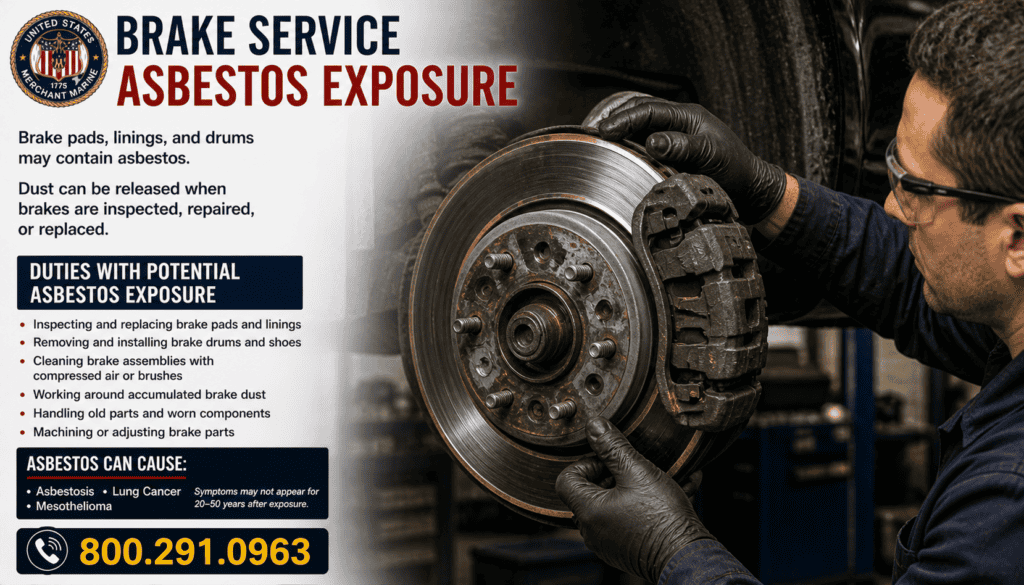
🏭 Brake Service Asbestos Exposure
Mechanics who serviced older drum brakes, disc brakes and replacement friction components may have encountered asbestos-containing brake materials. Exposure conditions depended on the parts used, the work performed and dust controls in place; not every brake pad, lining or repair job contained asbestos.
This guide describes historical brake service tasks, how dust could be released during repair, current OSHA control guidance, and what a mechanic diagnosed with mesothelioma or asbestos-related lung cancer can document about past work.
🏭 Where Asbestos Was Found In Brake Service
Historically, some brake shoes, pads and linings contained asbestos because it tolerated heat and friction. Brake dust could collect inside drums and on backing plates as components wore. During servicing, removing a drum or disturbing residue could release dust; identifying the actual friction material remains important because modern and historical replacements have varied formulations.
The related guide to Auto Repair Shops Asbestos Exposure describes the surrounding industry or legal framework. For this page, the decisive issue is still the person’s own dates, job duties, materials and applicable eligibility rules.
A mechanic removing a tight drum might strike or pry the assembly, potentially disturbing residue that had accumulated inside. Other tasks included cleaning backing plates, replacing brake shoes, sanding or grinding linings and machining drums or rotors. The dust generated by machining can differ from dust released during ordinary inspection.
A detailed account should distinguish ordinary operations from maintenance, equipment replacement and shutdown activity. A useful first step is to identify the work area, responsible employer, contractors and equipment involved, then compare that history with available records rather than infer exposure from a job title.
For additional context, Brake Products Asbestos Exposure explains a related work activity or claims process. The connection is useful for identifying questions to ask, not as independent proof that a specific product was present.
👷 Mechanics And Repair Shop Work
The shop environment matters. Brake service may have been performed on lifts, in open bays or at dedicated stations, sometimes alongside clutch work. Workers who were not directly replacing linings could have been nearby when compressed air or dry brushing dispersed settled dust. An exposure history should identify which tasks were done, how frequently, and what controls were used.
The occupational perspective in Brake Equipment Asbestos Exposure can help distinguish equipment-specific work from a broad industry description. It is important to identify who handled the product, who worked nearby and whether a contractor performed removal or cleanup.
Older replacement boxes, manufacturer part numbers and shop invoices can help identify whether asbestos-containing friction products were used. A generic recollection of “brake dust” is not enough to determine composition. The type of vehicle and model year can help locate records, but do not conclusively establish the material in a replacement part.
The most reliable work history describes what the person personally saw or did. Dates may be approximate, but a sequence of employers, job titles, units and maintenance events is still useful. If a witness remembers a brand, preserve the wording of that recollection and avoid changing it to match later assumptions.
The related resource Brake Lathe Machinery Asbestos Exposure discusses another relevant equipment or product category. That comparison can be useful when evaluating whether an old specification, manufacturer or installation date matches the actual workplace.
🧱 Brake Components And Shop Equipment
OSHA requires specific methods for automotive brake and clutch service when asbestos is present or not known to be absent. Its preferred approaches include a negative-pressure enclosure with HEPA vacuum equipment and a prescribed low-pressure wet-cleaning method. Compressed-air cleaning and dry brushing of suspect asbestos dust should not be treated as safe substitutes.
| Issue Or Material | Why It Matters | Potential Documentation |
|---|---|---|
| Thermal insulation and refractory | Possible disturbance during repair or removal | Specifications, outage records, photographs |
| Gaskets, packing and friction products | Historical formulations varied by maker and date | Invoices, part numbers, manufacturer catalogs |
| Contractor assignments | May place a worker near a particular task | Badge records, payroll, union dispatch |
| Medical and claim records | May establish diagnosis and relevant dates | Pathology, imaging, correspondence |
The information in Car Mechanics Asbestos Exposure provides an additional reference point for the kinds of historical materials that may require identification. It does not prove the product composition or legal responsibility in an individual case.
Preserve product names exactly as shown on original records. Similar equipment can have different replacement parts and suppliers over time. An old plant diagram may identify a line or vessel, while a dated purchase order may be needed to establish the manufacturer of a gasket or insulating material.
Where historical repair or service records are available, compare them with Auto Mechanics & Brake – Clutch Dust Exposure to understand a related occupational pathway. Direct handling, nearby work and secondhand dust on clothing are different scenarios and should not be collapsed into one unsupported allegation.
🌫️ How Brake Dust Could Become Airborne
For current work, OSHA identifies a negative-pressure enclosure with HEPA vacuuming and specified wet methods as preferred controls. The precise requirements are in 29 CFR 1910.1001 and Appendix F. Workers should follow trained procedures and avoid compressed-air blowout or dry brushing of suspect asbestos residue.
The task-specific background in Legal Pathways for Auto Mechanics Exposed to Asbestos Brakes helps identify questions about work practices, dust control and equipment condition. Evidence of a dusty environment is not by itself evidence that the dust contained asbestos; product composition and the actual disturbance must be assessed.
An exposure chronology should record whether work occurred during a planned turnaround, routine service, emergency repair or demolition. It should also describe ventilation, distance from the source, duration of the task, and whether cleanup or material handling could have spread residue into occupied areas.
Questions To Ask About Historical Work
Which equipment was opened? What material was removed? Who supplied or installed it? Were coworkers working at the same time? Did a maintenance order or invoice identify the component? These questions can turn a broad recollection into a more useful, testable history.
A related account of Truck Brake Service Machinery Asbestos Exposure may help families recognize a relevant job classification or worksite pattern. It should be used to organize records, not to assert that every worker in the occupation had the same exposure.
🩺 Mesothelioma After Brake Service Exposure
Mesothelioma is a cancer affecting the mesothelium, often the lining around the lungs. Asbestos is a major established cause, and the disease may be diagnosed decades after exposure. A medical diagnosis does not identify a particular manufacturer, facility or legally responsible party.
People receiving a diagnosis can review What is Asbestos Lung Cancer? for information on diagnostic tests and medical documentation. Pathology reports, imaging, specialist assessments and treatment records should be kept together; clinical decisions belong with the treating team.
Symptoms may include breathlessness, chest pain, fatigue or fluid around the lung, but these findings are not specific to mesothelioma. Confirmation commonly requires specialist evaluation and tissue analysis. A patient should not delay treatment while occupational records are being assembled.
The date a diagnosis was communicated may also be legally significant. Write down when the condition was first identified and retain the underlying report. Separate the medical timeline from the historical workplace timeline so that each can be reviewed accurately.
🫁 Asbestos-Related Lung Cancer
Asbestos is also an established cause of lung cancer. Smoking is an independent risk factor and can increase risk further when combined with asbestos exposure. A smoking history neither proves nor excludes a contribution from occupational asbestos.
The medical overview Mesothelioma Diagnosis explains the relationship between asbestos and lung cancer. Diagnosis, imaging, pathology and possible other occupational exposures should be discussed with clinicians rather than assumed from a workplace title.
In refineries, other hazards may include combustion emissions, chemical vapors and welding fumes; in auto repair, solvent vapors and other shop exposures may also occur. Different hazards have different evidence and medical implications. A reliable history records them separately.
Families should keep pathology reports, treatment summaries and the exact wording of the diagnosis. Eligibility for any lawsuit or trust depends on additional requirements beyond the presence of a disease, and the rules vary with the claim involved.
📋 Documenting Historical Brake Jobs
Begin with a dated list of employers, sites, departments, job titles and coworkers. Then add particular maintenance or service events, product names and documents. A short factual chronology is more useful than a long narrative built from uncertain assumptions.
| Record | What It Can Help Show |
|---|---|
| Payroll, union or personnel files | Employment and approximate dates |
| Work orders and shift schedules | Location, equipment and activities |
| Purchase orders and manuals | Possible manufacturer and product identity |
| Pathology and clinical reports | Diagnosis and medical chronology |
| Correspondence and claim submissions | Prior notices, filings and possible deadlines |
The related legal overview Motorcycle Brake Service Machinery Asbestos Exposure may help organize questions for counsel. Preserve original documents and note their sources; a photocopy with an uncertain date can be less useful than a clearly attributed record.
Service records may show the number of brake jobs per week, whether work involved drums or discs, whether linings were machined and what cleaning methods were used. Coworkers can describe the layout of bays and whether other mechanics were nearby. Record actual practices rather than assuming all shops worked the same way.
If the workplace has closed, unions, successor companies, former contractors, archives and coworkers may still hold records. Ask for copies without altering originals. Do not disturb or sample suspected asbestos materials yourself; qualified professionals can advise on safe identification.
⚖️ Compensation And Legal Options
Legal options depend on the diagnosis, applicable law, evidence of exposure, product identification and the relevant filing period. A civil lawsuit, bankruptcy trust claim, workers compensation matter and veterans benefit application are different processes; eligibility for one does not establish eligibility for another.
For broader legal context, see Auto Repair Services, Equipment & Materials Asbestos Exposure. Trust procedures may require medical evidence and exposure to products associated with a particular bankrupt company. Published trust values do not guarantee payment and can change.
A general Mesothelioma Lawsuit overview describes common lawsuit questions, but an individual evaluation must account for jurisdiction, responsible parties and prior settlements or releases. The facts of an industrial facility or auto repair shop cannot establish a claim on their own.
Filing deadlines deserve prompt attention. What Are Asbestos Trust Funds? discusses possible exceptions, but no general article can determine when a particular claim accrues. Different jurisdictions may use different rules for diagnosis, discovery, death and other events.
Families considering related occupational or compensation questions may also consult Auto Repair Shop Mesothelioma Lawsuits & Compensation. A qualified attorney can explain whether a particular route is appropriate and what records to preserve. No result, eligibility determination or compensation amount is guaranteed.
For a historical brake-service history, record whether the shop serviced passenger cars, heavy trucks or motorcycles; whether work centered on drum or disc brakes; and whether employees used a brake lathe or sanded replacement linings. Note whether dust was blown out with compressed air, swept from the floor or captured by a specialized enclosure. Shops often changed parts suppliers over time, so identify approximate years and any remembered packaging or invoice details. A mechanic who worked at several garages should list each separately, including how many brake jobs were performed during an ordinary week. Current workers should follow the applicable OSHA standard and training rather than repeat historical practices described here.
When preparing for a medical or legal appointment, bring a one-page chronology and a short list of unanswered questions. Clearly distinguish documents from recollections, and note any missing records without filling the gaps with assumptions. This helps the professional reviewing the case focus on what can actually be established.
❓ Frequently Asked Questions
Does Working At The Site Automatically Prove Asbestos Exposure?
No. A site name or job title alone does not identify an asbestos-containing product, a particular disturbance or an individual route of exposure. Records and credible firsthand accounts can help clarify those questions.
What If The Employer Or Manufacturer No Longer Exists?
Former coworkers, unions, contractors, archives and product records may still be available. Bankruptcy trusts are separate from lawsuits and only apply when their specific requirements are satisfied.
Can A Family Act After A Worker Has Died?
Depending on state law and the circumstances, an eligible representative or family member may be able to pursue a claim. Standing, deadlines and required evidence must be reviewed under the applicable law.
Does A Diagnosis Guarantee Compensation?
No. Medical diagnosis is separate from exposure evidence, eligibility, causation, product identification and legal responsibility. Neither a lawsuit nor a trust payment is automatic.
Should A Person Wait Until All Records Are Found?
No. Medical care and prompt legal deadline review should not be delayed. Records can often be gathered with professional assistance after an initial consultation.
🧭 Summary
The central task is to connect the person’s diagnosis and work history to specific dates, materials and activities without relying on assumptions. Preserve medical documents, identify coworkers and products when possible, and seek timely qualified advice about the distinct legal or benefit processes that may apply.
📚 Confirmed Sources
These sources support general medical and occupational information. They do not establish exposure or eligibility for an individual claimant.
- OSHA — Asbestos
- NCI — Asbestos Exposure and Cancer Risk
- OSHA — General Industry Asbestos Standard
- OSHA — Brake and Clutch Repair Guidance
Get The Compensation You Deserve
Find out if you may qualify for asbestos compensation today. Call 800.291.0963 or Submit Your Case Here.
Help is available 24/7/365. 25+ years of experience.
Disclaimer: Mesothelioma Help Center is not a law firm or medical provider and does not determine legal or VA eligibility. This information is not individualized medical or legal advice.